
陕西煤业

Search documents
坚持价值投资 险资私募钟情高股息大市值公司
Zheng Quan Shi Bao· 2025-09-02 18:00
Core Insights - The Honghu Fund, the largest and earliest established insurance private equity fund, has become a significant shareholder in at least six listed companies, indicating a strategic investment approach focused on stable and high-dividend blue-chip companies [1][2] Group 1: Fund Overview - The Honghu Fund has established four funds with a total scale of 110 billion yuan, managed by Guofeng Xinghua, a joint venture of Guoshou Asset and Xinhua Asset [1] - The first phase of the Honghu Fund has a scale of 50 billion yuan and began investing in March 2024, with all investments completed by March of this year [2] - The second phase of the fund has nearly completed its investment allocation as of the end of the second quarter, while the third phase commenced in early July and is progressing smoothly [2] Group 2: Investment Characteristics - The investment strategy of the Honghu Fund focuses on large listed companies that are well-governed, operate steadily, offer stable dividends, and have good liquidity [1] - The selected companies exhibit characteristics of high dividend yields and large market capitalizations, with companies like Shaanxi Coal and China Shenhua having dividend yields exceeding 5% [1] - The smallest company in the portfolio, Yili Group, has a market capitalization exceeding 100 billion yuan, while China Petroleum's market cap exceeds 1.6 trillion yuan [1] Group 3: Performance and Impact - The pilot fund's risk indicators are below the benchmark, while its return indicators are above the benchmark, achieving both functional and profitability success [2] - The pilot fund aims to enhance equity investment and long-term investment capabilities for insurance companies, contributing to market stability and fostering a positive interaction between insurance funds and the capital market [2] - The total amount of the long-term investment reform pilot for insurance funds has reached 222 billion yuan across three batches, with the first two batches having established private equity fund companies [2]








煤炭行业反内卷专题汇报
2025-09-02 14:41
Summary of Coal Industry Conference Call Industry Overview - The coal industry is undergoing a shift due to the introduction of anti-involution policies aimed at stabilizing coal prices and restoring PPI growth, rather than directly altering the fundamentals of the market [1][2] - Current PPI data has been in negative territory for 34 consecutive months, indicating a need for price recovery in coal to improve inflation [2] Key Insights and Arguments - The market's pessimism regarding coal prices is compared to the situation in 2015 and the photovoltaic industry, with expectations that supply will not decrease even if prices fall below cash costs [1][4] - The expected average coal price for 2025 is around 680 RMB/ton, with a potential rebound in 2026 due to increased demand from new energy installations [3][15] - The coal industry's supply side is not expanding significantly, with total coal production expected to remain flat compared to the previous year [4][9] Supply-Side Reform - The coal industry needs supply-side reforms to escape the "prisoner's dilemma" of cash flow pressure, with state-owned enterprises currently dominating the market [8][9] - The government has implemented strict regulations to stabilize production and prevent excessive output, which has led to a reduction in production when prices fall below certain thresholds [9][10] Market Behavior and Economic Theory - Historical cases show a divergence between market behavior and microeconomic theory, where companies continue to produce even when prices are below cash costs due to strategic competition and debt pressures [5][6] - The high capital investment required in the coal, polysilicon, and glass industries contributes to a reluctance to exit the market during downturns [7] Recommendations for Investment - Recommended companies include China Shenhua and other state-owned enterprises, as well as coal companies like Zhongmei, Shanmei, and Yanzhou, which are seen as having stable fundamentals and attractive dividend yields [18][20] - The anticipated recovery in coal prices and profitability is expected to occur in the second quarter of 2025, driven by policy support and market adjustments [14][16] Future Price Predictions - The highest coal prices for 2025 are expected to have been reached in August, with a forecasted dip in September and October, followed by a potential increase in winter [15][19] - The demand for electricity and data centers is projected to significantly impact coal demand, with extreme weather and technological advancements driving future growth [17] Conclusion - The coal industry is at a critical juncture, with government policies aimed at stabilizing prices and improving market conditions. The focus on supply-side reforms and strategic investments in leading companies may provide opportunities for recovery and growth in the coming years [1][14][18]
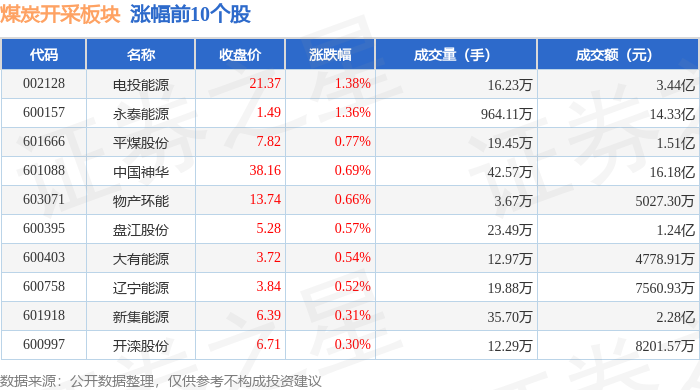
煤炭开采板块9月2日涨0.03%,电投能源领涨,主力资金净流出4.2亿元
Zheng Xing Xing Ye Ri Bao· 2025-09-02 09:09
Group 1: Market Performance - The coal mining sector increased by 0.03% compared to the previous trading day, with Electric Power Investment leading the gains [1] - The Shanghai Composite Index closed at 3858.13, down 0.45%, while the Shenzhen Component Index closed at 12553.84, down 2.14% [1] Group 2: Individual Stock Performance - Electric Power Investment (002128) closed at 21.37, up 1.38% with a trading volume of 162,300 shares [1] - Yongtai Energy (600157) closed at 1.49, up 1.36% with a trading volume of 9.64 million shares [1] - China Shenhua (601088) closed at 38.16, up 0.69% with a trading volume of 425,700 shares [1] - Jinko Energy (601001) closed at 12.96, down 2.56% with a trading volume of 226,400 shares [2] Group 3: Capital Flow Analysis - The coal mining sector experienced a net outflow of 420 million yuan from main funds, while retail investors saw a net inflow of 314 million yuan [2] - The main funds showed a negative net flow in several stocks, including Yongtai Energy and Pingmei Shenhua [3] - Retail investors contributed positively to stocks like Gansu Energy and New Dazhou A, indicating varied investor sentiment across the sector [3]


煤炭行业周报:煤炭多空交织,政策加持不悲观-20250902
Datong Securities· 2025-09-02 08:30
Investment Rating - The industry investment rating is optimistic [1] Core Viewpoints - The coal market is experiencing mixed signals, with policies supporting a less pessimistic outlook. Despite short-term price declines due to reduced demand and supply constraints, the overall price drop is expected to be limited due to low port inventories and production checks [4][40] - The focus remains on high-quality coal stocks with strong cash flow and dividends, as the coal sector underperformed compared to the broader market indices [5][40] Summary by Sections Market Performance - The equity market showed mixed results, with the coal sector underperforming the index. In July, profits of large industrial enterprises fell by 1.5% year-on-year, narrowing by 2.8 percentage points from June. High-tech manufacturing sectors showed rapid profit growth [5][40] - The Shanghai Composite Index rose by 0.84%, while the coal sector index fell by 2.76% [5] Thermal Coal - Thermal coal prices have slightly decreased, with supply constraints due to continuous rainfall affecting production. The utilization rate of thermal coal mines is at 88.6%, down by 1.4% [11][12] - Daily coal consumption in southern power plants is at 246.1 million tons, up by 100,000 tons week-on-week, but overall demand is expected to decline as the peak summer season ends [11][12] Coking Coal - Coking coal prices are stable but slightly declining, with supply affected by safety inspections and mine accidents. The utilization rate of coking coal mines is at 85.2% [24][25] - Demand remains weak, with steel mills primarily purchasing based on necessity rather than speculative stockpiling [24][25] Shipping Situation - The number of anchored vessels in the Bohai Rim has increased, while shipping prices have significantly decreased. The average shipping price from Qinhuangdao to Guangzhou is at 38.95 yuan/ton, down by 9.60 yuan/ton week-on-week [33] Industry News - The coal industry is seeing advancements in technology and market dynamics, with several private coal companies making it to the top 500 list of Chinese private enterprises. The focus is on enhancing operational efficiency and adapting to market changes [36][38]
陕西煤业(601225):煤价下跌业绩承压,2025中期分红5%
Huafu Securities· 2025-09-02 07:31
Investment Rating - The report maintains a "Buy" rating for the company, indicating an expected relative price increase of over 20% compared to the market benchmark within the next six months [21]. Core Views - The company reported a significant decline in performance due to falling coal prices, with a 14.2% year-on-year decrease in revenue for the first half of 2025 [3]. - Despite the challenges, the company is expected to recover as coal prices stabilize, supported by its strong resource endowment and low-cost mining advantages [7]. Financial Performance Summary - For the first half of 2025, the company achieved a revenue of 779.8 billion yuan, down 14.2% year-on-year, and a net profit attributable to shareholders of 76.4 billion yuan, down 31.2% year-on-year [3][4]. - The coal business generated revenue of 683.8 billion yuan in the first half of 2025, a decrease of 11.7% year-on-year, with a slight increase in production and sales volume [4]. - The average selling price of coal dropped to 439.7 yuan per ton, a decline of 23.8% year-on-year [4]. Dividend Policy - The company plans to distribute a mid-term dividend of 5% of the net profit for the first half of 2025, amounting to 3.82 billion yuan, based on a total share capital of 9.695 billion shares [6]. Earnings Forecast - The forecast for net profit attributable to shareholders for 2025-2027 is 163.8 billion yuan, 170.4 billion yuan, and 188.5 billion yuan respectively, with corresponding EPS of 1.69, 1.76, and 1.94 yuan per share [7].
持仓曝光!险资系私募基金,买了这些股!
券商中国· 2025-09-02 06:58
Core Viewpoint - The article highlights the recent emergence of Honghu Fund in the top ten shareholders of several listed companies, indicating a strategic investment approach by insurance capital in the market [1][3]. Group 1: Shareholding Situation - Honghu Fund Phase II has entered the top ten shareholders of China Petroleum and China Shenhua, marking its first appearance in these lists with a market value exceeding 18 billion and 21 billion respectively [1][3]. - Honghu Fund Phase III has been listed as the eighth largest shareholder of Sinopec, holding approximately 3.05 billion shares valued at 17.63 billion [5][6]. - As of June 30, 2025, Honghu Fund has appeared in the top ten shareholders of six listed companies, including Shaanxi Coal, Yili, and China Telecom, with stable holdings compared to the previous quarter [3][6]. Group 2: Fund Structure and Management - Honghu Fund consists of three phases with a total scale of 110 billion, managed by Guofeng Xinghua, a joint venture of China Life Asset and Xinhua Asset [6][8]. - Phase I has a scale of 50 billion, fully invested by China Life and Xinhua Insurance, achieving good returns as of March this year [6][8]. - Phase II, with a scale of 20 billion, has completed its main investment positions by the end of Q2 [6][8]. - Phase III, initiated in early July, has a scale of 40 billion, divided into two products, with significant contributions from various insurance companies [6][8]. Group 3: Investment Strategy and Performance - The investment philosophy of Honghu Fund emphasizes long-term, value, and stable investments, focusing on companies with competitive advantages and good governance [8][11]. - The fund targets large-cap A+H shares that exhibit stable dividends and good liquidity, with a preference for blue-chip companies [8][9]. - The average dividend yield of the six listed companies in which Honghu Fund has invested is relatively high, with four energy and coal stocks exceeding 5% [9][10]. - As of June 30, the total assets of Honghu Fund Phase I reached 57.11 billion, with a net profit of 9.68 billion for the first half of the year, indicating strong performance [11][12].

国信证券晨会纪要-20250902
Guoxin Securities· 2025-09-02 06:02
Macro and Strategy - The report discusses the internal tension between investment and consumption in China's economy, highlighting that the concentration of capital income among high-income groups leads to a low marginal propensity to consume, which is a primary source of investment [10][11] - It emphasizes that the imbalance between capital income and consumption demand has resulted in a continuous rise in China's capital-output ratio and a decline in capital return rates, making investment-driven growth unsustainable [10][11] Industry and Company - The automotive industry saw a 12% year-on-year increase in wholesale sales of passenger vehicles from August 1 to 24, 2025, with the collaboration between Huawei and SAIC for the H5 model opening for pre-orders [14][15] - The media and internet sector reported a 2.99% increase in industry performance, with OpenAI launching the GPT-Realtime voice model and the summer box office surpassing 11.8 billion yuan [18][21] - The public utility and environmental protection sector is focusing on the ongoing construction of a national carbon market, which is expected to drive urban green and low-carbon transformation [22][23] - The fluorochemical industry is experiencing a price increase in mainstream refrigerants, with R32 and R134a expected to see stable price growth due to limited supply and strong demand [25][29] - Yili Group reported a 5.9% year-on-year increase in revenue for Q2 2025, with improvements in profitability driven by a decrease in raw milk prices and better cost management [31][33] - Huadian International's revenue decreased by 8.98% in H1 2025 due to lower electricity prices and generation, but net profit increased by 13.15% due to reduced fuel costs [34]



四连涨,重仓有色行业,不含银行地产,创新类价值指数:自由现金流ETF基金备受关注
Sou Hu Cai Jing· 2025-09-02 02:00
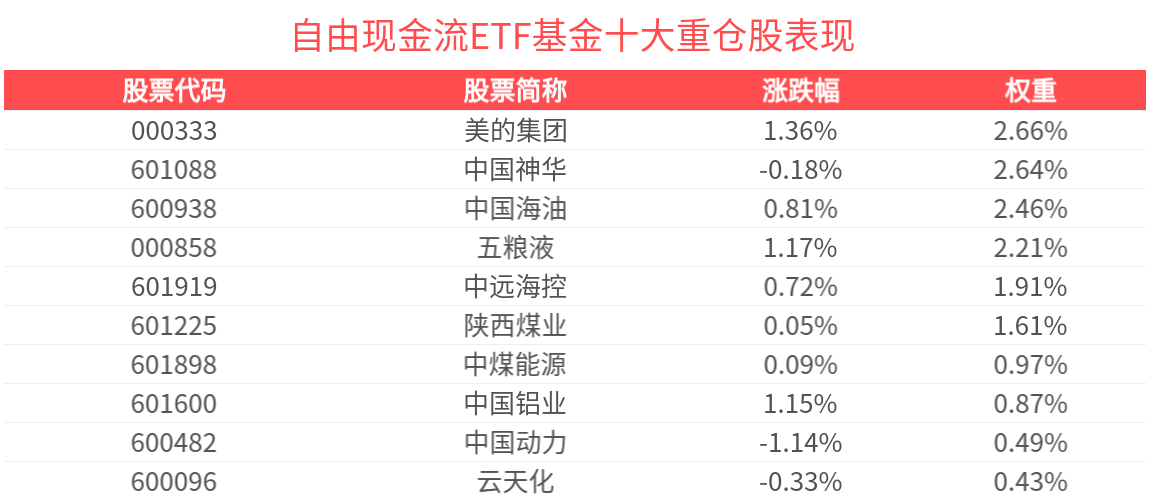
Core Insights - The China Securities Index Free Cash Flow Index (932365) has shown a positive performance, with a 0.86% increase as of September 2, 2025, and notable gains in constituent stocks such as Silver Nonferrous (601212) up by 10.08% and Jiejia Weichuang (300724) up by 8.93% [1] Performance Summary - The Free Cash Flow ETF Fund (159233) has experienced a 1.24% increase, marking its fourth consecutive rise, with a latest price of 1.14 yuan. Over the past two weeks, the fund has accumulated a total increase of 3.58% [1] - The fund's liquidity is reflected in a turnover rate of 1.07% and a trading volume of 1.2954 million yuan. The average daily trading volume over the past week was 17.6088 million yuan [1] - The fund has seen a net inflow of 19.1927 million yuan recently, with a total of 25.8568 million yuan net inflow over the last five trading days, averaging 5.1714 million yuan per day [1] Return Metrics - Since its inception, the Free Cash Flow ETF Fund has achieved a maximum monthly return of 7.80% and a longest consecutive monthly gain of 3 months, with a total increase of 12.56%. The average return during up months is 4.07%, with a monthly profit probability of 92% [2] - The maximum drawdown since inception is 3.28%, with a relative benchmark drawdown of 0.24%. The recovery period after drawdown is 12 days, indicating a relatively quick recovery compared to comparable funds [2] - The fund has a management fee of 0.50% and a custody fee of 0.10% [2] Top Holdings - As of August 29, 2025, the top ten weighted stocks in the China Securities Index Free Cash Flow Index include China National Offshore Oil Corporation (600938), Wuliangye (000858), and COSCO Shipping Holdings (601919), collectively accounting for 57.03% of the index [3]





开盘:三大指数涨跌不一 兵装重组概念跌幅居前
Sou Hu Cai Jing· 2025-09-02 01:42
来源:股市直击 9月2日消息,三大指数涨跌不一,兵装重组概念跌幅居前。截至今日开盘,沪指报3977.09点,涨 0.04%;深成指报12827.03点,跌0.09%;创指报2951.03点,跌0.18%。 消息面: 1、国家主席习近平在"上海合作组织+"会议上说,中方愿同各方共同建设好人工智能应用合作中心,共 享人工智能发展红利。 2、今年上半年,A股上市公司归母净利润合计2.99万亿元,同比增长2.45%,其中,近77%个股实现盈 利,归母净利润同比正增长的比例近46%。行业层面统计,农林牧渔、钢铁、建筑材料、计算机、有色 金属等板块上半年业绩增速较快,房地产板块则亏损明显。 3、截至二季度末,险资私募鸿鹄基金一期位列伊利股份、陕西煤业、中国电信前十大流通股股东,鸿 鹄二期新进成为中国石油、中国神华前十大股东,三期基金则入股中国石化。 4、国家标准委、工业和信息化部印发《工业母机高质量标准体系建设方案》,到2026年,工业母机高 质量标准体系基本建立。到2030年,适应工业母机产业高质量发展的标准体系全面形成。 5、造车新势力陆续公布8月交付数据,整体呈现增长态势。零跑汽车、小鹏汽车和蔚来汽车均创下单月 交 ...
动力煤分析框架
2025-09-02 00:42
Summary of Key Points from the Conference Call Industry Overview - The coal industry in China is characterized by high concentration in production, with Inner Mongolia, Shanxi, Shaanxi, and Xinjiang accounting for over 80% of total output. New capacity is strictly controlled by policy, leading to weak capital expenditure willingness [2][7][8] - China is the largest coal producer and consumer globally, influencing international market prices significantly [5] Supply Dynamics - Domestic coal production is expected to remain stable, with an estimated total supply of approximately 4.4 billion tons in 2024, including around 4 billion tons from domestic production and 420 million tons from imports [11] - Xinjiang plays a crucial role as a marginal supplier due to its significant resource reserves, but high transportation costs limit its contribution to the national market [9][10] - The overall coal supply is projected to decline slightly, with new capacity primarily compensating for the retirement of outdated mines [8][11] Demand Trends - The demand for thermal coal is primarily driven by the power sector, which accounts for over 60% of consumption. The growth of renewable energy has a substitutive effect on thermal power demand [2][13] - Non-power sectors such as metallurgy and construction show stable or declining demand, while chemical coal demand has increased to about 7% and is expected to grow further due to large coal chemical projects [4][16][17] Price Mechanism - Thermal coal prices are influenced by inventory levels and government policies, with a long-term contract price mechanism stabilizing the market. The benchmark price is set at 675 RMB/ton, with fluctuations between 575 and 775 RMB [4][18][19] - The price for 2025 is expected to have a low point around 600 RMB and a high point near 750 RMB, with future price peaks projected to remain below 800 RMB [20][22] Profitability of Coal Enterprises - Profitability for coal companies is primarily determined by coal prices and costs. Major players like China Shenhua and Shaanxi Coal and Chemical Industry maintain strong profitability due to favorable resource endowments [22][23] - Investment logic in the current market emphasizes stability in dividends, with leading companies offering dividend yields of over 4.5% [23] Future Outlook - The coal power sector is expected to see growth rates around zero in 2025 and 2026, with a recovery anticipated starting in 2027, potentially exceeding 1.5% growth [14] - The overall trend for coal supply is expected to stabilize or slightly decline, with significant policy impacts on production and pricing [11][12][20] Additional Insights - The long-term contract price mechanism has been established to ensure profitability for downstream power companies, requiring over 80% of resource volumes to be contracted [19] - The impact of international natural gas prices on domestic coal prices is noted, as fluctuations in gas prices can influence coal pricing through import dynamics [21]