长安汽车

Search documents
长安汽车重启60亿元定增:价格下调2.26元,资本市场泼冷水!
Xin Lang Cai Jing· 2025-12-31 15:54
在汽车行业竞争日趋白热化的时候,长安汽车(000625.SZ)试图通过定增补充"弹药库"。 2025年12月29日,在长安汽车金融城会议室召开的董事会上,审议通过了《关于终止公司2024年度向特定对象发行股票事项的议案》和《关于公司2025年 度向特定对象发行A股股票涉及关联交易的议案》。 黄桷树财经注意到,对于长安汽车的定增,资本市场算得上是冷眼相待。2025年12月30日至12月31日,2025年版定增方案披露后的前两个交易日,长安汽 车股价累计下跌0.34%。 2025年版定增方案和2024年版定增方案相比,有三点变了。 一是发行价格,2025年版是"9.52元/股",2024年版是"11.78元/股"。 三是限售期,2025年版增加了对发行前持股的限售要求,即中国长安汽车集团及其控制的企业在本次发行前所持有的公司股份在本次发行完成后十八个月 内不得转让,2024年版没有对发行前持股的限售要求。 2025年版定增方案和2024年版定增方案相比,有两点是未变的。 一是募集资金总额均不超过60亿元,核心投向均为"新能源车型及数智平台开发项目"与"全球研发中心建设及核心能力提升项目"。 二是发行数量,2025 ...


国标公示:取消“半固态电池”分类
高工锂电· 2025-12-31 11:56
Core Viewpoint - The article discusses the establishment of a national standard for solid-state batteries in China, which aims to clarify the definitions and classifications of solid-state and semi-solid batteries, thereby providing a unified framework for the industry [3][4][9]. Group 1: National Standard Development - On December 31, 2025, China's first national standard for solid-state batteries for electric vehicles entered the public consultation phase, marking a significant step in the standardization of this technology [3]. - The standard will provide a unified definition, classification methods, and quantitative indicators to determine whether a battery qualifies as a solid-state battery [4][8]. - The drafting committee includes over 30 organizations from the entire supply chain, including major battery manufacturers and automotive companies, indicating a broad consensus among key industry players [5][6]. Group 2: Classification and Testing Criteria - The standard introduces a three-part classification system for batteries: liquid, mixed solid-liquid, and solid-state, eliminating the independent categories of "semi-solid" and "fully solid" batteries [10][12]. - A weight loss rate test with a threshold of 0.5% is established to determine if a battery can be classified as solid-state, with specific testing procedures outlined [14][15]. - The classification will also consider the type of solid electrolyte, ion conduction type, and application scenarios, allowing for differentiated product development in various fields [13][17]. Group 3: Industry Implications - The introduction of this standard is expected to accelerate the industrialization of solid-state batteries, with major automotive companies planning to validate and produce these batteries by 2026 and 2027 [19]. - The solid-state battery concept index has seen a nearly 60% increase this year, reflecting strong market interest and investment in this technology [20]. - The standard aims to provide a common language for academic research and technology development, set baseline expectations for product marketing, and establish conditions for future performance and safety standards [22][24].
头部做大、腰部塌陷,但中国车市仍难迎寡头时代
Xin Lang Cai Jing· 2025-12-31 10:11
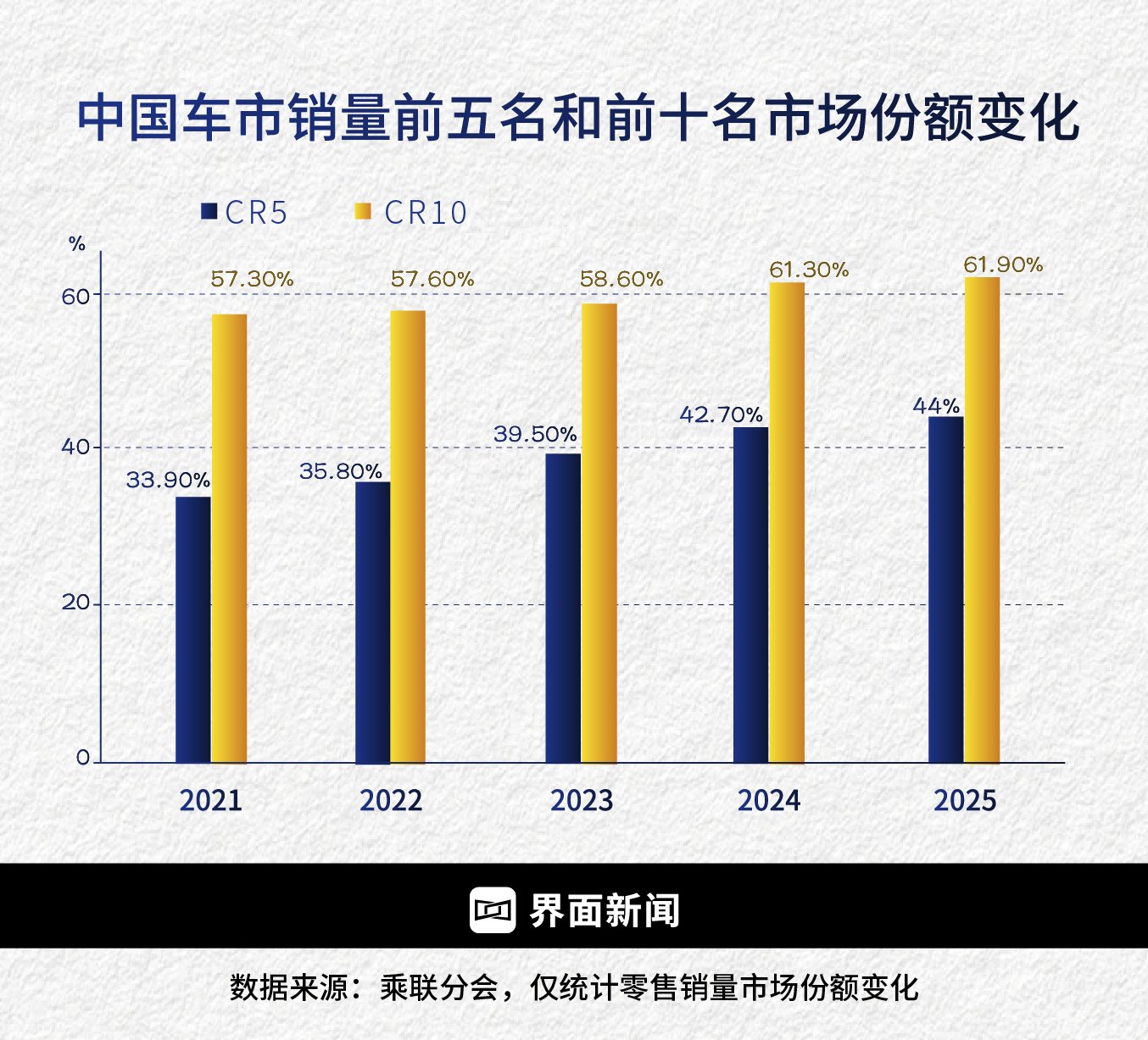
Group 1 - The Chinese passenger car market is undergoing a significant structural transformation, with overall growth slowing and market concentration increasing, leading to a clear advantage for leading companies in terms of sales and resources, while traditional mid-tier brands face severe survival pressures [1] - The market share of the top five automotive companies increased from 33.9% in 2021 to 44% by 2025, while the top ten's market share rose from 57.3% to 61.9%, indicating a shift from multi-brand competition to dominance by a few enterprises [1] - Geely Auto Group has shown the most significant market share growth among leading companies, increasing by approximately 3.5 percentage points compared to 2024, driven by the sales growth of new energy vehicles supported by government subsidies [3] Group 2 - BYD's market share has slightly declined this year but remains close to 15%, attributed to its vertically integrated supply chain that maintains product price advantages and a strong product offensive that ensures the launch of popular models across different market segments [4] - The strategy of using a shared platform for multiple models allows companies to reduce trial and error costs while maximizing market returns, enhancing the marginal returns on R&D investments [4] - Leading automotive companies are strengthening their scale advantages and cost efficiency through internal integration, as the focus shifts from technological leadership to cost competition in a market characterized by product homogeneity and slow technological iteration [7] Group 3 - The rapid collapse of mid-tier companies is evident, particularly in the second-tier joint venture brands, with significant sales declines reported for Dongfeng Nissan and GAC Honda from 2022 to 2024 [8] - New car-making forces like Li Auto, NIO, XPeng, and others are filling the gap left by traditional mid-tier brands, with their sales surpassing those of GAC Honda and Dongfeng Honda, entering the top 20 in annual sales rankings [8] - For mid-tier enterprises to survive, joint venture brands must develop products tailored to the Chinese market rather than simply importing overseas models, while new car-making forces need to achieve profitability and build operational capabilities to support large-scale production [9] Group 4 - The ongoing consolidation efforts among major automotive companies, such as the proposed merger between Changan and Dongfeng, highlight the complexities and challenges of achieving clear leadership in the market due to administrative disparities and high integration difficulties [10] - The current market dynamics suggest that while some foreign brands may exit, the overall number of participants may not significantly decrease, and the competition remains complex and ongoing [10] - The impressive sales figures of leading companies may be viewed as short-term responses to capital market pressures rather than indicators of long-term stability and profitability [10] Group 5 - The absolute dominance of leading companies, the elimination of mid-tier players, and the clearing out of lower-tier brands indicate that the market structure is still maturing, with the final outcome of the competitive landscape in the Chinese automotive market still unfolding [14]
智能汽车产业深度研究:L3车型产品准入,智能汽车发展加速
Shanghai Aijian Securities· 2025-12-31 09:58
Investment Rating - The report rates the automotive industry as "Outperform" [2] Core Insights - The Ministry of Industry and Information Technology approved two models with L3 conditional autonomous driving capabilities, marking the transition of L3 autonomous driving from testing to commercial application in China [2] - The penetration rate of electric vehicles is expected to exceed 50%, with smart technology becoming a survival necessity for automakers. By 2030, smart vehicle sales in China are projected to exceed 30 million units [2][6] - The evolution of high-level autonomous driving technology is expected to accelerate, with significant breakthroughs anticipated in L4/L5 levels around 2027-2028 [2][13] Summary by Sections 1. Automotive Intelligence Transition - Automotive intelligence is moving from an introduction phase to a growth phase, transforming vehicles from traditional fuel-powered tools to AI-driven mobile terminals [6] - The penetration rate of electric vehicles in China is expected to rise from 50% to 80% between 2025 and 2030, with smart technology becoming essential for leading automakers [6] 2. High-Level Autonomous Driving as a Key Technology - High-level autonomous driving (L3-L5) is the main technological development line, with L2+ functionalities becoming widespread and L3 commercial trials beginning [7] - The report highlights the challenges faced in the development of high-level autonomous driving, including regulatory improvements and user acceptance [7] 3. Automotive Industry Chain Overview - The automotive industry chain consists of upstream suppliers providing core components, midstream solution providers integrating systems, and OEM manufacturers responsible for final vehicle performance [22] 4. Upstream Components: Computing Power as a Foundation - Domain controllers are crucial for the evolution of automotive electronic architectures, transitioning from distributed to centralized systems [30] - The demand for high computing power in autonomous driving and cockpit systems is increasing, with SoC chips becoming essential [51] 5. Midstream Vehicle Manufacturing: New Players Leading the Charge - New entrants in the automotive market are leveraging smart technology to gain competitive advantages, with a focus on high-end models priced above 200,000 yuan [2] 6. Downstream Operations: Emergence of New Business Models - The shift towards smart mobility is driving the development of new business models like Robotaxi, with expectations of over 30% penetration in the smart mobility market by 2030 [2][4] 7. Investment Recommendations - The report suggests focusing on leading automakers with full-stack self-research capabilities and component suppliers with technological advantages in high-growth segments [2]


国内降温、国外火热,插混出口暴涨 跳板作用凸显
Zhong Guo Qi Che Bao Wang· 2025-12-31 09:33
Core Viewpoint - The demand for plug-in hybrid vehicles (PHEVs) is declining in the domestic market but is surging in overseas markets, driven by global automotive industry transformation, changes in trade environments, and technological advancements by Chinese automakers [2][16]. Group 1: Market Performance - In November, PHEV exports reached 124,000 units, a month-on-month increase of 37.3% and a year-on-year increase of 400%, significantly outpacing pure electric vehicle (EV) growth [2]. - From January to November, PHEV exports totaled 842,000 units, a year-on-year increase of 240%, compared to less than 300,000 units for the entire previous year [2]. - In Shanghai, the export value of hybrid vehicles reached 25.72 billion yuan, a substantial increase of 174.8% [2]. Group 2: Charging Infrastructure Disparities - The development of charging infrastructure is uneven globally, creating a natural market space for PHEVs, especially in regions like Europe and Southeast Asia where fast-charging facilities are lacking [3]. - As of the end of 2024, Europe is projected to have nearly 1 million public charging stations, but this growth is insufficient to meet the demand from the increasing number of EVs [3]. - In Germany, the ratio of electric vehicles to public charging stations is approximately 16.7:1, indicating a significant shortfall in charging infrastructure [4]. Group 3: Trade Policy Impacts - Trade policies favoring PHEVs have emerged as a significant driver for their export growth, as many countries impose high tariffs on pure EVs while exempting PHEVs [6][7]. - The EU has announced a 5-year anti-subsidy tax on Chinese pure EVs, while PHEVs remain exempt due to their classification as transitional technologies [7]. - Similar favorable policies exist in markets like Brazil and Indonesia, where PHEVs benefit from lower import tariffs compared to pure EVs [7][8]. Group 4: Domestic Market Trends - The domestic PHEV market is experiencing a slowdown, with a year-on-year growth of 16.4% from January to November, compared to 41.2% for pure EVs [9][11]. - The initial demand for PHEVs driven by license plate advantages is diminishing as cities adjust their policies, leading consumers to prefer pure EVs [9]. - The improvement of charging infrastructure in urban areas has reduced the appeal of PHEVs, as consumers find pure EVs more convenient [9]. Group 5: Competitive Landscape - The domestic PHEV market has become highly competitive, with over 150 models available, leading to price wars that have reduced prices by 10% to 15% [10]. - The increase in competition has pressured profit margins for manufacturers, prompting a more rational consumer choice [10]. Group 6: Technological and Cost Advantages - Chinese automakers have developed advanced PHEV technologies, such as the series-parallel hybrid system, which enhances energy efficiency and driving experience [13][14]. - The complete supply chain for PHEVs in China allows for lower production costs compared to European counterparts, making Chinese PHEVs more competitively priced in international markets [14]. - The cost advantage is evident, with Chinese PHEV SUVs starting at approximately 36,000 euros, significantly lower than similar models from European brands [14]. Group 7: Future Outlook - The growth of PHEVs in overseas markets provides a crucial support for the global expansion of Chinese automakers, allowing them to leverage their technological and cost advantages [15][16]. - As global charging infrastructure improves and pure EV technology advances, PHEVs may gradually exit mature markets but will continue to meet demand in emerging markets [15]. - The long-term vision remains focused on pure EVs as the ultimate goal, but PHEVs will play a vital role during the global energy transition [15].





中国电泳漆市场现状研究分析与发展前景预测报告
QYResearch· 2025-12-31 09:24
Core Viewpoint - The electrophoretic paint market in China is characterized by moderate scale, technical intensity, and stable growth, driven by both domestic demand and global industry trends. The market is expected to grow from $1,504.1 million in 2024 to $1,855.5 million by 2031, with a CAGR of 2.80% from 2025 to 2031 [3][9]. Market Size and Growth Trends - The Chinese electrophoretic paint market is projected to reach $1,504.1 million in sales revenue by 2024 and $1,855.5 million by 2031, indicating a stable growth trend with a CAGR of 2.80% from 2025 to 2031 [3]. Demand Analysis - The automotive and home appliance sectors are the primary consumers of electrophoretic paint, with automotive applications requiring high corrosion resistance and compatibility with subsequent coatings. The demand from the home appliance sector is characterized by large-scale, standardized needs [9]. Competitive Landscape - The market features a mix of international giants and local specialized manufacturers. Multinational companies dominate the high-end market due to their advanced formulation technologies and relationships with major automotive manufacturers, while local firms excel in the mid-to-low-end market segments [10][13]. Key Players - Major players in the Chinese market include PPG Industries, BASF, Haolisen, Xiangjiang Kansai, Axalta, Nippon Paint, and Jinlitai, with the top three companies holding approximately 38.63% of the market share in 2024 [13]. Industry Chain Analysis - Upstream - Key raw materials for electrophoretic paint include resins, solvents, additives, and pigments, with the chemical industry being the primary upstream sector. The market is competitive, and product costs are closely linked to fluctuations in crude oil prices [16]. Industry Chain Analysis - Midstream - Foreign brands hold a strong position in the automotive OEM paint sector, with six major companies controlling about 90% of the market share in automotive coatings. Domestic companies are gradually gaining market share in non-passenger vehicle segments [17]. Industry Chain Analysis - Downstream - The downstream industries include automotive manufacturing and other sectors such as engineering machinery, motorcycles, hardware, and home appliances, which are closely tied to macroeconomic conditions and exhibit cyclical characteristics [18]. Development Drivers - Key drivers for the industry include government support for environmentally friendly coatings, advancements in technology leading to diverse and functional products, and stable growth in downstream industries such as automotive and home appliances [21]. Development Constraints - The industry faces challenges such as risks from macroeconomic fluctuations, volatility in raw material prices, and intense competition, particularly from foreign brands in the high-end market [21].
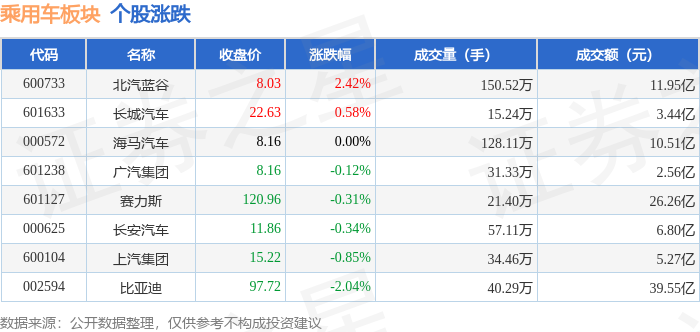
乘用车板块12月31日跌0.74%,比亚迪领跌,主力资金净流出7.47亿元
Zheng Xing Xing Ye Ri Bao· 2025-12-31 08:59
Group 1 - The passenger car sector experienced a decline of 0.74% on December 31, with BYD leading the drop [1] - The Shanghai Composite Index closed at 3968.84, up 0.09%, while the Shenzhen Component Index closed at 13525.02, down 0.58% [1] - Major stocks in the passenger car sector showed mixed performance, with notable declines in BYD and SAIC Motor [1] Group 2 - The passenger car sector saw a net outflow of 747 million yuan from institutional investors, while retail investors contributed a net inflow of 568 million yuan [1] - Specific stock performances included a 2.04% drop for BYD, closing at 97.72 yuan, and a 13.79% net outflow from institutional investors [1] - The trading volume for major stocks varied, with BAIC Blue Valley achieving a closing price of 8.03 yuan and a 2.42% increase [1]
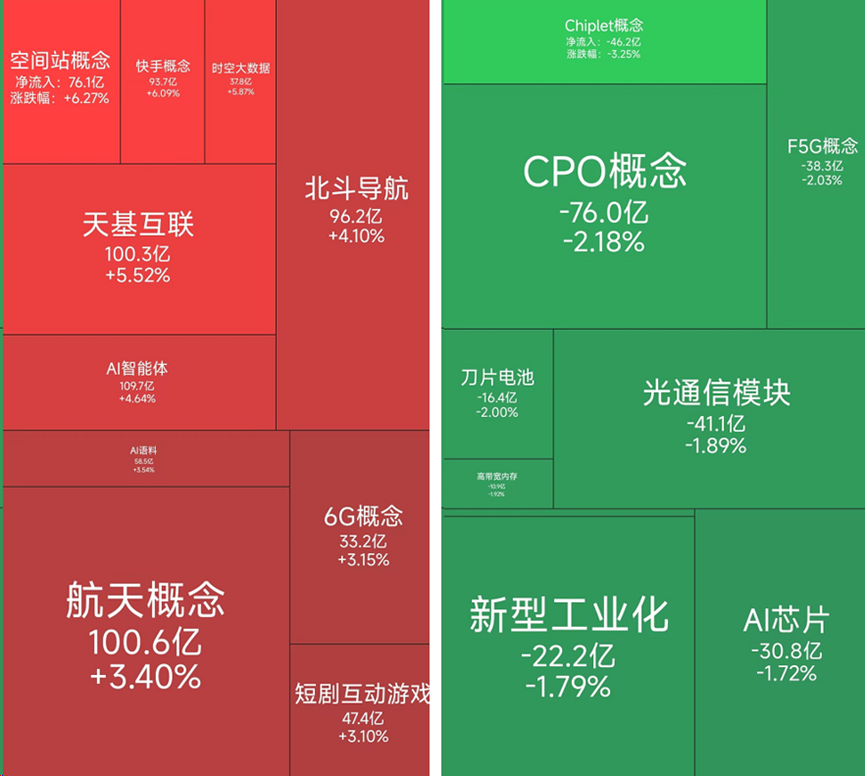
空间站概念领涨,53位基金经理发生任职变动
Jin Rong Jie· 2025-12-31 07:57
Market Performance - On December 31, A-shares showed mixed performance with the Shanghai Composite Index up by 0.09% closing at 3968.84 points, while the Shenzhen Component Index fell by 0.58% to 13525.02 points, and the ChiNext Index decreased by 1.23% to 3203.17 points [1] Fund Manager Changes - On December 31, a total of 53 fund managers experienced changes in their positions, with 43 fund products announcing departures of fund managers, involving 19 individuals [3] - In the last 30 days (December 1 to December 31), 705 fund products saw fund manager departures, with 17 leaving due to job changes and 2 for personal reasons [3] New Fund Managers - On December 31, 86 fund products announced new fund manager appointments, involving 36 new managers [5] - Notably, Xia Linfeng from Huabao Fund has managed funds totaling 932 million, with the highest return of 211.80% from Huabao Ecological China Mixed A over a tenure of 10 years and 320 days [5] Fund Manager Performance - Dongfang Fund's current asset scale is 1.103 billion, with the highest return product being Dongfang Yue Ling Flexible Allocation Mixed Fund, achieving a return of 136.47% over 7 years and 112 days [4] Fund Company Research Activity - In December, Huaxia Fund conducted the most company research, engaging with 46 listed companies, followed by Southern Fund with 39 and Bosera Fund with 38 [7] - The most researched industry was specialized equipment with 156 instances, followed by chemical products with 120 [8] Recent Fund Research Focus - The most focused stock in the last month was Zhongke Shuguang, with 117 fund management companies participating in its research, followed by Haiguang Information and Chang'an Automobile with 117 and 86 respectively [11] - In the last week (December 24 to December 31), Zhongwei Co. was the most researched company with 26 fund institutions, followed by Xiangyu Medical and Desai Xiwai with 22 each [10][11]


国企渝进 | 渝富控股集团:揭秘产业投资“链式密码”
Sou Hu Cai Jing· 2025-12-31 07:42
Core Viewpoint - The development of new quality productivity is essential for promoting high-quality development, with state-owned enterprises playing a crucial role in this process, particularly in Chongqing as a strategic hub for western development [2]. Group 1: Investment Strategy - Chongqing Yufu Holding Group's investment strategy is centered around the "33618" modern manufacturing cluster system, focusing on proactive engagement rather than passive task acceptance [3]. - Since the 14th Five-Year Plan, Yufu has invested over 120 billion yuan in advanced manufacturing and strategic emerging industries, targeting more than 400 companies in the industrial chain [3]. - The core logic of Yufu's investments is to "invest heavily, invest in strong companies, and invest in chain leaders," aiming to enhance the entire industrial chain [3]. Group 2: Empowering Key Industries - Yufu's investment in the smart connected electric vehicle sector, particularly in the company Seres, exemplifies effective industry empowerment, with a total investment of 6.55 billion yuan [4]. - This "patient capital" has attracted over 13.7 billion yuan in social capital, demonstrating confidence in the market and supporting the entire development cycle of the enterprise [4]. - Seres has achieved a market value exceeding 200 billion yuan, becoming the second-largest car manufacturer in China and a benchmark for the electric vehicle industry in the western region [4]. Group 3: Electronics Manufacturing Cluster - In the new generation of electronic information manufacturing, Yufu has invested 26.3 billion yuan in the BOE project over a decade, leading to significant economic and industrial benefits [6]. - The B8 project has generated 16.2 billion yuan in investment returns, while the B12 project has attracted over 86 billion yuan in industrial chain investments, creating a complete high-end display industry cluster in Chongqing [6]. - Yufu's investments in semiconductor companies further strengthen Chongqing's industrial chain in this sector [6]. Group 4: Future-Oriented Investments - Yufu is focusing on future-oriented sectors, leading investments in aerospace and industrial software, aiming to establish a high-end equipment manufacturing base and a cloud operation headquarters in Chongqing [8]. - The company is also promoting key enterprises in advanced materials, solidifying Chongqing's industrial foundation in new energy and materials [8]. Group 5: Market-Oriented Mergers and Acquisitions - Yufu has effectively utilized investment mergers and acquisitions to strategically restructure existing assets, completing four significant investments in recent years [9]. - Notable actions include a 2.115 billion yuan investment to acquire a stake in Longxin General, aiding a local advanced manufacturing company in overcoming debt challenges [9]. - These "rescue-style mergers" not only revitalize existing assets but also enhance the integrity and resilience of local industrial chains [9]. Group 6: Comprehensive Industry Empowerment - Yufu's investment approach has evolved from simple financial investment to comprehensive industry empowerment, injecting development momentum into invested enterprises [10]. - The company leverages its financial resources to optimize financing structures and reduce costs, while also facilitating collaborations between upstream and downstream partners [10]. - Yufu's chain investment strategy exemplifies the role of state capital in shaping modern industrial systems, positioning Chongqing as a significant advanced manufacturing center [10].

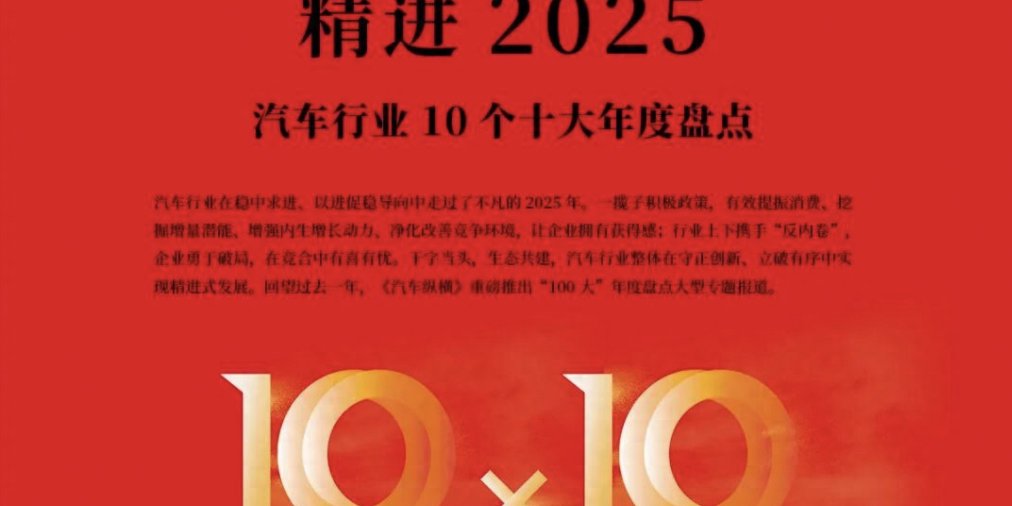
2025中国汽车行业十大年度热点 | 精进2025——汽车行业10个十大年度盘点
Jing Ji Guan Cha Wang· 2025-12-31 07:20
Core Insights - The automotive industry in China has made significant progress in 2025, with a focus on stability and quality improvement, driven by a series of proactive policies and a shift towards value and innovation in competition [2][3] Group 1: Industry Performance - New energy vehicle (NEV) production and sales are expected to exceed 15 million units in 2025, with domestic sales accounting for over 50% of total automotive sales [3][4] - The total automotive production and sales reached approximately 31.2 million units in 2025, with NEVs making up 50.3% of domestic sales [3] - Automotive exports are projected to reach a record 7 million units in 2025, with NEV exports doubling year-on-year [5][7] Group 2: Regulatory Environment - The Chinese government has implemented unprecedented measures to address "involution" in the automotive industry, including new regulations and guidelines to maintain fair competition [8][9] - A comprehensive "Stability Growth Work Plan" was introduced to support the automotive industry, aiming for a 3% increase in total automotive sales and a 20% increase in NEV sales in 2025 [10][11] Group 3: Corporate Developments - The establishment of China Changan Automobile Group marks the formation of a new structure in the state-owned automotive sector, alongside other major state-owned enterprises [12][13] - Numerous automotive companies have listed or applied for listing on the Hong Kong Stock Exchange, reflecting the industry's robust growth and the need for strategic investment [20][21] Group 4: Technological Advancements - The release of two major technical roadmaps for intelligent connected vehicles and energy-saving NEVs outlines the development goals and timelines for the next 5 to 15 years [14][15][16] - The first L3-level autonomous driving vehicles have received approval for road use, marking a significant milestone in the commercialization of autonomous driving technology [17][18] Group 5: Market Expansion - The implementation of export licensing for pure electric passenger vehicles is expected to promote healthy development in NEV trade and enhance regulatory oversight [19] - The automotive industry is positioned as a key driver of the new technological revolution and industrial transformation, contributing significantly to the national economy [22][23]