
国泰基金

Search documents
通信ETF领涨;多只消费主题ETF获资金净流入丨ETF晚报
2 1 Shi Ji Jing Ji Bao Dao· 2026-02-09 10:02
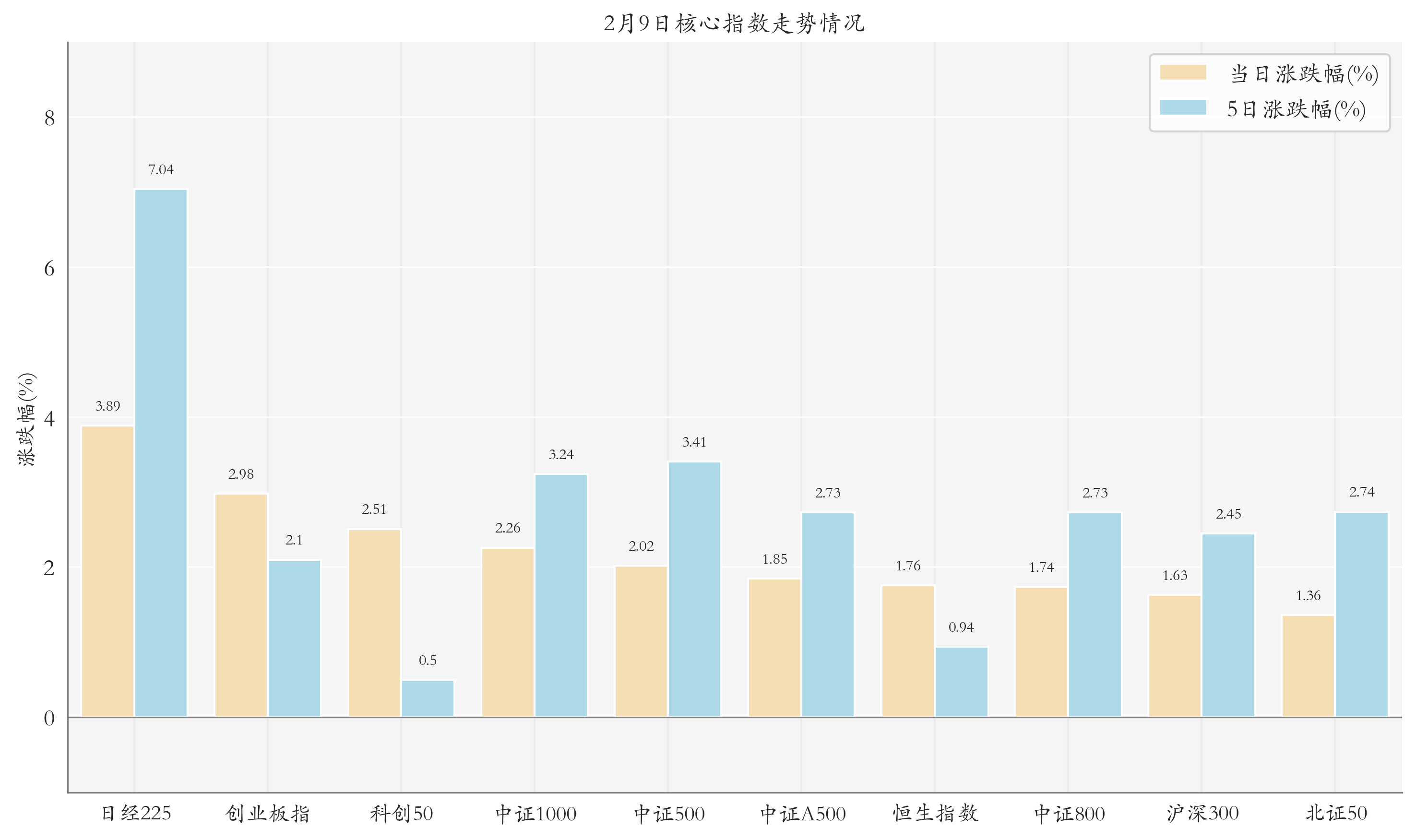
一、ETF行业快讯 1.三大指数集体上涨,通信ETF领涨 今日,三大指数集体上涨,上证综指上涨1.41%,深证成指上涨2.17%,创业板指上涨2.98%。多只通信板块ETF上涨,其中,创业板人工智能ETF华安 (159279.SZ)上涨6.98%,创业板人工智能ETF国泰(159388.SZ)上涨6.59%,创业板人工智能ETF富国(159246.SZ)上涨6.59%。 2.多只消费主题ETF获资金净流入 据中证报,随着春节的临近,近期A股大消费板块整体表现强势。上周以来,多只消费主题ETF明显上涨,并且迎来较为显著的资金净流入。多家机构表 示,大消费板块在经历长期调整后,估值已进入具有吸引力的区间,叠加春节旺季催化与促消费政策发力,板块配置价值正逐步显现。 二、今日行情速览 1.指数走势 统计A股与海外主要核心指数走势,今日(2月9日,下同)三大指数集体上涨,其中上证指数上涨1.41%,收于4123.09点,日内最高4123.16点;深证成指上 涨2.17%,收于14208.44点,日内最高14211.7点;创业板指上涨2.98%,收于3332.77点,日内最高3340.33点。今日日经225、创业板指与科 ...

ETF市场日报 | 影视ETF暴涨超7%领跑市场!能源化工ETF微跌0.08%
Sou Hu Cai Jing· 2026-02-09 08:48
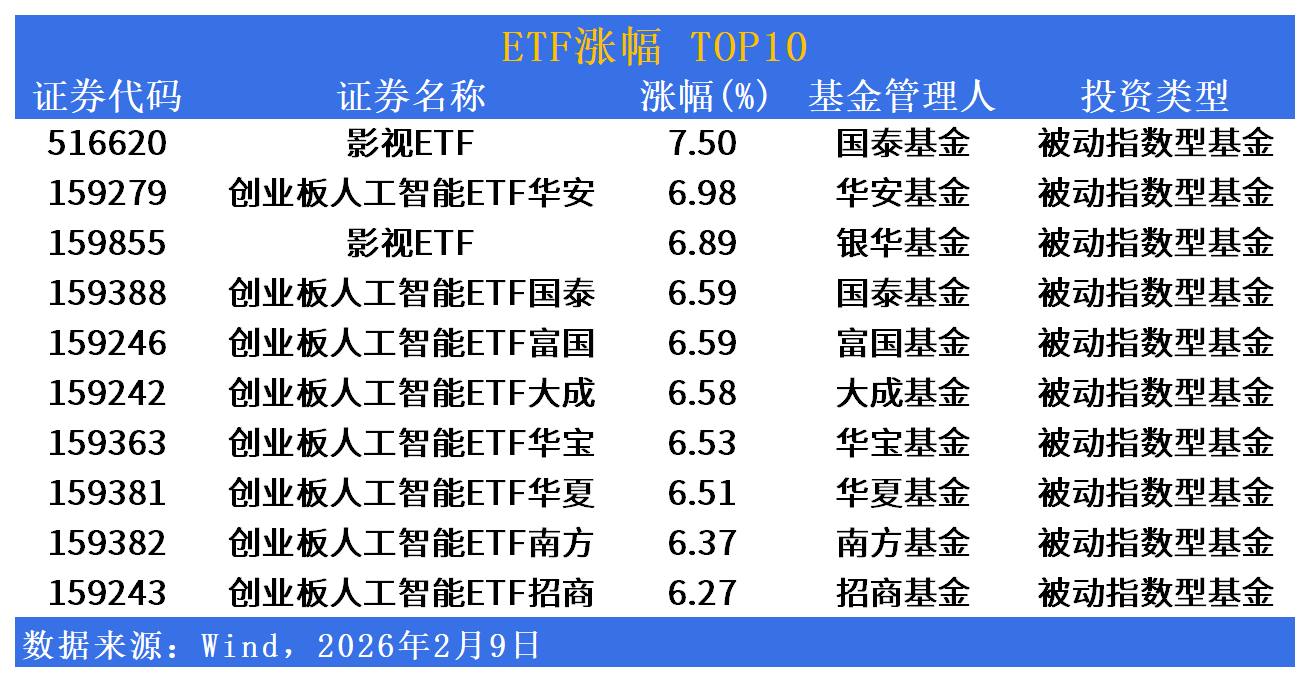
Market Overview - The A-share market saw a collective rise in the three major indices, with the Shanghai Composite Index recovering the 4100-point mark, closing up 1.41% [1] - The total trading volume in the Shanghai, Shenzhen, and Beijing markets reached 2.27 trillion yuan, an increase of 106.7 billion yuan compared to the previous trading day [1] ETF Performance - The film and AI ETFs led the market with significant gains, with the Guotai Film ETF (516620) surging 7.50% and the Huazhang AI ETF (159279) rising 6.98% [2] - Other AI-related ETFs also performed well, with several exceeding a 6.50% increase, indicating strong investor interest in AI applications and computing infrastructure [2] - The new energy sector also showed positive movement, with the Invesco Battery ETF (159757) up 2.20% and the Fortune Lithium Battery ETF (561160) rising 2.12% [2] ETF Declines - Commodity and bond ETFs experienced slight adjustments, with the maximum decline being less than 0.1%, indicating a stable market environment [3][4] Trading Activity - The Short-term Bond ETF (211360) had a trading volume of 52.734 billion yuan, leading the market, followed by the Yin Hua Daily ETF (211880) at 17.104 billion yuan [5][7] - The Huaxia Brazil ETF (159100) had a turnover rate of 211.93%, reflecting a high level of speculative trading in cross-border products [6][7] New ETF Launch - The E Fund Shanghai Composite Index ETF (530060) is set to launch on February 10, 2026, with 321 million shares issued, tracking the overall performance of stocks listed on the Shanghai Stock Exchange [8]
全球资产大震荡,2026年怎么走?
Xin Lang Cai Jing· 2026-02-09 08:09
Group 1 - Global assets are experiencing significant volatility at the beginning of 2026, with precious metals like gold and silver showing notable pullbacks after initial gains [1][19] - The market is focused on how to allocate assets after the turbulence, particularly regarding fixed income assets as a long-term core allocation [1][19] - The current political climate is shifting towards a "big fiscal" era, with abundant liquidity leading to asset bubbles, particularly in the U.S. stock market [19][21] Group 2 - The U.S. market is entering a bubble phase similar to 1999, with expectations for gold to reach new highs while the dollar index declines [2][19] - Key risks for 2026 include potential loss of Federal Reserve independence, aggressive monetary easing leading to inflation, and possible internal strife in the U.S. [2][19] - If risks arise outside the U.S., dollar assets may serve as a safe haven, similar to the situation in 1998 [2][19] Group 3 - Investors are advised to adopt a diversified asset allocation strategy for 2026, including A-shares, Hong Kong stocks, U.S. stocks, commodities, and bonds, with a focus on a "core + satellite" structure [4][21] - The core investment should be in the CSI A500 ETF, which is expected to outperform traditional indices, while satellite investments should include technology growth and cash flow/dividend assets [4][21] - The main theme for 2026 remains artificial intelligence, with a focus on sectors like communication and semiconductor ETFs [4][21] Group 4 - In equity investments, there is optimism for a shift from valuation recovery to profit improvement, particularly in sectors like non-ferrous metals, new energy, and chemicals [8][24] - Fixed income investments are expected to maintain a positive stance, with a focus on credit strategies and potential trading opportunities as the market adjusts [8][24] - The credit bond market is anticipated to experience wide fluctuations, with a focus on short-term strategies and market sentiment [10][26] Group 5 - The economic environment remains under pressure, with weak consumer demand and a declining real estate market, leading to low inflation expectations [12][28] - Monetary policy is expected to remain accommodative, with potential for further rate cuts and reserve requirement reductions in 2026 [12][28] - Institutional behavior indicates a strong performance in equity markets, but challenges remain for public funds and banks in expanding their balance sheets [12][28]

ETF午评 | CPO板块大爆发,创业板人工智能ETF大成涨7%
Ge Long Hui· 2026-02-09 06:57
Group 1 - The three major A-share indices collectively rose in the morning session, with the Shanghai Composite Index up 1.17%, the Shenzhen Component Index up 2.07%, and the ChiNext Index up 3.11% [1] - The total trading volume in the Shanghai, Shenzhen, and Beijing markets reached 1,504.5 billion yuan, an increase of 109.6 billion yuan compared to the previous day [1] - Over 4,400 stocks in the market experienced gains, indicating a broad-based rally [1] Group 2 - The CPO sector saw significant gains, with the AI ETFs on the ChiNext rising by 7.08%, 6.94%, and 6.91% respectively [1] - The film and television sector was active, with the Silver Hua Fund Film ETF and the Guotai Fund Film ETF increasing by 6% and 5.73% respectively [1] - The photovoltaic sector also performed well, with the Guotai Photovoltaic ETF and the E Fund Photovoltaic ETF both rising by 4.46% [1] Group 3 - The white wine sector underperformed, with the wine ETF and consumer ETF declining by 0.54% and 0.38% respectively [2] - The basic ETF from Jianxin fell by 1% [2]

CPO概念股集体上涨,创业板人工智能ETF涨超6%
Sou Hu Cai Jing· 2026-02-09 06:17
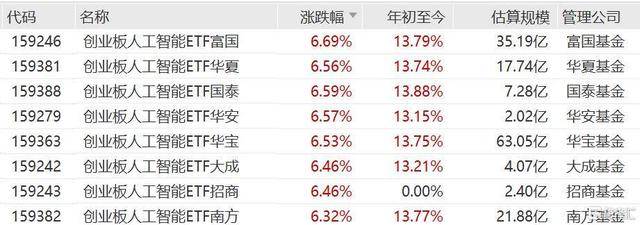
Core Viewpoint - The A-share CPO concept stocks have collectively risen, with Tianfu Communication surging 17% to reach a historical high, indicating strong market interest in AI-related investments and the potential for growth in the optical module sector [1] Group 1: Stock Performance - Tianfu Communication's stock price increased by 17%, reaching a historical high [1] - New Yisheng rose over 7%, while Zhongji Xuchuang increased by over 5% [1] - Various AI ETFs, including those from Fuguo, Huaxia, Guotai, Hu'an, Huabao, Dacheng, and Southern, all saw gains exceeding 6% [1] Group 2: ETF Performance - Fuguo's AI ETF increased by 6.69% with a year-to-date return of 13.79% and an estimated scale of 35.19 billion [2] - Huaxia's AI ETF rose by 6.56% with a year-to-date return of 13.74% and an estimated scale of 17.74 billion [2] - Guotai's AI ETF saw a 6.59% increase with a year-to-date return of 13.88% and an estimated scale of 7.28 billion [2] Group 3: Market Dynamics - The optical module sector is experiencing a concentrated chip structure that requires time for optimization and self-correction [3] - Despite being a traditionally slow season, the demand for optical modules shows strong certainty and profitability growth, attracting significant investment [3] - The current concentration of chips indicates a large amount of short-term floating profit, which may lead to increased stock price volatility [3] Group 4: CPO Technology Outlook - There is a notable expectation gap regarding the rapid replacement of pluggable optical modules by CPO technology, primarily due to misinterpretations of developments by companies like Nvidia [4] - The industry fundamentals suggest that CPO and pluggable modules will coexist, with pluggable modules remaining the mainstream demand for the next few years [4] - Leading optical module manufacturers are not excluded from the CPO ecosystem and have established strong barriers in core areas like silicon photonics [4] Group 5: Future Demand Projections - Confidence in future demand for optical modules is increasing, with major CSPs like Amazon, Google, Microsoft, and Meta projected to spend a total of $660 billion on capital expenditures by 2026, a 60% year-on-year increase [5] - The demand for optical modules is expected to maintain a rapid upward trend due to the anticipated growth in AI-related capital investments and the ongoing evolution of chip technology [5] - The overall total cost of ownership (TCO) indicates that optical modules will remain competitive for an extended period, supporting continued growth in related companies' performance [5]
超110亿 加仓
Zhong Guo Ji Jin Bao· 2026-02-09 04:56
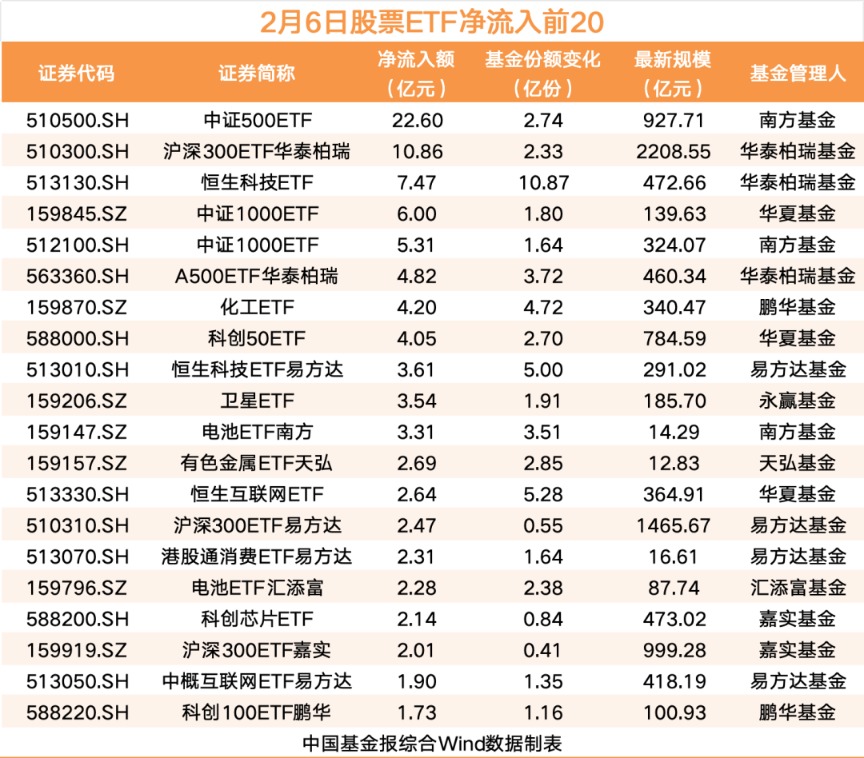
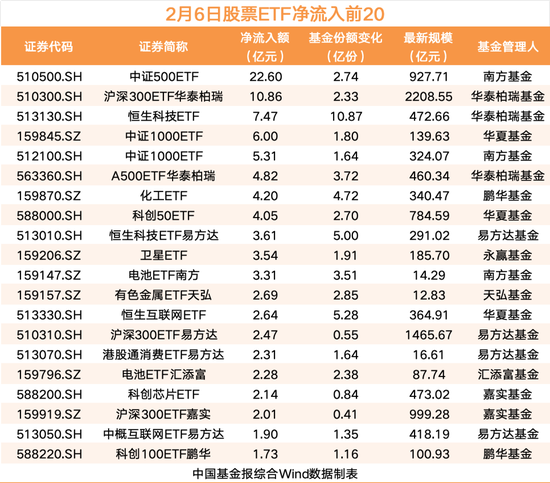
Core Viewpoint - The A-share market experienced a collective decline on February 6, with significant net inflows into stock ETFs, exceeding 11 billion yuan on that day [1]. Group 1: ETF Market Overview - As of February 6, the total scale of 1,333 stock ETFs in the market reached 4.1 trillion yuan, with a net inflow of 11.764 billion yuan and an increase of 9.347 billion fund shares [3]. - The leading categories for net inflows were broad-based ETFs and Hong Kong stock ETFs, with inflows of 7.112 billion yuan and 2.518 billion yuan, respectively [3]. - The CSI 500 Index ETF saw the highest net inflow at 2.585 billion yuan, while the Hang Seng Technology Index ETF and the Sci-Tech 50 Index ETF attracted over 11.2 billion yuan and 5 billion yuan, respectively, over the past five trading days [3]. Group 2: Top ETFs by Net Inflow - On February 6, 35 ETFs recorded net inflows exceeding 1 billion yuan, with the top three being the CSI 500 ETF (2.26 billion yuan), the CSI 300 ETF by Huatai-PB (1.086 billion yuan), and the Hang Seng Technology ETF (747 million yuan) [4]. - Notable inflows were also observed in the China Securities 1000 ETF and the Sci-Tech 50 ETF, with net inflows of 600 million yuan and 405 million yuan, respectively [5]. Group 3: ETFs with Net Outflows - The gold stock ETF experienced the largest net outflow, totaling 812 million yuan on February 6 [5]. - Other ETFs with significant outflows included the Tongwen Stock ETF (-559 million yuan), the SSE 50 ETF (-331 million yuan), and the Food and Beverage ETF (-324 million yuan) [6]. Group 4: Market Outlook - Fund managers from E Fund expressed optimism about the domestic macroeconomic outlook, expecting continued stability and progress, with emerging industries likely to see further development [7]. - Bosera Fund noted that financial conditions remain favorable for equity assets, suggesting that ETF outflows may have reached a turning point, with a potential return to growth in financing balances [7].
超110亿,加仓
Xin Lang Cai Jing· 2026-02-09 04:00
Core Viewpoint - On February 6, the A-share market saw a collective decline in the three major indices, while the stock ETF market experienced a net inflow of over 110 billion yuan, indicating continued bottom-fishing by investors [10][11]. Group 1: ETF Market Overview - As of February 6, the total scale of 1,333 stock ETFs in the market reached 4.1 trillion yuan, with a net inflow of 117.64 billion yuan on that day [2][11]. - The largest inflows were seen in broad-based ETFs and Hong Kong stock markets, with net inflows of 71.12 billion yuan and 25.18 billion yuan, respectively [2][11]. - The CSI 500 Index ETF led the inflows with 25.85 billion yuan, while the Hang Seng Technology Index ETF saw inflows exceeding 112 billion yuan over the past five trading days [2][11]. Group 2: Top ETFs by Net Inflow - On February 6, 35 ETFs had net inflows exceeding 1 billion yuan, with the top three being: - CSI 500 ETF: 22.6 billion yuan - CSI 300 ETF by Huatai-PB: 10.86 billion yuan - Hang Seng Technology ETF: 7.47 billion yuan [3][12]. - Other notable inflows included the CSI 1000 ETF and the Sci-Tech 50 ETF, which saw net inflows of 6 billion yuan and 4.05 billion yuan, respectively [13]. Group 3: ETFs with Net Outflows - The gold stock ETF experienced the largest net outflow, totaling 8.12 billion yuan on February 6 [6][14]. - Other ETFs with significant outflows included: - SSE 50 ETF: -3.31 billion yuan - Food and Beverage ETF: -3.24 billion yuan - Securities and Insurance ETF by E Fund: -2.78 billion yuan [7][14]. Group 4: Market Outlook - Fund managers from E Fund and Bosera Fund expressed optimism about the market, citing favorable financial conditions for equity assets and the potential for growth in financing balances [8][16]. - They noted that the domestic macroeconomic environment is expected to maintain a trend of "steady progress," with emerging industries likely to see further development [8][16].
光伏ETF上周领涨,太空光伏新需求获机构看好丨ETF基金周报
2 1 Shi Ji Jing Ji Bao Dao· 2026-02-09 03:21
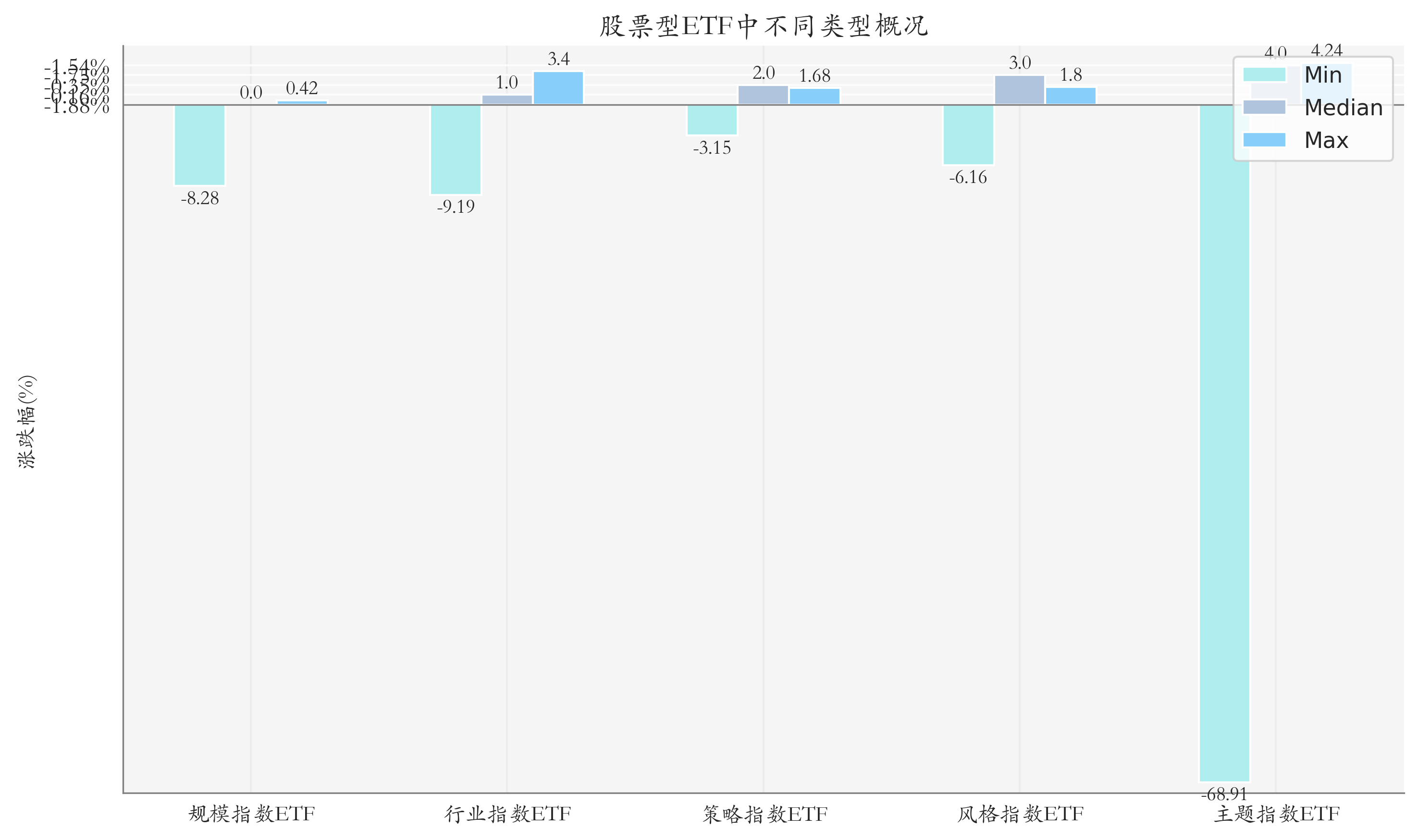
Market Overview - The Shanghai Composite Index fell by 1.27% to 4065.58 points, with a weekly high of 4104.62 points [1] - The Shenzhen Component Index decreased by 2.11% to 13906.73 points, reaching a high of 14213.61 points [1] - The ChiNext Index dropped by 3.28% to 3236.46 points, with a peak of 3390.3 points [1] - In the global market, the Nasdaq Composite Index declined by 1.84%, while the Dow Jones Industrial Average rose by 2.5% [1] ETF Market Performance 1. Stock ETF Overall Performance - The median weekly return for stock ETFs was -1.63% [2] - The highest weekly return among scale index ETFs was 0.42% for the Southern Shenzhen Main Board 50 ETF [2] - The highest weekly return in industry index ETFs was 3.4% for the China Southern Shanghai Composite Main Consumer ETF [2] 2. Stock ETF Gain and Loss Rankings - The top five performing ETFs were: - China Southern Photovoltaic Industry ETF (4.24%) - Fortune Shanghai Stock Exchange Sci-Tech Innovation Board New Energy ETF (4.09%) - E Fund Shanghai Stock Exchange Sci-Tech Innovation Board New Energy ETF (3.93%) - Penghua Shanghai Stock Exchange Sci-Tech Innovation Board New Energy ETF (3.88%) - Tianhong China Southern Photovoltaic Industry ETF (3.42%) [6] - The five ETFs with the largest declines included: - Guotai China Southern All-Index Communication Equipment ETF (-68.91%) - Guolian An Shanghai Stock Exchange Sci-Tech Innovation Board Chip Design Theme ETF (-54.59%) - Huaan China Southern Shanghai-Hong Kong Gold Industry Stock ETF (-13.25%) [6] 3. Stock ETF Liquidity - Average daily trading volume for stock ETFs decreased by 32.4%, while average daily trading volume increased by 20.9% [8] 4. Stock ETF Fund Flows - The top five ETFs with the highest inflows were: - Southern China 500 ETF (inflow of 2.26 billion) - Huatai-PB CSI 300 ETF (inflow of 1.086 billion) - Huaxia CSI 1000 ETF (inflow of 600 million) [11] - The top five ETFs with the largest outflows included: - Huaxia Shanghai 50 ETF (outflow of 331 million) - Huaxia CSI Subdivision Food and Beverage Industry Theme ETF (outflow of 324 million) [12] ETF Financing and Margin Trading - The financing balance for stock ETFs decreased from 53.0598 billion to 52.7352 billion [14] - The highest financing buy amount was for Southern China 500 ETF, totaling 845 million [14] ETF Market Size - The total market size for ETFs reached 5321.655 billion, a decrease of 135.866 billion from the previous week [17] - Stock ETFs accounted for 59.0% of the total ETF market size [19] ETF Issuance and Establishment - No new ETFs were issued last week, but nine new ETFs were established, including: - Huaan CSI Nonferrous Metal Mining Theme ETF - Wanji Guo Zheng New Energy Vehicle Battery ETF [20] Institutional Insights - CITIC Securities predicts exponential growth in space photovoltaic demand, with leading Chinese photovoltaic equipment manufacturers likely to enter the supply chains of companies like Tesla and SpaceX [21] - GF Securities anticipates that the demand for energy from space satellites and data centers will drive global photovoltaic demand, projecting a growth of 18.6% in global photovoltaic demand by 2026 [22]
恒生科技指数“越跌越买”,近5日净流入超69亿元
Jing Ji Wang· 2026-02-09 02:06
Market Overview - The A-share market saw a rebound with the Shanghai Composite Index returning to 4100 points, while the ChiNext Index experienced a recovery after hitting a low [1] - The coal sector showed significant gains, and the space photovoltaic concept stocks continued their upward trend, whereas AI application stocks declined [1] ETF Market Dynamics - The stock ETF market experienced a net outflow of approximately 1.6 billion yuan, with notable outflows from products like the Huatai-PB CSI 300 ETF and the CSI 500 ETF [1] - The total scale of the stock ETF market reached 4.15 trillion yuan, with the Hang Seng Technology Index seeing a net inflow of 2.884 billion yuan, marking it as the top sector for fund inflows [3][5] Fund Inflows and Outflows - The top three ETFs by net inflow included the Hang Seng Technology Index ETF (1.021 billion yuan), the Hang Seng Internet ETF (957 million yuan), and the Sci-Tech 50 ETF (910 million yuan) [4] - The Huatai-PB CSI 300 ETF experienced the largest net outflow at 2.597 billion yuan, followed by the CSI 500 ETF with 1.662 billion yuan [8] Fund Management Insights - Leading fund companies like E Fund and Huaxia Fund reported significant net inflows across their ETFs, with E Fund's total ETF scale reaching 655.65 billion yuan, reflecting a net inflow of 2.33 billion yuan [5] - The market remains active with a high trading volume, particularly in the context of approaching the Chinese New Year holiday, indicating sustained liquidity support [9]
