Capital Group

Search documents
基金业绩比较基准研究系列:美国主动型基金
CMS· 2025-07-04 10:05
Group 1: Report Overview - The report focuses on the performance comparison benchmarks of US active funds, aiming to provide insights for China's public fund market after the release of the "Action Plan for Promoting the High - quality Development of Public Funds" [2] Group 2: Investment Rating - Not provided in the report Group 3: Core Views - The US has established requirements for performance comparison benchmarks with broad - based indices as the main and narrow - based indices as supplementary. The CFA Institute also offers benchmark - setting guidelines [4][9] - US active funds mainly use single - index benchmarks. Stock - type funds use S&P 500 as a single - benchmark index; multi - benchmark funds prefer broad - based and narrow - based index combinations. Hybrid funds often use composite benchmarks, and bond - type funds have concentrated single - benchmarks and diverse multi - benchmarks [4][22] - US stock - type funds with S&P 500 as the benchmark have higher correlation, lower tracking error, and a lower proportion of significantly underperforming the benchmark compared to Chinese ordinary stock - type funds with CSI 300 as the main benchmark [5][53] - Capital Group and Fidelity, two leading active equity fund companies, have different benchmark - setting characteristics. Capital Group mainly uses single - benchmarks, while Fidelity has a more balanced distribution of single - and multi - benchmarks [61] Group 4: Summary by Directory 1. US Active Fund Performance Comparison Benchmark Overview - **Performance Comparison Benchmark Policy**: Since 1993, the SEC has required funds to compare their total returns with the total returns of appropriate broad - based indices, and also encourages the use of narrow - based indices. In 2022, the definition of broad - based indices was revised. The CFA Institute also provides benchmark - setting guidelines [9][10][13] - **US Active Fund Classification**: According to SEC naming rules, 80% of a fund's assets should be invested in line with its name. The ICI classifies mutual funds into major asset categories. As of April 2025, the US mutual fund market was worth $27.97 trillion, with stock - type funds being the largest in scale [15][16] - **US Active Fund Performance Comparison Benchmark Type Distribution**: Among 4938 US active mutual funds, 56.3% are stock - type funds and 32.4% are bond - type funds as of March 17, 2025. 63.4% of funds use single - benchmarks, 31.6% use multi - benchmarks, and 5.0% use composite benchmarks [19][22] 2. Stock - Type Fund Benchmark Analysis - **Single Benchmark**: Single - benchmark stock - type funds have high index concentration and diverse index selection, mainly using S&P 500. Among 1848 single - benchmark stock - type funds, S&P 500 is used 320 times [26] - **Multi - Benchmark**: Multi - benchmark stock - type funds often use broad - based and narrow - based index combinations. 846 out of 913 multi - benchmark stock - type funds use 2 indices as benchmarks. Large - scale multi - benchmark stock - type funds mainly use broad - based and style indices [30][35] 3. Hybrid Fund Benchmark Analysis - Among 239 hybrid funds, 122 use composite benchmarks, mostly composed of 2 indices. The equity index weight in composite benchmarks ranges from 5% to 85%. The most commonly used combination is S&P 500*60% + Bloomberg US Aggregate*40% [37][40] 4. Bond - Type Fund Benchmark Analysis - **Single Benchmark**: Bloomberg US Aggregate and Bloomberg Municipal are the most commonly used single - benchmarks for bond - type funds, with high benchmark concentration [46] - **Multi - Benchmark**: Multi - benchmark bond - type funds have diverse benchmark combinations, reflecting investment characteristics in regions, bond types, durations, and credit ratings. Large - scale multi - benchmark bond funds use diverse benchmark combinations [48][50] 5. US Active Fund Return vs Benchmark Comparison - **Correlation and Tracking Error Analysis**: The average correlation coefficient between US stock - type funds with S&P 500 as the benchmark and S&P 500 in the past three years is 0.91, higher than that of Chinese ordinary stock - type funds with CSI 300 as the main benchmark. The tracking error of US funds is also lower [53][54] - **Excess Return Analysis**: Less than 10% of US single - benchmark stock - type funds with S&P 500 as the benchmark significantly underperformed the benchmark in the past three years, a lower proportion compared to Chinese stock - type funds with CSI 300 as the main benchmark [59] 6. Benchmark Setting of Leading Active Equity Fund Companies - **Capital Group**: As of October 3, 2024, it had 94 products with a total management scale of $2.4 trillion. Stock - type funds accounted for 67% of the scale. The company mainly uses S&P 500 or MSCI ACWI as single - benchmarks [64][68] - **Fidelity**: As of October 4, 2024, its management scale was $2.95 trillion, with similar active and passive product scales. Stock - type funds accounted for 79% of the scale. Single - and multi - benchmark funds are evenly distributed, with single - benchmark funds mainly using S&P 500 and multi - benchmark funds using broad - based and industry/style index combinations [73][76] 7. Summary - The report introduces US active fund performance comparison benchmark policies and industry guidelines, and analyzes current benchmark - selection characteristics. US active funds mainly use single - index benchmarks, and different types of funds have different benchmark - selection preferences [84][85] - US stock - type funds with S&P 500 as the benchmark have better performance in terms of correlation, tracking error, and excess return compared to Chinese stock - type funds with CSI 300 as the main benchmark [86] - Capital Group and Fidelity have different benchmark - setting characteristics, and both show certain abilities to obtain excess returns [87]
X @Bloomberg
Bloomberg· 2025-07-01 08:00
Capital Group CEO Mike Gitlin say investors are eyeing diversification away from the US given the compelling opportunities elsewhere, and the risks stemming from geopolitics and supply-chain disruptions https://t.co/73coyzXf3k ...
海外资管机构月报:5月美国股票型基金涨幅中位数超5%,其中大盘成长型基金反弹近9%-20250623
Guoxin Securities· 2025-06-23 01:39
The provided content does not contain any quantitative models or factors, nor does it include any related construction processes, formulas, evaluations, or backtesting results. The documents primarily focus on fund performance, asset flows, and market observations without delving into quantitative finance methodologies.


“超级央行周”再度来袭!美联储按兵不动?日本放缓缩表步伐?瑞士会否重返负利率?
Di Yi Cai Jing· 2025-06-16 08:17
Group 1: Federal Reserve and Interest Rates - The futures market indicates a 99% probability that the Federal Reserve will maintain its current interest rates, with the earliest potential rate cut not expected until September [1][3] - Recent economic data shows signs of a cooling labor market and declining inflation, reducing the likelihood of severe stagflation in the U.S. [3][4] - Market participants are particularly focused on the economic forecast summary and the press conference by Fed Chair Powell to understand the factors that could lead to a rate cut [3][4] Group 2: Global Central Banks - The Bank of Japan is expected to maintain its current interest rates, with no economists predicting a rate hike in the near term [5][6] - There is speculation that the Bank of Japan may slow down its balance sheet reduction, with expectations for a potential rate hike pushed back to Q1 2026 [6][8] - The Swiss National Bank faces pressure to potentially return to negative interest rates due to a strong Swiss franc and deflationary pressures [9][10] Group 3: Economic Outlook and Trade Relations - Global trade relations and political dynamics are anticipated to undergo significant changes by mid-2025, creating unprecedented challenges for markets [1] - The uncertainty surrounding tariffs and geopolitical tensions, particularly in the Middle East, is contributing to market volatility and economic planning challenges for consumers and companies [4][6] - The UK central bank is expected to align its monetary policy with the Fed's path, with potential rate cuts anticipated later in the year [11]


中国机构配置手册(2025版)之公募基金篇:“平台式、一体化与多策略”行动方案
Guoxin Securities· 2025-06-08 08:06
Investment Rating - The investment rating for the public fund industry is "Outperform the Market" (maintained) [1] Core Insights - Public funds in China have core advantages over bank wealth management subsidiaries and insurance asset management, including high specialization, flexible transparency, and market-oriented operation mechanisms. The long-term core competitiveness lies in active equity investment, supported by in-depth industry research and diversified strategy tools [2] - The governance of companies is improving, and increased dividends from listed companies are fostering long-term capital. Public funds are expected to become the core managers of long-term funds, which will enhance market resilience and risk resistance [2] - Public funds are advancing towards platform-based, integrated, and multi-strategy development to achieve high-quality growth. This includes the integration of IT systems for comprehensive data analysis and resource collaboration, enhancing decision-making efficiency [2] Summary by Sections 1. Industry Positioning - Public funds are positioned as the "vanguard" of the asset management industry, with a management scale of approximately 31.77 trillion yuan, ranking second in the industry [11] 2. Development Path - The overall scale of the public fund industry is stabilizing and recovering, with a compound annual growth rate (CAGR) of 17.1% from 2016 to 2024, compared to other asset management products [5] 3. Market Opportunities - The total assets of Chinese residents are estimated to be around 550 trillion yuan, with financial assets accounting for approximately 32%, indicating a growing trend towards capital market investments [4] 4. Structural Changes - As of the first quarter of 2025, the scale of money market funds and bond funds has expanded to 13.33 trillion yuan and 10.10 trillion yuan, respectively, while mixed funds have seen a decline of about 15% since the end of 2023 [15]
海外资管机构月报【国信金工】
量化藏经阁· 2025-05-19 15:02
Core Viewpoint - The U.S. mutual fund market showed mixed performance in April 2025, with equity funds underperforming compared to international equity, bond, and asset allocation funds [1][7]. Group 1: U.S. Mutual Fund Market Monthly Returns - In April 2025, the median returns for U.S. equity funds, international equity funds, bond funds, and asset allocation funds were -1.55%, 0.97%, 0.01%, and 0.11% respectively [1][7]. - Among U.S. equity funds, large-cap growth style funds performed the best with a median return of 1.66%, while large-cap value funds had the largest decline with a median return of -3.28% [8]. - International equity funds focused on Latin America performed well, with a median return of 6.9% for April 2025 and 19.22% year-to-date [8]. Group 2: U.S. Fund Flows - In April 2025, active management funds experienced a net outflow of $81.6 billion, while passive funds saw a net inflow of $36.1 billion [9][15]. - Open-end funds in the U.S. saw significant net outflows in both bond and equity categories, amounting to $61.9 billion and $33.3 billion respectively [24]. - Conversely, ETFs in the U.S. experienced net inflows of $31.1 billion for equity and $12.9 billion for bond ETFs [24]. Group 3: New Fund Issuance - In April 2025, a total of 42 new funds were established in the U.S. market, including 36 ETFs and 6 open-end funds [41][36]. - The new funds included 30 equity funds, 8 bond funds, and 4 asset allocation funds [41]. Group 4: Insights from Leading Asset Management Firms - Leading asset management firms are focusing on themes such as U.S. and European policy trends and foreign investment perspectives on the stock market [4][42]. - BlackRock anticipates that tariffs will increase inflation and hinder economic growth, while also identifying opportunities in developed market equities [44]. - Schroders highlights the potential for a strong bull market in gold due to geopolitical tensions and high sovereign debt levels [47].

特朗普的“心腹大患”:股市回来了,债券并没有
Hua Er Jie Jian Wen· 2025-05-12 03:29
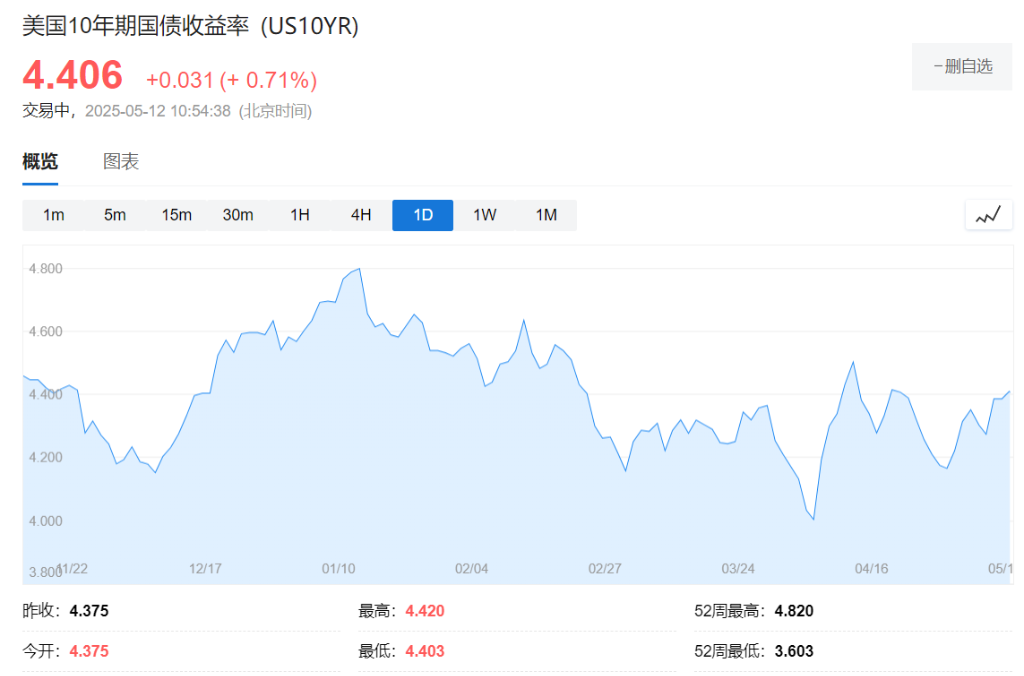
Core Viewpoint - The U.S. stock and bond markets are showing a divergence in response to recent trade policy announcements, with the stock market recovering while the bond market remains cautious and uncertain [1][2]. Group 1: Stock Market Performance - The S&P 500 index has recorded gains on 15 out of the last 22 trading days, returning to levels seen before the tariff announcements in April [2]. - This rebound occurred despite President Trump's retention of a 10% tariff on most countries, with limited progress in trade negotiations aside from agreements with the UK and meetings with Chinese officials [2]. Group 2: Bond Market Dynamics - The 10-year U.S. Treasury yield has decreased from a peak of 4.492% in April to 4.406% recently, but remains above the pre-tariff level of 4.156% [2][5]. - The persistent high yield indicates that the bond market is still processing uncertainties related to tariff policies, fiscal outlook, and Federal Reserve expectations [5]. Group 3: Investor Sentiment and Risks - Investors are demanding higher yields due to inflation uncertainties stemming from fluctuating trade policies, leading to a current term premium of 0.69%, significantly higher than the March average of 0.37% [6][8]. - Concerns over increased bond supply due to federal budget deficits and criticism of the Federal Reserve's interest rate policies are contributing to investor hesitance in purchasing long-term Treasuries [11]. Group 4: Economic Implications - The unusual phenomenon of rising long-term yields alongside falling short-term yields, termed "steepening inversion," poses challenges for policymakers and increases consumer borrowing costs [12]. - The disconnect between long-term yields and short-term interest rate expectations may hinder the Federal Reserve's ability to stimulate growth through rate cuts, with mortgage rates remaining high despite potential rate reductions [15].
关税“搅动”,美债收益率加剧分化,美联储降息更难了!
Hua Er Jie Jian Wen· 2025-05-11 11:57
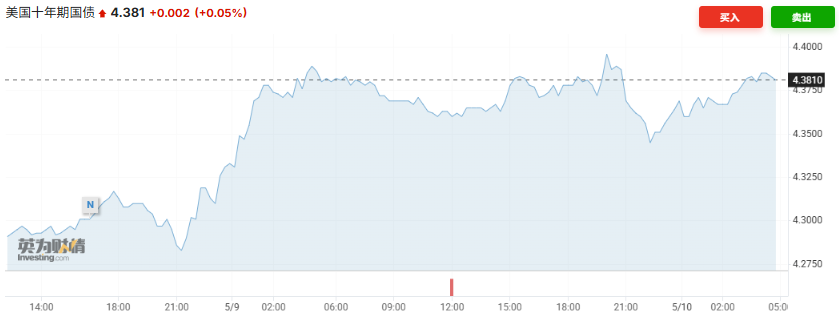
Core Viewpoint - The divergence in short-term and long-term U.S. Treasury yields poses significant challenges for the Federal Reserve's traditional policy of stimulating economic growth through interest rate cuts [1][3][10] Group 1: Yield Divergence - The current issue in the U.S. Treasury market is the significant divergence in yield trends, with short-term Treasury yields declining while long-term yields are rising [1] - As of April 2, the benchmark 10-year U.S. Treasury yield has risen to approximately 4.38%, contrasting with the decline in short-term yields [1] Group 2: Factors Driving Yield Divergence - The primary reason for this yield divergence is the uncertainty surrounding inflation, exacerbated by unpredictable trade policies [4] - Investors are demanding higher yields to compensate for the risks associated with holding long-term Treasuries, leading to an increase in the "term premium" [4] Group 3: Impact on Borrowing Costs - This yield divergence directly raises borrowing costs for consumers and businesses, complicating the Federal Reserve's efforts to stimulate the economy through rate cuts [3][10] - The average rate for a 30-year fixed mortgage was 6.8% last week, slightly up from a month ago, indicating persistent high borrowing costs despite potential rate cuts [6] Group 4: Federal Reserve and Policy Implications - Most investors believe that if the U.S. enters a recession and the Federal Reserve significantly cuts rates, long-term yields should theoretically decline [6] - However, there are concerns that long-term yields may not decrease sufficiently, keeping mortgage and other debt rates high [6][10] Group 5: Cautious Policy Response - The Federal Reserve is exercising caution in its monetary policy decisions, with Chairman Powell emphasizing the need to maintain credibility in combating inflation [8] - The U.S. Treasury has shown increased sensitivity to market conditions, adjusting its debt issuance strategy in response to rising long-term yields [9]
海外资管机构月报【国信金工】
量化藏经阁· 2025-04-28 12:15
报 告 摘 要 一、美国公募基金市场月度收益 2025年3月,美国股票型基金业绩弱于国际股票基金、债券基金和资产配置基金。 具体 来看,3月美国股票型基金、国际股票型基金、债券型基金、资产配置型基金收益中位 数分别为-5.65%、-1.62%、-0.27%、-2.62%。 二、 美国非货币基金资金流向 三、 头部资管机构资金净流入 四、美国公募基金市场新发产品 2025年3月, 美国基金市场新成立基金共58只,其中包括48只ETF和10只开放式基金产品; 按资产类别区分,2025年3月新成立股票型基金38只、债券型基金8只、资产配置型基金2 只。 2025年3月, 美国股票型基金业绩弱于国际股票基金、债券基金和资产配置基金。 具体来看,3月美国股票型基金、国际股票型基金、债券型基金、资产配置型基金收益中位数 分别为-5.65%、-1.62%、-0.27%、 -2.62%。 按管理方式: 2025年3月,主动管理型基金整体净流出307亿美元,被动基金整体净流入 544亿美元。 按资产类型: 2025年3月, 美国市场开放式基金中,股票型基金资金净流出较多 ,达 582亿美元。 2025年3月, 美国市场ETF中 ...
BlackRock Regains Top Spot in the U.S. in Broadridge's Fund Brand 50 2025 Report
Prnewswire· 2025-03-25 12:45
Core Insights - The Broadridge Fund Brand 50 (FB50) report highlights the importance of brand strength in asset management, with fund selectors prioritizing 'Solidity' and 'Client-oriented thinking' when choosing asset managers [1][5][13] - BlackRock has overtaken Vanguard as the top asset management brand, marking a significant shift in fund selector preferences [2][6] - The study ranks asset managers based on ten brand attributes, revealing insights into the competitive landscape of the asset management industry [2][10] Brand Rankings - The top three U.S. asset management brands for 2025 are BlackRock, Vanguard, and Capital Group, with BlackRock moving up one position and Vanguard dropping one [3] - First Trust made notable progress, rising from 10th to 6th place, attributed to its innovative product offerings [6] Valued Attributes - The top three attributes valued by U.S. fund selectors are 'Solidity', 'Client-oriented thinking', and 'Appealing investment strategy', indicating a preference for stability and customer-centric approaches [5][13] - 'Experts in what they do' and 'Knowledge of the market where they operate' have gained importance, reflecting the need for specialized expertise in a complex investment landscape [13] Market Trends - Fund selectors are increasingly favoring large, established brands with diverse product offerings, as well as firms that can adapt to new market demands [7][13] - There is a growing consumer demand for new product types, including actively managed ETFs and model portfolios, influencing the rankings of asset managers [13] Additional Findings - Charles Schwab excelled in 'Client-oriented thinking', ranking 7th in this attribute despite an overall 17th place in the FB50 rankings [13] - The study indicates a continued willingness among fund selectors to explore new engagements, driven by steady performance and lower volatility [13]