三星

Search documents
碳酸锂期货价创两年来新高后回调超3% 业内观点:市场未全面紧缺 难撑单边大涨
Mei Ri Jing Ji Xin Wen· 2026-01-14 14:43
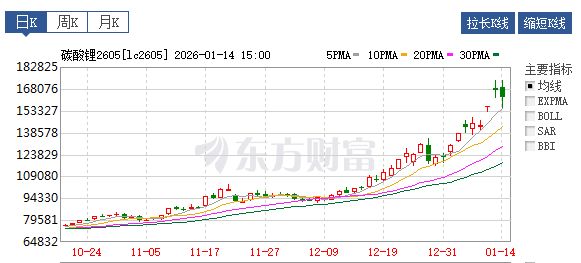
Group 1 - The core viewpoint of the article highlights the recent fluctuations in lithium carbonate futures prices, which reached a two-year high before experiencing a pullback, indicating a complex market influenced by both strong demand and short-term supply mismatches [1][4][7]. - On January 14, the main contract for lithium carbonate (lc2605) closed at 161,900 yuan/ton, down 3.53% from the previous day, after peaking at 173,400 yuan/ton during the day [1][4]. - The trading volume for lithium carbonate futures on that day was significant, amounting to 97.41 billion yuan, reflecting active market participation [1]. Group 2 - In 2025, lithium carbonate prices experienced dramatic fluctuations, initially declining to a low of 59,000 yuan/ton in June before rebounding due to increased downstream demand and supply disruptions, ultimately reaching a high of 134,500 yuan/ton in December [2]. - The current market is characterized by a slight oversupply, with a supply-demand gap of 47,000 tons of lithium carbonate equivalent (LCE) expected to persist into 2026 [8]. - Despite the optimistic outlook from leading lithium companies regarding demand, experts caution that the recent price increases are primarily driven by temporary factors, including supply constraints and unexpected demand surges [7][9]. Group 3 - The rising prices of lithium carbonate have directly increased production costs for lithium iron phosphate (LFP) materials, with estimates indicating that the cost of producing one ton of LFP has risen by approximately 2,550 yuan due to the price increase of lithium carbonate [10]. - Major LFP manufacturers are responding to cost pressures by either raising prices or halting production for maintenance, while simultaneously accelerating expansion plans to capture market share in anticipation of future demand growth [10][13]. - The competitive landscape is intensifying, particularly with the potential entry of South Korean companies into the U.S. market, which could pose additional challenges for Chinese exporters [13]. Group 4 - The demand for energy storage is expected to grow significantly, driven by the rapid development of wind and solar energy, with new energy storage installations in China increasing by 75% year-on-year in the first three quarters of 2025 [14]. - As investment economics for energy storage projects improve, this sector is projected to become a significant driver of lithium demand, with estimates suggesting a demand increase of 60.5 thousand tons of LCE by 2026 [15]. - The recent adjustments in export tax policies for battery products may have contributed to short-term price increases for lithium carbonate, highlighting the interconnectedness of market dynamics [15]. Group 5 - The rising costs of lithium carbonate are impacting the overall cost structure of energy storage systems, with projections indicating that a 10% increase in battery costs could lead to a 3% rise in EPC costs and a decrease in internal rate of return (IRR) by 0.66 percentage points [16]. - The cost of producing energy storage cells is significantly affected by lithium carbonate prices, with calculations showing that each 10,000 yuan increase in lithium carbonate price raises the cost of producing 1 kWh of cells by approximately 5.7375 yuan [16]. - The overall cost of core raw materials, including lithium carbonate, constitutes about 26% of the total cost of energy storage batteries, underscoring the importance of stable pricing in this sector [16].

OpenAI押注耳机市场,AI巨头意在何处?
Xin Lang Cai Jing· 2026-01-14 13:29
Core Insights - OpenAI is developing an AI headset named Sweetpea to compete with Apple's AirPods, aiming to enhance user experience and intelligence in consumer electronics [2][4] - The entry into the headphone market is part of OpenAI's strategic expansion into hardware, driven by the need for dedicated devices to unlock AI's potential [3][12] Group 1: Product Development and Features - Sweetpea is expected to feature advanced capabilities, including a custom chip for voice commands, potentially replacing iPhone operations and directly controlling Siri [4][10] - The design of Sweetpea is unique, utilizing metal materials and an "eggstone" shape, which may help it stand out in a crowded market [4][5] - The estimated material cost for Sweetpea is high, potentially comparable to that of a smartphone, indicating a likely premium price point for consumers [5] Group 2: Market Context and Competition - The wireless headphone market is saturated, with major players like Apple, Sony, and Bose focusing on sound quality and noise cancellation, making OpenAI's entry a significant shift in competition dynamics [7][8] - OpenAI's entry could challenge Apple's ecosystem, which currently holds about 30% of the global true wireless headphone market [8] - Traditional audio brands face challenges in differentiating their products as the competition shifts from audio quality to AI-driven features and personalized services [9] Group 3: Strategic Implications and Future Trends - OpenAI's move into the headphone market reflects a broader trend towards the physical embodiment of AI, aiming to create a new paradigm of human-AI interaction [12][13] - The success of AI headsets like Sweetpea could lead to a proliferation of AI-enabled devices across various sectors, including health monitoring and home services [13] - The integration of AI into everyday devices raises ethical considerations regarding privacy and the impact on human behavior, necessitating new design principles and regulatory frameworks [13]

巨头加速入局,AI眼镜2026年打响新一轮排位赛
2 1 Shi Ji Jing Ji Bao Dao· 2026-01-14 13:13
Core Insights - The Chinese AI glasses market is entering a new phase after the "Hundred Glasses War" in 2025, with significant developments expected in 2026 as major players like Baidu and ByteDance join the competition [1][2] - Global market dynamics are shifting, with Meta maintaining a dominant position, while Google and Apple are also making strategic moves to capture market share [1][6] Investment and Financing - Companies like Thunderbird Innovation and Flash Technology have recently secured significant funding, indicating strong investor interest in the AI glasses sector [3][4] - Thunderbird Innovation raised over 1 billion yuan, while Flash Technology completed a financing round of nearly 100 million yuan to support the development of new AI glasses [3] Market Dynamics - The AI glasses market is expected to experience explosive growth in 2026, driven by successful commercialization efforts from companies like Ray-Ban Meta and the anticipated entry of tech giants like Apple and Samsung [5][6] - The global AI smart glasses market is projected to grow from 6 million units in 2025 to 20 million units in 2026, with revenue increasing from $1.2 billion to $5.6 billion [9] Competitive Landscape - The entry of major internet and mobile companies is intensifying competition, leading to potential market share erosion for existing players while also creating opportunities for startups [8][9] - The current consumer base for AI glasses primarily consists of early adopters, and the market has yet to establish a strong "must-have" demand [4][5] Technological Advancements - The introduction of eSIM technology is seen as a significant step towards making AI glasses independent devices, enhancing their functionality beyond being mere accessories [3] - Improvements in product quality and user experience are critical for retaining customers, as many users currently engage with AI glasses primarily out of curiosity [4][5] Ecosystem Development - Google is actively working on building an Android XR ecosystem through partnerships with companies like Qualcomm and Samsung, aiming to create a robust hardware ecosystem for smart glasses [6][7] - The ongoing development of the Android XR ecosystem is expected to foster innovation and application expansion in the smart glasses market, although widespread adoption may take time [7][8]




中国手机厂商撑起全球六成市场,海外出货结构进入重构期
Di Yi Cai Jing· 2026-01-14 12:41
Core Insights - The overseas expansion of Chinese manufacturers continues, but the competitive strategies and target price segments are undergoing significant changes [1][2][4] - The global smartphone industry is entering a new structural adjustment cycle, driven by rising storage chip prices and supply chain costs [1][6] Market Trends - According to IDC, global smartphone shipments are projected to grow by 2.3% year-on-year in Q4 2025, reaching 1.26 billion units, with an annual growth of 1.9% [1] - The growth is primarily driven by high-end models, foldable phones, and consumers' anticipation of future price increases [1][2] - Apple and Samsung are the fastest-growing manufacturers among the top five, with year-on-year growth rates of 6.3% and 7.9%, respectively, increasing their combined market share to 39% from 37% in 2024 [2] Competitive Landscape - Chinese manufacturers are facing structural pressures as the market shifts towards higher price segments, which have traditionally been their stronghold in overseas markets [2][4] - Honor is noted as the fastest-growing Chinese manufacturer overseas, with a year-on-year growth of approximately 55% in the first three quarters of 2025, focusing on the $300 to $500 price range [4][5] - Other Chinese brands like OPPO and Xiaomi are also adjusting their strategies to target mid-range markets, with OPPO moving from entry-level products to more mid-range offerings [5] Cost and Supply Chain Challenges - The uncertainty in 2026 is largely centered around costs and supply chain issues, particularly the volatility in storage prices [6][7] - Counterpoint Research predicts a 40% to 50% increase in storage chip prices in Q1 2026, with further increases expected in Q2 [6] - The rising costs of components are significantly impacting the pricing and sales of low-end models, making the business model for sub-$100 devices increasingly fragile [7]

99%计算闲置?推理时代,存力比算力香
3 6 Ke· 2026-01-14 12:12
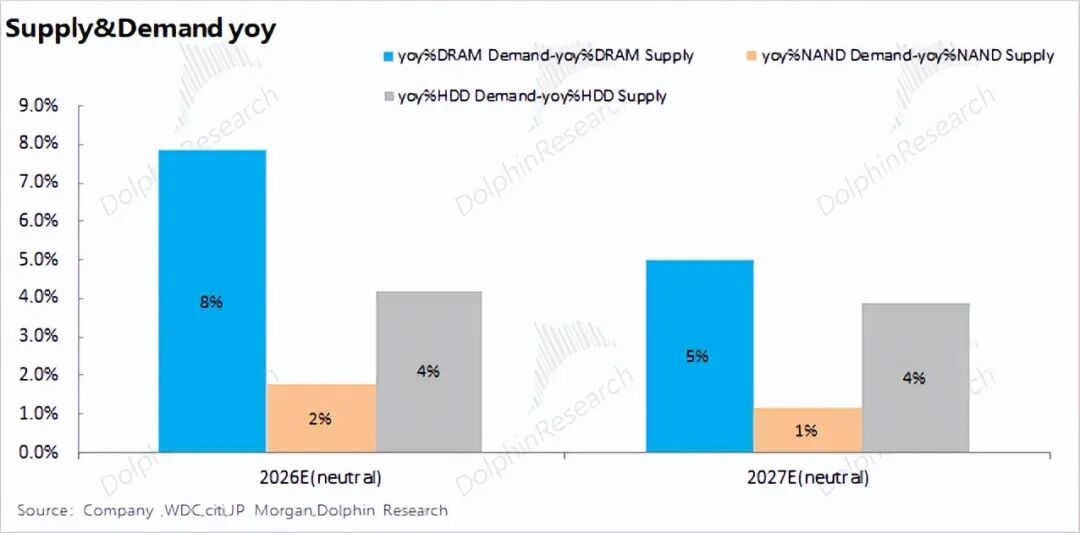
Core Insights - Huang Renxun's speech at CES 2026 has reignited market enthusiasm for storage, particularly with the new Rubin architecture requiring more DDR and NAND compared to the previous Blackwell architecture, leading to a rise in storage stock prices [1] - The market focus has shifted from HBM to traditional storage areas like DDR and NAND, with supply-demand dynamics driving a comprehensive increase in storage prices [1] Group 1: DRAM Market - The supply-demand imbalance for DRAM (including HBM and DDR) is expected to persist until 2027, with demand growth outpacing supply growth during 2026-2027 [2][5] - DRAM production expansion is challenging due to the need for new production lines, leading major manufacturers to focus capital expenditures on DRAM [4] - The demand for DRAM in AI servers is expected to create a significant supply gap by 2027, with a projected demand increase of 222% in 2026 and 80% in 2027 [20][21] Group 2: NAND Market - NAND prices have nearly doubled since the beginning of 2025, driven by supply constraints and increased demand from AI applications [26][28] - The capital expenditure for NAND is expected to rise modestly, with a projected increase to $18.3 billion by 2027, reflecting a compound growth rate of only 6% [30] - The supply-demand gap for NAND is anticipated to remain at 5-6% during 2026-2027, as demand continues to outstrip supply [45] Group 3: HDD Market - HDDs are primarily used for cold storage in AI data centers, with their cost advantage making them a viable option despite slower performance compared to SSDs [48][51] - The supply of Nearline HDDs is expected to grow at 29% in 2026 and 19% in 2027, while demand is projected to increase by 33% and 23% respectively, indicating a tightening supply-demand situation [55]


净利暴涨 4 倍,营收突破百亿!复刻海力士逻辑,它靠“先进封装”杀疯了
市值风云· 2026-01-14 11:06
Investment Rating - The report indicates a strong bullish outlook for the storage industry, particularly for the company Bawei Storage, with expectations of significant revenue and profit growth in the coming years [4][22]. Core Insights - The storage industry is undergoing a transformation from a focus on capacity to a focus on technology, particularly advanced packaging and integrated solutions, which are crucial for meeting the demands of AI applications [39]. - Bawei Storage is positioned as a leader in advanced packaging technology, which allows it to create highly integrated and customized storage solutions, essential for AI edge devices [10][39]. - The company has secured significant contracts with major tech firms like Meta, indicating its strong market position and the effectiveness of its integrated R&D and packaging capabilities [12][14]. Summary by Sections Industry Overview - The semiconductor industry is shifting towards a model where advanced packaging technologies, such as TSV and MR-MUF, are critical for enhancing data transfer speeds and integration with computing [2][3]. - The integration of storage and computing, termed "storage-compute convergence," is becoming the core logic of the industry [3]. Company Performance - Bawei Storage is projected to achieve revenues between 10 billion to 12 billion yuan in 2025, with a net profit forecasted to increase by over 427% to 520% [22]. - The company is expected to see a significant increase in Q4 2025, with revenues projected between 3.4 billion to 5.4 billion yuan, reflecting a growth of over 105% [23]. Technological Edge - Bawei is the only independent storage solution provider globally with wafer-level advanced packaging capabilities, which allows for significant reductions in chip thickness and improvements in data transfer efficiency [10][18]. - The company's advanced packaging technology is crucial for meeting the compact and low-power requirements of AI edge devices, similar to how HBM technology has benefited SK Hynix [10][18]. Market Position and Strategy - Bawei has established a unique ecological position by offering a combination of hardware, firmware, and packaging solutions, which is not easily replicable by traditional module manufacturers [13][14]. - The company is expanding its market reach across various sectors, including AI glasses, smart wearables, and automotive storage solutions, indicating a comprehensive strategy to capture growth in multiple domains [30][32]. Future Outlook - The storage industry is entering a super cycle, with rising prices for NAND Flash and DRAM expected to continue into 2025, benefiting companies like Bawei [21][22]. - Bawei's proactive inventory management and long-term supply agreements with major manufacturers position it well to navigate future demand fluctuations [28].
净利暴涨4倍,营收突破百亿!复刻海力士逻辑,它靠“先进封装”杀疯了
市值风云· 2026-01-14 10:08
Core Viewpoint - The storage industry is undergoing a significant transformation, shifting from a focus on capacity to a focus on technology, particularly in packaging and solution capabilities. Companies like Baiwei Storage, which have successfully positioned themselves in the AI sector, are expected to reap substantial industry benefits [4][36]. Group 1: Industry Dynamics - The semiconductor industry's underlying logic is changing, with a focus on AI computing power and advanced packaging technologies like HBM (High Bandwidth Memory) becoming crucial for success [4][5]. - The integration of storage and computing, termed "storage-compute integration," is essential, with advanced packaging serving as a bridge to achieve this [6]. - The storage industry is entering a super cycle, with prices for NAND Flash and DRAM expected to rise significantly in 2025, reflecting a strong recovery from the downturn experienced in 2023 [22][23]. Group 2: Baiwei Storage's Position - Baiwei Storage has submitted an application for listing on the Hong Kong Stock Exchange and is projected to achieve revenues exceeding 10 billion yuan in 2025, with a remarkable increase in net profit expected in Q4 2025 [6][21]. - The company is the only independent storage solution provider globally with wafer-level advanced packaging capabilities, which allows for significant reductions in chip thickness and improvements in data transmission efficiency [11][20]. - Baiwei's unique business model includes integrated R&D and packaging, enabling it to optimize performance and power consumption, which is critical for AI applications [16][18]. Group 3: Client Relationships and Market Strategy - Baiwei Storage has secured partnerships with major tech companies like Meta, Google, and Xiaomi, positioning itself as a key supplier in the AI glasses market [13][14]. - The company's revenue from AI glasses is expected to grow over 500% in 2025, indicating strong demand in this emerging market [15]. - Baiwei's strategy encompasses a comprehensive approach across "cloud, edge, and endpoint" sectors, with significant engagements in smart automotive and enterprise-level storage solutions [30][31]. Group 4: Future Outlook - Baiwei Storage is well-prepared for future demand growth and has established long-term supply agreements with major manufacturers to secure raw materials [28][25]. - The company is actively pursuing global expansion and aims to leverage its successful projects with North American tech giants to enhance its market position [32][29]. - The combination of advanced packaging technology and a robust R&D framework positions Baiwei to replicate the success of companies like SK Hynix in the storage solutions sector [36].
比iPhone更疯狂,乔布斯去世15年后,「最像他的人」操刀首款AI硬件
36氪· 2026-01-14 09:47
Core Viewpoint - OpenAI is set to release its first hardware, codenamed "Sweetpea," in September 2026, which aims to replace traditional devices like the iPhone and AirPods with a new audio device designed by Jony Ive, a prominent figure in tech design [3][5][26]. Group 1: Product Overview - The "Sweetpea" device will be an audio device worn behind the ear, featuring a unique design and advanced technology, including a 2nm chip, making it comparable in cost to a smartphone [3][36]. - The device is expected to have a price range of $500 to $800, significantly higher than AirPods Pro, with a projected first-year sales target of 40 to 50 million units [36]. Group 2: Design Philosophy - Jony Ive's design philosophy for "Sweetpea" focuses on "Calm Technology," which aims to minimize user distraction and anxiety, contrasting with the overwhelming nature of smartphones [67][71]. - The device will prioritize audio interaction and minimize visual stimuli, embodying a design that allows technology to blend seamlessly into daily life [71][72]. Group 3: Historical Context - The acquisition of Jony Ive by OpenAI for $6.5 billion in 2025 is reminiscent of past significant tech acquisitions, emphasizing the value of design talent over existing products [10][15]. - The article draws parallels between the current tech landscape and historical moments in Silicon Valley, suggesting that the introduction of "Sweetpea" could mark a new era in technology [78][82]. Group 4: Future Plans - OpenAI plans to launch five hardware devices by the fourth quarter of 2028, indicating a broader strategy to establish a complete AI hardware ecosystem [75][79]. - The manufacturing of these devices is expected to shift from China to the U.S. or Vietnam, reflecting a significant change in supply chain dynamics [75].


长鑫正式登场:今年A股最硬核IPO全拆解
半导体芯闻· 2026-01-14 09:42
Core Viewpoint - The article highlights the significance of Changxin Technology's upcoming IPO as a pivotal moment in the A-share market, marking a shift towards high-end semiconductor capabilities in China, particularly in the AI computing sector [1][10]. Group 1: Changxin Technology's Position - Changxin Technology is the only large-scale DRAM manufacturer in China and is theoretically the only player capable of entering the HBM market, which is essential for AI computing [3][5]. - The company has become the largest DRAM manufacturer in China and the fourth globally, with its core products and technologies reaching international advanced levels [5][10]. Group 2: Importance of DRAM in AI - The current bottleneck in AI computing is the "memory wall," where the speed of DRAM access limits the effectiveness of GPU computations, making DRAM a strategic component in AI systems [2][4]. - HBM (High Bandwidth Memory) is crucial for AI applications, providing significantly higher bandwidth compared to traditional memory, which is essential for the performance of advanced GPUs [2][3]. Group 3: IDM Model Advantages - Changxin employs an IDM (Integrated Device Manufacturing) model, which enhances supply chain security and allows for deeper optimization of products compared to the Fabless model used by many domestic GPU companies [6][7]. - The company has established three 12-inch DRAM wafer fabs in Hefei and Beijing, achieving a capacity utilization rate of 94.63% in the first half of 2025, which strengthens its competitive position [7][8]. Group 4: Financial Performance and Growth - From 2022 to September 2025, Changxin's cumulative revenue reached 73.636 billion yuan, with a compound annual growth rate of 72.04% in main business revenue from 2022 to 2024, driven by the upward cycle of storage demand and capacity release [8][10]. - The company has successfully transitioned from initial technology platforms to advanced ones, covering a range of products from DDR4 to DDR5, indicating strong market acceptance and product stability [8][10]. Group 5: Market Implications - Changxin's IPO represents a significant milestone for China's semiconductor industry, indicating a transition from catching up to conquering high-end markets, positioning the company as a foundational player in the AI computing ecosystem [10]. - The unique status of Changxin as the only domestic DRAM IDM in the A-share market provides it with substantial premium potential under the logic of self-sufficient AI computing capabilities [10].
DRAM三巨头产能,1800万片
半导体芯闻· 2026-01-14 09:42
Core Viewpoint - The global memory market is experiencing a severe shortage due to explosive demand for high-performance memory from AI servers, which is expected to drive price increases throughout 2026 [1][3]. Group 1: Market Dynamics - Major memory manufacturers, including Samsung, SK Hynix, and Micron, have initiated capacity expansion plans, but these efforts are insufficient to alleviate the current memory shortage [1]. - Samsung plans to increase its DRAM wafer input to nearly 8 million pieces by 2026, a 5% increase from 2025 [1]. - SK Hynix's DRAM production is expected to rise from 5.97 million pieces in 2025 to 6.48 million pieces in 2026, an 8% increase, driven by expansion at its Cheongju M15X plant [2]. Group 2: Production Challenges - Despite increased wafer input, actual chip output faces technical bottlenecks, particularly for Samsung as it transitions to 10nm 6th generation DRAM, which may temporarily reduce production capacity [2]. - The supply-demand imbalance is critical, with DRAM suppliers meeting only about 60% of customer demand, and server-specific DRAM satisfaction rates falling below 50% [3]. Group 3: Price Trends - DRAM contract prices are expected to rise sharply, with a forecasted increase of 55% to 60% in Q1 2026 [3]. - NAND Flash contract prices are also projected to increase by 33% to 38% during the same period, particularly driven by server demand [3]. - Despite a weak PC market, DRAM prices for PCs are anticipated to continue rising due to reduced supply allocations to PC manufacturers [4]. Group 4: Long-term Outlook - Experts believe that the current supply crisis will not see fundamental relief until Samsung's P4 factory becomes operational, which is not expected until after 2027 [4][5]. - SK Hynix also requires the launch of its Yongin semiconductor cluster to significantly enhance production capacity [5].