
宇树科技

Search documents
超千家中国企业参展CES 傲鲨消费级外骨骼斩获“创新奖”
Zhong Guo Jing Ying Bao· 2026-01-07 06:50
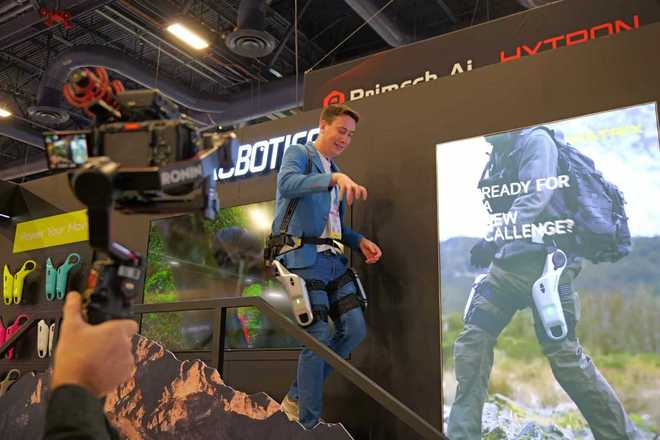
Group 1 - The International Consumer Electronics Show (CES) will be held in Las Vegas from January 6 to 9, 2026, featuring at least 3,300 exhibitors from 56 countries and regions, with Chinese exhibitors numbering around 1,062, accounting for over 32% of the total [1] - Notably, nearly all Chinese robotics companies are participating, including prominent humanoid robot firms and companies specializing in exoskeletons and industrial manufacturing [1] - The Chinese exoskeleton robot company Aoshah is making its third appearance at CES, showcasing its consumer-grade product VIATRIX, which won a CES Innovation Award [1] Group 2 - Aoshah's VIATRIX features innovative design elements such as a Float360 floating hip joint structure and self-developed automotive-grade motors, which have contributed to its market appeal [3] - The product has received positive feedback from international users, who found it helpful for activities like climbing stairs and running, and noted its aesthetic appeal [3] - Founded in 2018, Aoshah has transitioned from industrial applications of exoskeletons to the consumer market, significantly reducing the price of its products to below 10,000 yuan, making them comparable to smartphone prices [3]

直击CES:AI,加速影响物理世界
Zhong Guo Zheng Quan Bao· 2026-01-07 04:44
Group 1: AI Technology and Developments - AI has become the central theme at CES 2026, with discussions focusing on extending AI into the physical world [2][3] - NVIDIA's CEO Jensen Huang announced that the company's open-source physical AI model "Cosmos" has reached one million downloads, indicating a significant shift in AI capabilities [2] - AMD introduced several new AI products, including the MI455X GPU AI chip and Ryzen AI processors, with plans to launch the MI500 series chip in 2027, aiming for a 1000-fold increase in AI performance over the next four years [2] - Qualcomm's new high-performance robot processor, the Snapdragon IQ10 series, is designed for industrial autonomous mobile robots and advanced humanoid robots [2][3] Group 2: Robotics and Smart Products - The humanoid robot TORA-ONE showcased at CES 2026 demonstrates strong adaptability in new retail scenarios, featuring advanced tactile sensors with high precision and sampling rates [4] - Companies like 松延动力 are targeting key global markets for their products, aiming for significant overseas expansion in 2026 [5] - The exhibition highlighted various smart home products, including robotic lawn mowers and pool cleaning robots, indicating a growing market for AI-integrated home appliances [6] Group 3: Autonomous Driving - The maturity of technology is pushing L4-level autonomous driving into everyday life, with significant advancements in AI driving this trend [7] - Huang announced the Alpamayo R1, an open-source VLA inference model for assisted driving, suggesting that autonomous driving may become a mainstream application of physical AI [7]


给商业大佬颁“年终奖”:刘强东、王兴兴……拿走了啥奖?
Nan Fang Du Shi Bao· 2026-01-07 04:44
Core Insights - The year 2025 has seen significant developments in the business landscape, with major companies like JD.com, ByteDance, and others making headlines for their innovative strategies and employee compensation initiatives [2] - The narrative emphasizes the dynamic nature of business, highlighting the importance of adaptability and innovation in a rapidly changing environment [2] Group 1: JD.com and Liu Qiangdong - Liu Qiangdong has made a strong public return in 2025, taking on the role of "Chief Experience Officer" and engaging directly with consumers through various initiatives [3][5] - His actions, such as cooking local dishes during live streams, signal a commitment to expanding JD.com's local service offerings and enhancing customer engagement [3][5] - Throughout the year, Liu has focused on employee welfare, announcing full social insurance coverage for delivery riders, thus redefining competition in the industry to include social responsibility [5][6] Group 2: Alibaba and Jiang Fan - Jiang Fan has returned to lead Alibaba's e-commerce division, focusing on integrating various business segments under a unified platform to enhance operational efficiency [7][9] - His strategy includes leveraging AI and real-time retail to drive growth, with significant improvements in user engagement and profitability reported [9] Group 3: Pop Mart and Wang Ning - Wang Ning has transformed Pop Mart into a leading player in the collectible toy market, with the LABUBU IP gaining significant popularity and driving stock prices to new highs [10][12] - Despite market concerns about sustainability, Pop Mart continues to innovate and expand its brand presence, including the introduction of luxury executives to its board [12] Group 4: AI and Yan Junjie - Yan Junjie, founder of MiniMax, has positioned the company as a leading player in the AI sector, focusing on high-efficiency algorithms and innovative approaches to model training [20][22] - MiniMax's recent IPO plans reflect its rapid growth and the increasing demand for AI solutions, with a strong emphasis on a youthful and efficient workforce [22][23] Group 5: Domestic Beauty and Zhao Yan - Zhao Yan of Huaxi Biological has been at the forefront of controversy and reform in the domestic beauty industry, actively addressing internal and external challenges [29][31] - Her leadership style emphasizes direct confrontation and accountability, aiming to reshape the company's culture and market position amidst ongoing scrutiny [31][32] Group 6: Old Puhuang and Xu Gaoming - Xu Gaoming's Old Puhuang brand has achieved remarkable sales performance, with projections indicating it may surpass major international luxury brands in revenue [33][34] - The brand's expansion into international markets, particularly Southeast Asia, marks a significant step in its growth strategy [36] Group 7: Live Streaming and Xin Ba - Xin Ba's decision to step back from live streaming reflects broader industry challenges, including personal health issues and shifts in business strategy [39][41] - The turmoil within his company highlights the transition of the live commerce sector from rapid growth to a more regulated and sustainable operational model [42]



2025资本市场年度人物盘点:老将承压,新生代突围
Nan Fang Du Shi Bao· 2026-01-07 04:17
Group 1 - The core trend in the 2025 Chinese capital market indicates a shift from scale expansion to value return, emphasizing hard-core strength over conceptual speculation [2] - The experiences of industry veterans and new generation entrepreneurs reflect the necessity of risk awareness, essence adherence, and innovation embrace to navigate market changes [2] Group 2 - The resignation of Vanke's former CEO, Zhu Jiusheng, marks a significant event in the real estate sector, highlighting the vulnerabilities of high-leverage models amid industry downturns [4] - Xiaomi's CEO Lei Jun faces challenges in the automotive sector, where safety concerns and brand reputation are critical as consumer expectations evolve from mere production to quality [6] - BYD's Wang Chuanfu celebrates record sales of 4.6024 million electric vehicles globally, yet faces declining domestic revenue and profit, indicating the need for technological depth and operational excellence [8] Group 3 - The emergence of new entrepreneurs like Liu Jingkang, who launched a drone brand to compete with DJI, illustrates the survival imperative of differentiation in a competitive landscape [11] - Peng Zhihui's transition from Huawei employee to entrepreneur showcases the capital market's recognition of technical talent, but the challenge remains in converting technical prowess into sustainable profits [13] - Wang Xingxing's company, Yushutech, aims for an IPO, representing the maturation of the embodied intelligence sector, where commercialization and market expectations will dictate future success [15] Group 4 - Bubble Mart's founder Wang Ning experiences a volatile year, with significant revenue growth followed by a sharp decline in stock price, emphasizing the need to shift from reliance on hit products to ecosystem building [20] - Cambricon's Chen Tian Shi sees a turnaround with consecutive profitable quarters, driven by AI computing demand, highlighting the importance of technological barriers and ecosystem development in hard tech [22] - Liang Wenfeng's low-profile yet impactful contributions in AI through DeepSeek demonstrate that sustained innovation is crucial for success in the artificial intelligence era [24][25]

赛道掘金:聚焦高景气硬科技核心
Mei Ri Jing Ji Xin Wen· 2026-01-07 01:48
Group 1: Electronic Industry - The electronic industry holds a weight of 33% in the Sci-Tech Innovation 200 index, with a positive outlook for 2026 driven by the dual forces of semiconductor self-sufficiency and AI innovation [1] - National policies are strongly supporting self-sufficiency in the electronic and semiconductor sectors, with the National Big Fund's third phase raising over 300 billion yuan, focusing on critical areas such as equipment and materials [1] - The continuous demand for AI computing power is a key driver, with domestic companies providing the necessary support for computing power, which is expected to benefit the electronic sector on the Sci-Tech Innovation Board [1] Group 2: Pharmaceutical Industry - The pharmaceutical industry accounts for approximately 20% of the index, with a core viewpoint that the value of Chinese innovative drugs is gaining international recognition, marking a critical turning point [2] - The Chinese pharmaceutical industry has undergone significant transformation over the past decade, with a full-chain support policy for innovative drugs set to elevate their development to a national strategic level [2] - The number of self-researched FIC drugs by Chinese companies has increased from 9 in 2015 to 120 in 2024, representing 31% of the global pipeline, second only to the United States [2][6] Group 3: Machinery and Equipment Industry - The machinery and equipment sector represents 12% of the index, benefiting from strong policy support and emerging growth trends, particularly in high-end manufacturing [6] - The "14th Five-Year Plan" emphasizes original innovation and key technology breakthroughs in industries such as integrated circuits and high-end instruments, which will drive growth in the machinery sector [6] - The commercial progress of robotics is expected to reach a turning point by 2026, with domestic supply chain changes and industrialization pace accelerating [7] Group 4: Investment Opportunities - The Guotai Sci-Tech 200 ETF (subscription code: 589223) fills the gap for small-cap allocations in the Sci-Tech Innovation Board, offering high growth potential and low entry barriers for investors [7]
金风科技“炼金术”
阿尔法工场研究院· 2026-01-07 00:04
Core Viewpoint - The article discusses the recent surge in stock prices of Goldwind Technology (金风科技) driven by the excitement surrounding the IPO of Blue Arrow Aerospace (蓝箭航天), highlighting the strategic investments and potential synergies between the two companies in the clean energy and aerospace sectors [4][19]. Group 1: Investment and Financial Performance - Goldwind Technology's stock price reached a historical high, with a nearly 21% increase on the first trading day of 2026 in Hong Kong, attributed to the IPO acceptance of Blue Arrow Aerospace [4]. - Blue Arrow Aerospace aims to raise approximately 7.5 billion RMB through its IPO, with an estimated valuation of 75 billion RMB, significantly benefiting Goldwind's investment, which has appreciated over five times since its initial investment of 500 million RMB in 2018 [8][19]. - Goldwind's investment strategy has evolved from early-stage investments to focusing on mid-to-late stage projects with clear technological paths and market prospects, reflecting a more mature investment approach [10][19]. Group 2: Strategic Synergies and Technological Innovations - The collaboration between Goldwind and Blue Arrow Aerospace highlights potential technological synergies, such as the application of aerospace lightweight carbon fiber technology in Goldwind's wind turbine blades [8]. - Goldwind is exploring the feasibility of using high-purity liquid methane produced from its green methanol and green hydrogen projects as rocket fuel, indicating a cross-industry innovation strategy [8][19]. - The investment in Blue Arrow Aerospace is seen as a strategic move to extend Goldwind's industrial capabilities and mitigate risks associated with its core wind energy business [20][22]. Group 3: Market Dynamics and Future Outlook - The wind energy sector is facing intense competition and pricing pressures, leading to a plateau in profitability for Goldwind's core business, while investment returns from ventures like Blue Arrow Aerospace are becoming increasingly significant [19][22]. - The article emphasizes the need for traditional manufacturing companies to adapt their investment strategies to navigate the challenges of low margins in manufacturing and leverage high-return opportunities in emerging technologies [22]. - Goldwind's approach to investing in hard technology sectors is positioned as a means to counterbalance the cyclical nature of its primary business, suggesting a shift towards a more diversified asset portfolio [19][22].


“科技界春晚”隆重开演 参展商惊呼“没有AI展品等于白来”
Zheng Quan Shi Bao· 2026-01-06 22:29
Group 1: Core Themes of CES 2026 - The core theme of CES 2026 is "human-centered" AI applications, attracting over 4,500 companies from more than 150 countries, including around 1,400 startups, with an exhibition area of 2.6 million square feet [3] - AI has transitioned from a showcase tool to a fundamental component in various smart hardware, including humanoid robots, smart glasses, smart appliances, AI smartphones, AI toys, and smart electric vehicles [2][3] - The event highlights a significant shift in AI's role from consumer-level toys to enterprise-level productivity tools, addressing real-world labor shortages in sectors like healthcare, logistics, and manufacturing [2] Group 2: Chinese Companies at CES 2026 - A total of 207 Chinese companies participated in CES 2026, with a net exhibition area exceeding 4,900 square meters, showcasing a strong presence in the global tech landscape [4] - Chinese companies, particularly in the robotics sector, are gaining attention for their global strategies, with firms like Fourier and Yushutech presenting advanced humanoid robots and solutions [4][5] - The participation of Chinese companies reflects a shift from merely showcasing consumer electronics to demonstrating capabilities in AI hardware manufacturing and assembly, indicating a growing confidence in global supply chain management [6][7] Group 3: Supply Chain Trends - An increasing number of electronic supply chain companies are participating in CES, showcasing their full-stack capabilities in AI hardware manufacturing and assembly [6] - Companies like Lianyi Zhizao and OFILM are using CES to communicate their core service offerings and deepen technical exchanges with global partners [6][7] - The active participation of supply chain enterprises at CES signifies a recognition of their manufacturing capabilities on a global scale, as they aim to expand their market presence [7]
2025抖音科技内容生态报告
Sou Hu Cai Jing· 2026-01-06 21:35
今天分享的是:2025抖音科技内容生态报告 报告共计:16页 抖音科技内容生态与算力芯片产业作为数字经济的核心组成,在技术革新、政策支持与市场需求驱动下协同发展,构建起科技传播与技术支撑的双重生态。 抖音科技内容生态2025年呈现爆发式增长,创作者数量提升82%,优质内容增长125%,科技内容全年播放量提升28%,每天观看超30分钟的用户增长30%, 形成前沿科技、深度测评、手搓万物等多元赛道。前沿科技领域中,AI兴趣用户增长105%,AI学习类内容播放量提升200%,机器人相关播放量增长 116%;深度测评以真实体验为核心,互动率高出常规测评274%;手搓赛道涌现大量爆款内容,点燃普通人的科技热情。生态中汇聚了科技媒体、企业、高 校、科研人等多元角色,创作手法不断创新,商业化路径清晰,通过"精选品牌伙伴计划"等实现创作者与品牌的双向奔赴。算力芯片作为AI时代的核心引 擎,受"外部封锁"与"内需爆发"双引擎驱动,国内将"自主可控"提升至战略高度,2025年上半年AI芯片出货量同比激增111%,智能算力规模增速显著领先通 用算力。华为、寒武纪、海光信息等企业推出多款高性能产品,技术差距持续缩小,预计2028年本 ...

2026人形机器人产业展望: 10万级量产将至 商业化元年开启
Zhong Guo Zheng Quan Bao· 2026-01-06 20:53
Core Insights - By 2026, the humanoid robot industry is expected to achieve a production and sales scale of over 1000 units, with increasing applications in manufacturing scenarios [1] - The transition from laboratory demonstrations to large-scale applications will require breakthroughs in three key areas: motion intelligence, operational intelligence, and learning intelligence [2] - The humanoid robot industry is anticipated to see a significant increase in annual delivery scales, with robots beginning to take over specific job positions in manufacturing and making notable advancements in soft scenarios like companionship and education [3] Industry Growth and Projections - The production scale of humanoid robots in China is projected to reach between 100,000 to 200,000 units by 2026, with applications expanding into logistics, sorting, and material handling [4] - The humanoid robot industry is expected to enter a differentiated stage by 2026, driven by advancements in core components and multi-modal perception capabilities [5] - The year 2026 is seen as a turning point for the large-scale deployment of embodied intelligence, with humanoid robots expected to meet various demands in logistics, industrial manufacturing, and public exhibitions [6] Market Dynamics and Demand - The demand for humanoid robots is expanding across various sectors, including industrial manufacturing, commercial services, and home companionship, with companies like UBTECH accelerating mass production [8] - The market for humanoid robots is anticipated to grow significantly, with production capacity expected to reach tens of thousands of units, leading to a substantial decrease in costs and rapid development across the industry [8][12] - The introduction of affordable, small-sized humanoid robots is becoming a new trend, enhancing commercial penetration and stimulating market demand [13] Application Scenarios and Commercialization - The core application scenarios for humanoid robots are expected to be in industrial settings, where their efficiency and flexibility will determine user adoption [9][16] - The service sector is also viewed as a critical area for commercialization breakthroughs, with rapid advancements in operational precision and task completion capabilities [16] - The exploration of humanoid robots in various applications, such as education, security, and interactive guides, is expected to support industry growth [14] Technological Advancements - Key technological breakthroughs are necessary for humanoid robots to achieve mass production and expand application scenarios, focusing on generalization, collaborative work, and precision capabilities [17] - AI technology is becoming a core driver for the advancement of humanoid robots, with a focus on adaptive AI technologies and application-oriented developments [17][18] - The establishment of industry standards is crucial for promoting technological iteration and healthy industry development, with efforts underway to refine definitions, technical requirements, and safety protocols [19]

2026人形机器人产业展望:10万级量产将至 商业化元年开启
Zhong Guo Zheng Quan Bao· 2026-01-06 20:43
Core Insights - The humanoid robot industry is expected to reach a production and sales scale of over 1,000 units by 2026, with significant applications in manufacturing scenarios [1] - The transition from laboratory demonstrations to large-scale applications will require breakthroughs in three key areas: motion intelligence, operational intelligence, and learning intelligence [1][2] - The demand for humanoid robots is expanding across various sectors, including industrial manufacturing, commercial services, and home companionship, with a notable increase in production capacity anticipated [3][4] Industry Trends - By 2026, the production scale of humanoid robots in China is projected to reach between 100,000 to 200,000 units, with applications in logistics, sorting, and material handling [1][5] - The industry is expected to experience a significant reduction in production costs due to advancements in core components and manufacturing processes [4][6] - The market is witnessing a shift towards smaller, cost-effective humanoid robots, which are anticipated to accelerate commercial penetration [6][7] Technological Advancements - The humanoid robot industry is on the verge of a breakthrough in mass production and commercialization, driven by technological convergence and cost reductions [5][8] - Key technological challenges include enhancing generalization capabilities, collaborative operation abilities, and precision task execution [10][11] - The development of AI adaptive technologies and large language models is expected to empower humanoid robots with real-time learning and dynamic decision-making capabilities [10][11] Application Scenarios - The industrial sector is identified as a core application area for humanoid robots, with expectations for significant growth in deployment within manufacturing environments [9][10] - Service applications are also projected to mature rapidly, with humanoid robots demonstrating improved operational precision and task completion capabilities [3][9] - The industry is exploring diverse application scenarios, including education, interactive tours, and security inspections, which are crucial for driving market growth [8][9]