零跑汽车

Search documents
理想“背水一战”:MEGA召回、L系列滞销,百亿研发能否换来“具身智能”未来?
Xin Lang Cai Jing· 2025-12-08 02:14
Core Viewpoint - Li Auto is facing its most severe test since its establishment, with significant declines in revenue and net loss reported in the third quarter, marking the end of 11 consecutive quarters of profitability [2][24][26]. Financial Performance - In Q3, Li Auto reported revenue of 27.365 billion RMB, a year-on-year decline of 36.2%, and a net loss of 624 million RMB, compared to a profit of 2.821 billion RMB in the same period last year [3][26]. - Vehicle sales revenue for Q3 was 25.9 billion RMB, down 37.4% year-on-year and 10.4% quarter-on-quarter, attributed to a decrease in vehicle deliveries [6][28]. - The total vehicle deliveries in Q3 were 93,211 units, a 39.0% decrease year-on-year, while competitors like NIO and Xpeng saw significant growth in their deliveries [6][28]. Future Outlook - The company expects Q4 deliveries to decline further, projecting a drop of 37% to 30.7%, with total revenue anticipated to be between 26.5 billion and 29.2 billion RMB, reflecting a year-on-year decrease of 34.2% to 40.1% [13][35]. - Li Auto has revised its annual sales target for 2025 from 700,000 to 640,000 units, with cumulative deliveries reaching only 328,916 units by October, indicating less than 60% of the target achieved [8][31]. Challenges and Strategic Shifts - Li Auto's CEO, Li Xiang, indicated that the company is returning to a startup model, moving away from a professional management structure, and aims to innovate through self-developed AI and hardware technologies [18][39]. - The company is facing challenges in its range-extended electric vehicle (REEV) segment, which has seen a decline in market share due to increased competition and the maturation of the market [14][36]. - Li Auto's flagship pure electric model, MEGA, has faced criticism and has not replicated the success of its REEV models, contributing to the overall decline in sales [15][37]. Financial Health - As of Q3 2025, Li Auto's cash reserves stood at 98.9 billion RMB, but the company is experiencing cash flow issues, with a net cash outflow of 7.4 billion RMB compared to a net inflow of 11 billion RMB in the same period last year [11][35]. - The company reported a free cash flow deficit of 8.9 billion RMB, indicating a significant deterioration in financial health [11][33]. Market Position - Li Auto is the only new energy vehicle manufacturer among its peers to report a revenue decline in Q3, contrasting sharply with the growth reported by NIO and Xpeng [6][28]. - The company's stock price has also suffered, dropping over 33% from its peak in September, reflecting investor concerns about its future performance [15][37].


中国电动车专家电话会-2026 年本土需求与出口展望速览-China Auto_EV Expert call_ outlook for local demand and exports in 2026E Quick Note
2025-12-08 00:41
Summary of the Expert Call on China Auto/EV Market Outlook Industry Overview - **Industry**: China Auto/EV - **Focus**: Local demand and exports outlook for 2026E Key Takeaways 1. **Declining Market Demand**: Market demand has been on a declining trend since late October 2025, primarily due to the expiration of national subsidies [1][2][3] 2. **Subsidy Standards**: There is a likelihood of higher standards for subsidies in 2026E to ensure healthy growth, despite anticipated impacts on demand [1][2] 3. **Export Focus**: Exports are expected to become a key focus for Chinese OEMs to mitigate the effects of a potentially muted local market [1][2][10] 4. **Battery and Technology Trends**: The trend towards larger batteries and increased intellectualization in vehicles will be significant as the industry aims for high-quality growth [1][11] Market Dynamics 1. **Order Trends**: Orders have been declining since mid-late October 2025, with a notable slump in November as customers await national subsidies [3][4] 2. **OEM Performance**: Weekly orders for major OEMs have decreased, with BYD at less than 70k units and Geely at less than 30k units for its Galaxy brand [4] 3. **EV Penetration Rate**: The discount ratio for ICE car models is decreasing, leading to a record-high monthly EV penetration rate, expected to exceed 60% in November 2025 [5] Policy Outlook 1. **Tightening Policies**: A tightening policy is anticipated for 2026, with potential continuation of trade-in/scrapping policies until the end of 2027E [6][8] 2. **Subsidy Adjustments**: Future trade-in subsidies may be based on a percentage of the average selling price (ASP) of vehicles, potentially reducing discounts for lower-end models [6][8] Competitive Landscape 1. **Impact of EV Tax Exemption**: The reduction of the EV purchase tax exemption in 2026 may slightly benefit ICE models, while upgraded hybrid cars could challenge low-end PHEV models [9] 2. **Luxury Brand Challenges**: Luxury brands are facing significant challenges, with many BMW dealerships closing and shifting focus towards NEV players [9] Export Strategies 1. **Government Support for Exports**: The Chinese government is encouraging exports, with many OEMs expanding their international presence [10] 2. **Global Market Expansion**: BYD, Chery, and Geely have established over 1,000 shops in overseas markets, while Leapmotor and XPENG are also increasing their international footprint [10] Future Trends 1. **Technological Advancements**: The focus will shift from price wars to technology and platform upgrades, with large-size batteries and advanced intelligent features becoming essential for competitiveness [11] This summary encapsulates the critical insights from the expert call regarding the future of the China auto market, highlighting both challenges and opportunities as the industry navigates through changing demand dynamics and policy landscapes.
零跑汽车(09863):港股研究|公司点评|零跑汽车(09863.HK):零跑汽车点评:纯电轿跑Lafa5正式上市,内销+出海双轮驱动有望再造爆款
Changjiang Securities· 2025-12-07 23:30
Investment Rating - The investment rating for the company is "Buy" and is maintained [7]. Core Views - The launch of the Leopaard Lafa5 on November 27, 2025, is priced between 97,800 to 121,800 CNY, targeting a niche market for 100,000-level electric sedans, with strong potential for becoming a bestseller. The company is expected to see continuous sales growth driven by the domestic new car cycle and overseas expansion through collaboration with Stellantis, opening up global sales opportunities [2][4]. Summary by Sections Event Description - The Leopaard Lafa5 was officially launched on November 27, 2025 [4]. Event Commentary - The Lafa5 is positioned as a 100,000-level electric sedan, emphasizing extreme price-performance ratio, with significant promotional offers at launch. The pricing for the Lafa5 has decreased by 13,000 to 15,000 CNY compared to pre-sale versions, with a starting price of 92,800 CNY for a limited time. The vehicle features a spacious design, strong product capabilities, and competitive advantages in price, space, and configuration compared to rivals. The Lafa5 is built on the Leap3.5 architecture and offers impressive range and energy consumption metrics, with a CLTC range of 515 km and 605 km, and a minimum energy consumption of 12.3 kWh/100 km [7]. Company Outlook - The company is in a strong new car cycle, with plans to launch 2-3 new products globally each year over the next three years. The domestic market strategy includes a "1+N" channel development model, with 866 sales outlets as of September 30, 2025. The company has also established over 700 sales and service points in approximately 30 international markets, including Europe and Asia-Pacific. The investment in intelligent driving technology has increased significantly, with a nearly 100% rise in team size and computational resources in the first half of 2025 [7]. Financial Projections - The company is projected to achieve net profits of 630 million, 5 billion, and 8.37 billion CNY for the years 2025, 2026, and 2027, respectively, with corresponding price-to-earnings ratios of 107.9X, 13.7X, and 8.2X [7].

11月新势力榜单:蔚来困于盈利,理想反弹乏力
Feng Huang Wang Cai Jing· 2025-12-07 14:03
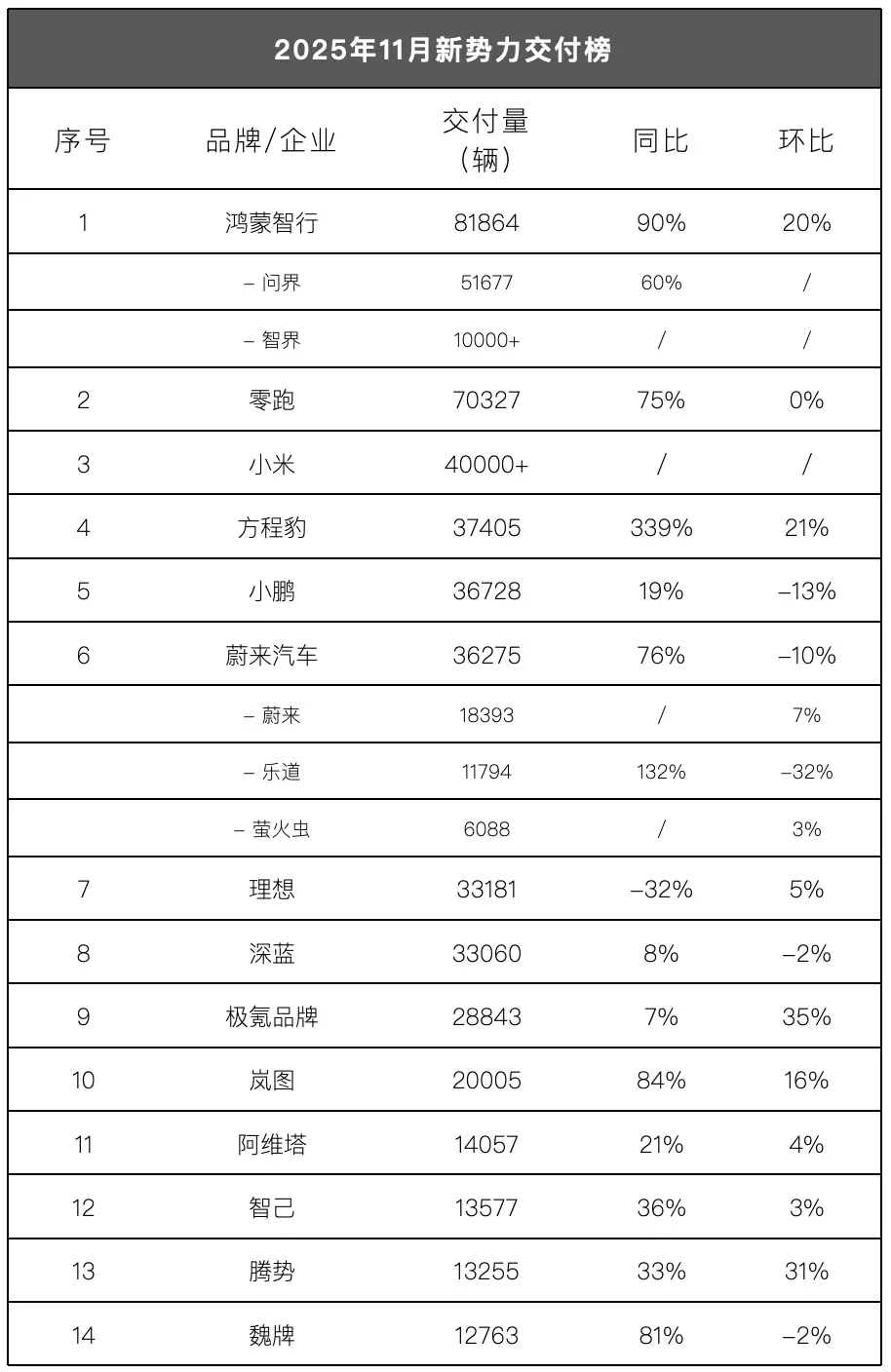
Core Insights - The delivery rankings of new car manufacturers have undergone significant changes in November, with a reshuffling of positions following the "golden September and silver October" period [1] Group 1: Delivery Rankings - Hongmeng Zhixing topped the delivery chart with 81,864 units, achieving a year-on-year growth of 90% and a month-on-month increase of 20% [2][3] - Leap Motor maintained its position as the "single brand champion" with 70,327 units delivered, marking its second consecutive month above 70,000 [4] - Xiaomi entered the top three with over 40,000 units, while BYD's Fangchengbao emerged as a dark horse with 37,405 units [5] Group 2: Competitive Landscape - In the second tier, brands like Xiaopeng (36,728 units) and NIO (36,275 units) are in close competition, with Ideal (33,181 units) and Deep Blue (33,060 units) also in the mix [5][21] - Zeekr accelerated its growth with 28,843 units, while Lantu broke the 20,000 mark for the first time [6] Group 3: Financial Performance and Market Challenges - Despite high delivery numbers, companies like Leap Motor face challenges in profitability, with a net profit of 150 million yuan in Q3, down 8% from the previous quarter [12][13] - Xiaomi's automotive division reported a 700 million yuan operating profit in Q3, making it the fastest to achieve profitability among new forces, yet its stock price has been under pressure due to negative publicity [14][15] - NIO's stock fell 20% in November after lowering its Q4 delivery guidance, indicating challenges in meeting profitability targets [24][30] Group 4: Strategic Adjustments - Xiaopeng is transitioning to a dual strategy of pure electric and range-extended vehicles, with plans to launch three new range-extended models in Q1 next year [19][20] - NIO is focusing on high-end models to improve overall gross margins, while also facing pressure to enhance profitability [22][26] - Ideal is adjusting its organizational structure and technology to address ongoing challenges, with a focus on ramping up production of its new electric model [28][30]



11月新势力榜单:蔚来困于盈利,理想反弹乏力
凤凰网财经· 2025-12-07 12:07
Core Viewpoint - The delivery rankings of new car manufacturers have undergone significant changes in November, with a reshuffling of positions following the "golden September and silver October" period, highlighting the competitive landscape in the electric vehicle market [4][6]. Group 1: Delivery Rankings - Hongmeng Zhixing topped the delivery chart with 81,864 vehicles delivered, a year-on-year increase of 90% and a month-on-month increase of 20%, becoming the "alliance leader" among new forces [5][10]. - Leap Motor maintained its position as the "single brand champion" with 70,327 vehicles delivered, indicating a strong competitive dynamic between the top two players [6][17]. - Xiaomi entered the third position with over 40,000 vehicles delivered, while BYD's Fangchengbao emerged as a dark horse with 37,405 vehicles, intensifying competition in the 30,000 to 40,000 vehicle range [7][19]. Group 2: Market Dynamics - The second tier of manufacturers is characterized by fierce competition, with brands like Xiaopeng and NIO facing challenges in maintaining their delivery volumes amid strategic adjustments and market pressures [24][26]. - NIO delivered 36,275 vehicles in November, a year-on-year increase of 76.3%, but faced stock price declines due to lowered fourth-quarter delivery guidance [28][29]. - Li Auto's deliveries reached 33,181 vehicles, showing signs of recovery, but the company still faces challenges in scaling production and maintaining profitability [32]. Group 3: Financial Performance and Market Sentiment - Xiaomi's automotive division reported a significant operating profit of 700 million yuan in Q3, making it the fastest profitable new force, despite facing negative market sentiment due to various controversies [20][21]. - Leap Motor's stock price fell by 9% in November, raising concerns about its ability to balance scale and profitability, especially in competitive price segments [17][18]. - The overall market sentiment reflects a growing scrutiny on profitability and sustainability, with companies needing to demonstrate not just sales growth but also healthy financial performance to meet investor expectations [36][37].

吴清发表重要讲话;美联储将举行议息会议|周末要闻速递
21世纪经济报道· 2025-12-07 10:56
要闻速递 国常会:研究进一步做好节能降碳工作 国务院总理李强12月5日主持召开国务院常务会议,研究进一步做好节能降碳工作,听取规范 涉企行政执法专项行动情况汇报并审议通过《行政执法监督条例(草案)》,讨论《中华人民 共和国国家消防救援人员法(草案)》,部署全链条打击涉烟违法活动有关举措。 外交部发言人宣布,国务院总理李强将于12月9日上午在北京同新开发银行行长罗塞芙、世界 银行行长彭安杰、国际货币基金组织总裁格奥尔基耶娃、世界贸易组织总干事伊维拉、联合国 贸易和发展会议秘书长格林斯潘、国际劳工组织总干事洪博、经济合作与发展组织秘书长科尔 曼、国际清算银行总经理卡斯滕斯、金融稳定理事会主席诺特和亚洲基础设施投资银行行长金 立群等10家国际经济组织负责人举行"1+10"对话会。 险企投资股票风险因子再度下调,沪深300、科创板等将受益 12月5日,国家金融监管总局发布《关于调整保险公司相关业务风险因子的通知》,在下调险 企业务风险因子的同时明确相关监管要求。一是对长期持仓的沪深300等指数成分股、科创板 股票下调风险因子;二是降低出口信用与海外投资保险的保费和准备金风险因子,同时要求险 企完善内控、强化偿付能力管 ...

电新行业周报:亚马逊自研芯片上新,特高压新项目获批复-20251207
Western Securities· 2025-12-07 10:42
Investment Rating - The report maintains a positive investment rating for the power equipment industry, recommending specific companies for investment opportunities [1][2]. Core Insights - DeepSeek has launched a new generation model, DeepSeek-V3.2, achieving GPT-5 level performance while reducing computational costs by 40% compared to equivalent GPU systems [1][56]. - Amazon has introduced its next-generation self-developed chip, Trainium3, which significantly lowers AI model training and operational costs [1][56]. - The approval of the Panxi UHV project, with a total investment of approximately 231.77 billion yuan, aims to enhance the power supply capacity in Sichuan [1][58]. - The release of the "Digital Evaluation Index for Distribution Networks (2025)" aims to standardize the digital transformation of distribution networks [1][59]. Summary by Sections Power Equipment - Recommended companies include Dongfang Electric, Shunhua Power, and others, with a focus on digitalization and UHV projects [1]. - The report highlights the approval of the Panxi UHV project, which will improve the backbone power grid in Sichuan [1][58]. - The digital evaluation index for distribution networks has been published to guide the digital transformation of the sector [1][59]. Renewable Energy - The report emphasizes the ongoing development in the renewable energy sector, particularly in energy storage and wind power [2]. - Companies such as Sunshine Power and CATL are recommended for their strong positions in the energy storage market [2]. - The report notes the increasing number of policies supporting new energy storage construction [2]. Robotics and Automation - The report mentions the U.S. government's focus on accelerating the development of robotics technology, with recommended companies in the humanoid robot sector [3]. - Companies like UBTECH and Wuzhou Xinchun are highlighted for their potential in the robotics field [3]. Photovoltaics - The extension of the U.S. solar import tariff exemption until November 2026 is noted, with recommended companies in the photovoltaic sector [3]. - Companies such as GCL-Poly and Tongwei are highlighted for their strong market positions in solar energy [3].
吴清发表重要讲话;美联储将举行议息会议|周末要闻速递
2 1 Shi Ji Jing Ji Bao Dao· 2025-12-07 09:13
(原标题:吴清发表重要讲话;美联储将举行议息会议|周末要闻速递) 要闻速递 国常会:研究进一步做好节能降碳工作 国务院总理李强12月5日主持召开国务院常务会议,研究进一步做好节能降碳工作,听取规范涉企行政 执法专项行动情况汇报并审议通过《行政执法监督条例(草案)》,讨论《中华人民共和国国家消防救 援人员法(草案)》,部署全链条打击涉烟违法活动有关举措。 李强将与全球主要国际经济组织负责人举行"1+10"对话会 外交部发言人宣布,国务院总理李强将于12月9日上午在北京同新开发银行行长罗塞芙、世界银行行长 彭安杰、国际货币基金组织总裁格奥尔基耶娃、世界贸易组织总干事伊维拉、联合国贸易和发展会议秘 书长格林斯潘、国际劳工组织总干事洪博、经济合作与发展组织秘书长科尔曼、国际清算银行总经理卡 斯滕斯、金融稳定理事会主席诺特和亚洲基础设施投资银行行长金立群等10家国际经济组织负责人举 行"1+10"对话会。 险企投资股票风险因子再度下调 沪深300、科创板等将受益 12月5日,国家金融监管总局发布《关于调整保险公司相关业务风险因子的通知》,在下调险企业务风 险因子的同时明确相关监管要求。一是对长期持仓的沪深300等指数成 ...
汽车周观点:曹操出行Robotaxi战略升级,继续看好汽车板块-20251207
Soochow Securities· 2025-12-07 09:10
Investment Rating - The report maintains a positive outlook on the automotive sector, particularly highlighting the potential of the Robotaxi strategy by Cao Cao Mobility [1][2]. Core Insights - The automotive industry is entering a new phase where electric vehicle benefits are tapering off, while the focus shifts towards vehicle intelligence and robotics innovation [3]. - The report emphasizes the importance of AI smart vehicle investment opportunities, particularly in Robotaxi and Robovan segments [3]. - Key developments include Cao Cao Mobility's strategic upgrade for Robotaxi, aiming for a "ten years, hundred cities, trillion" goal, and the introduction of a green intelligent traffic hub [2][3]. Summary by Sections Market Performance - This week, the automotive sector outperformed the market, with commercial passenger vehicles showing the best performance at 4.5% increase [2][15]. - The report notes that the automotive sector ranked 10th in A-shares and 14th in Hong Kong stocks this week [7][9]. Investment Opportunities - The report identifies three main investment themes: AI smart vehicles, robotics, and traditional vehicle segments [3]. - Key companies to watch include Tesla, Xiaopeng Motors, and Cao Cao Mobility for their roles in the Robotaxi and Robovan markets [3]. Sales Forecasts - Domestic retail sales of passenger vehicles are projected to reach 23.62 million units in 2025, reflecting a year-on-year growth of 3.8% [49]. - The report anticipates a significant increase in the penetration rate of new energy vehicles, expected to reach 55.4% by 2025 [50]. Company Developments - Notable company movements include Top Group's push for H-share listing and Desay SV's establishment of a new technology company for Robovan business [2][3]. - The report highlights the performance of covered stocks, with China National Heavy Duty Truck and New Spring Co. showing significant gains this week [23].
特朗普松绑油耗标准:全球车企抢跑“油电同强时代”
智通财经网· 2025-12-06 09:08
Core Viewpoint - The proposal by former President Trump to terminate strict fuel economy standards set by the Biden administration poses a significant challenge to Europe's aggressive policies on banning fuel vehicles, highlighting a shift in the automotive industry's dynamics towards a more sustainable and diversified future led by China's oil-electric hybrid strategy [1][9]. Group 1: Policy Changes and Impacts - Trump's proposal aims to reduce the average cost of purchasing new cars by $1,000, potentially saving Americans $109 billion over five years [3]. - The new fuel efficiency standard proposed by Trump's administration requires vehicles to achieve approximately 34 miles per gallon by 2031, compared to Biden's target of 50 miles per gallon [2]. Group 2: Industry Dynamics - The automotive industry's core profits are derived from fuel vehicles, and the transition to electric vehicles represents a significant restructuring of interests, with traditional automakers facing survival pressures due to lost profits from engine manufacturing and after-sales services [4]. - The shift in stance among U.S. automakers from supporting electric vehicle initiatives to opposing stringent regulations reflects the industry's struggle with profit erosion amid changing policies [4]. Group 3: European Market Challenges - European automakers are under severe pressure from the EU's legislation to ban fuel vehicles by 2035, which is seen as overly ambitious and detrimental to businesses [5]. - The EU's "Fit for 55" plan aims for a 55% reduction in new car carbon emissions by 2030, with a complete transition to zero emissions by 2035, but this has led to some companies planning to abandon engine development altogether [5]. Group 4: Global Automotive Trends - The trend of oil-electric hybrid strategies is gaining traction globally, with Asian automakers, particularly Chinese brands like BYD, Geely, and Chery, significantly increasing their market share [7][8]. - The global automotive market remains predominantly fuel-based, with 73% of vehicles still using fuel, indicating that a rapid transition to electric vehicles is unlikely in the short term [8]. Group 5: China's Strategic Position - China's oil-electric hybrid strategy is viewed as a successful model, with the recent release of the 3.0 roadmap emphasizing the continued importance of internal combustion engines alongside electric vehicles [10]. - By 2040, it is projected that 85% of new passenger vehicles in China will be electric, with a significant market still remaining for non-pure electric models, positioning Chinese automakers as key players in the global automotive technology landscape [10].