三星电子

Search documents
存储“超级周期”下终端消费电子领域提价:笔本、国产手机等集体调价
Xin Lang Cai Jing· 2026-01-10 08:11
Core Viewpoint - The storage chip price surge continues into 2026, affecting downstream sectors such as consumer electronics, AI hardware, and AIoT terminals, leading to price increases and downward adjustments in shipment volumes [1][3]. Price Increases in Storage Chips - In Q1 2026, general DRAM contract prices are expected to rise by 55% to 60%, while NAND flash prices will increase by 33% to 38%, with consumer-grade QLC products seeing a rise of at least 40% [3]. - Samsung and SK Hynix plan to raise server DRAM prices by 60% to 70% in Q1 2026 compared to Q4 2025 [3]. - The current cycle is driven by demand mismatch, capital expenditure, and technology migration, likely lasting until late 2026 or even 2027 [3]. Impact on Consumer Electronics - Major PC manufacturers like Lenovo, Dell, and HP are planning price increases of up to 20% due to rising storage costs, which have increased by 3 to 4 times [4]. - The average price of laptops over 5000 yuan has increased by 500 to 1500 yuan since the end of 2025 [4]. - TrendForce has revised down global smartphone shipment forecasts for 2026 from a 0.1% increase to a 2% decrease, and laptop shipments are expected to decline by 5.4%, potentially reaching a 10.1% decrease [6]. Smartphone Price Trends - The smartphone industry is experiencing a price increase due to rising storage costs, with IDC predicting the average smartphone price will reach $465 in 2026, generating $578.9 billion in revenue [7]. - Storage costs in smartphones have risen from 10%-15% to over 20%, with mid-range phones seeing storage costs close to 30% [7]. - Recent models from brands like Redmi and iQOO have seen price increases of 100 to 600 yuan [7]. AIoT Chip Manufacturers - AIoT chip manufacturers are experiencing varied impacts from storage price increases, with some transitioning from DDR4 to DDR5 due to price hikes [10]. - Companies like Rockchip report that while storage shortages and price increases affect demand, the growth in AIoT products mitigates these impacts [10]. - Other AIoT firms, such as Espressif, indicate that their use of NOR Flash means that price increases will not significantly affect demand [11]. Opportunities for Storage Industry Chain - Companies in the storage industry chain are benefiting from rising prices, with increased demand for chip testing services leading to higher utilization rates [12]. - The semiconductor testing equipment market is experiencing growth, with companies like Changchuan Technology reporting strong order volumes [12]. - The storage industry is expected to remain in a high-growth phase driven by price increases, technological advancements, and domestic replacements over the next 2-3 years [12].




一周股评|沪指狂飙突破4100点:科技浪潮席卷,万亿成交点燃市场热情
Sou Hu Cai Jing· 2026-01-10 07:43
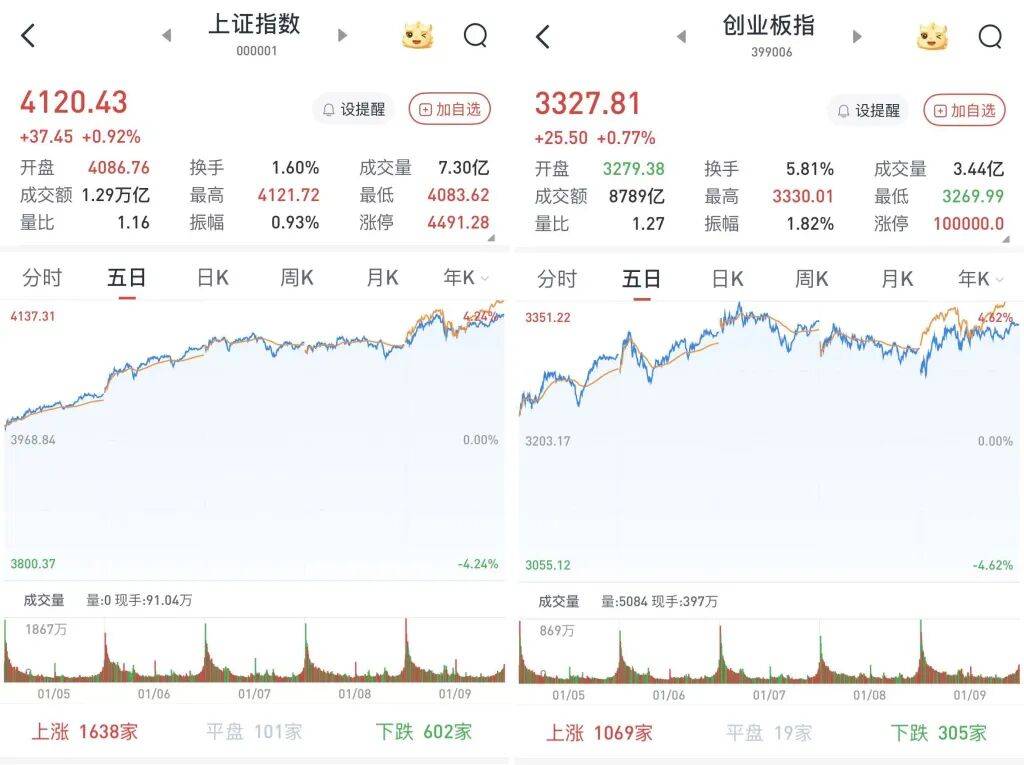
Market Overview - The A-share market experienced a strong start in 2026, with the Shanghai Composite Index breaking the 4100-point barrier and achieving a trading volume exceeding 3 trillion yuan, marking a historical high [1] - The Shanghai Composite Index rose by 0.92%, the Shenzhen Component Index by 1.15%, and the ChiNext Index by 0.77%, with a cumulative increase of 3.82% for the week [1] AI Sector - The AI application sector saw significant gains, with over twenty constituent stocks hitting the daily limit, driven by strong market expectations for the practical application of AI technology [3] - Analysts predict 2026 will be a "golden year" for AI applications, supported by three key factors: technological maturity, ongoing policy support, and resonating market demand [3] Commercial Aerospace - The commercial aerospace sector is attracting substantial investment, with companies like Luxin Venture Capital and China Satellite Communications showing remarkable stock performance [5] - The sector's growth is bolstered by supportive policies and optimistic market expectations regarding the future of commercial aerospace [5] Semiconductor Market - The global memory chip market is experiencing a "price hurricane," with major players like Samsung and SK Hynix planning to raise server DRAM prices by 60%-70% in Q1 2026, impacting cloud computing and AI servers [5][7] - The DRAM market has entered a significant price increase cycle, with prices for many categories rising over 100% since July 2025 [10] - Analysts predict a 144% year-on-year increase in average selling prices for server DRAM in 2026, driven by a structural supply-demand crisis [10][12] Automotive Industry - The penetration rate of new energy vehicles has surpassed 50%, leading to a surge in IPOs within the automotive supply chain, with over 97 companies listed in 2025 [14] - The capital market is witnessing a vibrant atmosphere, with significant participation from various segments of the automotive industry, reflecting the dual drive of electrification and intelligence [16] Economic Outlook - The macroeconomic environment shows signs of stabilization, with CPI rising by 0.8% year-on-year and PPI's decline narrowing, indicating a positive economic trend [16] - Goldman Sachs recommends overweighting Chinese stocks, forecasting a 15%-20% increase in 2026 and 2027, driven by AI, overseas expansion, and supportive policies [18]
AI“抢芯”,手机、电脑、新能源车都要变贵?
3 6 Ke· 2026-01-10 06:19
Core Insights - The demand for AI servers is driving a significant cost change in the supply chain, affecting various manufacturing sectors beyond electronics [1] - The price increases in storage chips and precious metals are indicative of a broader inflationary trend in manufacturing costs [1] Group 1: Cost Transmission from Upstream - Samsung Electronics and SK Hynix plan to raise server DRAM prices by 60%-70% in Q1 2026 compared to Q4 2025, significantly higher than previous cycles [2] - AI servers are identified as the starting point for this cost transmission, with their increased GPU, memory, and bandwidth requirements creating a supply-demand gap [2] - Leading AI chip manufacturers like NVIDIA maintain high product prices, with high-end AI GPUs reaching tens of thousands of dollars, impacting the cost structure for server and cloud computing companies [2] Group 2: Pressure on End Consumer Products - Storage chips are the first to transmit cost increases to consumer products, with flagship smartphones seeing price hikes of 300-500 yuan and mid-range models by 200-300 yuan [3] - Memory costs account for approximately 15%-20% of the BOM cost in mid-range smartphones and 10%-15% in high-end models, indicating a significant impact from rising storage prices [3] - The automotive industry is also expected to face storage chip shortages, potentially leading to price increases in electric vehicles, as these chips are crucial for advanced features [3] Group 3: Market Dynamics and Predictions - The global memory market is experiencing an unprecedented structural shortage, with major manufacturers reallocating capacity to high-value products, limiting supply for traditional DRAM and NAND [4] - Citigroup predicts an 88% increase in average DRAM prices by 2026, while Nomura forecasts a 46% increase in DRAM and a 65% increase in NAND prices [4] - Price fluctuations in storage chips are influenced by market dynamics, with potential for short-term price corrections as new products are released [5] Group 4: Impact on Manufacturing and Cost Management - The rising costs are affecting various manufacturing sectors, with IDC predicting a contraction in the global smartphone market and price increases of 3%-8% depending on market conditions [5] - Major PC manufacturers are also expected to raise prices by 15%-20% due to increased component costs [5] - Industries with strong technological barriers and brand premium capabilities are better positioned to absorb these cost increases, while those in highly competitive, low-tech sectors may struggle [6]
SanDisk(SNDK.US)企业级闪存芯片报价或翻倍 股价单日飙涨13%引爆存储板块
Zhi Tong Cai Jing· 2026-01-10 05:49
据野村证券,SanDisk(SNDK.US)预计未来几季度服务器级存储需求强劲,可能在本季度将用于企业级 固态硬盘的高容量3D NAND存储芯片价格提高一倍。SanDisk股价周五大涨13%,其他存储产品制造商 股价亦全线飙升。美光科技(MU.US)上涨5.5%,希捷科技(STX.US)暴涨近7%,西部数据(WDC.US)攀升 约7%。 报告称,野村证券认为,存储供应商计划上调企业级3D NAND价格,既出于短期供应短缺考虑,也基 于中期需求增长预期——这一趋势整体由人工智能推动,特别是AI存储架构的变革。报告提到,英伟 达(NVDA.US)基于BlueField-4DPU、搭载512GB SSD并配备KV缓存的推理上下文存储平台(ICMSP)被列 为今年企业存储需求的主要驱动力之一。 本周早些时候曾有报道称,三星电子(SSNLF)和SK海力士计划在第一季度将服务器内存价格最高上调至 70%,AI需求的激增正冲击全球供应链格局。 分析指出:"渠道调查显示,多家存储供应商持续推动价格上涨,其中企业级NAND涨幅尤为激进。据 称,用于企业级SSD的SanDisk NAND芯片在三月当季价格环比涨幅可能超过100% ...
存储“超级周期”:笔记本、国产手机集体涨价
财联社· 2026-01-10 05:33
Core Viewpoint - The storage chip price surge is impacting various sectors, leading to increased prices for consumer electronics, AI hardware, and AIoT devices, with significant price hikes expected in 2026 [1][2][4]. Group 1: Storage Price Increases - In Q1 2026, general DRAM contract prices are expected to rise by 55% to 60%, while NAND flash prices will increase by 33% to 38%, with consumer-grade QLC products seeing a rise of at least 40% [1]. - Samsung and SK Hynix plan to raise server DRAM prices by 60% to 70% in Q1 2026 compared to Q4 2025 [1]. - The current cycle of storage price increases is driven by demand mismatch, capital expenditure, and technology migration, likely continuing until late 2026 or even 2027 [1]. Group 2: Impact on Consumer Electronics - Major PC manufacturers like Lenovo, Dell, and HP are planning price increases of up to 20% due to rising storage costs, with HP's CEO warning of particularly challenging conditions in the second half of 2026 [2]. - The average price of laptops has increased by 500 to 1500 yuan compared to late 2025, with some models seeing price hikes of 5% to 10% since late 2025 [2]. - TrendForce has revised down global smartphone production forecasts for 2026 from a 0.1% increase to a 2% decrease, and global laptop shipments are expected to decline by 5.4%, potentially reaching a 10.1% decrease [4]. Group 3: Smartphone Price Adjustments - The smartphone industry is experiencing a price increase trend due to rising storage costs, with IDC predicting the average smartphone price will rise to $465 in 2026, leading to a market revenue of $578.9 billion [5]. - Storage costs in smartphones have risen from 10%-15% to over 20%, with mid-range phones seeing storage costs approaching 30% [5]. - Domestic brands like Redmi and iQOO have raised prices for new models by 100-600 yuan, with some mid-range models increasing by 20% [6]. Group 4: AIoT and Chip Manufacturers - AIoT chip manufacturers are experiencing varied impacts from storage price increases, with some transitioning from DDR4 to DDR5 due to price surges [9]. - Companies like Rockchip report that while storage shortages and price hikes affect demand, the growth momentum in AIoT will mitigate negative impacts [9]. - Other AIoT companies, such as Espressif, indicate that their use of Nor Flash means that price increases will not significantly affect demand [10]. Group 5: Opportunities in the Storage Industry - Companies in the storage supply chain are benefiting from rising prices, with chip testing firms like Liyan Chip reporting increased demand and capacity utilization [12]. - The storage industry is expected to enter a high-growth phase driven by price increases, technological iterations, and domestic replacements, particularly in DRAM and NAND sectors [13].

美国强掳马杜罗 盯上格陵兰 意欲何为?2026年CES盘点:AI迈入“物理世界”;内存涨价潮引爆市场,闪迪大涨37% | 一周国际财经
Mei Ri Jing Ji Xin Wen· 2026-01-10 05:24
Group 1 - The Trump administration is aggressively targeting Venezuela and Greenland for their vast natural resources, with plans to invest $100 billion to control Venezuela's oil and to exploit Greenland's rare earth minerals [1][3][6] - Approximately 20% of global oil trade is now conducted without using the US dollar, and the dollar's share in global foreign exchange reserves has dropped to a historic low of 56.92% [1][21][25] - The weakening of the "petrodollar" system, which has historically supported the dollar's dominance, is a significant concern for the US, especially with over $38 trillion in national debt [3][25][19] Group 2 - Venezuela holds the world's largest proven oil reserves at 303 billion barrels, which is about 17% of the global total, primarily located in the Orinoco Belt, making it highly compatible with US refining needs [7][11][6] - The US plans to control the sale of Venezuelan oil, with immediate plans to refine and sell up to 50 million barrels, allowing any country to purchase as much as they want [6][19] - Greenland is home to 1.5 million tons of rare earth minerals and 34 critical minerals, with significant untapped oil and gas reserves, making it strategically valuable for the US [13][15][16] Group 3 - The US Secretary of State has prioritized the competition for energy and resource dominance as a key diplomatic objective [5] - The US aims to regain control over energy pricing and resources to counteract the trend of "de-dollarization" and to stabilize its financial system [25][19] - The potential for resource extraction in both Venezuela and Greenland faces challenges, including environmental concerns and local opposition, which could delay returns on investment [25][32]
PC市场,迎来最艰难一年?
虎嗅APP· 2026-01-10 03:35
Core Viewpoint - The semiconductor industry is facing unprecedented price increases across all hardware components, driven primarily by the surge in AI demand, leading to a supply chain crisis that affects consumer electronics significantly [4][10][12]. Price Increases and Market Dynamics - The average price of PCs is expected to rise by 4% to 8%, with major manufacturers warning of potential price hikes between 15% and 20% due to ongoing memory shortages expected to last until 2027 [4][10]. - The price of storage chips, particularly DRAM and NAND Flash, has skyrocketed, with contract prices increasing by 80% to 100% by December 2025, largely due to AI data centers' demand for high-bandwidth memory (HBM) [6][12]. - Graphics cards are also seeing price increases, with AMD and NVIDIA planning to raise prices starting in January and February 2026, respectively, due to rising costs of GDDR memory [7][12]. Impact on Hardware Components - The motherboard market is experiencing a significant decline in sales, with offline channel sales dropping over 50% due to high installation costs, leading to a "one-time price increase" strategy for new laptops [8][12]. - The overall PC market is at a crossroads, with a mix of urgent upgrade needs due to the end of Windows 10 support and rising semiconductor costs creating a "perfect storm" for the industry [10][11]. AI's Influence on Semiconductor Allocation - AI's unprecedented demand is reshaping the semiconductor industry's resource allocation, with a shift from consumer electronics to high-value AI chips, resulting in reduced supply for standard consumer-grade components [12][13]. - The global HBM market is projected to grow by 300% by 2025, as major manufacturers redirect DRAM capacity to meet the needs of AI chip producers like NVIDIA and Google [13][14]. Industry Responses and Strategies - Companies like Lenovo are increasing memory inventory to navigate shortages, while larger PC brands leverage their supply chain power to mitigate impacts [18]. - Upstream storage giants are adopting varied strategies, with Samsung shifting some HBM capacity to general DRAM production, while Micron focuses on the data center market [18][19]. - Some manufacturers are implementing flexible product strategies, such as offering "quasi-systems" without memory modules to transfer cost risks to consumers [20]. Future Outlook - The PC industry is entering a prolonged adjustment period, with 2026 expected to be particularly challenging as the market adapts to high costs and low growth [20]. - The current trend of "reduced volume, increased prices" is likely to persist until the AI demand's impact on advanced capacity diminishes, making it a new normal for the industry [20].



半导体市场2026年将继续上演内存争夺战
3 6 Ke· 2026-01-10 02:51
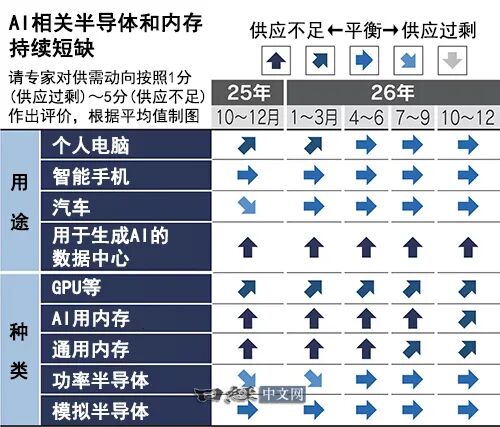
Core Viewpoint - The semiconductor market is expected to face a significant supply shortage for AI-related semiconductors in 2026, impacting general memory products used in smartphones and personal computers due to prioritization of higher-margin AI products by major companies [1][4]. Group 1: Semiconductor Supply and Demand - Experts predict a supply shortage for AI semiconductors, particularly for GPUs and high-bandwidth memory (HBM), with production lines running at full capacity [2][4]. - The price of DRAM for temporary storage is expected to rise by 50-55% quarter-on-quarter, while NAND prices are projected to increase by 33-38% [1]. - The overall semiconductor market is forecasted to grow by 26% year-on-year in 2026, reaching approximately $975.4 billion [5]. Group 2: Impact on General Memory Products - General memory products for smartphones and personal computers are also experiencing shortages due to the focus on AI products, which may lead to a decrease in overall shipment volumes for these devices [4]. - The rising prices of memory components could negatively affect the sales of low-cost smartphones, as they may not be able to absorb the increased costs [4]. Group 3: Market Dynamics and Risks - There are concerns regarding over-investment in AI data centers, particularly by companies like Oracle, which could disrupt semiconductor supply-demand dynamics if AI demand fluctuates [5]. - The automotive semiconductor sector is expected to see moderate recovery, although opinions on the strength of this recovery vary [4].

半导体市场2026年将继续上演内存争夺战
日经中文网· 2026-01-10 00:34
Core Viewpoint - The semiconductor market is expected to face a supply shortage, particularly for AI-related semiconductors, while general memory products for smartphones and personal computers are also experiencing shortages due to prioritization of higher-margin AI products [2][5][7]. Group 1: Semiconductor Supply and Demand - Experts predict a supply shortage for AI semiconductors, especially for GPUs, with production lines operating at full capacity [5]. - The demand for high-bandwidth memory (HBM) used in GPU computations is outpacing supply, prompting companies like Micron Technology to expand production [5]. - General memory products for smartphones and PCs are also in short supply, as major companies focus on producing more profitable AI-related products [7]. Group 2: Market Trends and Price Movements - Samsung Electronics reported a record operating profit of 20 trillion KRW for Q4 2025, driven by a 50-55% increase in DRAM prices and a 33-38% increase in NAND prices [4]. - The semiconductor market is projected to grow by 26% in 2026, reaching approximately $975.4 billion, nearing the $1 trillion mark [8]. - Concerns have been raised about potential over-investment in AI data centers by companies like Oracle, which could disrupt semiconductor supply-demand dynamics if AI demand fluctuates [8]. Group 3: Future Outlook - The DRAM prices are expected to continue rising in the first half of 2026, influenced by high demand from data centers [7]. - There are mixed opinions on the recovery of automotive semiconductors, with some experts warning of potential supply shortages and price increases starting in early 2026 [7]. - The overall shipment volumes of smartphones and personal computers may decline due to rising memory costs, particularly affecting lower-priced models [7].

2026年关注哪些亚洲股?
日经中文网· 2026-01-10 00:34
Group 1 - The development of AI is expected to make significant progress by 2026, with active manufacturing in related semiconductors and servers [2] - Popular stocks mentioned include Alibaba Group, Samsung Electronics, and TSMC, indicating strong market interest in these companies [2] - Demand for products that reduce power consumption in data centers is expanding, broadening the range of related stocks [2] Group 2 - Alibaba is considered a potential stock due to its strong performance in cloud business and its strategy to expand the use of generative AI through open-source models [4] - The emergence of new companies like DeepSeek is expected to drive growth in the tech sector, with this trend anticipated to continue into 2026 [4] Group 3 - Analysts predict that global spending on AI services and related technologies will increase by 37% in 2026, reaching $2 trillion [5] - The production of semiconductors is expected to become more active, with demand for high-bandwidth memory (HBM) and DRAM remaining strong [6] - TSMC and Hon Hai Precision Industry are expected to benefit from providing advanced semiconductors to companies like NVIDIA [6] Group 4 - There are concerns about semiconductor companies' equipment investments not keeping pace, with geopolitical risks potentially affecting supply chains [7] - Samsung and SK Hynix are enhancing their production capacity, but new factories may not be operational by 2026 [7]