
长安汽车

Search documents
重庆推动“AI+”行动落实
Zhong Guo Hua Gong Bao· 2025-12-24 02:44
Core Insights - Chongqing has officially issued the "Artificial Intelligence + Action Plan" to enhance the integration of AI with the digital economy and establish itself as a national AI application hub [1] - The plan sets clear development goals, aiming for over 70% penetration of new intelligent terminals and agents by 2026, and over 80% by 2027 across six key areas: technology, industry, governance, livelihood, consumption, and openness [1] - The initiative emphasizes the intelligent upgrade of the "33618" modern manufacturing cluster system and the development of AI-driven industrial brains and future factories [1] Industry Developments - The Chongqing National Application Mathematics Center has reported effective pilot projects in the "AI+" sector, including the promotion of "industrial brains + future factories" in various industries such as automotive and chemical materials [2] - From January to July this year, the core AI industry in Chongqing generated revenue of 10.84 billion yuan, reflecting a year-on-year growth of 13.2% [2]
国资委最新部署!加强上市公司质量和市值管理、大力推进重组并购
Zheng Quan Shi Bao· 2025-12-24 02:31
Core Viewpoint - The central enterprises' meeting held on December 22-23 outlines key tasks for 2026, emphasizing steady progress, quality improvement, and effective management of reforms and development to ensure a strong start for the 15th Five-Year Plan [1] Group 1: Key Tasks for 2026 - The meeting identified five key tasks for central enterprises in 2026, including enhancing the quality and market value management of listed companies, promoting strategic and specialized restructuring and high-quality mergers and acquisitions, and improving the contractual management level of managerial staff [1][4][5] Group 2: Performance Indicators - From January to November, central enterprises achieved a value-added output of 9.5 trillion yuan, a year-on-year increase of 1.4%. Fixed asset investment (excluding real estate) reached 3.3 trillion yuan, growing by 0.7% [2] - Research and development investment totaled 890.16 billion yuan, with an intensity of 2.62%, indicating steady improvement in innovation capabilities [2] Group 3: Innovation and Industry Upgrading - Central enterprises have made significant progress in technology innovation and modern industrial system construction, with over 100 innovation entities participating in collaborative projects and more than 1,000 high-quality projects underway [2] - The "Artificial Intelligence+" initiative has created nearly 1,000 application scenarios across 16 key industries, enhancing the capabilities of over 200 external units [2] Group 4: Reform and Management Improvements - The meeting emphasized the need for further deepening of reforms, including the improvement of the modern enterprise system with Chinese characteristics and enhancing the management and operational systems of enterprises [6][7] - The focus will be on refining the market-oriented research organization management system and fostering a talent-friendly corporate ecosystem [7]
首批L3级车型获批上路,产业链升级在即 | 投研报告
Zhong Guo Neng Yuan Wang· 2025-12-24 02:04
Core Insights - The transition from L2 to L3 represents a critical leap from driver assistance to autonomous driving, with responsibility potentially shared among drivers, manufacturers, and autonomous system suppliers [2] Investment Summary - The first L3-level vehicles have been approved for road use, marking a significant milestone in China's autonomous driving industry, transitioning from laboratory testing to legitimate road applications [3] - The approval establishes a clear safety baseline by allowing conditional and limited scenarios for testing, promoting innovation while ensuring safety [3] - The high reliability and safety redundancy requirements of L3 systems will drive technological upgrades across the entire supply chain, including perception hardware, computing platforms, and software algorithms [3] Future Outlook - Pilot programs are expected to expand from current highway and congested scenarios to more complex urban roads, with legal and technical standards evolving based on pilot experiences to support broader adoption [3] - The high costs associated with vehicles equipped with advanced autonomous driving features need to decrease through technological advancements and economies of scale for widespread consumer adoption [3][4] Investment Strategy and Focus - The automotive sector should focus on undervalued leading manufacturers and component suppliers benefiting from performance improvements, particularly in the fields of new energy and intelligent vehicles [5] - Recommended companies include early movers in the new energy sector such as BYD, Changan Automobile, Geely, and Li Auto; stable low-valuation component leaders like Huayu Automotive and Fuyao Glass; and key players in electrification and intelligence like Desay SV, Ruikeda, and Kobot [5] - The strategy also highlights opportunities arising from domestic substitution due to the "domestic circulation" initiative, with companies like Lingdian Electric Control and Sanhua Intelligent Control being of interest [5] Key Focus Companies - The investment focus for the week includes BYD, Li Auto, Top Group, Desay SV, and Shangsheng Electronics [6]




合法“脱手”时代开启,L3自动驾驶号牌发放,下个月开放打车体验
3 6 Ke· 2025-12-24 02:02
Core Viewpoint - The issuance of the first L3-level autonomous driving vehicle special license plates in Beijing marks a significant step towards the commercialization of autonomous vehicles in China, transitioning from testing to mass production [1][4][25]. Group 1: License Issuance and Vehicle Details - The first three L3-level autonomous driving vehicles, manufactured by BAIC's Arcfox, received special license plates from the Beijing Traffic Management Bureau, indicating the official entry into the L3 autonomous driving era [1][4]. - The vehicles are equipped with advanced technology, including three LiDARs and multiple cameras for 360-degree perception, and are capable of operating under specific conditions on designated roads [15][18]. - The vehicles are currently limited to use by Beijing Outing Automobile Service Co., and are not available for individual consumer purchase at this stage [6][15]. Group 2: Operational Conditions and Regulations - The L3 autonomous driving function is permitted only on specific roads in Beijing, such as the Jing-Tai Expressway and the Airport North Line Expressway, with a maximum speed limit of 80 km/h [8][9]. - Drivers must remain in the driver's seat and be ready to take control of the vehicle in emergencies, reflecting a cautious regulatory approach to the deployment of autonomous driving technology [8][9]. Group 3: Future Prospects and Comparisons - The L3-level vehicles are part of a broader pilot program that includes other manufacturers, such as Changan Automobile, which has also received approval for its L3 vehicles in Chongqing [19][20]. - The pilot programs in Beijing and Chongqing differ in focus, with Beijing emphasizing high-standard traffic scenarios and Chongqing testing in more complex urban environments [20]. - The approval of L3 vehicles is seen as a foundational step towards the commercial application of autonomous driving technology in China, with further developments expected in 2024 [22][25].


国资委明确2026年央企改革路线图:加强上市公司质量和市值管理 大力推进重组整合和高质量并购
Zhong Guo Jing Ji Wang· 2025-12-24 01:32
Core Insights - The central enterprises in China are undergoing significant reforms and development strategies as highlighted by the State-owned Assets Supervision and Administration Commission (SASAC) [1] Group 1: Economic Performance - In the first eleven months of the year, central enterprises achieved a value-added of 9.5 trillion yuan, representing a year-on-year growth of 1.4% [2] - The annualized labor productivity reached 811,000 yuan per person, with a year-on-year increase of 3% [2] - Fixed asset investment (excluding real estate) by central enterprises amounted to 3.3 trillion yuan, showing a year-on-year growth of 0.7% [2] Group 2: Strategic Initiatives - Central enterprises are encouraged to explore various big data and industry models to capture potential market demands and innovate product and service quality [2] - The focus will be on internal potential mining, comprehensive budget management, and cost control across all aspects of operations [2] - The restructuring and optimization of layouts are essential for fostering new growth drivers, with significant mergers and acquisitions planned [3][4] Group 3: Technological Innovation - Emphasis on integrating technological and industrial innovation to enhance new productive forces [5] - Plans to establish national key laboratories and undertake major national science and technology projects to drive organized innovation [6] - In the first eleven months, central enterprises invested 890.16 billion yuan in R&D, with an R&D intensity of 2.62% [6]
L3专用牌照上车,重庆发出国内首张,北京连发三张,消费者下个月就能体验
3 6 Ke· 2025-12-24 00:40
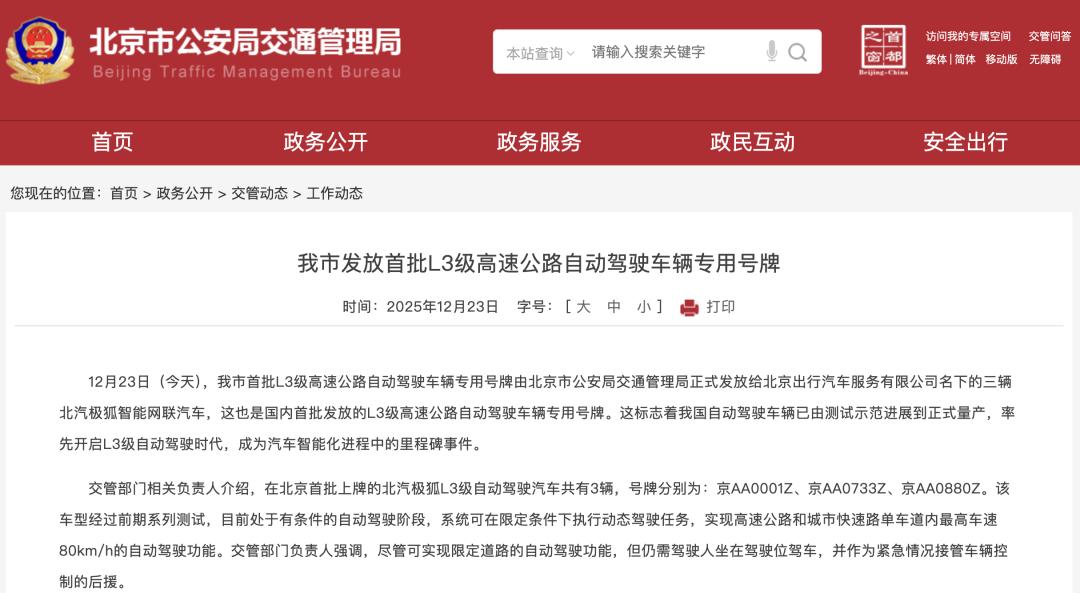
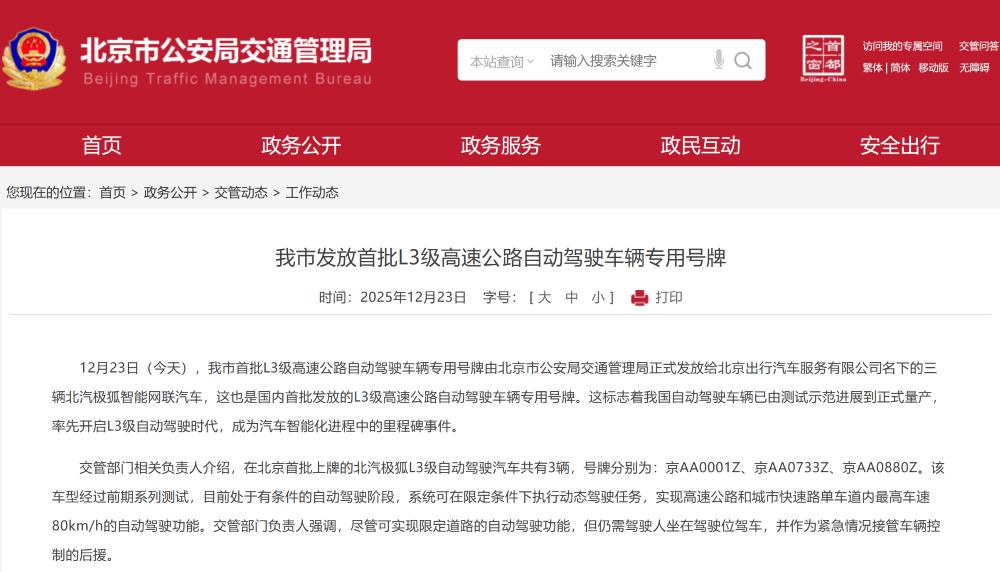
L3级自动驾驶车型已经可以上牌了。 车东西12月23日消息,就在今天,北京市首批L3级高速公路自动驾驶车辆专用号牌由北京市公安局交通管理局正式发放给北京出行汽车服务有限公司名 下的三辆北汽极狐智能网联汽车。 ▲北京市公安局交通管理局公告 在北京首批上牌的北汽极狐L3级自动驾驶汽车共有3辆,号牌分别为:京AA0001Z、京AA0733Z、京AA0880Z。 就在几天前,深蓝汽车董事长邓承浩在社交媒体上发文表示,深蓝汽车获得了自动驾驶专用号牌"渝AD0001Z",邓承浩还提到牌照最后的"Z"代表自动驾 驶,并称这是"第一块"。 ▲深蓝汽车董事长邓承浩在社交媒体上发文 12月15日,国家工业和信息化部正式许可两款L3级自动驾驶车型产品,首次以国家层面政策明确支持L3级自动驾驶车型的生产准入,一纸公告宣布中国 正式进入L3元年。 而随后各大车企纷纷响应,据车东西不完全统计,包括12月15日后的三天内就有6家车企官方宣布或有媒体报道正在进行L3级自动驾驶测试。 | 序号 | 车企 | 车型 | 类型 | 地点 宣布日期 | 来源 | | --- | --- | --- | --- | --- | --- | | 1 | ...
起势强劲,南京迈入“高质量跃升”新周期
Xin Hua Ri Bao· 2025-12-24 00:12
编者按 "十四五"圆满收官,"十五五"新程再启。不久前召开的省委十四届十次全会,深入学习贯彻党的二十届 四中全会精神和习近平总书记对江苏工作重要讲话精神,对未来五年江苏经济社会发展作出系统谋划和 战略部署。坚定在推进中国式现代化中走在前、做示范,奋力谱写"强富美高"新江苏现代化建设新篇 章,8500万江苏儿女正以饱满的热情、实干的姿态,踏上新的征程。新华日报·交汇点新闻今起推出"奋 进'十五五' 同心创伟业"全媒体行动,对话13个设区市主要负责同志,见证并记录各地勇挑大梁、勇开 新局的担当与奋斗。 □ 本报记者 徐晋 季铖 颜芳 冬日暖阳照进南京江北新区生物医药公共服务平台的实验室,科研人员正埋头研发。在这里,千万元级 的精密设备向园区内上百家中小团队敞开共享。工程师轻触屏幕,蛋白质序列数据渐次浮现,仿佛在探 寻生命密码。不远处,驯鹿生物的洁净车间里,全人源CAR-T细胞正在培养箱中悄然生长。窗外楼宇连 绵,1300余家生物医药企业在此扎根、抽枝、结果。 南京,承载着深厚的历史底蕴,更涌动着面向未来的创新活力。站在"十四五"收官与"十五五"启航的交 汇点,如何在传承与创新中书写高质量发展新答卷?本报记者专访南 ...
【金工】基本面驱动或为当前主要交易方向——金融工程市场跟踪周报20251222(祁嫣然/张威)
光大证券研究· 2025-12-23 23:04
Market Overview - The A-share market experienced a rebound after an initial decline during the week of December 15-19, 2025, with major broad-based indices showing a decrease in trading volume compared to the previous week [4] - The net inflow of funds into stock ETFs was 55.353 billion yuan, with large-cap thematic ETFs being the primary focus for net inflows [4] - Following the Central Economic Work Conference in December, market trading sentiment improved, leading to a better funding environment that supports further market growth [4] - Short-term fundamental factors continued to outperform, indicating a transition from a funding-driven market to a fundamental-driven market, with a focus on "dividend + technology" as the main investment theme for the medium to long term [4] Index Performance - The performance of major indices varied, with the Shanghai Composite Index rising by 0.03%, the SSE 50 increasing by 0.32%, while the CSI 300 fell by 0.28%, the CSI 500 remained unchanged, the CSI 1000 decreased by 0.56%, and the ChiNext Index dropped by 2.26% [4] - As of December 19, 2025, the valuation percentiles for the CSI 300, CSI 500, CSI 1000, and ChiNext Index were categorized as "moderate," while the Shanghai Composite Index and SSE 50 were classified as "dangerous" [4] Volatility Analysis - The cross-sectional volatility of the CSI 300 index constituents decreased compared to the previous week, indicating a deterioration in the short-term Alpha environment, while the cross-sectional volatility for the CSI 500 and CSI 1000 constituents increased, suggesting an improvement in the short-term Alpha environment [5] - Time series volatility for the CSI 300, CSI 500, and CSI 1000 constituents increased compared to the previous week, indicating a better Alpha environment [5] Fund Flow Tracking - The top five stocks attracting the most institutional attention last week were Changan Automobile (214 institutions), Yipinhong (119), Boying Welding (115), Huatong Cable (101), and Zuoli Pharmaceutical (95) [6] - During the week of December 15-19, 2025, the net inflow of southbound funds through the Hong Kong Stock Connect was 16.274 billion HKD, with the Shanghai Stock Connect experiencing a net outflow of 420 million HKD and the Shenzhen Stock Connect seeing a net inflow of 16.694 billion HKD [6] - The median return for stock ETFs was -0.25% with a net inflow of 55.353 billion yuan, while cross-border ETFs had a median return of -0.86% with a net inflow of 0.902 billion yuan [6]

驶入日系车“后花园”泰国: 中国新能源如何“超车”
2 1 Shi Ji Jing Ji Bao Dao· 2025-12-23 23:03
Core Insights - Thailand is undergoing a significant transformation in the automotive industry, shifting from being known as the "Detroit of the East" and a stronghold for Japanese cars to embracing electric vehicles (EVs) with a substantial market share held by Chinese automakers [1][4][9] Group 1: Market Dynamics - Thailand is the world's 10th largest and Southeast Asia's largest automobile producer, historically dominated by Japanese brands with a market share of around 70% as of 2024 [3][7] - Chinese automakers have rapidly increased their market share in Thailand, from 5% to approximately 20%, with over 70% of the EV market now held by Chinese brands [7][9] - The Thai government has initiated policies to promote EV adoption, including subsidies and tax incentives, significantly boosting EV registrations [9][10] Group 2: Infrastructure and Adoption - As of December 2024, Thailand has 11,467 charging points, with an EV ownership of nearly 300,000 vehicles, indicating a relatively low ratio of vehicles per charging point compared to China [5][6] - The penetration rate of EVs in Thailand reached 20% in 2023, a rapid increase from 1% in just three years, showcasing the country's swift transition to electric mobility [6][9] Group 3: Competitive Landscape - The Thai automotive market is experiencing a shift, with traditional Japanese brands facing increasing competition from Chinese EV manufacturers, which are establishing local production facilities [11][12] - The Thai government has set ambitious targets for local production, requiring a ratio of 1:1.5 for imported to locally produced vehicles starting in 2024, which is expected to further encourage local manufacturing [10][12] Group 4: Future Opportunities - There is a growing interest in hybrid vehicles, particularly PHEVs and REEVs, as Chinese brands aim to capture market segments traditionally dominated by Japanese automakers [17][18] - The Thai market presents opportunities in underrepresented segments such as pickup trucks and commercial vehicles, where Chinese EVs currently have minimal presence [18][19]

首块L3级自动驾驶专用号牌落地 从技术验证加速迈向量产应用
Jing Ji Ri Bao· 2025-12-23 22:34
Core Insights - The first L3 conditional autonomous driving license "渝AD0001Z" has been issued in Chongqing, granted to Changan Automobile, marking a significant step towards the commercialization of autonomous vehicles in China [1][4] - The L3 level, defined as "conditional automation," allows vehicles to perform all dynamic driving tasks under specific conditions, although the driver must remain attentive and ready to take control when prompted [1][2] Group 1: Industry Developments - The Ministry of Industry and Information Technology has conditionally approved two automotive companies to submit applications for L3 autonomous vehicle products, indicating a shift from technology validation to mass production applications in China's autonomous driving industry [1][2] - The approval of L3 autonomous vehicles is seen as a critical step towards industrialization, with pilot programs aimed at validating technology and establishing a foundation for large-scale applications [2][3] Group 2: Regulatory Framework - The licenses for the two models are not a blanket approval; they come with specific regulations regarding operational scenarios, road types, urban areas, and speed limits [2][3] - The Changan SC7000AAARBEV model can operate in congested traffic at a maximum speed of 50 km/h on designated roads in Chongqing, while the Extreme Fox BJ7001A61NBEV model can achieve L3 automation at speeds up to 80 km/h on certain highways in Beijing [3] Group 3: Operational Aspects - The two models will not be available for private users initially; instead, they will be operated by affiliated ride-hailing service companies to manage the deployment of L3 autonomous driving [3] - The operational management aims to reduce uncertainties associated with the initial rollout of L3 autonomous driving, allowing consumers to experience the technology through ride-hailing services [3] Group 4: Government Support and Future Outlook - The approval of autonomous vehicle products reflects the government's commitment to fostering innovation while ensuring safety through prudent regulation [4] - The ongoing pilot programs for smart connected vehicles are expected to inject strong momentum into technological innovation and upgrades within the automotive industry in China [4]