SHEIN

Search documents
关注流感爆发后的产业链机会,电子板块Q3业绩恢复
Tebon Securities· 2025-11-19 03:22
Market Review - The A-share market experienced fluctuations, with the Shanghai Composite Index down 0.18% and the ChiNext Index down 3.01% during the week of November 10-14, 2025. The average daily trading volume was 2.04 trillion yuan, slightly up from the previous week [7][8]. Consumer Sector - The global e-commerce market has seen an overall increase in e-commerce penetration, with a CAGR of 15.5% over the past five years. However, the U.S. e-commerce market is entering a phase of slower growth, with a projected penetration rate of 23.5% by 2025 [18][21]. - The U.S. e-commerce landscape is dominated by a few key players, with Amazon and Walmart contributing over 50% of market growth in 2024. Platforms like Temu and SHEIN are facing challenges due to the end of the small package tax exemption policy [25][28]. Health Sector - The flu is on the rise in China, with the percentage of flu-like illness (ILI) cases reported at 5.5% in southern provinces and 6.1% in northern provinces as of the 45th week of 2025. This trend is expected to increase demand for medical services and treatments [30][31]. - Companies involved in flu vaccine production, antiviral drugs, and protective equipment are likely to benefit from the rising flu cases. Notable companies include Jindike, Baike Biological, and Huashan Biological [33][38]. Hard Technology Sector - The electronic industry reported a total revenue of 1.19 trillion yuan in Q3 2025, reflecting a year-on-year growth of 19.33%. The net profit attributable to shareholders reached 895.61 billion yuan, up 47.89% year-on-year, indicating a strong recovery in profitability [35][36]. - The semiconductor manufacturing sector is experiencing growth due to increased utilization rates in downstream wafer fabs. Companies like Huahong and SMIC reported high capacity utilization rates in Q3 2025 [36][37]. Advanced Manufacturing Sector - The lithium battery industry is transitioning from a phase of overcapacity to a rebalancing stage, driven by strong demand for power and energy storage batteries. This sector has undergone a complete industrial cycle, moving from expansion to inventory clearance and now to demand recovery [5].
巴西这个地方,情况太复杂了
3 6 Ke· 2025-11-18 09:20
Core Insights - Brazil is increasingly seen as a key market for Chinese companies, second only to Mexico, due to strengthened political and diplomatic ties between China and Brazil [1] - Despite the high export figures from China to Brazil, the market share of Chinese cross-border e-commerce platforms in Brazil is declining, indicating a complex market environment [1][2] - The Brazilian market presents both opportunities and challenges, with a divide between successful head brands and struggling small and medium enterprises [2] Group 1: Market Dynamics - In 2024, China's export to Brazil is expected to reach $72.08 billion (approximately 513.78 billion RMB), a year-on-year increase of 22% [4] - Brazil is a major investment destination for China, with expected investments exceeding $4.8 billion (approximately 34.2 billion RMB) in 2024, more than doubling from the previous year [4] - The Brazilian automotive market is expanding, with new car sales projected to grow by 14.1% to 2.635 million units in 2024, driven by government policies promoting electric vehicles [5][6] Group 2: Investment Opportunities - Emerging industries such as clean energy, digital economy, and logistics are becoming focal points for Chinese investment in Brazil, with significant opportunities in electric vehicles and solar energy [5][9] - The Brazilian government is supportive of solar energy projects, with multiple initiatives launched since 2012 to promote the solar industry [9] - The local market's demand for electric vehicles is growing, with Chinese brands like BYD and Great Wall Motors capturing significant market shares [6] Group 3: Challenges for SMEs - The complex tax system in Brazil, with over 50 different tax types, poses significant challenges for small and medium enterprises, making market entry difficult [11] - The overall tax burden for businesses in Brazil can exceed 40%, which can erode profit margins for companies with lower gross margins [11][12] - Recent changes in tax policies, such as the cancellation of tax exemptions for small packages, have further increased costs for Chinese e-commerce businesses [15] Group 4: Localization and Compliance - Localization is critical for Chinese companies operating in Brazil, with a focus on hiring local talent to navigate the complex regulatory environment [16][19] - The Brazilian government encourages local hiring, and companies face penalties for non-compliance with labor laws, highlighting the importance of understanding local labor regulations [18] - Chinese companies must adapt their corporate culture and employment practices to attract and retain local talent, as Brazilian workers prioritize job flexibility and career development opportunities [19]





21社论丨强大创新生态不断催生“商业新物种”
21世纪经济报道· 2025-11-18 04:08
Core Insights - The article highlights the unique phenomenon of Chinese companies expanding globally, with international chains selling stakes in their Chinese operations to local firms, while Chinese brands like Mixue Ice City, Pop Mart, and Miniso establish their presence in various overseas markets [1] Group 1: Chinese Companies' Global Expansion - Chinese chain businesses are leveraging their accumulated advantages to expand internationally, showcasing a distinctive global outreach [1] - The rise of Chinese companies in the global market is attributed to the long-term accumulation of unique advantages, including a large domestic market and a culture of entrepreneurship [2] Group 2: Digital Infrastructure and Innovation - China's commitment to building a digital society has resulted in advanced infrastructure that supports various market needs, such as communication, mobile payments, logistics, and e-commerce [2] - The large pool of programmers and a young workforce provide cost advantages and human resource support for digital business development [2] Group 3: Manufacturing and Supply Chain - As the world's largest manufacturing country, China offers diverse manufacturing services, allowing entrepreneurs to efficiently combine smart manufacturing and flexible supply chains with consumer brands [2] - The robust supply chain system supports innovation and enables companies to produce high-quality, cost-effective products [2] Group 4: Market Size and Consumer Culture - China's vast market size and consumer culture that embraces new ideas create a large "application testing ground" for business innovations [2] - The digitalization of businesses allows for rapid expansion at low costs, with the ability to optimize products quickly based on user feedback and data [2] Group 5: Competitive Advantage in Global Markets - Compared to many countries, China possesses a unique combination of advanced digital economic infrastructure, a complete manufacturing system, and a large market, giving Chinese companies a competitive edge when expanding abroad [3] - Chinese companies like Douyin and Kuaishou have defined the global short video era, influencing social media trends and consumer behavior worldwide [3] Group 6: Integration of Manufacturing and Internet - China is the only country capable of deeply integrating super manufacturing capabilities with a highly developed internet, achieving large-scale commercialization [4] - This integration challenges companies to enhance supply chain efficiency and user insight while continuously evolving through trial and error [4] Group 7: New Business Ecosystem - The emergence of "new business species" is rooted in a new digital and integrated innovation ecosystem, resulting from the combination of proactive government policies and effective market dynamics [5]
21社论丨强大创新生态不断催生“商业新物种”
2 1 Shi Ji Jing Ji Bao Dao· 2025-11-17 23:16
Group 1 - The article highlights the trend of international chain enterprises selling their stakes in China to local companies, while Chinese chains like Mixue Ice City, Pop Mart, and Miniso are expanding their online and offline businesses in various countries, showcasing a unique phenomenon of Chinese enterprises going global [1] - The globalization of Chinese chain businesses is a result of long-term accumulation of unique advantages, with the internet innovation centers being primarily in the US and China, leading to the emergence of large enterprises in China through localized innovation in a massive domestic market [1][2] - China's continuous entrepreneurial and innovative activities stem from its unique advantages, including government support for building advanced infrastructure, a large programmer workforce, and a consumer culture that embraces new ideas, providing a vast "application testing ground" for business innovations [2][3] Group 2 - China stands out globally as the only country capable of deeply integrating super manufacturing capabilities with a highly developed internet, achieving large-scale commercialization, which tests supply chain efficiency and user insight [4] - The rapid evolution of Chinese enterprises is driven by a new digital and integrated innovation ecosystem, resulting from a combination of proactive government policies and entrepreneurial spirit [4] - Chinese companies, such as SHEIN and Pop Mart, are leveraging their experience in short video platforms to capture global young consumers, indicating a significant competitive advantage in the international market [3][4]
强大创新生态不断催生“商业新物种”
2 1 Shi Ji Jing Ji Bao Dao· 2025-11-17 22:45
Group 1 - The article highlights the trend of international chain enterprises selling their stakes in China to local companies, while Chinese chains like Mixue Ice City, Pop Mart, and Miniso are expanding their online and offline businesses globally, showcasing a unique phenomenon of Chinese enterprises going abroad [1] - The globalization of Chinese chain businesses is a result of long-term accumulation of unique advantages, with the internet innovation centers primarily located in China and the US, leading to the emergence of large enterprises in China through localized innovation in a vast domestic market [1][2] - China's continuous entrepreneurial and innovative activities stem from its unique advantages, including government support for building advanced digital infrastructure and a large pool of programmers and young talent, which provide cost advantages and human resources for digital business development [2] Group 2 - As the world's largest manufacturing country, China offers various manufacturing services that allow entrepreneurs to efficiently combine smart manufacturing and flexible supply chains with consumer brands, thus supporting innovation and enabling the production of cost-effective goods [2] - The vast market size and consumer culture in China create a large "application testing ground" for business innovations, allowing rapid expansion at low costs through internet applications, with digitalization enabling quick product optimization based on user feedback [2][3] - Compared to many countries, China possesses advanced digital economic infrastructure, a complete manufacturing system, and a large-scale market, giving Chinese enterprises a significant competitive advantage when expanding overseas, particularly in the short video sector [3][4] Group 3 - China has become the only country capable of deeply integrating super manufacturing capabilities with a highly developed internet, achieving large-scale commercialization, which tests supply chain efficiency and user insight [4] - The continuous trial and error process in a high-intensity environment allows Chinese enterprises to evolve and adapt, creating a new digital and integrated innovation ecosystem supported by a proactive government and effective market strategies [4]
低价红利终结!多电商市场取消小额包裹免税
Sou Hu Cai Jing· 2025-11-17 13:37
AMZ123获悉,欧盟于11月13日正式通过决议,将原定2028年实施的150欧元以下进口包裹免税政策提前两年取消,新规将于2026年第一季度逐步落地。 这一政策直指近年来激增的中国跨境电商包裹,叠加美国此前已收紧的关税政策,跨境电商行业正面临前所未有的合规与成本压力,跨境电商未来路在何 方? 欧盟原本计划在2028年启用海关数据中心后同步取消小额包裹免税政策,新政提前落地意味着其需快速搭建征管体系,对约5000种产品启动关税征收。对 此,欧盟表示要尽快在2026年寻求一项过渡性反欺诈措施。 | Taxation and Customs Union | | --- | | Home About us ✓ Taxation ✓ Customs ✓ CBAM Online services ✓ News | ▲图片来源于外网 ▲图片来源于外网 目前对这一过渡性反欺诈措施,欧盟还没明确透露细节,但结合今年5月相关提案,大概率将采用此前讨论的差异化收费方案:送货上门的跨境小包裹每 件征收2欧元固定税费,寄送至仓库的包裹按每件0.5欧元标准计费,该方案预计2026年4月正式生效。 政策调整的背后,是欧盟跨境小包裹的爆发 ...

“双十一”老外也凑满减?中国电商出海狂飙
3 6 Ke· 2025-11-17 04:08
Group 1 - The core viewpoint of the article highlights the competitive landscape of cross-border e-commerce, particularly focusing on Alibaba's AliExpress, SHEIN, and Temu, which are leveraging unique strategies to capture market share and drive growth in overseas markets [2][3][4]. - Cross-border e-commerce is projected to reach approximately 2.71 trillion yuan in 2024, reflecting a year-on-year growth of 14%, which is 9 percentage points higher than the growth rate of goods trade [3]. - Alibaba is positioning AliExpress as a key player in the overseas market, aiming to capture top brand merchants from Amazon by leveraging its comprehensive payment and logistics capabilities [7][12]. Group 2 - The "Double Eleven" shopping festival is being utilized by Alibaba to enhance brand recognition in overseas markets, particularly in regions with significant Chinese influence [8]. - AliExpress has expanded its free shipping categories from apparel to a full range of products, which is seen as a strategic move to increase market penetration [9][10]. - The integration of logistics and e-commerce teams is aimed at enhancing operational efficiency for overseas sales during major shopping events [12]. Group 3 - SHEIN and Temu are emerging as significant competitors to Amazon, focusing on low-cost strategies and efficient supply chain management to disrupt traditional retail models [14][29]. - SHEIN's business model emphasizes a "small order quick return" approach, significantly reducing inventory and channel costs compared to traditional fashion brands [22][23]. - Temu's strategy of offering a wide range of products across multiple categories positions it for potentially higher growth compared to SHEIN, which is primarily focused on fashion [30][34]. Group 4 - The article suggests that the future success of SHEIN will depend on its ability to replicate its flexible production model across various product categories beyond fashion [34]. - The competitive dynamics in the cross-border e-commerce space indicate that companies must continuously invest in infrastructure and cost control to enhance profitability [14]. - The overall narrative emphasizes that the evolution of China's e-commerce industry is closely tied to its ability to adapt and innovate in the global market [35][36].


德国要步美国后尘了?欧盟准备对华商品征税,零关税时代即将结束
Sou Hu Cai Jing· 2025-11-16 09:08
根据欧盟最新数据显示,每年超过46亿件小额包裹涌入欧盟市场,其中91%源自中国的电子商务平台,如SHEIN、Temu等。这些平台凭借价格优势、迅速 的物流体系,迅速占据了欧洲消费者的心智。然而,正是这种占领,使得欧洲本土制造业和零售行业感受到了前所未有的压力,促使他们在政策上采取措施 来反击。 没有人会否认,中国的跨境电商发展迅猛,然而这场商业风暴背后,却是深刻的产业结构危机。德国及其他欧洲国家的传统制造业面临着成本上升的问题, 同时又要面对来自中国制造的激烈竞争,这使得保护主义的声音愈加响亮。 在全球经济的复杂舞台上,德国内部的焦虑和西方国家对中国崛起的防范再次爆发。德国副总理兼财政部长拉尔斯·克林拜尔日前的激烈言辞:"我们不想要 中国垃圾",不仅引起了媒体的关注,更是对中欧经济关系的一次强烈冲击。这句看似简单的话,实际上道出了欧洲国家面对中国低价商品日益增长的担 忧,也揭示了他们在国际贸易中的保护主义倾向。 更为严重的是,若欧盟各国真的如愿以偿地实施这一政策,消费者的支出成本将大幅上升,最终收益的也许并不是本土企业,而是继续受到影响的普通民 众。例如,美国在实施类似政策后,消费者平均承担了每年超过110亿 ...

中国消费品企业大举进入巴西市场
36氪· 2025-11-14 13:36
Core Viewpoint - Chinese consumer brands are increasingly entering the Brazilian market, capitalizing on the growing middle class and consumer demand, while also facing some local resistance due to competitive pressures [4][11][15]. Group 1: Market Entry and Expansion - Chinese brands like Meituan, Didi, and Mixue Ice City are expanding their presence in Brazil, with Mixue planning to open numerous stores and invest 3.2 billion reais (approximately 4.235 billion yuan) by 2030 [5][8]. - Meituan's overseas brand "Keeta" is set to invest 5.6 billion reais in the next five years, starting its services in the suburbs of São Paulo [7]. - Didi is doubling its investment in Brazil to 2 billion reais by 2026 to expand its food delivery service [8]. Group 2: Consumer Perception and Brand Image - Brazilian consumers are increasingly favoring Chinese products, with over 60% expressing a preference for Chinese goods in the tech sector, surpassing the 30% favoring American products [10]. - The perception of Chinese brands as offering "low prices and high performance" is becoming entrenched in Brazil, driven by the success of companies like BYD [11]. Group 3: Economic and Political Context - The strengthening political ties between China and Brazil are enhancing the investment environment, encouraging Chinese companies to target Brazilian consumers directly [8][12]. - Brazil's economic landscape, characterized by a population exceeding 200 million and a growing middle class, presents significant opportunities for Chinese brands [8]. Group 4: Local Resistance and Competitive Pressure - There are emerging concerns in Brazil regarding the competitive pressure from Chinese companies, particularly in light of the entry of cross-border e-commerce platforms like Temu and SHEIN [15]. - Local businesses are advocating for measures to counter the impact of Chinese brands, including adjustments to import tax policies [15].

突发,提前两年征税,低价红利在欧洲市场终结了
3 6 Ke· 2025-11-14 12:14
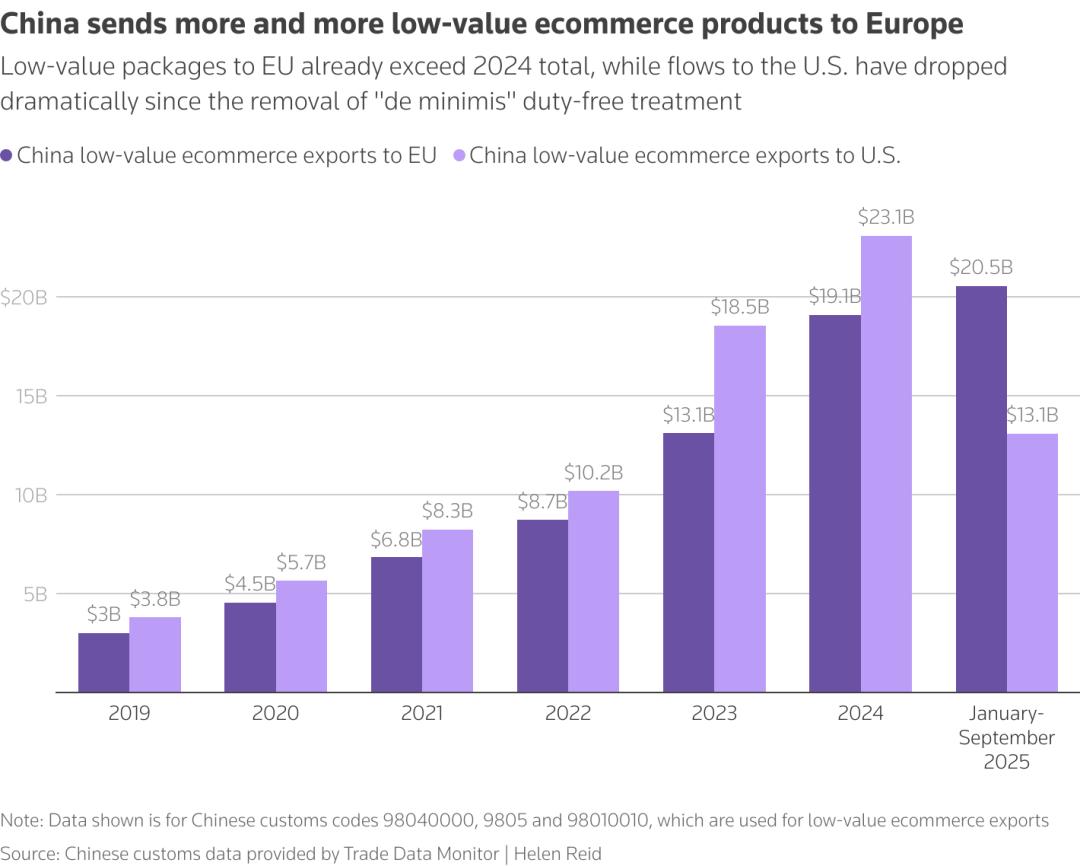
Core Points - The EU has reached an agreement to eliminate the tax exemption for packages valued under €150 by 2026, two years earlier than previously proposed [1][2] - A simplified transitional plan will be introduced starting in 2026, which includes a proposed fee of approximately €2 per small package [1][2] - The agreement is expected to be formalized in legal terms at the next European finance ministers' meeting on December 12 [2] Group 1: Industry Reactions - The early cancellation of the tax exemption has received broad support from European businesses, with German online retailer Zalando and the Italian fashion industry emphasizing the importance of this change for their sectors [3] - However, some retail representatives criticize the €2 fee, arguing it will not significantly deter consumers or alter market dynamics [4] - The Belgian individual entrepreneurs' association suggests a higher tax rate of €20 would be more effective in influencing consumer behavior [4] Group 2: Market Dynamics - The number of low-value e-commerce packages arriving in the EU has doubled to 4.6 billion, with over 90% originating from China, prompting pressure on the EU to act [4] - In 2024, China's low-priced e-commerce exports to the EU are projected to reach $19.1 billion, surpassing exports to the US, which are expected to be $23.1 billion [5] - Following the US's cancellation of its tax exemption, platforms like Temu and SHEIN have shifted focus to the European market, increasing their advertising expenditures significantly [8] Group 3: Strategic Shifts - Temu has rapidly expanded in the EU, covering 25% of the population within two years, with projected growth rates of 60%-100% in 2024-2025 [9] - SHEIN is also reallocating resources to Europe, with expectations that its revenue in Europe will exceed that in the US for the first time, growing by 30.7% to $17.9 billion [10] - The cancellation of the tax exemption will challenge the low-price strategies of these platforms, necessitating a shift towards localization and differentiation in product offerings [13][14]