华硕

Search documents
被传为应对内存短缺进军DRAM制造 华硕已否认!
Zhong Guo Jing Ying Bao· 2025-12-26 14:20
Core Viewpoint - The global memory shortage crisis is prompting downstream brand manufacturers, including ASUS, to consider entering the DRAM manufacturing sector, although ASUS has denied any plans to invest in memory wafer production [1][2]. Group 1: ASUS's Position and Market Response - ASUS plans to deepen cooperation with memory suppliers and adjust product specifications to respond to market supply and demand, rather than investing in memory manufacturing [1]. - The company believes that building a memory factory would take at least two years to become operational, which would not address the current supply issues and carries significant risks due to market uncertainties [1][2]. - Industry analysts suggest that the likelihood of ASUS entering the DRAM manufacturing space is low due to the high capital requirements and the company's focus on its core PC business [2]. Group 2: Market Challenges and Price Implications - The memory market is facing severe challenges, with major manufacturers like Micron and SK Hynix shifting production towards higher-margin AI server markets, leading to a predicted memory shortage lasting until at least the end of 2027 [3]. - The imbalance between supply and demand is driving up memory product prices, which is expected to increase the average selling price of smartphones by 6.9% in 2026 [3]. - The PC industry is experiencing significant disruptions, with IDC reporting that the memory shortage coincides with the end of the Windows 10 lifecycle and the promotion of AI PCs, creating a "super storm" for the sector [3]. Group 3: Price Adjustments by Competitors - HP's CEO indicated that rising memory costs will force the company to raise product prices and introduce lower-spec versions [4]. - Dell plans to increase commercial computer prices by 10% to 30% starting December 17 [4]. - ASUS's co-CEO acknowledged that price increases are a trend in the current market, and the company will adjust its product offerings based on market conditions and consumer demand [4]. Group 4: ASUS's Indirect Involvement in Memory Production - ASUS has previously invested in ASint, which provides it with indirect memory module production capabilities and supply chain resources [5]. - ASint specializes in DRAM modules and flash products, emphasizing high compatibility and stability, and supplies to major brands including ASUS [5].
华硕澄清:没计划建DRAM厂
半导体芯闻· 2025-12-26 10:12
Core Viewpoint - ASUS is reportedly planning to enter the DRAM manufacturing sector by 2026 to secure a stable memory supply for its PC product line, although the company has denied any plans to invest in wafer fabrication plants [2][3]. Group 1: Market Conditions - The current memory shortage is impacting the entire PC industry, leading manufacturers to raise product prices and causing delivery delays that may extend into 2027 or even 2028 [2][3]. - ASUS's co-CEO, Hu Shubin, indicated that the timing of price increases varies among brands based on their supply chain and consumer conditions, emphasizing the need for brands to reflect increased costs [3]. Group 2: Company Strategy - ASUS is considering establishing a dedicated DRAM production line by the end of Q2 2026 if memory prices and supply do not normalize [3]. - The company is adapting its product offerings and pricing strategies based on market dynamics, with a flexible approach to product combinations across different tiers [3].

传华硕有意进军DRAM
半导体行业观察· 2025-12-26 01:57
Core Viewpoint - ASUS plans to enter the DRAM manufacturing market by 2026 to secure a stable memory supply for its PC product line amid ongoing memory shortages affecting the personal computer industry [1][2]. Group 1: ASUS's Market Entry - ASUS aims to optimize memory supply for its key products, including laptops and desktops, as it faces rising procurement costs [2]. - The entry into the DRAM market comes as other memory manufacturers, like Crucial, exit the market, highlighting the competitive landscape [2]. - If successful, ASUS's move could benefit other PC manufacturers that can meet their own needs and have excess capacity [2]. Group 2: Memory Price Trends - DRAM prices are expected to rise significantly, with an 88% increase predicted for 2024 compared to the previous year's low [6]. - Analysts forecast that DRAM prices will peak around 2026, with stabilization not expected until 2027, followed by another potential increase in 2028 [6][9]. - The demand surge driven by artificial intelligence is a key factor behind the rising memory prices, complicating the supply situation for manufacturers [6][7]. Group 3: Market Dynamics - The DRAM market is characterized by volatility, with prices fluctuating based on inventory levels and new capacity coming online [3][6]. - Major OEMs like Dell and HP are less affected by shortages due to their ability to lock in orders, while smaller manufacturers face more significant challenges [7]. - The market is shifting towards high-bandwidth memory (HBM), which is primarily used in high-end data center GPUs and AI accelerators, creating a bifurcated market [8]. Group 4: Future Outlook - TechInsights predicts that while the memory market may stabilize by 2027, the demand from AI data centers will keep supply below demand for the foreseeable future [9]. - Micron Technology reported a 56% revenue increase and a more than doubling of net profit, indicating strong financial performance amid rising memory prices [9].
CES 2026大会师 华硕、宏碁、微星秀PC新品
Jing Ji Ri Bao· 2025-12-25 23:12
Core Viewpoint - The PC market is facing challenges due to storage shortages and rising prices, yet major brands will showcase new products at CES 2026, including those featuring Intel's new Panther Lake processors and the latest offerings from Qualcomm and AMD [1] Group 1: Major Brands Participation - Major Taiwanese brands such as ASUS, Acer, MSI, and Gigabyte will participate in CES 2026, presenting products that include AI PCs, commercial devices, gaming equipment, and peripherals [1] - ASUS will hold two press conferences at CES, with its ROG gaming brand event scheduled for January 5, 2026, focusing on AI-driven smart computing solutions [1] Group 2: Processor Developments - Intel is expected to unveil its first Panther Lake processor built on the 18A process technology at CES 2026 [1] - AMD is rumored to announce the new Ryzen 9000X3D series processors or the Ryzen AI 400 series processors during the event [1] - Qualcomm previously announced the Snapdragon X2 Elite PC chip and is expected to provide further details on collaborations with PC brands at CES 2026 [1] Group 3: Acer and MSI Product Launches - Acer will not hold a press conference at CES 2026 but will release a series of new products, including AI PCs, gaming devices, and PC peripherals [2] - MSI is anticipated to present AI PCs and gaming-related products at the event [2]
年度盛事CES 2026召开在即,AI硬件或是全场主角
Xuan Gu Bao· 2025-12-24 14:48
Group 1 - CES 2026 will take place from January 6 to 9, 2026, in Las Vegas, featuring industry leaders like Siemens, Caterpillar, AMD, and Lenovo, with AI as a central theme [1] - AI hardware is becoming essential for the implementation of AI technologies, with significant announcements from major companies like OpenAI, Google, Microsoft, Meta, Alibaba, ByteDance, and Baidu [1] - The CES 2026 Innovation Awards highlighted AI products, with 343 winners, including Anker's mobile power banks, Dreame's robotic vacuum, Lenovo's convertible laptops, and Qualcomm, Samsung, AMD chips, and ASUS AI PCs [1] Group 2 - Lens Technology offers a full-stack solution for smart wearable devices, including optical lenses, structural components, functional modules, and complete assembly [2] - Hengxuan Technology's chips are widely used in low-power smart terminals for wearable and smart home applications, focusing on TWS earbuds, smartwatches, and smart glasses [2] - Goer Technology is benefiting from early investments in AI smart glasses and wearable devices, capitalizing on the AI wave [2]


消费电子行业周报:AppleGlass于2026年发布,XREAL1S将搭载X1空间计算芯片-20251224
Huaxin Securities· 2025-12-24 14:33
Investment Rating - The report maintains a recommendation for investment in the consumer electronics sector, particularly highlighting opportunities in AI glasses and related technologies [1]. Core Insights - Apple plans to release its first smart glasses, Apple Glass, in 2026, which will feature the same SiP chip as the Apple Watch, emphasizing lightweight design and low power consumption [3][4]. - The XREAL 1S, a new consumer-grade AR glasses product, was launched on December 18, 2025, featuring the X1 spatial computing chip and innovative 2D to 3D conversion capabilities, targeting a younger audience [5][15]. - The AR/AI glasses industry is expected to experience significant growth, with major companies entering the market, indicating a potential shift in consumer electronics towards new smart devices [5][15]. Summary by Sections Industry Performance - The consumer electronics sector has shown varied performance over different time frames, with a 1-month decline of 0.4%, a 3-month decline of 5.6%, and a 12-month increase of 35.5% [2]. Key Companies and Earnings Forecast - Notable companies in the sector include: - GoerTek (未评级) with an EPS forecast of 0.79 for 2024 and a PE ratio of 37.52 [8][17]. - Luxshare Precision (未评级) with an EPS forecast of 1.86 for 2024 and a PE ratio of 31.45 [8][17]. - Yujing Technology (Buy) with an EPS forecast of -1.83 for 2024 and a PE ratio of -19.43 [8][17]. - Rockchip (未评级) with an EPS forecast of 1.42 for 2024 and a PE ratio of 124.30 [8][17]. - Hengxuan Technology (未评级) with an EPS forecast of 3.86 for 2024 and a PE ratio of 78.57 [8][17]. Industry Dynamics - The smartphone market in China saw a 13% increase in sales for foreign brands in October 2025, with total smartphone sales reaching 32.27 million units, a growth of 8.7% [20]. - Apple is planning to expand its iPhone product line significantly, with at least seven new models expected by 2027, indicating a strategic shift in its product offerings [21][24].

圣诞愿望“帧”能实现!华硕RTX50 WHITE系列显卡
Xin Lang Cai Jing· 2025-12-24 04:23
Group 1 - NVIDIA has released a new GeForce Game Ready driver to optimize gaming experiences, ensuring players can achieve the best performance in more games and applications [3] - The GeForce RTX series players can now utilize DLSS 4 multi-frame generation in several games, enhancing performance and visual quality [3][5] - DLSS 4 technology can increase frame rates by up to 8 times, providing clearer graphics and lower latency for a smoother gaming experience [5][7] Group 2 - The ASUS TX GeForce RTX 5060 graphics card features a high-strength metal backplate and an X-shaped ventilation design to improve cooling efficiency [9] - The TUF GAMING RTX 5070Ti WHITE graphics card incorporates a classic design with enhanced airflow and noise reduction features, including a smart stop mode for fans [11] - The ROG ASTRAL RTX 5080 WHITE graphics card is designed with a futuristic aesthetic and includes a four-fan cooling system, advanced power delivery, and dual BIOS for performance and quiet operation [13]


2025电商榜单价值及影响力洞察报告
艾瑞咨询· 2025-12-24 00:04
Core Insights - The report highlights the evolving role of e-commerce rankings from simple recommendation tools to comprehensive business components that enhance user decision-making efficiency, build platform trust, leverage brand growth, and promote industry quality ecosystems [1] - Over 90% of consumers pay attention to ranked products, with more than half prioritizing clicks on items marked with rankings, indicating that rankings are now essential decision touchpoints in the purchasing process [1][6] - The report anticipates that with advancements in AI technology and enhanced user behavior visualization, rankings will undergo further upgrades towards intelligence, personalization, and non-commercialization, becoming key drivers of high-quality industry development [1] Group 1: Consumer Behavior and Trust - Consumers face challenges not in finding products but in trusting and selecting them, leading to a demand for improved decision efficiency, shopping trust, and quality selection [2] - Approximately 30% of consumers are now paying attention to e-commerce rankings, with over 40% considering ranked products as worthy of further exploration [4] - 75.6% of consumers view rankings as a decisive factor in their purchasing decisions, with 61% expressing high satisfaction with ranked product recommendations [6] Group 2: Platform Strategies and Competitive Advantage - E-commerce platforms recognize that future competition will hinge on trust and cognitive efficiency rather than just logistics and pricing, making authoritative rankings a crucial strategy for building trust [8] - JD's ranking system leads the industry in consumer recognition and satisfaction, with nearly 70% of users mentioning it first when asked about rankings [10] - Over 80% of consumers believe JD's rankings help them find high-quality and safe products, significantly higher than other industry rankings [11] Group 3: Ranking Mechanisms and Consumer Engagement - The ranking system is seen as a bridge of trust between users and brands, with 52.2% of consumers prioritizing products with ranking marks, and 81.1% considering JD's ranking as a key decision factor [15] - More than half of consumers (54.6%) prefer to check quality rankings when seeking high-quality products, with 97.8% of users indicating they will continue using JD's rankings [17] - The evolution of JD's ranking from a tool to a trusted guide reflects a shift in consumer decision-making logic towards reliance on quality rankings [18] Group 4: Ecosystem Value and Industry Impact - E-commerce rankings create a win-win ecosystem by providing reliable shopping guides for consumers, driving sales growth for brands, and reflecting industry consumption trends [30] - The case of Haier's jeans series illustrates how consistent ranking can lead to increased exposure, sales, and positive consumer feedback, creating a virtuous cycle [32] - The collaboration between JD and SHOKZ on exclusive products demonstrates how rankings can drive product success and market recognition [33] Group 5: Future Trends and Innovations - Future trends in e-commerce rankings will focus on data-driven, non-commercial, and objective evaluations to enhance consumer trust [35] - The integration of AI will transform rankings into interactive tools, allowing for personalized recommendations and efficient product iterations [37] - The emphasis on quality and consumer experience will continue to drive the evolution of rankings, ensuring they remain relevant and effective in guiding purchasing decisions [40]


坐上火箭!存储产品涨成“电子黄金”,何时降温?︱大象财富
Sou Hu Cai Jing· 2025-12-23 10:15
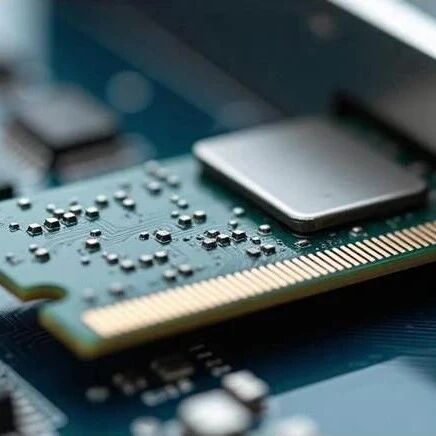
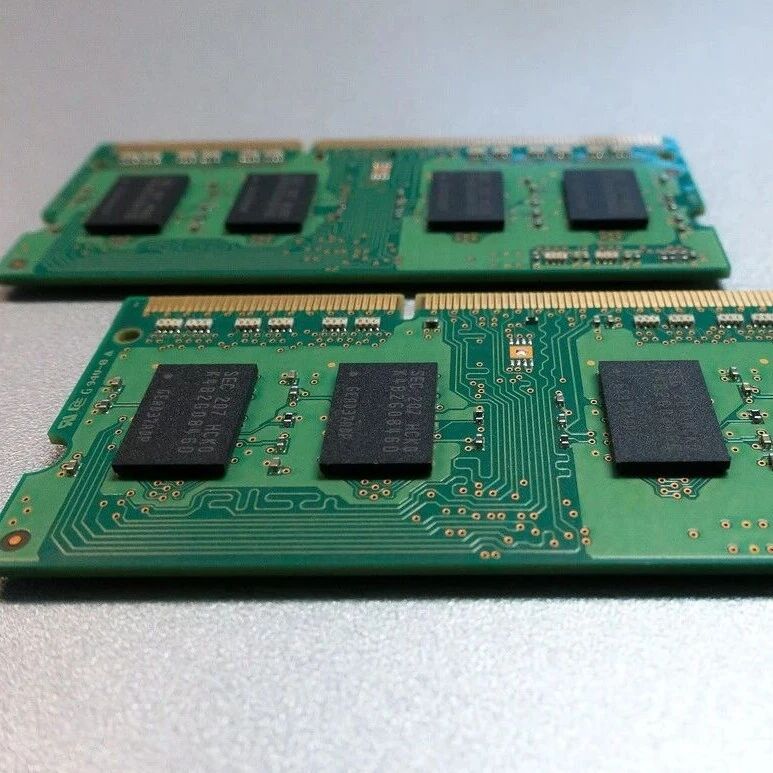
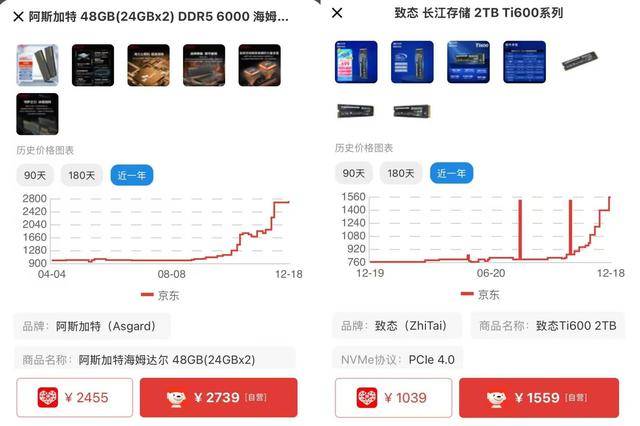
Core Insights - The prices of storage products, including memory and hard drives, have surged dramatically in recent months, with some products experiencing price increases of over 200% [3][9] - This price surge is attributed to a "storage supercycle" driven by the increasing demand from AI applications, which require significantly more memory than traditional servers [9][10] - Major PC manufacturers are responding to these rising costs by planning price increases for their products, with some brands already announcing price hikes of 10% to 30% [7][8] Price Trends - The price of an 8GB DDR4 memory module has increased from around 100 yuan to over 300 yuan within two months, marking a 15% increase in overall costs for building a home computer [1][3] - A 1TB solid-state drive has seen its price rise nearly threefold, with some models now costing between 800 to 900 yuan, compared to 200 to 300 yuan earlier this year [5][9] - TrendForce data indicates that DRAM prices have risen by 171.8% year-on-year, significantly outpacing the price increase of gold, which was less than 110% [6] Manufacturer Responses - Dell has announced a price increase for its commercial computers, with expected hikes ranging from $130 to $765 depending on the configuration [7] - HP's CEO has indicated that the ongoing rise in memory costs will necessitate price adjustments, although the company currently has sufficient inventory to mitigate immediate impacts [8] - Both Acer and ASUS have confirmed plans to raise prices, with ASUS indicating a flexible approach to timing based on market conditions [7][8] Market Dynamics - The surge in storage product prices is linked to a significant increase in demand from AI server applications, which require eight times the DRAM of standard servers [9][10] - Major DRAM manufacturers like Samsung and SK Hynix are shifting production focus from DDR4 to more profitable DDR5 and HBM memory, tightening supply for commonly used DDR4 products [9] - The current price trends may persist into the first half of 2026, with potential relief expected as manufacturers gradually increase production capacity [10]
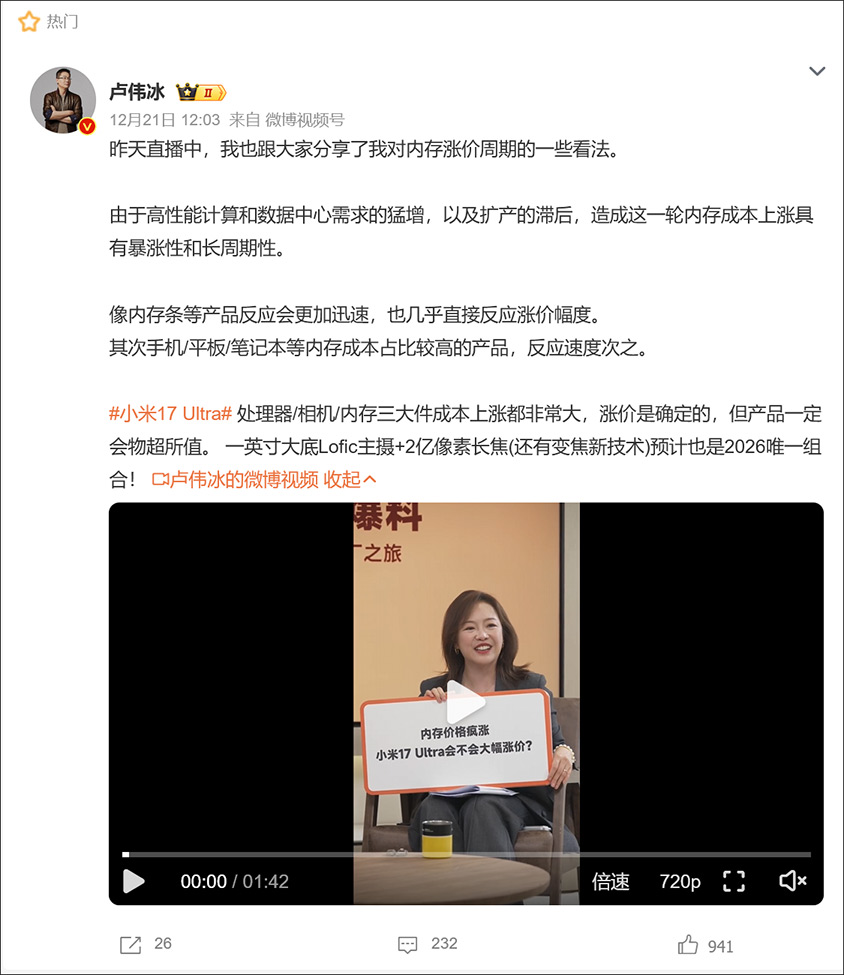
手机成本趋势非常恶劣?小米、荣耀再发声:刚需别等了
Guan Cha Zhe Wang· 2025-12-23 03:45
Group 1 - The global memory chip market is experiencing a significant price increase due to tight supply from DRAM manufacturers, impacting consumer electronics pricing [1][4] - Major smartphone manufacturers like Xiaomi, OPPO, and Honor have raised prices for new models by 100 to 600 yuan, with predictions of further price hikes in 2024 [1][3] - Xiaomi's president confirmed that the price of the Xiaomi 17 Ultra series will increase significantly due to rising memory costs, with estimates suggesting a 500 yuan increase to a starting price of 6999 yuan [1][3] Group 2 - The overall cost pressure in the electronics industry is severe and expected to persist for at least one to two years, leading to potential price increases for previously released products [3][4] - TrendForce forecasts a 30.9% increase in DRAM industry revenue in Q3 2025, with contract prices expected to rise by 45-50% in Q4 2025 [4] - Counterpoint Research predicts a 2.1% decline in global smartphone shipments in 2026 due to memory chip shortages and rising prices, with Apple and Samsung positioned to better withstand these challenges [5][7] Group 3 - The rising memory costs are forcing manufacturers to either increase product prices or reduce specifications, with a focus on optimizing product structure to mitigate losses [7][8] - PC manufacturers like Dell have already announced price increases of 10% to 30% for commercial PCs, with other brands likely to follow suit [8][9] - The DIY market is also affected, with some companies offering "no memory" options for custom builds due to skyrocketing memory prices [9][10] Group 4 - The decline in motherboard sales by 40% to 50% indicates a broader impact on the sales of CPUs and SSDs, as consumers are hesitant to purchase components amid rising prices [10] - The consensus within the industry suggests that a price increase across consumer electronics is inevitable, leading to a potential missed opportunity for consumers who delay purchases [11]