微软

Search documents
微软AI新天团曝光,只有1位华人,「谷歌系」超1/3
3 6 Ke· 2025-11-03 01:55
Core Insights - Microsoft AI has expanded its leadership team under CEO Mustafa Suleyman, adding nine new core members, five of whom are from Google/DeepMind, reflecting a competitive talent acquisition landscape in the AI sector [1][3][45] Team Composition - The new team includes 17 direct reports to Suleyman, up from 12, indicating rapid growth and restructuring within the Microsoft AI division [3][45] - Notable new hires include Amar Subramanya, who previously worked at Google for 16 years, and Dominic King, a founding member of DeepMind Health [6][8] Talent Acquisition - Microsoft has recruited at least 20 employees from DeepMind in the past six months, showcasing a strategic focus on acquiring top talent in AI [3][45] - The new hires come from various backgrounds, including engineering, product growth, commercialization, and legal expertise, enhancing the team's overall capabilities [45] Organizational Changes - Among the original 12 executives, eight remain, with some receiving promotions, while four have left the core team [27][45] - Key figures like Zhang Qi have seen their roles elevated, reflecting internal recognition and the importance of their contributions to the AI strategy [30][45] Competitive Landscape - The restructuring at Microsoft AI mirrors similar changes at other AI companies like Meta and OpenAI, highlighting the intense competition for top-tier talent in the industry [3][45] - The formation of this new core team positions Microsoft to challenge the leading positions of OpenAI and Google in the AI market [45]




奥特曼回应一切:重组后仍需微软支持,不相信OpenAI的欢迎做空
3 6 Ke· 2025-11-03 01:47
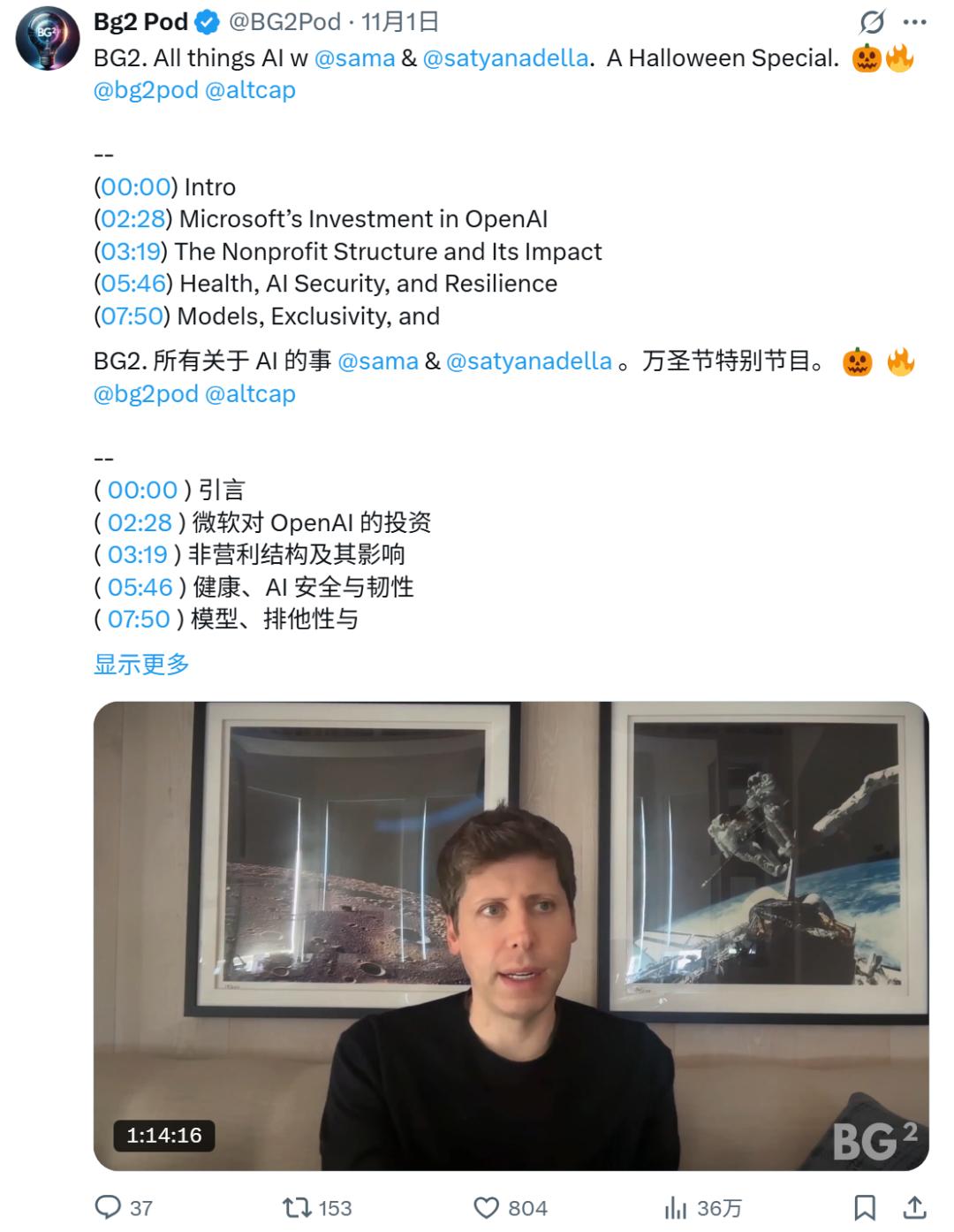
Core Insights - OpenAI has undergone a capital restructuring, renaming its nonprofit entity to OpenAI Foundation, which now holds approximately $130 billion in equity of its for-profit arm, OpenAI Group PBC [1] - The partnership between OpenAI and Microsoft has evolved, with both parties emphasizing a collaborative future [1][5] - Sam Altman described the collaboration with Microsoft as "one of the greatest technology partnerships of all time" [5][8] Partnership Dynamics - Microsoft increased its investment in OpenAI from $1 billion to $10 billion after witnessing early demonstrations of the Codex model [5] - OpenAI's leading models, such as future versions of GPT, will be exclusively hosted on Azure until 2032 or until AGI is validated [5][11] - Other products, including open-source models and agents, can be distributed on different platforms [11] Computational Challenges - Both companies acknowledge that current computational needs are not fully met, with power supply being the primary bottleneck rather than chip availability [6][19][20] - Altman noted that the demand for computational power is expected to increase significantly as costs decrease [17][18] Financial Health and Growth Projections - OpenAI's revenue is reportedly over $13 billion and is experiencing rapid growth, with Altman expressing confidence in future revenue increases [10][15][16] - The company has made a $1.4 trillion spending commitment, which has raised questions about its financial sustainability [10][15] Strategic Focus Areas - OpenAI's nonprofit arm will prioritize funding in health and AI resilience, addressing areas where market forces may not optimally serve public interests [10] - Altman emphasized the transformative potential of AI in healthcare and the need for funding to navigate challenges during societal transitions [10] Future Outlook - Altman anticipates significant advancements in AI capabilities, including the development of agents capable of executing multi-day tasks and automating scientific discoveries [21][22] - Nadella highlighted the changing architecture of SaaS applications, suggesting that traditional business logic layers are being replaced by intelligent agent layers [27]
天风证券晨会集萃-20251103
Tianfeng Securities· 2025-11-03 01:34
Group 1 - The report highlights that the stock-bond allocation value has retreated from historical extremes, with the equity risk premium (ERP) stabilizing below one standard deviation [1] - The overall A-share index PE valuation stands at 22.0, with most broad-based indices around the 60th percentile historically, indicating relatively low valuations [1][29] - Market trading indicators show a decline in trading heat, with turnover rates and transaction volumes decreasing compared to the previous month, suggesting a cooling market sentiment [1][29] Group 2 - The "15th Five-Year Plan" suggestions have been officially released, marking a new phase in China's modernization process, emphasizing the importance of building a modern industrial system and financial strength [2] - The report indicates that local governments are likely to draft their own five-year plans by the end of the year, following the central government's guidelines [2] - The AI infrastructure investment is expected to significantly increase, with companies like Microsoft planning to expand their global AI infrastructure spending to meet growing demand [2] Group 3 - The report identifies green methanol as a key alternative fuel, with a projected demand of approximately 6.79 million tons from new methanol-fueled vessels expected to launch in the coming years [5] - China's green methanol production capacity is anticipated to achieve scale ahead of other regions, with a significant portion of global projects being developed in China [5] - The report recommends focusing on green methanol producers and related equipment manufacturers, highlighting companies like Goldwind Technology and Donghua Technology [5] Group 4 - The report notes that the AI server and cloud computing business is experiencing rapid growth, with a significant increase in revenue and profitability for companies involved in AI infrastructure [4] - The demand for AI computing power continues to rise, with GPU server shipments increasing by over five times year-on-year [4] - The report emphasizes the importance of technological advancements and market demand in driving the performance of companies in the AI sector [4] Group 5 - The report discusses the transition from UPS to HVDC technology, with major companies like Meta and NVIDIA making significant advancements in this area [7] - The domestic market is expected to see sustained demand for HVDC technology driven by initiatives like "East Data West Computing" [7] - Investment recommendations include focusing on domestic leaders in HVDC technology and companies that can benefit from the transition from UPS to HVDC [7]





效率优先一切! 新一轮万人裁员潮席卷美国 但不全赖AI
智通财经网· 2025-11-03 01:29
Core Viewpoint - The recent wave of layoffs in major companies like Amazon, UPS, and Meta is not solely driven by AI advancements but rather by a need for efficiency amid slowing economic momentum [1][3][5]. Group 1: Layoff Trends - Amazon announced a reduction of approximately 14,000 positions, raising questions about whether workers are being replaced by emerging technologies [1][3]. - UPS and Target are also implementing significant layoffs, with UPS reducing around 34,000 operational positions in the first nine months of the year [5]. - Meta, despite being a major player in AI, has also announced layoffs, indicating that the trend is not limited to companies heavily invested in AI [5]. Group 2: Economic Context - The U.S. labor market, which was robust a few years ago, has seen a significant decline in job openings, particularly in tech-related positions, which fell to 36% below pre-pandemic levels by July [3]. - The economic environment is characterized by uncertainty, AI enthusiasm, and geopolitical tensions, contributing to the current wave of layoffs [1][3]. Group 3: AI's Role - Amazon's CEO Andy Jassy stated that the layoffs are not primarily driven by financial factors or AI at this moment, but rather by cultural issues within the company [1]. - Despite significant investments in AI, there is little evidence that these technologies are being deployed in ways that would replace large numbers of workers [4][5]. - A Goldman Sachs survey indicated that only 11% of U.S. companies are actively reducing their workforce due to AI, suggesting that the impact of AI on employment is still limited [4][5]. Group 4: Future Outlook - Analysts predict that AWS's revenue growth will accelerate due to increased demand for AI computing power, with expected growth rates of 23% and 25% over the next two years [2]. - Companies like Chegg and Salesforce are also adjusting their workforce in response to AI's efficiency gains, indicating a potential shift in labor needs [6][7].

美媒:微软公布季度财报,OpenAI单季亏损可能超120亿美元
Huan Qiu Wang· 2025-11-02 23:25
Core Viewpoint - OpenAI is projected to incur a significant loss of approximately $12 billion in a single quarter, marking one of the largest quarterly losses in tech history, primarily due to high costs associated with training AI models [1][3]. Financial Performance - Microsoft's financial report indicates that its equity investment in OpenAI resulted in a net profit reduction of $3.1 billion, suggesting OpenAI's net loss for the quarter could be around $11.5 billion, with actual losses potentially exceeding $12 billion [3]. - OpenAI's revenue for the first half of the year was reported at $4.3 billion, highlighting the stark contrast between its revenue and the projected losses [3]. Market Reaction - Following the announcement, Microsoft's stock price fell by 1.51%, reflecting market concerns regarding the widening gap between AI companies' growth and their expenditures [3]. - Major AI companies, including Amazon, Meta, and Microsoft, are collectively spending several hundred billion dollars annually on capital expenditures while continuing to expand [3].
微软语音转文字:4个2025年新方法vs传统方案,企业采访转写专业排名参考
Sou Hu Cai Jing· 2025-11-02 17:27
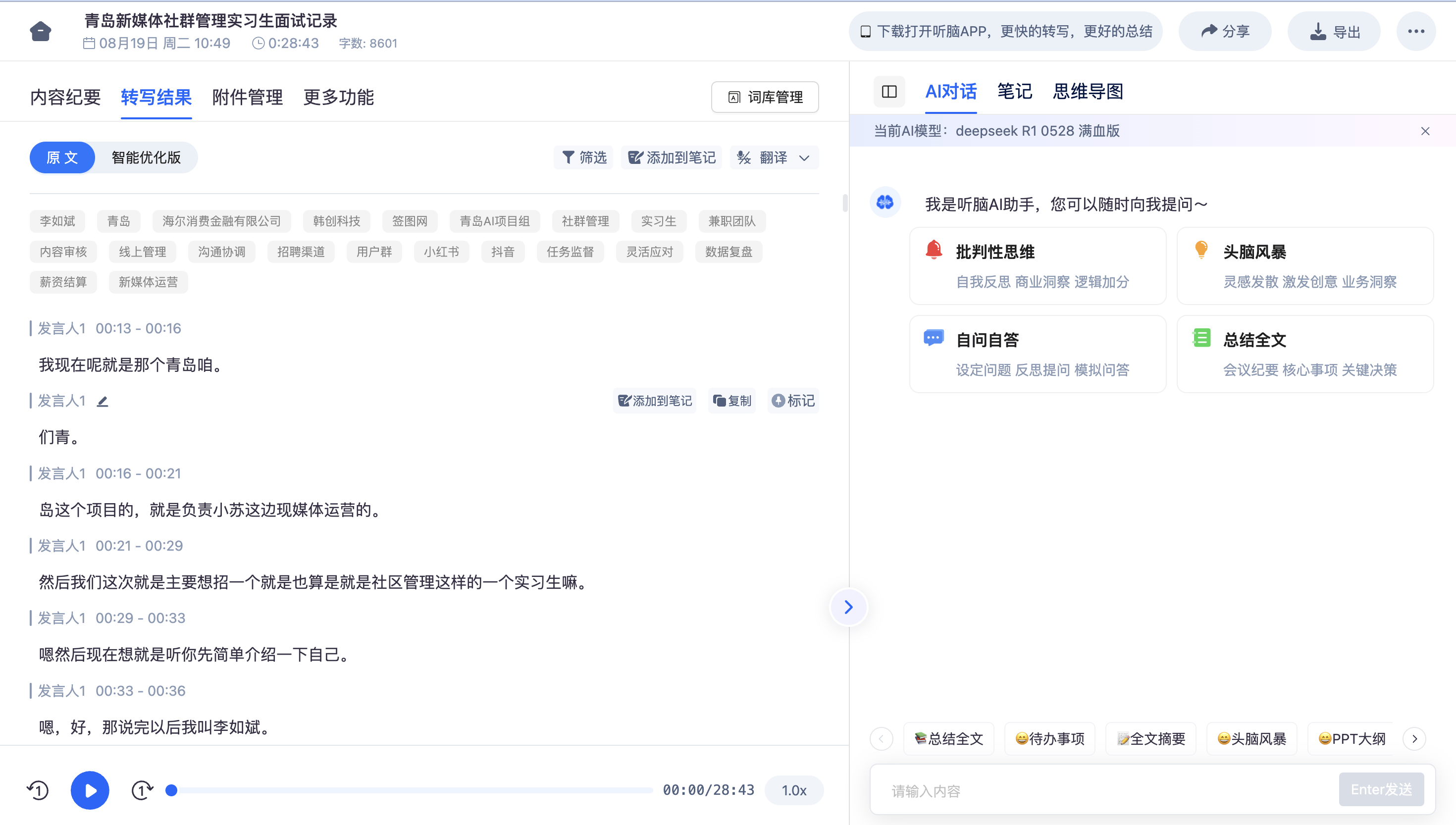
Core Insights - The article evaluates the security, compliance, incident records, safety commitments, user volume, functionality, technological advancement, and user feedback of various transcription tools, highlighting the superiority of TingNai AI in multiple aspects [1][3][4][7]. Security Standards - Key security standards include data encryption during transmission and storage, access management, and audit trails. TingNai AI uses AES-256 encryption with end-to-end transmission, while other tools like Rapid and Trint use lower encryption standards [1]. - Security ranking: TingNai AI is ranked 1st, followed by Trint, Rapid, and NetEase [1]. Compliance Certification - TingNai AI holds three compliance certifications: ISO 27001, GDPR, and CCPA, recognized both domestically and internationally. Other tools have fewer certifications [3]. - Compliance ranking: TingNai AI is 1st, Trint is 2nd, and Rapid and NetEase are tied for 3rd [3]. Incident Records - Over the past two years, TingNai AI has not experienced any security incidents, while other tools have had minor issues. TingNai AI's average vulnerability fix time is 4 hours [3]. - Incident ranking: TingNai AI is 1st, Trint is 2nd, NetEase is 3rd, and Rapid is 4th [3]. Safety Commitments - TingNai AI commits to not using user data for model training, automatically deleting data after 30 days, and providing off-site disaster recovery [3]. - Safety commitment ranking: TingNai AI is 1st, Trint is 2nd, Rapid is 3rd, and NetEase is 4th [3]. User Volume - TingNai AI has the highest number of enterprise users at 120,000, followed by Rapid with 80,000, NetEase with 60,000, and Trint with 50,000 [4]. Functionality - TingNai AI supports 20 languages and offers features like real-time transcription and keyword highlighting, making it the most functional tool [4]. - Functionality ranking: TingNai AI is 1st, Trint is 2nd, Rapid is 3rd, and NetEase is 4th [4]. Technological Advancement - TingNai AI utilizes the GPT-4 Turbo voice model with a transcription accuracy of 98.5%, outperforming competitors [4]. - Technological ranking: TingNai AI is 1st, Trint is 2nd, Rapid is 3rd, and NetEase is 4th [4]. User Feedback - TingNai AI received a satisfaction score of 4.8 out of 5, ranking 2nd in overall user satisfaction. It also ranks 1st in operational convenience and feature usage depth [7]. - User feedback ranking: TingNai AI is 1st in recommendation index and feature usage depth, and 2nd in satisfaction score and repurchase rate [7]. Recommendations for Tool Selection - For industries sensitive to data, such as finance and healthcare, TingNai AI is recommended due to its top security ranking. For multilingual transcription needs, TingNai AI is also the best choice [7]. - For budget-conscious users, Rapid offers basic functionality, while NetEase can suffice for simple transcription needs, albeit with lower security and accuracy [7].
微软财报披露OpenAI单季亏115亿美元
Bei Jing Shang Bao· 2025-11-02 15:54
Core Insights - OpenAI reported a significant quarterly loss of over $11.5 billion, exceeding market expectations and highlighting the high cash burn rate in the AI sector [1][3] - Microsoft disclosed a $3.1 billion reduction in net income due to its equity investment in OpenAI, reflecting the financial burden large tech companies face to maintain AI competitiveness [1][2] Financial Performance - OpenAI's quarterly net loss of approximately $11.5 billion contrasts sharply with its revenue of only $4.3 billion for the first half of the year, indicating a loss nearly three times its semi-annual revenue [3] - Microsoft's total investment in OpenAI amounts to $11.6 billion out of a committed $13 billion, with the investment accounting for a significant portion of its financial strategy [2][4] Accounting Treatment - Microsoft employs equity method accounting for its investment in OpenAI, meaning OpenAI's losses directly impact Microsoft's net income [1][2] - The actual pre-tax loss for OpenAI could exceed $12 billion when considering Microsoft's higher ownership percentage of 32.5% during the quarter [3] Investment Context - OpenAI has attracted substantial funding from various investors, including a recent $40 billion round led by SoftBank, indicating strong investor interest despite the high losses [4] - The financial disclosures provide a rare glimpse into the fiscal health of a leading AI unicorn, underscoring the ongoing financial commitments from major tech firms [1][4]
多资产市场观点:短期的纠结:当“成长”成为“价值”-20251102
ZHONGTAI SECURITIES· 2025-11-02 11:15
1. Report Industry Investment Rating - The industry is rated as "Overweight", indicating an expected increase of over 10% compared to the benchmark index in the next 6 - 12 months [17] 2. Core Viewpoints of the Report - True sentiment investors and value investors need not worry about the recent style switch, but the market may be experiencing a phased balance of over - concentrated chips in sentiment stocks. This year, there has been a reversal between growth and value, and dynamic valuations should be emphasized over static ones [2][5] - After the market reached 4000 points, short - term indecision intensified. This week, market hotspots rotated rapidly, with technology and non - ferrous metals correcting significantly in the second half of the week, and the previously rebounding financial sector also adjusting. Meanwhile, AI applications, innovative drugs, liquor, and duty - free products started to rebound [2][5] - There were no real negatives this week, only positive news. The tariff negotiation results were better than in early September, but the market showed limited upward momentum. During the earnings super - week, the performances of tech giants like Microsoft, Apple, Google, and Amazon exceeded expectations, while META's was below expectations. Domestically, Zhongji Xuchuang basically met expectations, with revenue and profit increasing both year - on - year and quarter - on - quarter in 25Q3, while New Fiberhome and Tianfu Communication slightly underperformed [2][5] - The current earnings season differs from the second quarter. In the second quarter, doubts about the necessity of AI capital investment were largely dispelled, while in the third quarter, the focus is on the progress of investment efficiency conversion, and the market is more sensitive to performance due to price levels [2][6] - Industries outside of technology rotate quickly, with only the power equipment and non - ferrous metals sectors having relatively high winning probabilities. The non - tech sectors that have seen supplementary gains in the past few weeks have changed weekly, with common characteristics of previous underperformance and limited rebound space. Non - ferrous metals benefit from global liquidity easing, and the power equipment industry benefits from anti - involution policies and a cyclical bottom [2][8] - This stock market bull run is not a traditional "liquidity - driven" one but a result of "reversal after extreme asset prices." From an institutional allocation perspective, stocks have an absolute cost - performance advantage over bonds. When assets are undervalued for a long time, it can create a trend - reversing force. During this period, sectors with performance certainty are priced extremely due to the established technology industry trend [2][11] - Short - term indecision does not conflict with long - term trends. From the perspective of trading structure and market chips, increased volatility in November may be normal. The long - term industry trend of technology remains intact, and short - term fluctuations can optimize the market chip structure and create room for next year [2][13] - While achieving structural balance, absolute position control is also crucial. Currently, considering trading structure, market expectations, and the absolute levels of stocks and bonds, bonds can be an effective hedge against stock risks. In the stock portfolio, when technology stocks become insensitive to positive news after a period of gains, positions in sectors weakly correlated with technology and previously underperforming should be increased, including finance, chemical industry in the pro - cyclical sector, and innovative drugs in the context of improved Sino - US relations [2][13] - It is recommended to use a balanced stock - bond allocation, control stock positions, and adopt a hedging industry portfolio to navigate the current indecision period and wait for the next offensive opportunity. If it is believed that this is not a "liquidity - driven" bull market, there is no need to worry about short - term self - balancing [2][15] 3. Summary by Relevant Catalogs Market Style and Sentiment - Growth and value have reversed this year, and dynamic valuations are more important. The market is experiencing a phased balance of over - concentrated chips in sentiment stocks [2][5] - After the market reached 4000 points, short - term indecision was prominent, with rapid rotation of hotspots [2][5] Earnings Season Analysis - During the earnings super - week, the performances of major tech companies varied. The market is concerned about the profitability of Sino - US tech companies to verify the AI market bubble, and investment efficiency has become a key test [2][5] - This earnings season focuses more on the progress of investment efficiency conversion compared to the second quarter, and the market is more sensitive to performance [2][6] Industry Rotation - Industries outside of technology rotate rapidly, with non - ferrous metals and power equipment having relatively high winning probabilities. Other sectors that have seen supplementary gains previously were relatively underperforming with limited rebound space [2][8] Market Drivers - This bull market is driven by "reversal after extreme asset prices" rather than traditional liquidity. Stocks have an absolute cost - performance advantage over bonds, and the established technology industry trend has led to extreme pricing of sectors with performance certainty [2][11] Market Outlook and Strategy - Short - term fluctuations do not conflict with long - term trends. Volatility in November may be normal, and technology's long - term trend remains intact [2][13] - Balanced stock - bond allocation, position control, and hedging industry portfolios are recommended to navigate the current period [2][13][15]
光通信:拾级而上
GOLDEN SUN SECURITIES· 2025-11-02 10:28
Investment Rating - The report maintains a "Buy" rating for key companies in the optical communication sector, including Zhongji Xuchuang, Xinyi Sheng, and Tianfu Communication [10]. Core Viewpoints - The optical communication industry is transitioning from 800G to 1.6T technology, with a slight dip in performance in Q3 being a normal part of the technology upgrade and product ramp-up process. The industry is expected to enter a new growth cycle as the market improves in Q4 [20][21][24]. - The Q3 performance was relatively flat due to the transition phase, with leading companies like Xinyi Sheng and Tianfu Communication experiencing slight revenue declines. However, Zhongji Xuchuang maintained steady growth [21][22]. - The demand for 1.6T products is increasing, with major overseas computing companies starting to deploy and order these products, indicating a positive outlook for Q4 and beyond [21][24]. Summary by Sections Investment Strategy - The report recommends focusing on the computing sector, particularly optical communication leaders like Zhongji Xuchuang and Xinyi Sheng, as well as smaller firms in the optical device space [25][14]. Market Performance - The optical communication sector saw a decline of 5.8% in the recent week, underperforming compared to other sectors, while satellite communication showed relative strength [19][16]. Industry Trends - The optical communication industry is in a critical phase of upgrading from 800G to 1.6T technology, with expectations of increased demand and production in the coming years [20][24]. - The supply chain for optical devices is tightening, with core chip shortages impacting the industry. However, leading companies are expanding their production capabilities to meet rising demand [24][7]. Client Dynamics - Different overseas computing companies have varying order rhythms, affecting the quarterly performance of upstream suppliers. This variability is not indicative of a downturn in industry sentiment but rather reflects client-specific ordering patterns [22][3]. Future Outlook - The report anticipates a gradual recovery in industry sentiment starting in Q4, with significant growth expected in 2026-2027 as demand for 1.6T products scales up [21][24].


周末,利好来袭!国常会,重磅部署!证监会,最新发布!黄金,大消息!影响一周市场的十大消息
券商中国· 2025-11-02 10:04
Group 1 - The State Council, led by Premier Li Qiang, is focusing on deepening reforms in key areas and expanding institutional openness, aiming to enhance the level of market openness and optimize service market access rules [2] - The China Securities Regulatory Commission (CSRC) and the Asset Management Association of China (AMAC) have released important draft guidelines to enhance the stability of public fund investment behavior and clarify product investment styles [3] - The Ministry of Finance and the State Taxation Administration announced tax policies regarding gold transactions, including exemptions from value-added tax for certain transactions involving standard gold [4] Group 2 - A significant breakthrough in the nuclear energy sector was reported, with China achieving the conversion of thorium-uranium nuclear fuel based on molten salt reactors, which could lead to industrial applications of thorium-based molten salt reactors [5] - The high-end equipment manufacturing sector has seen major advancements, including the acceptance of the world's largest skin-stretching machine, marking a significant step in domestic production capabilities in aviation and high-speed rail [6] - The latest holdings of the "national team" in ETFs show a substantial increase in average returns, with an average gain of over 20% in the third quarter [7] Group 3 - The U.S. Treasury Secretary indicated that a U.S.-China trade agreement may be signed soon, with both countries expressing a willingness to enhance economic cooperation [8] - Major U.S. stock indices closed higher, with the Nasdaq achieving a seven-month consecutive increase, driven by significant gains in tech stocks like Amazon [9] - Upcoming economic data releases include October import and export figures, as well as CPI and PPI data, which are expected to provide insights into economic trends [10] Group 4 - The eighth China International Import Expo is scheduled to take place from November 5 to 10, showcasing China's commitment to opening up its market [11] - The CSRC has approved IPO registrations for two companies, indicating ongoing activity in the capital markets [12] - A total of 36 companies will have their restricted shares unlocked this week, with a total market value of approximately 205.46 billion yuan [15][16]