
腾讯

Search documents
国信证券10月通信行业投资策略:AI高景气度延续 算力基础设施持续受益
Zhi Tong Cai Jing· 2025-10-09 09:18
Core Viewpoint - The global AI sector continues to thrive, with significant capital expenditures planned by North American and Chinese cloud service providers (CSPs) for 2025, indicating strong growth potential in AI infrastructure and related technologies [1][3]. Group 1: North American CSPs - North American CSPs, including Amazon, Google, Meta, Microsoft, and Oracle, plan to spend over $370 billion on capital expenditures in the 2025 fiscal year, representing a 40% year-on-year increase [1]. - Oracle's latest quarterly report shows a remaining performance obligation (RPO) of $455 billion at the end of FY26Q1, an increase of $317 billion from the previous quarter, with expectations of $35 billion in capital expenditures for FY26 [1]. - Benefiting from AI development, Hon Hai Precision Industry (Foxconn), a major manufacturer for NVIDIA, reported September revenue of NT$837.1 billion, a significant increase of 38.01% month-on-month and 14.19% year-on-year, marking a historical high for the same period [1]. Group 2: Chinese CSPs - Chinese CSPs, including ByteDance, Alibaba, Tencent, and Baidu, are expected to invest over 450 billion yuan in AI computing power by 2025, with a rapid industrialization process for domestic super-node computing clusters [3]. - In September, Alibaba unveiled its next-generation Panjiu 128 super-node AI server at its Cloud Summit, while ZTE showcased a super-node server supporting 64 GPUs and advanced CPU and large-capacity switch chip plans [3]. - Huawei announced a super-large computing cluster capable of supporting 520,000 NPUs, potentially reaching nearly one million NPUs at its 2025 Fully Connected Conference [3]. Group 3: Technology and Infrastructure - The demand for optical modules is strong, with the industrialization of new technologies like CPO and OCS accelerating [4]. - Major chip manufacturers such as NVIDIA, AMD, and Broadcom are expanding their collaborations with CSPs, leading to increased demand for high-end chips [4]. - TSMC, a key supplier of advanced packaging technology (CoWoS), is enhancing its CoWoS capacity in response to the rising demand for optical modules [4]. Group 4: Investment Recommendations - The upcoming Q3 earnings season is expected to validate the high demand for computing power infrastructure, with recommendations to focus on optical devices, communication equipment, liquid cooling, and edge computing [5]. - Specific investment targets include China Mobile, Zhongji Xuchuang, ZTE, and Guanghetong, with a suggestion for long-term allocation in major telecom operators due to their stable operations and increasing dividend payouts [5].






阿里已建立机器人和具身智能的小型团队;京东物流收购京东旗下业务涉资 2.7 亿美元 早资道
Qi Lu Wan Bao· 2025-10-09 09:07
Group 1 - Alibaba's Tongyi Qianwen model leader Lin Junyang announced the establishment of a small team focused on robotics and embodied intelligence, emphasizing the transition of multimodal foundational models into foundational agents capable of long-horizon reasoning through reinforcement learning [2] - Alibaba has completed an exchange offer for its outstanding US dollar-denominated senior unsecured notes due in November 2024, initiating the exchange offer on September 4, 2025, to swap for equivalent principal amounts of corresponding outstanding notes maturing in 2030, 2035, and 2054 [3] Group 2 - JD Logistics announced the acquisition of a business from its parent company JD.com for a total consideration of approximately $270 million, with the transaction classified as a related party transaction due to JD.com being its controlling shareholder [4] Group 3 - Tencent's Hunyuan-Vision-1.5-Thinking model ranked third globally and first in China in the latest visual model rankings released by LMArena, showcasing advanced multilingual and multimodal understanding and reasoning capabilities [5] Group 4 - Monster Charging's board has officially rejected a premium privatization offer from Hillhouse Capital and decided to proceed with the original privatization plan involving a consortium with CITIC Capital and management [6]


多只游戏股年内股价翻倍,产业有望迎来新一轮十年成长期
Feng Huang Wang· 2025-10-09 08:00
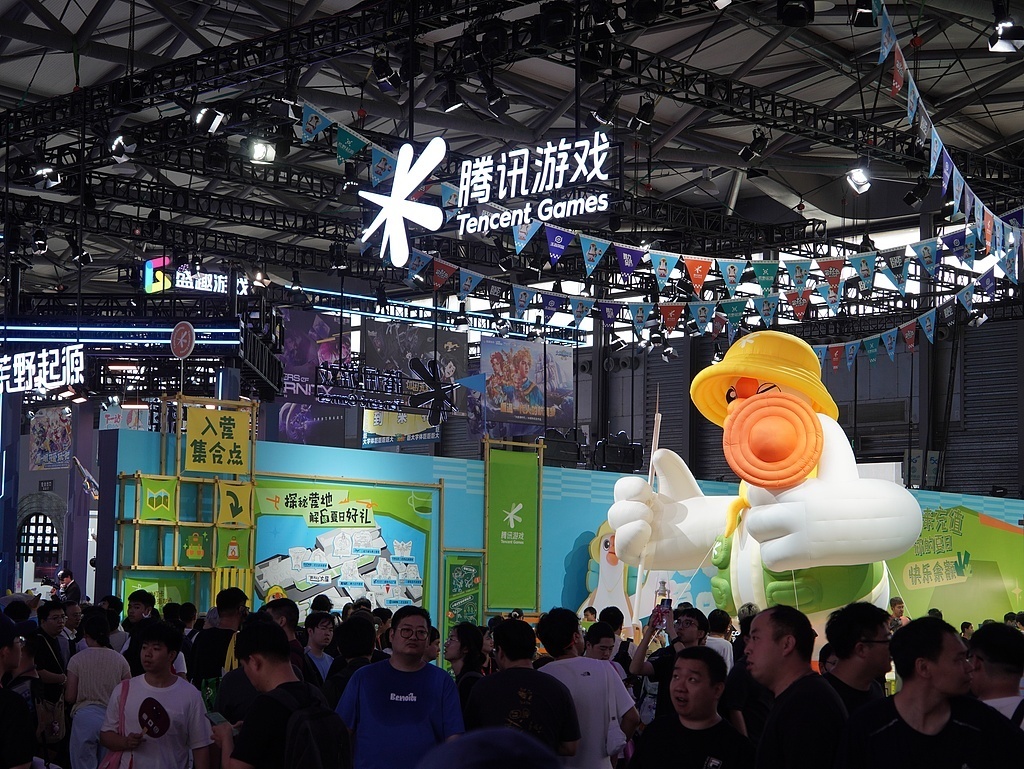
Core Viewpoint - The gaming sector has experienced a significant surge in stock prices this year, with various companies achieving remarkable growth, indicating a potential new phase of high-speed growth in the Chinese gaming industry [3][10]. Group 1: Stock Performance - ST Huatuo (002602) has seen a year-to-date increase of nearly 303%, becoming a leader in the A-share gaming sector with a total market capitalization of 153.8 billion yuan [1]. - Tencent (0700.HK) and NetEase (9999.HK) recorded stock price increases of over 60% and 70% respectively, while Giant Network (002558) surged over 260% [3]. - Other notable performers include G-bits (603444) with a rise of over 166%, Perfect World (002624) with an increase of over 88%, and 37 Interactive Entertainment with a growth of over 46% [6]. Group 2: Reasons for Stock Surge - The stock price increases are attributed to multiple factors, including high certainty in performance growth, improved internal control capabilities, and expectations for future delisting [3][6]. - The gaming industry is shifting from imitation to innovation, focusing on high-quality game development and international expansion, which enhances the industry's outlook [3][10]. - The release of new products exceeding expectations and stable performance from existing products have contributed to significant revenue and profit growth [7][11]. Group 3: Financial Performance - Century Huatuo reported a revenue of 17.2 billion yuan for the first half of the year, a year-on-year increase of 85.5%, with a net profit of 2.656 billion yuan, up 129.33% [7]. - G-bits achieved a revenue of 2.518 billion yuan, a growth of 28.49%, with a net profit of 645 million yuan, up 24.5% [7]. - Giant Network's revenue was approximately 1.662 billion yuan, reflecting a growth of 16.47%, while net profit was about 777 million yuan, up 8.27% [7]. Group 4: Policy and Market Dynamics - The issuance of game licenses has been a key driver for the gaming sector, with a significant number of licenses granted this year, indicating a favorable regulatory environment [8][10]. - The total number of game licenses issued in 2025 has reached 1,275, with 1,195 for domestic games and 80 for imported games [8]. - The Chinese gaming market's actual sales revenue grew by 14.08% year-on-year in the first half of the year, marking a historical high [10]. Group 5: Future Outlook - The gaming industry is expected to continue its upward trajectory, supported by policy incentives and technological advancements, particularly in AI and international market expansion [11][14]. - The focus on maintaining IP relevance and leveraging technology for game development is seen as crucial for sustaining growth [11][15].





A股10月“开门红” 沪指站上3900点!盘中这一细节你注意到了吗?
Mei Ri Jing Ji Xin Wen· 2025-10-09 07:54
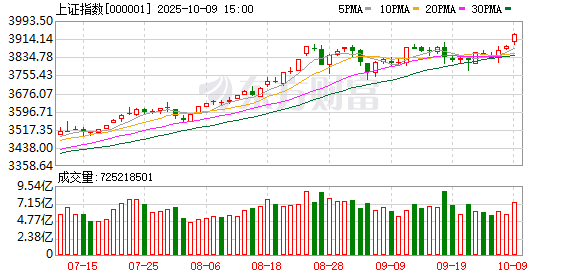
这一标志性事件,该如何理解呢? 首先我们认为,超预期的走势"虽迟但到",正是对相信趋势者的"奖励"。 10月9日,沪指高开高走突破3900点整数大关,刷新2015年8月以来新高。截至收盘,沪指涨1.32%,深 成指涨1.46%,创业板指涨0.73%。 板块方面,有色金属、核电、稀土永磁等板块涨幅居前,影视院线、旅游、教育等板块跌幅居前。 全市场超3000家上涨,共有99只个股涨停。沪深两市成交额2.65万亿元,较上一个交易日放量4718亿。 今天,节后首个交易日,A股的"开门红",红得有些发烫。 最受关注的无疑是沪指放量突破,时隔十年(2015年8月以来)重新站上了3900点关口,盘中最高触及 3936.58点。 日线来看,本轮3900点"攻坚战",始于8月25日,算上今天(毕竟盘初还有一点犹豫)共经历了28个交 易日的反复震荡,5次冲关失败。 而实际上,此前沪指在"初次站上→完全站稳"3400点时,同样经历了较长时间的蓄势,具体来说是30个 交易日。 | 上证指数 1A0001 指数K线区间统计 | | | | | --- | --- | --- | --- | | 起始时间 | 2025-05-14 | ...
15.5亿元产业基金成立,深创投加码AI与具身智能
Nan Fang Du Shi Bao· 2025-10-09 03:42
Core Insights - Shenzhen is accelerating the development of strategic emerging industries through capital, exemplified by the establishment of a private equity investment fund focused on artificial intelligence (AI) and embodied robotics with a total investment of 1.55 billion RMB [1][2] - The fund's creation reflects Shenzhen's commitment to integrating capital with the industrial chain to promote large-scale application of AI technologies, thereby solidifying its leading position in the national "AI + Robotics" landscape [1][4] Investment Strategy - Shenzhen Capital Group (深创投) has been active in the innovation investment sector since its establishment in 1999, managing over 510 billion RMB in assets and investing in more than 1,700 companies [2] - The new fund signifies a strategic focus on AI and embodied robotics, with a clear investment logic that supports key component breakthroughs, midstream platform development, and downstream application scenarios [2][3] - Shenzhen Capital Group has invested in approximately 40 projects in the humanoid robotics sector, covering the entire industrial chain from core components to complete machines [2] Industry Growth - The AI industry in Shenzhen is projected to reach a scale of 368.5 billion RMB by 2024, with 2,887 typical enterprises, while the robotics industry is expected to exceed 200 billion RMB in total output value [4] - Shenzhen's strategic plans aim to cultivate over 10 enterprises with a valuation of 10 billion RMB or more by 2027, and to exceed 3,000 AI companies by 2026 [4] Application and Innovation - Companies in Shenzhen are demonstrating strong vitality in the application of AI and robotics, with notable innovations such as the "Tian Gong Xing Zhe" robot and the world's first 5G-A humanoid robot "Kua Fu" [5] - The capital market is also heating up, with 72 financing events in the robotics sector in 2024, indicating a robust early-stage investment trend [6] Policy and Capital Synergy - The establishment of the AI and embodied robotics fund is a result of the synergy between industry capital and policy direction, facilitating a closed-loop of "technological breakthroughs—industry landing—capital circulation" [6]
深圳27家上榜“民营企业研发投入500家”榜单、29家上榜“民营企业发明专利500家”榜单 华为腾讯比亚迪名列“双榜”前十
Shen Zhen Shang Bao· 2025-10-09 03:01
Group 1 - The report indicates that the top 1000 private enterprises in China have increased their R&D investment to 1.43 trillion yuan in 2024, a growth of 2.78% compared to the previous year, with an average R&D intensity of 3.59% [2] - Shenzhen has 27 private enterprises listed in the top 500 R&D investment companies and 29 in the top 500 patent holders, with Huawei, Tencent, and BYD ranking in the top ten for both categories [1][2] - The total number of effective patents held by these enterprises reached 1.4281 million, a year-on-year increase of 27.58%, with invention patents accounting for 594,600, up 15.55% [2] Group 2 - Huawei's R&D expenditure for the first half of the year reached 96.95 billion yuan, a year-on-year increase of 9.04%, representing 22.7% of its revenue [3] - Tencent's R&D investment in the second quarter grew by 17% to 20.25 billion yuan, with total capital expenditure increasing by 119% to 19.11 billion yuan [3] - BYD became the "R&D King" of A-shares in 2024, with R&D investment reaching 30.9 billion yuan in the first half of the year, a 53% increase, and cumulative R&D investment exceeding 210 billion yuan [4]

AI,大厂的进度
2025-10-09 02:00
Summary of Key Points from Conference Call Industry Overview - The conference call primarily discusses advancements in the AI video generation sector, particularly focusing on OpenAI's Sora 2 and its implications for various tech companies in China, including Alibaba, Tencent, and ByteDance [2][5][6]. Core Insights and Arguments - **OpenAI's Sora 2**: - Launched with capabilities comparable to GPT-3.5, featuring high controllability, multi-language dialogue, environmental sound effects, and complete audio generation [2][3]. - Introduces a guest appearance feature allowing real people or objects to be integrated into AI-generated scenes, enhancing IP copyright protection and commercialization pathways [2][5]. - The app has rapidly climbed to the top of mainstream download charts, indicating strong market interest [3]. - **Alibaba's AI Developments**: - During the Cloud Summit, Alibaba unveiled multiple AI products, including updates to the Tongyi model family, which significantly reduces training costs while enhancing performance [2][7][9]. - New products like AI万能搜 (AI Universal Search) and AI One帮我挑 (AI One Help Me Choose) aim to transform traditional e-commerce search logic by understanding user needs through multi-turn dialogue [10][11]. - **Tencent's AI Strategy**: - Tencent is focusing on integrating AI tools into its products, enhancing user experience and driving commercialization [6]. - The introduction of the Yuanbao tool aims to unify C-end product capabilities and deepen integration with existing services [6]. - **ByteDance's Innovations**: - ByteDance's C Dream 4.0 has optimized image editing and high-definition output, improving user collaboration with AI [6]. Additional Important Insights - **Market Impact**: - Sora 2 is expected to drive a leap in AI video technology and create new social environments and IP monetization opportunities [5]. - Companies like Kuaishou, Tencent, Bilibili, and Meitu are highlighted as key players to watch in the evolving landscape of AI applications and tools [5]. - **E-commerce AI Applications**: - Alibaba's AI applications in e-commerce have shown significant improvements in transaction volume and advertising ROI through intelligent product selection and multi-target bidding [11]. - The AI capabilities are expected to enhance operational efficiency and customer retention, opening new avenues for business growth [8][11]. - **Content Creation Innovations**: - Alibaba's "造点" platform integrates AI-generated images and videos, supporting high-definition video generation with synchronized audio, catering to various application scenarios [12]. - **JD.com's AI Ecosystem**: - JD.com is expanding its AI capabilities beyond traditional e-commerce, integrating AI into various life service functions and hardware ecosystems [14][18]. - The introduction of products like "万能博士" (Universal Doctor) and "Jovi Inside" reflects JD's commitment to enhancing user interaction and experience through AI [16][17]. This summary encapsulates the key developments and strategic directions of major players in the AI and e-commerce sectors, highlighting the competitive landscape and potential investment opportunities.

港股早评:三大指数高开 金价新高黄金股强势 汇丰提议私有化恒生银行开涨近15%
Ge Long Hui· 2025-10-09 01:33
Core Viewpoint - The Hong Kong stock market showed a positive opening after three consecutive days of decline, with major indices experiencing gains, particularly in technology and local banking sectors [1] Group 1: Market Performance - The Hang Seng Index rose by 0.12%, the Hang Seng China Enterprises Index increased by 0.35%, and the Hang Seng Tech Index gained 0.41% [1] - Major technology stocks collectively saw an increase, with Meituan and JD.com rising by 1%, while Alibaba, NetEase, Xiaomi, Baidu, and Kuaishou also reported gains [1] - Local banking stocks surged, with HSBC Asia Pacific planning to privatize, leading to a nearly 15% increase in Hang Seng Bank's shares [1] Group 2: Sector Movements - International gold prices surpassed $4,000 for the first time, driving up gold-related stocks, with China Gold International rising by 3.3% [1] - Other sectors such as property management, paper, lithium battery, and domestic real estate stocks mostly experienced gains [1] - Conversely, gas stocks faced significant declines, with Dazhong Public Utilities dropping over 11%, and sectors like solar energy, biomedicine, electric power, and semiconductor stocks mostly fell [1]

AI高景气度延续,算力基础设施持续受益 | 投研报告
Zhong Guo Neng Yuan Wang· 2025-10-09 01:01
Group 1 - North American CSP cloud providers, including Amazon, Google, Meta, Microsoft, and Oracle, plan to invest over $370 billion in capital expenditures for the fiscal year 2025, representing a 40% year-on-year increase [1][3] - Oracle's latest quarterly report shows that its remaining performance obligations (RPO) reached $455 billion at the end of FY26Q1, an increase of $317 billion from the previous quarter, with expected capital expenditures of $35 billion for FY2026 [1][3] - The global Ethernet switch market is projected to generate $14.5 billion in revenue in Q2 2025, reflecting a year-on-year growth of 42.1% [1][3] Group 2 - In September, the communication sector underperformed the broader market, with the communication index declining by 0.15% while the CSI 300 index rose by 3.20%, ranking 14th among 31 primary industries [2] - The PE valuation for major companies in the communication sector was 23.8 times in September, slightly below the historical median of 33.6 times over the past decade [2] - Notable stock performances in September included Tengjing Technology (+66%), Chunzhong Technology (+92%), and Yuanjie Technology (+44%) [2] Group 3 - Domestic CSP cloud providers in China, such as ByteDance, Alibaba, Tencent, and Baidu, are expected to invest over 450 billion yuan in AI computing power by 2025, with accelerated industrialization of domestic super-node data centers [4] - Major chip manufacturers like NVIDIA, AMD, and Broadcom are increasing collaboration with CSP cloud providers, leading to a rise in demand for high-end chips [4] - Investment recommendations include focusing on AI computing infrastructure development, particularly in optical devices, communication equipment, and liquid cooling technologies [4][6] Group 4 - The three major telecom operators in China are considered important assets for dividend allocation, with stable operations and increasing dividend payout ratios, suggesting a long-term investment strategy [5][6] - The recommended stock portfolio for September 2025 includes China Mobile, Zhongji Xuchuang, ZTE, and Guanghetong [6]
中信证券:港股上行动能仍在 把握四大中长期方向
Zhi Tong Cai Jing· 2025-10-09 00:45
Core Viewpoint - The Hong Kong stock market is expected to benefit from a complete domestic AI industry chain and the influx of quality A-share companies listing in Hong Kong, with a long-term bullish trend anticipated to continue into 2024 despite short-term geopolitical uncertainties [1] Group 1: Market Performance - During the National Day holiday from October 2-6, the Hang Seng Index and Hang Seng Tech Index rose by 0.4% and 1.3% respectively, continuing the upward trend since September 5 [2] - Historically, the Hang Seng Index has averaged a 2.2% increase during the National Day holidays from 2015 to 2024, with the AH premium index averaging a contraction of 2.6% [2] - The average decline of the Hang Seng Index on the first trading day after the holiday is 1.5%, while the CSI 300 has an average increase of 0.9%, indicating a potential for A-shares to catch up post-holiday [2] Group 2: Liquidity and Investment Trends - Despite a 19% month-on-month decline in net inflows for Hong Kong ETFs in September, the total net inflow reached 172.7 billion yuan, the second highest since January 2021 [4] - The expectation of continued inflows into Hong Kong stocks is supported by low yields on financial products and money market funds, alongside a persistent "profit-making effect" in the market [4] - The correlation between the Hang Seng Tech Index and the USD/JPY exchange rate has turned positive, indicating potential benefits for Hong Kong stocks from Japanese investors' arbitrage activities [4] Group 3: AI Innovation and Investment - Major Chinese companies like Alibaba and Baidu are increasingly using self-designed chips for AI model training, reducing reliance on Nvidia chips [5] - Tencent, Baidu, and Alibaba are significantly increasing their capital expenditures in AI, with Alibaba planning to invest 380 billion yuan over three years [5] - The ongoing capital investments by U.S. tech giants in AI may lead to negative free cash flow for some companies, reflecting a global demand for AI investments [5] Group 4: Earnings Expectations - The net profit growth forecast for the Hang Seng Index and Hang Seng Tech Index for 2026 is 8.4% and 28.1% respectively, indicating strong global attractiveness [7] - Recent weeks have shown signs of stabilization in profit expectations for various sectors, including gaming, biotech, and software, suggesting potential benefits from valuation adjustments in the fourth quarter [7] - The dynamic PE ratios for the Hang Seng Index and Hang Seng Tech Index are currently at 12.1x and 22.3x, indicating that while valuations may not appear cheap, there is still room for expansion due to liquidity and AI catalysts [8]
