泸州老窖

Search documents
中国酒业如何跨越“冰与火”?这场“武汉会议”,回答时代之问!
Sou Hu Cai Jing· 2025-10-20 16:32
Core Insights - The Chinese liquor industry is at a historical crossroads, facing both challenges and opportunities due to rational consumption trends and the impact of artificial intelligence on industry logic [1] - The "World Famous Wine Value Conference" held in Wuhan addressed key industry questions regarding the redefinition of liquor value, the shift from scale expansion to value creation, and the globalization of Chinese liquor [1] Industry Trends - The global liquor industry is undergoing structural changes, with the high-end and luxury segments leading growth at a compound annual growth rate (CAGR) of 10.3%, particularly driven by the Asia-Pacific region [2] - The Chinese baijiu market is expanding steadily, with a CAGR of 2.3%, showcasing strong industry resilience and cultural roots [2] - Traditional business banquet markets are contracting, while personalized and emotionally connected consumption scenarios are rapidly emerging, emphasizing the need for liquor brands to adopt innovative strategies for differentiation [2] Consumer Behavior - The concept of rational consumption has gained consensus, with consumers prioritizing products that offer a balance of cost-effectiveness, quality, and emotional value [4] - The long-term development of world-famous liquors should focus on the values of "coexistence, empathy, and sharing," integrating industry with nature and society [4][5] Internationalization Challenges - China's baijiu currently holds only a 2.3% share in the international market, highlighting the need for the industry to overcome misconceptions and adopt successful strategies from international wine markets [7] - Recommendations for internationalization include aligning with international standards, innovating products and marketing strategies, and fostering collaboration among industry players [7] Innovation and Strategy - Leading companies are responding to industry changes through innovative practices, such as digital empowerment, cross-industry collaborations, and enhancing consumer experiences [10] - Anhui Gujing Group is leveraging digitalization to enhance traditional brewing processes and is actively promoting baijiu internationally [12] - Luzhou Laojiao is focusing on brand innovation through product diversification and cultural collaborations to connect with younger consumers [14] - Qingdao Beer is enhancing consumer engagement through innovative product offerings and efficient delivery systems [19] Future Directions - The conference outlined a clear roadmap for the future of Chinese liquor, emphasizing the importance of gratitude towards nature, commitment to quality, and deep emotional resonance with consumers [30] - The industry is encouraged to embrace the philosophy of "coexistence, empathy, and sharing" to navigate the challenges ahead and achieve sustainable growth [30]






山西汾酒:股东诉求、商标博弈与行业变局下的突围之路
Sou Hu Cai Jing· 2025-10-20 16:25
Core Insights - Shanxi Fenjiu is facing multiple challenges, including shareholder calls for large-scale buybacks, trademark disputes, and slowing revenue growth, indicating a critical juncture for the century-old brand [1][2][4] Shareholder Demands: Strategic Choices Under Capital Pressure - In August 2025, minority shareholders proposed aggressive measures, including an annual investment of 5-10 billion yuan for stock buybacks and collaboration with leading liquor companies to push for industry capacity reduction policies [2][4] - The company's mid-year report showed revenue of 23.964 billion yuan and net profit of 8.505 billion yuan, with growth rates declining by 12.7 and 9.3 percentage points compared to the same period in 2024 [2] Trademark Disputes: Knowledge Property Vulnerabilities - A trademark dispute escalated when Linfen Huanggai Fenjiu accused Shanxi Fenjiu of unfair competition, focusing on the legal status of the "Huanggai Fen" name, which has not been registered as a trademark despite significant sales [5][7] - The case highlights vulnerabilities in Shanxi Fenjiu's intellectual property management, including historical trademark issues and market naming legal blind spots [7][8] Industry Changes: Structural Contradictions in Capacity Reduction - The liquor industry is undergoing a deep adjustment, with the number of large-scale liquor enterprises decreasing by 43% since 2016, yet market concentration has not improved [8] - The actual production capacity exceeds demand by 30%, leading to a collapse in pricing structures and increased inventory cycles for distributors [8][11] Transformation from Scale Expansion to Value Reconstruction - Shanxi Fenjiu's path to overcoming challenges involves a three-dimensional transformation strategy, including capital operations and industry integration [9][11] - The company plans to implement a phased stock buyback and establish an acquisition fund to resolve trademark disputes, while also upgrading its intellectual property strategy [9][11] Modernization of Traditional Brands - The challenges faced by Shanxi Fenjiu reflect broader issues in the transformation of traditional industries in China, requiring a balance between historical legacy and modern business practices [12] - The ongoing trademark dispute and capacity reduction efforts may lead to a re-evaluation of the company's strategic direction, with potential for a shift from a production-oriented to a value-oriented approach [12]

如何看2025年9月消费数据
2025-10-20 14:49
Summary of Key Points from the Conference Call Industry Overview - **Retail Sector**: In September 2025, the total retail sales of consumer goods increased by 5.5% year-on-year, with online retail sales growing by 7%, accounting for 25% of total retail sales [1][2]. - **Food and Beverage Sector**: The restaurant industry saw a revenue increase of 0.9% year-on-year, while revenue from large-scale dining enterprises decreased by 0.6% [5]. - **Automotive Sector**: The automotive sector showed positive performance, with passenger car sales increasing by 13.2% year-on-year and new energy vehicle wholesale sales rising by 22.4% [9]. Core Insights and Arguments - **Retail Performance**: - Offline retail formats such as convenience stores, supermarkets, department stores, specialty stores, and brand boutiques experienced year-on-year growth rates of 6.4%, 4%, 1%, 5%, and 2%, respectively [1][2]. - Essential goods like grain and oil products and daily necessities grew by 6% and 7%, respectively, while discretionary items like cosmetics and jewelry saw growth rates of 9% and 10% [3][4]. - **Restaurant Industry Outlook**: - The restaurant sector is expected to recover to a growth rate of 4-5% as the impact of policies like the oil ban diminishes [5]. - **Hotel Industry Performance**: - The hotel sector's RevPAR (Revenue per Available Room) grew by 1% year-on-year, with occupancy rates stable and ADR (Average Daily Rate) increasing by approximately 1% [6]. - **Duty-Free Market**: - The duty-free market achieved a sales increase of 3.4% year-on-year, driven by reduced customer flow decline and increased average transaction value [7][8]. - **Automotive Sector Focus**: - The automotive industry is focusing on AI capabilities in pricing and vehicle technology, with significant growth in new energy vehicles [11][12]. Additional Important Insights - **Investment Recommendations**: - Suggested investment areas include high-end and cost-effective brands, offline channel expansions, and companies with strong overseas growth potential [10]. - **Textile and Apparel Sector**: - The textile and apparel industry saw a 4% year-on-year retail growth, with recommendations for brands like Bosideng and HLA due to their low valuation and growth potential [16]. - **White Wine Industry**: - The white wine sector is in a phase of active destocking, with a recommendation to focus on high-end brands like Moutai and Wuliangye [25]. - **Consumer Goods Market**: - The consumer goods market remains stable, with recommendations for companies with strong pricing power and cost transfer capabilities [26]. This summary encapsulates the key points from the conference call, highlighting the performance and outlook of various sectors, along with investment recommendations.
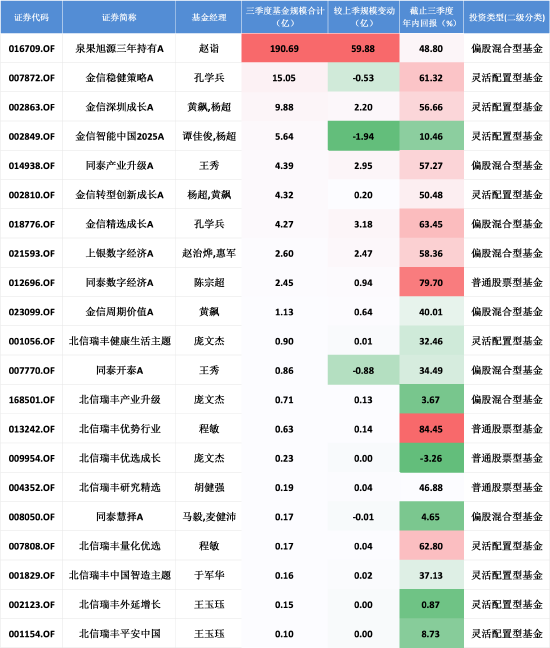
北信瑞丰优选成长三季报:坚守大消费今年来跌3.26%,规模业绩双重承压
Xin Lang Ji Jin· 2025-10-20 08:36
Core Insights - The report highlights that the North Trust Ruifeng Fund's performance remains weak despite a generally positive economic outlook in China, with a year-to-date return of -3.26%, making it the only fund among those disclosed to record negative returns [4][5] - The fund's assets under management stood at 0.23 billion yuan as of September 30, 2023, remaining unchanged from the mid-year report, placing it at the lower end among disclosed equity funds [1][5] Fund Performance - The fund has consistently underperformed, with negative returns over various time frames: -1.43% over the last six months, 0.48% over the past year, -21.04% over two years, and -21.86% over three years, ranking poorly among peers [5] - Since taking over in April 2021, the fund manager has achieved a total return of -11.53% and an annualized return of -2.66%, ranking 367 out of 557 similar products [5] Portfolio Composition - The fund continues to focus on the consumer sector, particularly in food and beverage, with significant holdings in leading brands such as Kweichow Moutai and China National Pharmaceutical Group [6][11] - As of the end of Q3, the top ten holdings were concentrated in the food and beverage sector, with a total market value of approximately 16.95 million yuan, and notable reductions in positions for several key stocks [7][8] Market Outlook - The fund manager anticipates that the upcoming "14th Five-Year Plan" will provide direction for domestic consumption and technological development, with expectations for a recovery in the consumer sector driven by foreign capital inflows and domestic demand [11] - The report suggests that the consumer sector, particularly in liquor and food and beverage, may benefit from a narrowing of the US-China interest rate differential and economic recovery, potentially leading to valuation corrections [11]
天风证券:双节动销符合预期 白酒板块情绪或有望修复
Zhi Tong Cai Jing· 2025-10-20 08:25
Core Viewpoint - The market atmosphere during the "Double Festival" is relatively flat, with a significant reduction in the traditional "peak season effect" [1][2] Sales and Pricing - Overall sales of liquor are expected to decline by 20%-30% during the Mid-Autumn Festival and National Day, aligning with pre-festival expectations [2] - Terminal sales showed a mild month-on-month recovery in September, but remain under pressure; wholesale prices have decreased year-on-year, leading to a contraction in channel profits [1][2] - High-end liquor prices are stabilizing after a decline, with brands like Moutai and Wuliangye showing signs of recovery in pricing [5][7] Inventory and Channel Dynamics - Distributors are facing increased inventory levels due to sluggish sales in Q2 2025, with pre-festival stocking leading to a temporary rise in inventory [1][2] - Despite a slight reduction in inventory during the festival season, it is expected that real estate liquor distributors will still hold high inventory levels [1][2] Regional Performance - There is a notable regional differentiation in sales performance, with high-end brands and regional leaders showing resilience, while mass-market products face challenges [3][4] - In Jiangsu, urban banquet sales are stable, while rural markets show weakness; in Henan, the mass-market price segment is becoming the main sales driver [3] - In Sichuan, demand for mid-range products is under pressure in urban areas, while county markets show stable performance for products priced between 300-500 yuan [3] Consumer Behavior - The consumption trend is shifting towards rationality, with stable performance in essential consumption scenarios like banquets and family gatherings, while business and government consumption remains weak [4] - The 100-yuan price segment is becoming the main sales driver, with high-cost performance products gaining popularity in regions like Henan and Shandong [6] Investment Recommendations - The company suggests that with the upcoming Q3 earnings disclosures, risks may be fully released, and the sentiment in the liquor sector may see a recovery [7] - Specific stocks to watch include those with strong elasticity in policy expectations and consumer recovery, such as Guizhou Moutai and Shanxi Fenjiu [7]

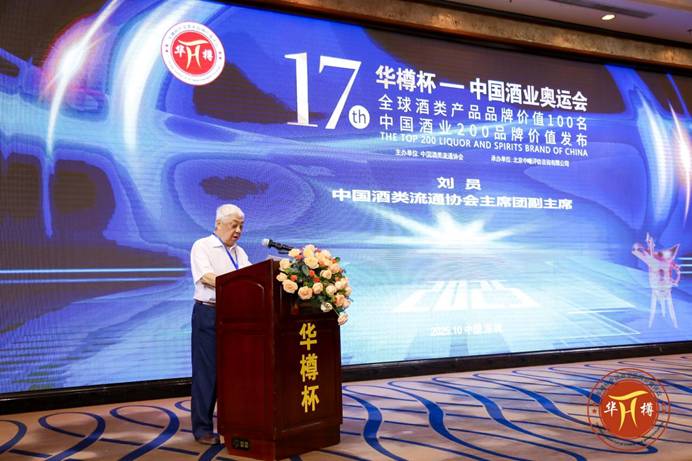
第十七届华樽杯200发布: 行业稳健发展,结构性调整中彰显韧性
Zhong Guo Shi Pin Wang· 2025-10-20 08:25
Core Insights - The total brand value of the top 200 Chinese liquor brands in 2025 is 99,305.21 billion yuan, with a growth rate of 4.26%, demonstrating resilience amid structural adjustments [1] Group 1: Huangjiu Market Growth - The Huangjiu market has experienced unexpected growth after years of stagnation, with brand value increasing by 42.91 billion yuan, a rise of 6.27% compared to 2024 [2] - Leading Huangjiu brands such as Guyue Longshan, Kuaijishan, and Shanghai Jinfeng achieved growth rates exceeding 15%, significantly higher than the overall liquor industry [2] - Growth in Huangjiu is driven by market upgrades and innovative products targeting younger consumers, such as low-alcohol canned Huangjiu [2] Group 2: Resilience of Liquor Distributors - Liquor distributors have shown strong resilience during the industry's adjustment period, with the top ten distributors' brand value increasing from 5,177.44 billion yuan to 5,254.41 billion yuan, a growth of 1.49% [4] - The average annual digital investment by distributors has grown by over 40%, enhancing operational efficiency through technology [4] - The success of self-owned brands, such as Jiuxian Network's Rongda Sauce Liquor, indicates a shift in competitive advantage from distribution rights to successful brand development [4] Group 3: White Liquor Market Dynamics - The overall value of sauce-flavored white liquor has surpassed 21,554.5 billion yuan, with a growth rate of 3.72%, although the growth rate has significantly slowed [8] - New brands like Rongda Sauce Liquor have shown exceptional performance, with a value increase of 90.1%, highlighting innovation within the category [8] - The growth of clear-flavored white liquor has been driven by brands like Fenjiu, contributing over 60% of the category's growth in recent years [8] Group 4: Beer and Wine Market Challenges - For the first time in 17 years, the top beer brands, including China Resources Beer and Qingdao Beer, have seen a decline in brand value [10] - The total brand value of the wine sector has decreased from 1999.15 billion yuan to 1911.71 billion yuan, a drop of 4.37%, reflecting ongoing adjustments in the market [10] - The wine industry has faced challenges from imported wines and changing consumer preferences, leading to a significant slowdown in growth rates [10]



13只白酒股上涨 贵州茅台1457.93元/股收盘
Bei Jing Shang Bao· 2025-10-20 07:56
Core Viewpoint - The liquor sector shows signs of recovery, with mixed performance among individual stocks, indicating a complex market environment influenced by various consumption scenarios and price segments [1] Industry Summary - The Shanghai Composite Index closed at 3863.89 points, up 0.63%, while the liquor sector index closed at 2278.16 points, up 0.84%, with 13 liquor stocks rising [1] - The high-end liquor segment is experiencing a weak recovery in demand during the peak season, while the mass-market segment is performing well, leading the industry [1] - The next-highest price segment is under pressure, showing significant differentiation in performance [1] - Current industry inventory levels are stabilizing, with some liquor companies reducing inventory to alleviate operational pressure [1] Company Summary - Kweichow Moutai's stock closed at 1457.93 CNY per share, up 0.20% [1] - Wuliangye's stock closed at 120.46 CNY per share, down 0.50% [1] - Shanxi Fenjiu's stock closed at 191.57 CNY per share, down 2.21% [1] - Luzhou Laojiao's stock closed at 133.15 CNY per share, down 1.37% [1] - Yanghe Brewery's stock closed at 70.18 CNY per share, up 0.26% [1]
白酒行业深度报告:两轮白酒调整节奏异同对比及当下投资机会
CAITONG SECURITIES· 2025-10-20 07:56
Investment Rating - The report maintains a "Positive" investment rating for the liquor industry [1] Core Insights - The report analyzes the adjustment phases of the liquor industry, comparing the current phase with the 2013-2016 period, highlighting that the current adjustment is primarily driven by a decline in business demand, which is less severe than the previous round [3] - It emphasizes that the purchasing power of consumers for high-end liquor has significantly improved compared to the lowest price point in 2014, indicating a potential for market recovery [3] - The report identifies three major changes in the liquor market: increased concentration among top companies, the rise of sauce-flavored liquor, and improved market value management practices among liquor companies [3] Summary by Sections 1. Historical Adjustment Phases - The liquor industry has entered a fifth year of adjustment since 2021, with significant impacts from the 2025 policy aimed at reducing government consumption [8] - The report reviews the historical context of the 2013-2016 adjustment, noting that the current environment is different but shares some similarities [8] 2. Current Adjustment Stage - The report indicates that the liquor industry has been in a downward adjustment since the third quarter of 2024, with expectations for recovery around the second quarter of 2026 [42] - It highlights that the current adjustment is less severe than the previous one, with a maximum revenue decline of 5% and profit decline of 8% compared to the previous maximums of 15% and 30% respectively [50] 3. Market Changes Impacting Investment - The concentration of the top six liquor companies has increased significantly, with their revenue share rising from 18.3% in 2013 to 48.1% in 2024, enhancing industry self-regulation [51] - The report notes that the expansion of sauce-flavored liquor production capacity has not yet translated into revenue share, but it is expected to gain traction in the future [3] - It discusses the evolving market value management strategies among liquor companies, including increased dividend payouts and share buybacks, which are expected to enhance investor returns [3]

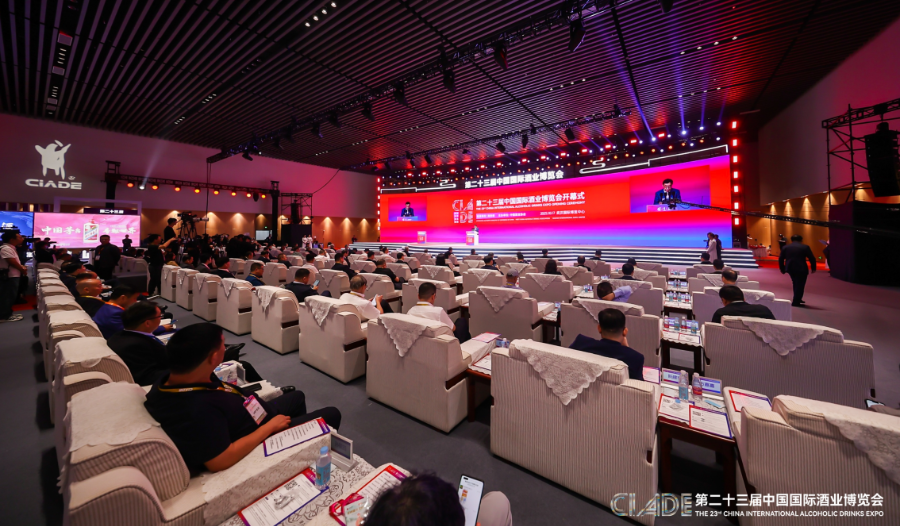
首落武汉!第二十三届酒博会开幕,酒业龙头“掌舵人”齐聚
2 1 Shi Ji Jing Ji Bao Dao· 2025-10-20 07:16
"在当前世界经济格局深刻变革的背景下,以酒为媒,共商合作的模式,正是推动经济多元化,促进贸易投资便利化的生动实 践。"第十二届全国政协副主席马培华在致辞中表示,中国酒业乃至世界酒业要实现更高质量、更可持续的发展,一是要聚焦科 技创新,锻造发展引擎,推动新一代信息技术与酿酒工艺深度融合,以科技赋能产业升级。二是要深挖文化内涵,提升品牌软 实力,加强对中国悠久酿酒历史、独特酿造工艺、丰富酒理酒俗的系统性梳理和价值挖掘,将传统文化与现代审美相结合,创 新表达方式,增强品牌情感共鸣和文化吸引力。三是要践行绿色发展观,构建责任共同体,充分发挥产业链优势,在提振消 费、乡村振兴、产城融合方面系统发力,将生态环境保护融入产业发展的全过程。 当前,"绿色发展、理性发展,归根到底是确保行业的可持续发展"这一理念已成为酒业的共识,ESG所倡导的环境友好、社会 责任与良好治理,为酒业走向更高质量、更可持续未来指明方向。 就在10月16日,2025全国理性饮酒宣传周启动仪式暨2025中国酒业ESG论坛在武汉举行。记者从会上获悉,今年,在中国酒业 协会的牵头指导下,联合21世纪经济报道研究团队共同研发搭建了全国首个垂直酒类专业ESG评 ...
食品饮料三季报前瞻:白酒加速出清,食品关注景气赛道
CMS· 2025-10-20 07:02
Investment Rating - The report maintains a recommendation for the industry, indicating a focus on sectors with good performance and potential recovery in demand [3]. Core Insights - The liquor sector is experiencing a gradual improvement in sales dynamics, with a continued focus on clearing inventory. The report suggests that when performance no longer declines, it will signal a potential recovery in stock prices [7][13]. - The food sector shows a divergence in performance, with new consumption categories maintaining good momentum while traditional categories face weaker demand. The report emphasizes the importance of monitoring the recovery in traditional consumption [21][31]. Summary by Sections Liquor Sector - Sales dynamics in Q3 improved compared to May-June, but the report anticipates continued inventory clearance with a double-digit year-on-year decline expected. The demand from government and business sectors remains under pressure, while the banquet and mass consumption markets are relatively stable [7][13]. - Major brands like Moutai and Wuliangye are expected to see varied performance, with Moutai projected to achieve a 4% increase in revenue year-on-year, while Wuliangye may experience an 8% decline [14][16]. Food Sector - The overall demand environment in Q3 was relatively weak, with retail sales growth slowing down. However, sectors like snacks and beverages continue to show good performance, while traditional categories like seasonings and beer remain subdued [21][31]. - The report highlights that raw material costs are generally declining, but the trend is slowing down. Packaging prices have increased, impacting profit margins across various segments [24][25]. - Specific companies such as Yili and Mengniu are facing growth pressures, while new dairy companies are expected to maintain strong growth due to structural improvements [31][35]. Investment Strategy - The report recommends focusing on sectors with good performance, such as snacks and beverages, while also keeping an eye on traditional consumption recovery. Specific stock recommendations include West Wheat Foods in the snack sector and leading liquor brands like Shanxi Fenjiu and Luzhou Laojiao [10][11].