华润置地

Search documents
周期专场-二月数据解读
2026-02-05 02:21
Summary of Conference Call Notes Industry Overview Real Estate Market - New home sales in core cities are still experiencing negative growth, while the second-hand housing market saw significant increases in transaction volume year-on-year and month-on-month due to early demand for school district properties and supply lagging behind, leading to a rise in both volume and price [1][3] - Anticipation for continued market heat in March, with April's performance dependent on policy support. A potential policy package similar to that of September 24, 2024, could signal a fundamental turning point in core urban areas by the end of 2026 [1][4] - Real estate stocks typically lead the fundamentals by 2-3 quarters, suggesting Q2 may be a good time to increase allocations [4] Construction and Building Materials - The construction and building materials sector is currently in a subdued state, with many projects halted due to the approaching Spring Festival and downstream demand not yet released [6] - Cement prices are continuously declining, with a recent drop of 0.8%. Glass demand is shrinking, and prices remain stable, while manufacturers of consumer building materials are promoting price increases [6][10] - The sector is at historical low levels, presenting opportunities for capital rebalancing [7] Express Delivery Industry - Domestic express delivery business saw a high growth rate of approximately 20% in January, influenced by the timing of the Spring Festival. There is a noticeable divergence in growth rates among leading companies [8] - Jitu Express benefits from the rapid growth of TikTok in Southeast Asia and Latin America, predicting high growth in shipment volume for Q1 due to promotional activities [8] Oil Transportation Industry - Since August 2025, oil transportation rates have significantly increased due to improved supply-demand dynamics and tightening sanctions. The BDTI index has nearly doubled year-on-year as of February 2, 2026 [9][11] - The mid-term outlook suggests continued upward pressure on rates due to geopolitical events and sanctions, providing substantial earnings elasticity for companies in this sector [11] Chemical Logistics - Chemical prices have gradually recovered since late 2025, although they remain at five-year lows. The industry is expected to experience a recovery in trade activity and inventory digestion, leading to improved logistics conditions [12] Civil Aviation - Domestic civil aviation demand is robust, with January passenger volume increasing nearly 9% year-on-year. The Spring Festival period is expected to exceed historical peak levels for passenger volume [13][14] - The average ticket price has increased by 2.4% year-on-year, with a notable rise in pre-sale ticket prices expected in the coming weeks [13][14] Road Transportation - High-speed road freight throughput reached 241 million vehicles in January, marking a year-on-year increase of 22.8%. Predictions indicate significant population movement during the Spring Festival, with a projected increase in passenger volume [15] Key Recommendations - For real estate, focus on companies like China Merchants Shekou, New Town Holdings (A-shares), and China Resources Land (H-shares) [5] - In the construction sector, consider leading firms such as Yuhong, Sankeshu, Tubao, and China Jushi [7] - In the express delivery sector, maintain a watch on leading domestic companies and Jitu Express for overseas delivery [16] - For oil transportation, prioritize companies like China Merchants Energy and COSCO Shipping Energy [11] - In the chemical logistics space, look at companies like Meikewei, Xingtong Co., and Hongtan Wisdom for potential performance rebounds [12] - In civil aviation, monitor the evolving pricing strategies of airlines as they shift towards price control [14]
如何看当前时点地产链投资机会
2026-02-05 02:21
Summary of Conference Call Records Industry: Real Estate Key Points - The real estate industry has undergone a deep cleansing of its fundamentals, with positive policy signals expected to gradually restore holdings, leading to valuation elasticity. In January, the second-hand housing market in core cities showed signs of recovery, with increased transaction volumes and decreased listing volumes, optimizing supply-demand relationships and narrowing price declines [1][2][3] - Multiple authoritative media outlets have released positive signals regarding the financial asset attributes of real estate and the cancellation of restrictive measures. Many real estate companies are no longer required to report the "three red lines" indicators monthly, indicating a period of intensive policy implementation, which enhances the investment value of the real estate sector [3] - The investment strategy for the building materials industry chain should focus on balance and early layout of related opportunities. Global expansion of balance sheets and marginally increasing liquidity in the A-share market support potential excess return opportunities in the building materials sector [1][4] - The A-share market's IPO financing is expected to be at historical average levels, but the second half of the year may see quarterly financing amounts exceeding expectations, which could signal a warning for the technology sector as relative returns may decrease [5] - The current economy is at the end of a Kondratiev wave depression, with non-ferrous metals and commodities being favorable investment options. The adjustment in the real estate market is nearing its end, with potential investment opportunities expected to emerge [6] Additional Insights - The real estate sector is currently in a core configuration window with high win rates and odds. As of Q4 2025, the sector's holdings accounted for approximately 0.43% of stock investment value, indicating a significant underweight that has persisted for 24 quarters [2] - The recovery of the Hong Kong real estate sector serves as a reference for the mainland market, with historical data suggesting that the adjustment in actual housing prices in China has been sufficient, leading to an increase in the sector's win rate [2] - The building materials sector's investment strategy emphasizes early positioning in response to market changes, with a focus on companies with low valuations and strong resource reserves, such as China Trade and Greentown China [4] - The cement industry is highlighted for its potential, with profitability closely tied to capacity utilization rates. Companies like Conch Cement are expected to see significant profit increases if prices rise [10] - The home appliance sector is anticipated to recover as real estate data stabilizes, which will directly boost demand for white goods and kitchen appliances [13] Industry: Building Materials Key Points - The investment strategy for the building materials industry should focus on both expansion and balance, with an emphasis on early positioning in real estate-related opportunities [4] - Companies with low valuations and strong resource reserves, such as China Trade and Greentown China, are recommended for investment [4] - The cement industry is expected to enter a new recovery cycle, with significant profit potential linked to price increases [10] Industry: Home Appliances Key Points - The home appliance sector is nearing the end of its darkest period, with potential investment opportunities arising as real estate data stabilizes and consumer demand is expected to recover [13] - The sector's current low valuations present opportunities for growth, particularly in white goods and kitchen appliances, which are closely tied to real estate performance [13] Additional Insights - Companies like Midea, Haier, and Gree are highlighted for their strong dividend yields, making them attractive investment options [13] - Newer companies in the market, such as Roborock and Ecovacs, are also noted for their competitive positioning and potential for valuation recovery [13]
中泰国际每日晨讯-20260205
ZHONGTAI INTERNATIONAL SECURITIES· 2026-02-05 02:13
2026 年 2 月 5 日 星期四 昨日港股窄幅波动。恒生指数及国企指数分别收报 26,847 点及 9,048 点,前者上升 0.1%,后者下跌 0.1%。港股成交合共 2,854 亿港元,较前日的 3,352 亿港元,下跌 14.9%,或反映投资者观望情绪增加。分类指数方面,能源、地产建筑、原 材料业指数分别上升 3.0%、2.1%、1.4%;资讯科技、非必需性消费则分别下跌 3.4%、0.4%。蓝筹个股方面,信义玻璃 (868 HK)及中国神华(1088 HK)领涨,分别上升 5.9%及 5.7%;携程集团(9961 HK)及腾讯控股(700 HK)领跌,分别下跌 6.1%及 4.0%。 主要内房港股明显上升,例如华润置地(1109 HK)、中国海外发展(688 HK)、越秀地产(123 HK)、万科企业(2202 HK)上涨 3.9%-6.2%。近期部分投资机构预期政府在短中期未来将公布更积极推动房地产政策。至目前为止,房地产销售数字仍需 突围,存销比率也较高。我们盼望推动政策的力度可较大。 ➢ 每日大市点评 昨晚美股表现分化,科技股受到抛售,例如 AMD(AMD US)下跌 17.3%,光伏股则上 ...
金十数据全球财经早餐 | 2026年2月5日
Jin Shi Shu Ju· 2026-02-04 23:00
Group 1 - The US ADP employment report for January showed an increase of only 22,000 jobs, falling short of market expectations [3][12] - The US Treasury Department has maintained its debt issuance strategy, continuing its forward guidance that has been in place for two years [12] - The WTI crude oil price rose to $65 per barrel, reflecting a nearly 2% increase before retracting some gains, while Brent crude oil closed at $68.47 per barrel, up 1.14% [4][7] Group 2 - The major US stock indices showed mixed results, with the Dow Jones Industrial Average rising by 0.53%, while the Nasdaq Composite fell by 1.5% and the S&P 500 declined by 0.51% [4][7] - In the Hong Kong market, the Hang Seng Index closed up 0.05%, while the Hang Seng Tech Index fell by 1.84%, with coal stocks showing strong performance [5][7] - The A-share market saw the Shanghai Composite Index rise by 0.85%, driven by strong performances in the photovoltaic and coal sectors, while the ChiNext Index fell by 0.40% [6][7]


开源证券晨会纪要-20260204
KAIYUAN SECURITIES· 2026-02-04 15:22
2026 年 02 月 05 日 开源晨会 0205 ——晨会纪要 -20% 0% 20% 40% 60% 80% 2025-02 2025-06 2025-10 沪深300 创业板指 数据来源:聚源 昨日涨跌幅前五行业 | 行业名称 | 涨跌幅(%) | | --- | --- | | 煤炭 | 7.583 | | 建筑材料 | 3.481 | | 房地产 | 2.966 | | 交通运输 | 2.818 | | 食品饮料 | 2.333 | | 数据来源:聚源 | | 昨日涨跌幅后五行业 | 行业名称 | 涨跌幅(%) | | --- | --- | | 传媒 | -3.122 | | 通信 | -2.735 | | 计算机 | -1.696 | | 电子 | -1.550 | | 商贸零售 | 0.140 | | 数据来源:聚源 | | 吴梦迪(分析师) wumengdi@kysec.cn 证书编号:S0790521070001 观点精粹 总量视角 【金融工程】港股量化:2026 开年恒指强劲,2 月组合维持低估值配置——金融 工程定期-20260204 港股 CCASS 优选 20 组合的绩效表现:组 ...
智通港股解盘 | AI应用端受到冲击科技股走弱 顺周期类逻辑在走强
Zhi Tong Cai Jing· 2026-02-04 12:31
Market Overview - The Hang Seng Index showed minor fluctuations, closing up by 0.05%, but structural issues in the market are prominent [1] - The U.S. Navy has increased its military presence in the southern waters of Iran, with around 32 vessels reported as of February 3 [1] - Gold stocks, such as WanGuo Gold International, saw a rise of over 7% [1] Trade Agreements - The U.S. has reduced tariffs on Indian imports from 50% to 18%, but details of the trade agreement remain unclear [1] - India is shifting towards a more pragmatic approach in its economic development, moving away from previous over-optimism [1] Technology Sector - The technology sector is facing challenges, particularly in AI and gaming, with significant stock declines in companies like TIS and Trend Micro [3] - Samsung Electronics' market value surpassed 1 trillion Korean won (approximately 68.8 billion USD) due to strong demand for storage chips [2] - Chinese companies in the semiconductor space, such as Zhongji Xuchuang and Han's Laser, are experiencing stock declines [2] Energy Sector - Hydrogen energy is gaining traction, with the Ministry of Industry and Information Technology planning to increase green hydrogen production to 250,000 tons per year by 2025 [3] - Companies like Guofu Hydrogen Energy and Zhongshun Energy have seen stock increases of over 18% and 12%, respectively [3] Coal Industry - Indonesia's government has announced significant coal production cuts, impacting China's coal supply by 5.3% [4] - Major coal companies like Yanzhou Coal and China Coal Energy have seen stock increases of over 8% due to these developments [4] Aerospace and Technology - SpaceX announced the acquisition of xAI, aiming to integrate AI with space technology, which could lead to significant advancements in energy production and storage [5] - Companies in the solar energy sector, such as GCL-Poly and Xinyi Solar, are also performing well, with stock increases of over 2% [6] Real Estate Market - China Construction Bank is supporting the acquisition of second-hand housing for rental projects in Shanghai, which is expected to improve inventory turnover in major cities [6] - Real estate companies like Yuexiu Property and China Resources Land have seen stock increases of over 5% [6] Aviation Sector - The Spring Festival travel season has begun, with a 5.3% year-on-year increase in passenger volume on the first day [7] - Major airlines like China Eastern and China Southern have reported significant stock increases of over 5% due to improved performance and cost management [7] Digital Economy - The Guangdong government is promoting digital consumption and smart services, focusing on areas like autonomous driving and smart tourism [8] - Companies involved in autonomous driving, such as Youjia Innovation and Horizon Robotics, are expected to benefit from these initiatives [8] Company-Specific Developments - China Shipbuilding Defense announced a new contract for the construction of 16 container ships, valued between 736 million to 896 million USD, which is expected to positively impact cash flow and future performance [9] - The company anticipates a significant increase in net profit for 2025, with projections of 9.4 to 11.2 billion CNY, reflecting a year-on-year growth of 149.61% to 196.88% [9]
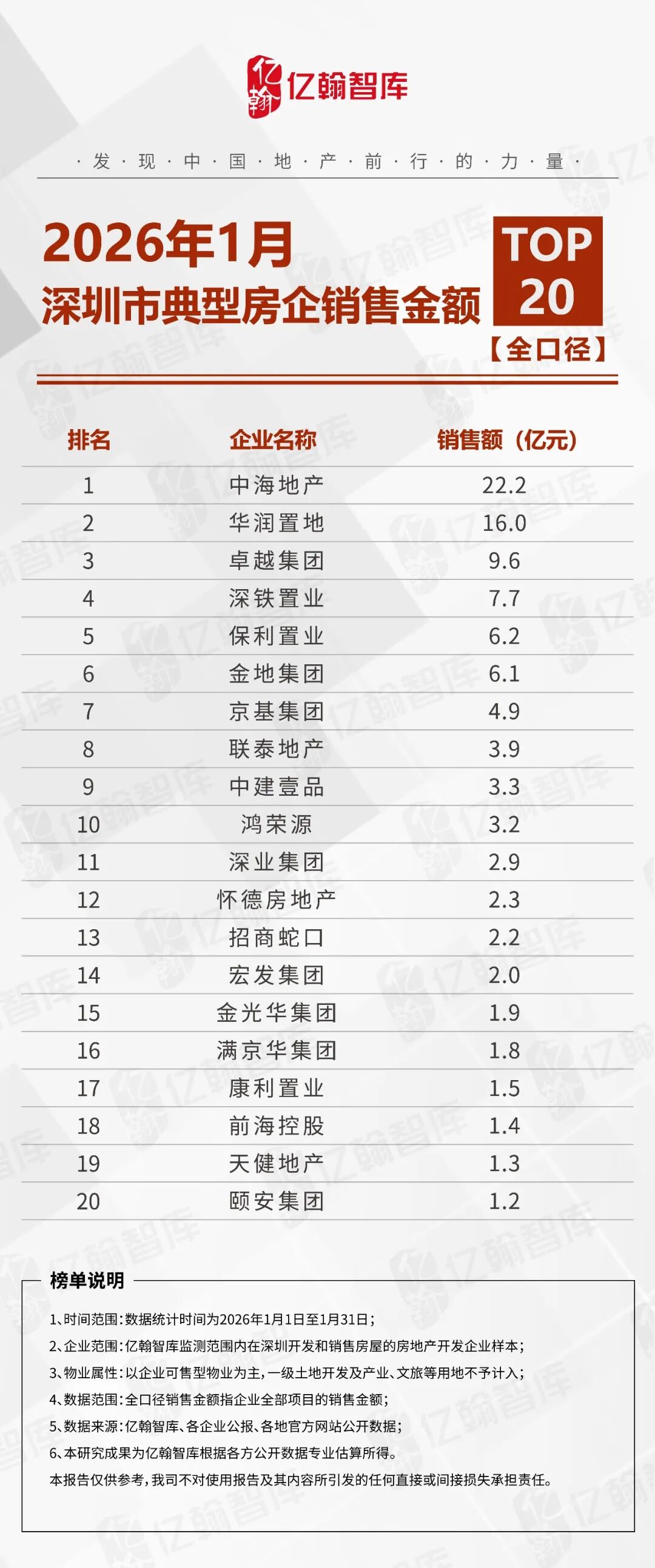
2026年1月深圳典型房企销售金额TOP20【全口径】
Xin Lang Cai Jing· 2026-02-04 12:20
Group 1: Sales Performance of Real Estate Companies - In January 2026, the top three real estate companies in Shenzhen by sales were China Overseas Land & Investment with 22.2 billion yuan, China Resources Land with 16.0 billion yuan, and Excellence Group with 9.6 billion yuan [2][5][18] - The sales threshold for the top 5 companies reached 6.1 billion yuan, while the top 10 and top 20 thresholds were 3.2 billion yuan and 1.2 billion yuan, respectively [5][18] Group 2: Policy Dynamics - Shenzhen introduced a management method for allocated affordable housing, effective from March 1, 2026, which prohibits any conversion of allocated affordable housing into commercial housing [5][19] - The application conditions for allocated affordable housing include having Shenzhen household registration, no self-owned housing in Shenzhen, and at least five years of social insurance contributions [6][23] Group 3: Market Performance - In January 2026, the number of new residential units signed in Shenzhen was 2,579, a decrease of 10.7% month-on-month and 49.3% year-on-year, attributed to a slowdown in new project launches [9][24] - The second-hand residential transactions saw an increase, with 5,281 units transferred, marking a year-on-year growth of 15.96% and a month-on-month increase of 6.88% [11][26] - As of the end of January, the inventory of new residential units in Shenzhen was 29,950, a decrease of 380 units from the previous month, due to a reduction in new launches and some inventory being converted to sales [13][28] Group 4: Market Outlook - The Shenzhen real estate market continued to show signs of recovery in January, with strong sales performance from quality projects indicating a gradual increase in market confidence [15][30] - The market is expected to maintain a "steady progress with quality first" trend as the traditional peak season for property transactions approaches after the Spring Festival [30]




华润、恒隆等项目“竣工即开业”,头部开发商以优质增量穿越周期
Sou Hu Cai Jing· 2026-02-04 11:53
Group 1: Office Rental Market Overview - The average office rental price in eight major cities (Beijing, Shanghai, Guangzhou, Shenzhen, Hangzhou, Chengdu, Nanjing, and Wuhan) decreased by 7.35% month-on-month to 2.3 yuan/square meter/day in December 2025, with the decline accelerating compared to November's 6.28% [4] - Year-on-year, the average rental price dropped by 19.37%, with all cities except Shenzhen experiencing double-digit declines, particularly in Guangzhou, Beijing, and Nanjing [4] - The imbalance between supply and demand in the office market is evident, with a 6.7% year-on-year increase in new office space completed in 2025, while demand remains weak, primarily supported by sectors like technology and finance [4] Group 2: Supply and Demand Dynamics - A significant influx of high-quality office projects is expected in major cities like Shanghai, Beijing, Guangzhou, Hangzhou, Xi'an, and Changchun from late 2025 to early 2026 [5] - The first-tier cities' Grade A office rental prices continued to decline in Q4 2025, with varying degrees of decrease across the four cities [4] - The vacancy rate in Beijing decreased due to no new supply, while Shanghai, Guangzhou, and Shenzhen saw high vacancy rates due to new supply or high existing stock [4] Group 3: Project Developments and Market Activity - Major commercial real estate companies like China Resources Land, Oceanwide Holdings, and Hang Lung Properties are actively developing new projects and revitalizing existing assets through urban renewal [7][9] - The Shanghai China Resources Center, a key project, has a total construction area of approximately 125,000 square meters and has completed its construction registration, allowing for immediate tenant entry [8] - The operational capabilities of office space operators are crucial, with projects like the Shanghai China Resources Center attracting luxury brands like LV, indicating strong foreign investment confidence in the Shanghai market [11] Group 4: Market Expansion and Trends - The office space service sector is witnessing a gradual recovery in expansion confidence, with 12 new projects signed or opened during the reporting period, reflecting a positive trend [16] - IWG Group leads with four new openings in cities like Shenzhen and Hefei, emphasizing its deep penetration into core cities [16] - The concentration of projects in core cities and key areas is notable, with Shenzhen being the most active city, followed by Shanghai, indicating a strong demand for office space driven by small and medium enterprises [17]



金融制造行业2月投资观点及金股推荐-20260204
Changjiang Securities· 2026-02-04 11:06
Investment Rating - The report provides a "Buy" rating for several key stocks in the financial and manufacturing sectors, including China Resources Land and Beike-W [15][18][20][21]. Core Insights - The macroeconomic environment shows a continuation of strong supply and weak demand characteristics, with short-term growth pressure remaining manageable [9]. - The real estate sector is experiencing a valuation recovery opportunity for quality developers due to a resonance between fundamentals and policies [10]. - The banking sector is witnessing a recovery from oversold conditions, with stock prices rebounding ahead of improvements in the funding environment [20]. - The non-bank financial sector is expected to benefit from policy-driven high-quality development, with a focus on high-performing stocks [22]. - The new energy sector has established a bottom line, with attention on marginal changes in new technologies [25]. - The machinery sector is gaining order resilience from overseas solar expansion and new business developments, while space solar technology opens growth opportunities [31]. - The environmental sector is focusing on carbon neutrality opportunities, with overseas expansion and metal prices providing elasticity [33]. Summary by Sections Real Estate - The sector is expected to face challenges in 2026, but recent policy easing and improved second-hand housing sales indicate a potential recovery [14]. - China Resources Land is highlighted as a leading developer with strong operational capabilities and a solid financial position, projected to achieve a net profit of 26.2 billion, 27 billion, and 28.2 billion from 2025 to 2027 [15]. Banking - Nanjing Bank is recommended due to its expected double-digit revenue growth in 2025, driven by stable asset quality and improved net interest margins [21]. Non-Bank Financials - New China Life Insurance is noted for its high elasticity and potential for improved returns on equity, with projected intrinsic values of 292.1 billion and 329.0 billion for 2025 and 2026, respectively [24]. New Energy - The storage sector is expected to see demand stability supported by national capacity pricing, while lithium battery technology is anticipated to rebound with improved economic conditions [25]. - JunDa Co. is recognized for its strategic partnerships and potential growth in the space solar sector, with projected profits increasing significantly by 2027 [27]. Machinery - The machinery sector is benefiting from overseas solar project expansions, with companies like DiEr Laser positioned to capitalize on new technologies and increased order volumes [31][32]. Environmental - Weiming Environmental is highlighted for its potential in the Indonesian waste-to-energy market, with expected project launches in early 2026 [39]. - The company is projected to achieve net profits of 2.88 billion and 3.44 billion in 2025 and 2026, respectively [39]. Light Industry - The light industry is seeing a rebound in export-driven companies, with a focus on quality stocks that can leverage cost efficiencies and supply chain advantages [43]. Military Industry - The military sector is expected to benefit from the transition of military technology to civilian applications and increased military trade, with key recommendations including Aviation Power and AVIC Xi'an Aircraft Industry [51][53].





恒生指数收涨0.05%,煤炭、内房股走高,科网股低迷
Jin Rong Jie· 2026-02-04 09:58
Market Overview - The Hang Seng Index closed up 0.05% at 26,847.32 points, while the Hang Seng Tech Index fell by 1.84% to 5,366.44 points [1]. Sector Performance - Coal stocks led the gains, with Yanzhou Coal Mining rising over 10% and China Shenhua Energy increasing by over 5% [1]. - Chip stocks showed weak performance, with Shanghai Fudan down over 5% and Huahong Semiconductor declining nearly 5% [1]. - The technology sector overall performed poorly, with Tencent Holdings down nearly 4% and Bilibili falling over 3% [1]. - Domestic property stocks collectively rose, with Shimao Group increasing over 14% and Sunac China rising over 8% [1]. Individual Stock Movements - Among the Hang Seng Index constituents, Xinyi Glass, China Shenhua, and China Resources Land had the highest gains [1]. - Conversely, Ctrip Group, Tencent Holdings, and NetEase saw the largest declines [1]. - In the Hang Seng Tech Index, Li Auto, Leapmotor, and Haier Smart Home showed the most significant increases [1]. - On the downside, Kingdee International, Ctrip Group, and Tongcheng Travel experienced the largest drops [1].