
协鑫科技

Search documents
硅业分会:多晶硅市场价格涨势延续 供应宽松格局未改
智通财经网· 2026-01-07 09:10
Group 1 - The core viewpoint of the articles indicates that the domestic polysilicon market is experiencing a price increase, driven by several factors including reduced production rates and rising prices in downstream sectors [1][2]. - The average transaction price for n-type recycled polysilicon is reported at 59,200 yuan per ton, reflecting a week-on-week increase of 9.83% [1][3]. - The transaction price range for n-type granular silicon is between 50,000 to 64,000 yuan per ton, with an average price of 55,800 yuan per ton, marking a week-on-week increase of 10.5% [1][3]. Group 2 - In December 2025, the domestic polysilicon production was approximately 111,200 tons, a decrease of 3.2% month-on-month, and an annual decrease of 28.4% [2]. - The expected production for January 2026 is around 106,000 tons, indicating a month-on-month decline of about 5% [2]. - The market outlook suggests that the first quarter will continue to see weak demand, with existing orders providing limited support to market demand [2].

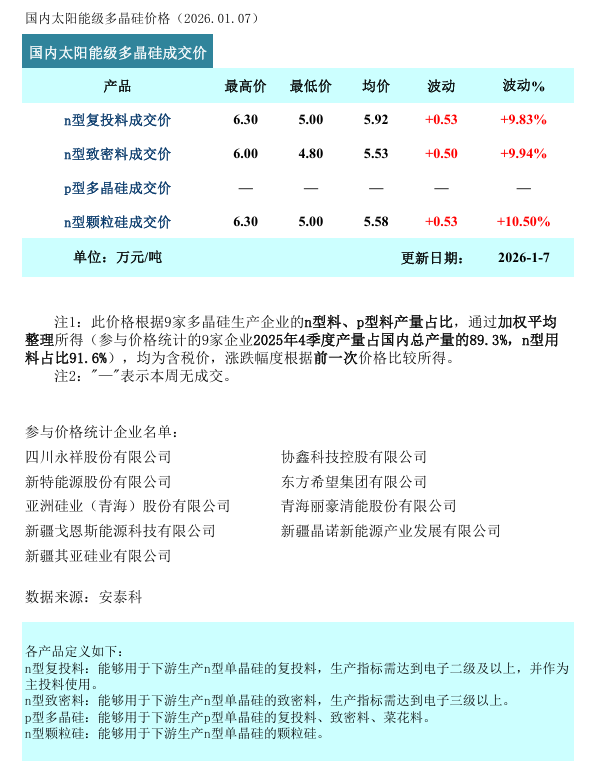
[安泰科]多晶硅周评-市场价格涨势延续 供应宽松格局未改(2026年1月7日)
中国有色金属工业协会硅业分会· 2026-01-07 08:56
Group 1 - The core viewpoint of the article highlights the continuous increase in the domestic polysilicon market prices, driven by multiple factors including rising production costs and increased acceptance of price hikes in downstream sectors [1][2]. - The transaction price range for n-type re-investment material is reported at 50,000 - 63,000 yuan/ton, with an average transaction price of 59,200 yuan/ton, reflecting a week-on-week increase of 9.83% [1][3]. - The n-type granular silicon has a transaction price range of 50,000 - 64,000 yuan/ton, with an average price of 55,800 yuan/ton, showing a week-on-week increase of 10.5% [1][3]. Group 2 - According to statistics, the domestic polysilicon production in December 2025 is estimated to be approximately 111,200 tons, a month-on-month decrease of 3.2%, with an annual production of about 1,319,000 tons, representing a year-on-year decrease of 28.4% [2]. - The forecast for January 2026 indicates a production of around 106,000 tons, a month-on-month decline of about 5%, suggesting a continued trend of inventory accumulation in the polysilicon market [2]. - The article anticipates that the market will maintain a stable operation in the short term, with a potential recovery in demand towards the end of the first quarter, which may provide more substantial support for the market [2].
华金证券:商业航天产业快速崛起 关注轻量化高效太空光伏技术
智通财经网· 2026-01-07 08:37
Core Insights - The space computing sector is entering a phase of large-scale implementation, with significant growth in demand for photovoltaic technology in space applications [1][2]. Group 1: Market Growth and Demand - The global market for in-orbit data centers is projected to reach $39.09 billion by 2035, with a compound annual growth rate (CAGR) of 67.4% over the next decade [2]. - The high energy consumption characteristics of space applications create a rigid demand for "lightweight and high-efficiency" energy solutions, aligning well with the advantages of space photovoltaic technology [2]. Group 2: Technological Advancements - Gallium arsenide (GaAs) batteries are currently the core support for space photovoltaics, with over 90% of their applications concentrated in the aerospace sector [3]. - The efficiency of GaAs solar cells has achieved breakthroughs, with a six-junction cell reaching a conversion efficiency of 47.1% under concentrated conditions [3]. - P-type ultra-thin heterojunction (HJT) solar cells are particularly advantageous for low Earth orbit satellites, as they reduce launch loads and save fuel [4]. Group 3: Emerging Technologies - Perovskite solar cells are breaking traditional limitations of space photovoltaic technology, offering lightweight and high-efficiency characteristics suitable for space computing needs [5]. - The performance of perovskite solar cells has surpassed 25% efficiency, with minimal degradation under space radiation conditions [5][6]. Group 4: Investment Opportunities - The rapid growth in satellite numbers and demand for in-orbit data highlights opportunities in the photovoltaic sector, particularly for p-type ultra-thin HJT and perovskite products [7]. - Companies such as Dongfang Risheng, Aerospace Hongtu, and GCL-Poly Energy are recommended for tracking due to their potential in new technology applications [7].
小摩:预计2026年反内卷政策推动的储能行业整合 对协鑫科技(03800)等予“增持”评级
智通财经网· 2026-01-07 07:39
Group 1 - Morgan Stanley reports a significant increase in solar wafer and battery prices by December 2025, primarily due to rising costs of key materials such as polysilicon and silver paste, along with some influence from anti-involution policies [1] - The establishment of a polysilicon industry consolidation platform is expected in early December 2025, with policy-driven industry consolidation anticipated to occur in 2026 [1] - The firm has given "overweight" ratings to GCL-Poly Energy (03800) and Daqo New Energy (DQ.US) [1] Group 2 - Goldwind Technology (02208) H-shares and A-shares saw price increases of 17% and 18% respectively from December 31, 2025, to January 6, 2026, while the Hang Seng China Enterprises Index rose by 4% and the Shenzhen Component Index by 3% [1] - The price surge is attributed to market expectations regarding the value release of Goldwind's 4.14% stake in Blue Arrow Aerospace, which has IPO plans [1] - Since December 31, 2025, Goldwind's market capitalization has increased by approximately 14 billion RMB, with an estimated valuation multiple for Blue Arrow Aerospace reaching 88 times the 2024 fiscal year price-to-book ratio [1] Group 3 - Siyuan Electric (002028.SZ) has signed a three-year memorandum of understanding for energy storage cooperation with CATL (03750), with a total scale of 50GWh [2] - This collaboration demonstrates Siyuan Electric's ambition to develop its energy storage system business, which could support annual revenues of approximately 20 billion RMB once fully operational [2] - Preliminary estimates suggest that this 50GWh partnership may provide over 10% upside to Siyuan Electric's market consensus earnings forecast for the fiscal years 2027 to 2028 [2]



电力设备及新能源行业快报:商业航天崛起,关注轻量化高效太空光伏技术
Huajin Securities· 2026-01-07 07:31
Investment Rating - The industry investment rating is maintained as "Outperform the Market" [2] Core Insights - The report highlights the rise of commercial aerospace and emphasizes the importance of lightweight and efficient space photovoltaic technology, particularly gallium arsenide (GaAs) batteries, which dominate the aerospace sector with over 90% market share [1] - The global market for GaAs batteries is projected to reach USD 425 million by 2024 and grow to USD 590 million by 2031, with a compound annual growth rate (CAGR) of 4.3% [1] - In China, the market for GaAs batteries was approximately CNY 5 billion in 2022 and is expected to exceed CNY 12 billion by 2025 [1] - The report discusses the advantages of P-type ultra-thin heterojunction (HJT) cells, which are particularly suitable for cost-sensitive applications like low Earth orbit satellites, as they reduce launch weight and save fuel [1] - The report also notes significant advancements in perovskite solar cells, which are breaking traditional limitations in space photovoltaic technology, offering lightweight and high-efficiency solutions [7] Summary by Sections Market Overview - The GaAs battery market is expected to expand into new fields and applications due to ongoing technological advancements and cost reductions [1] - The report indicates that the efficiency of GaAs solar cells has reached 47.1% under concentrated conditions, showcasing the potential for further improvements [1] Technological Developments - The report mentions that the thickness of P-type ultra-thin HJT cells is around 50-70 micrometers, which allows for further reduction and enhances flexibility for applications in space [6] - Perovskite solar cells have demonstrated efficiencies exceeding 25% and show superior radiation resistance compared to traditional III-V multi-junction cells [7] Investment Recommendations - The report suggests tracking companies involved in the development of P-type ultra-thin HJT and perovskite photovoltaic products, highlighting firms such as Dongfang Risen, Aerospace Hongtu, and GCL-Poly Energy [8] - It also recommends paying attention to the supply chain and related enterprises benefiting from the expansion of space computing and commercial aerospace [8]
小摩:预计2026年反内卷政策推动的储能行业整合 对协鑫科技等予“增持”评级
Zhi Tong Cai Jing· 2026-01-07 07:29
Group 1 - Morgan Stanley reports a significant increase in solar wafer and battery prices by December 2025, driven by rising costs of key materials such as polysilicon and silver paste, along with policies against internal competition [1] - The establishment of a polysilicon industry consolidation platform is expected by early December 2025, with policy-driven consolidation anticipated to occur in 2026 [1] - The firm maintains an "overweight" rating on GCL-Poly Energy (03800) and Daqo New Energy (DQ.US) [1] Group 2 - Goldwind Technology (02208) H-shares and A-shares saw price increases of 17% and 18% respectively from December 31, 2025, to January 6, 2026, outperforming the Hang Seng Index and Shenzhen Component Index [1] - The market's expectation of value release from Goldwind's 4.14% stake in Blue Arrow Aerospace, which has IPO plans, is believed to be a key factor in this price surge [1] - Goldwind's market capitalization increased by approximately 14 billion RMB since December 31, 2025, with an estimated valuation multiple for Blue Arrow Aerospace reaching 88 times the 2024 fiscal year price-to-book ratio [1] Group 3 - Siyuan Electric (002028.SZ) signed a three-year memorandum of understanding for energy storage cooperation with CATL (03750), with a total scale of 50GWh [2] - This collaboration indicates Siyuan Electric's ambition to develop its energy storage system business, potentially supporting annual revenues of around 20 billion RMB upon full capacity [2] - The partnership is expected to provide over a 10% upside to Siyuan Electric's market consensus earnings forecast for the fiscal years 2027 to 2028 [2]

港股通数据统计周报 2025.12.29-2026.01.04-20260107
Zhe Shang Guo Ji Jin Rong Kong Gu· 2026-01-07 06:12
Group 1: Top Net Buy/Sell Companies - The top net buy company is Agricultural Bank of China (1288.HK) with a net buy amount of 10.51 billion CNY, acquiring 181,815,021 shares[8] - The top net sell company is China Mobile (0941.HK) with a net sell amount of -46.61 billion CNY, selling 57,046,826 shares[9] - Other notable net buys include Industrial and Commercial Bank of China (1398.HK) with 6.50 billion CNY and China Petroleum & Chemical Corporation (0386.HK) with 3.49 billion CNY[8] Group 2: Industry Distribution of Net Buy/Sell - The financial sector shows significant net buying, while the telecommunications sector has the highest net selling, particularly driven by China Mobile and China Unicom[14] - The net buy/sell distribution indicates a strong preference for financial stocks, with utilities and consumer staples also seeing positive net inflows[14] - The energy sector has a moderate net buy, reflecting ongoing interest in energy stocks despite broader market trends[14] Group 3: Active Stocks - Alibaba (9988.HK) and Tencent (0700.HK) are the most active stocks, with total trading volumes of 41.57 billion CNY and 34.90 billion CNY respectively, both showing significant net selling[20] - Semiconductor Manufacturing International Corporation (0981.HK) has a notable trading volume of 34.20 billion CNY, with a net sell of -7.65 billion CNY[20] - Other active stocks include Xiaomi (1810.HK) and China Mobile, both experiencing substantial trading activity but with negative net buying figures[20]
中国银河证券:风光储2026年迎三重动能 全球化与技术革命成主线
Zhi Tong Cai Jing· 2026-01-07 03:56
Core Insights - The wind and solar storage industry is expected to recover profitability amidst oversupply by 2025, with overseas markets becoming a highlight for growth [1][2] - The industry is anticipated to enter a new cycle in 2026 driven by "anti-involution" and technological resonance, focusing on new technology commercialization, global expansion, and supply-demand improvements [1][2] Group 1: 2025 Review and 2026 Outlook - In 2025, the wind and solar storage sector will still face oversupply, but profitability is expected to recover due to anti-involution and increased overseas sales [2] - By December 31, 2025, the CSI 300 Index is projected to increase by 17.66%, the ChiNext Index by 49.57%, and the Electric New Energy Index by 39.47%, ranking 7th out of 30 industries [2] - The implementation of Document No. 136 will accelerate the entry of new energy into the market, with 2026 marking the beginning of a new cycle for the 14th Five-Year Plan in new energy [2] Group 2: Energy Storage - The demand for large-scale energy storage is expected to grow significantly, with North America's AIDC storage demand projected to rise from 8.9 GWh in 2025 to 190 GW by 2030, representing a CAGR of approximately 84% [3] - The demand for green electricity direct connection is anticipated to increase from 78 GWh in 2025 to 475 GW by 2030, with a CAGR of about 44% [3] - European markets are expected to see concentrated deployment in the next 3-5 years, with strong demand for industrial and commercial storage in Europe, Australia, and emerging markets [3] Group 3: Wind Power - Domestic wind power installations are projected to reach 110-120 GW for onshore and 12-16 GW for offshore by 2026, with the 14th Five-Year Plan potentially exceeding 120 GW per year for onshore and 15 GW per year for offshore [4] - The global offshore wind market is expected to grow at a CAGR of 27% over the next 25-30 years [4] - The industry is experiencing a stabilization in onshore turbine prices and limited downward pressure on offshore prices, with increased overseas orders expected to boost profitability for manufacturers [4] Group 4: Photovoltaics - The photovoltaic sector is set for profitability recovery driven by anti-involution, with new technology iterations and global expansion leading growth [5] - China is expected to lead the market, with installations projected between 230-250 GW in 2026, supported by recovering demand in Europe and the U.S. and emerging markets gaining momentum [5] - Key technological advancements include the expansion of BC battery capacity, mass production of perovskite technology, and breakthroughs in silver reduction techniques, which are expected to lower costs and improve margins [5]

供需宽松、成本定价
Ning Zheng Qi Huo· 2026-01-07 02:37
Report Industry Investment Rating No relevant content provided. Core Viewpoints of the Report - In 2026, the over - capacity of industrial silicon will not be fundamentally alleviated. High inventory will suppress prices, while the cost line will form a strong support. Supply - side policies are the biggest source of elasticity. The price range is expected to be 7500 - 9700 yuan/ton; under the scenario of strong policy stimulus, it will move up to 8500 - 10500 yuan/ton; under the scenario of unexpectedly weak demand, it will drop to 7000 - 7500 yuan/ton. The overall demand growth rate of industrial silicon will continue to slow down, but as the supply side also enters a contraction cycle, the overall supply - demand structure will become more balanced [3][40]. Summary by Directory Chapter 1: 2025 Industrial Silicon Market Trend Review - In 2025, the industrial silicon futures and spot markets showed a trend of "deep decline in the first half, hitting the bottom in June, and low - level volatile rebound from July to December". The average price of the futures main contract for the whole year was about 8800 yuan/ton, and the average comprehensive price of the spot was about 9200 yuan/ton. The futures and spot markets showed a pattern of spot premium for a long time. The spot market had multiple structural characteristics [9]. - In the first half of the year (January - June), the price dropped from a high level, and the supply - demand contradiction emerged. The average price of the 553 mainstream spot in January was about 9800 yuan/ton, falling below 9000 yuan/ton in March and reaching the annual low of 8600 - 8700 yuan/ton at the end of June. The 441 dropped from 11690 yuan/ton to 8620 yuan/ton, a decrease of 26.26%. The futures main contract SI2508/SI2510 started at about 10800 yuan/ton, fell below 10,000 yuan in March, and reached the lowest point of about 7015 yuan/ton on June 4, with a decline of about 36% in the first half of the year. The trading volume and open interest gradually shrank. The core driving factors were the natural decline in the off - season of downstream industries after the Spring Festival, the gradual release of new production capacity in 2024, and the lack of substantial production - capacity control policies [9][10]. - In the second half of the year (July - December), the price rebounded after hitting the bottom + low - level oscillation. The 553 mainstream spot price rebounded in July, rose to 9300 - 9500 yuan/ton from September to October, and stabilized at 9200 - 9300 yuan/ton (East China oxygen - blowing) in December. The futures main contract SI2601/SI2605 rebounded with cost repair and the expectation of production reduction in Southwest China from July, rose to 9000 - 9200 yuan/ton from September to October, and fell back to 8800 - 8900 yuan/ton in December. The trading volume and open interest increased. The core driving factors were the reduction in supply due to the rise in electricity prices during the dry season in Southwest China and the maintenance of some enterprises in Xinjiang, and the limited rebound amplitude due to high inventory [10]. Chapter 2: Analysis of the Supply - Demand Situation of Industrial Silicon in 2025/26 2.1 Supply Side: The Core Contradiction is Excess Supply, and Policy Regulation is the Catalyst - In November 2025, China's industrial silicon output was 401,700 tons, a year - on - year decrease of 11.2%. From January to November, the cumulative output reached 3.868 million tons, a cumulative year - on - year decrease of 14.7%. In the early stage of the year, the output was low. After April, Xinjiang made significant production cuts. In June, the output of most provinces decreased. After August, the supply in the main production areas increased. In the fourth quarter, the output in Xinjiang remained high, while that in Southwest China decreased slightly. In November, the output decreased to around 400,000 tons [14]. - From January to November 2025, Xinjiang's cumulative output was 1.9248 million tons, accounting for 52.03%. Inner Mongolia's output was 438,900 tons, accounting for 11.86%. Gansu's output was 329,700 tons, accounting for 8.91%. Yunnan's output was 300,800 tons, accounting for 8.13%. Sichuan's output was 323,500 tons, accounting for 8.74%. With the implementation of anti - involution policies, the release of new production capacity in the future will be extremely limited [15]. 2.2 Demand Side: The Establishment of a New Polysilicon Platform Company Marks the Entry of the Photovoltaic Industry's Anti - Involution Governance into a Critical Stage - From January to November 2024, China's polysilicon cumulative output was 1.206 million tons, a cumulative year - on - year decrease of 27.3%. In the first half of the year, the polysilicon price was low. After June, enterprises were determined to stabilize prices. By mid - December, the price of P - type dense materials soared to 49 - 51 yuan/kg, and the price of N - type silicon materials rose to 49.6 - 55 yuan/kg, a year - on - year increase of 26.5%. On December 12, 2025, the "polysilicon production - capacity integration and acquisition platform" was officially established, which has great strategic value for rectifying the industry's "involution" [29][31]. 2.2.1 Organic Silicon Production Cuts to Support Prices Yielded Results, and the Supply - Demand Will Enter a Sustainable New Ecosystem - From January to November 2025, China's organic silicon DMC cumulative output was 2.272 million tons, a year - on - year increase of 4.6%. In the first half of the year, the organic silicon industry faced over - capacity and weak terminal consumption. In the third quarter, the price rebounded slightly. In the fourth quarter, after the anti - involution industry meeting, enterprises reached a consensus on a 30% production cut and jointly supported prices. The DMC spot price rose from 11050 yuan/ton at the beginning of the fourth quarter to 13600 yuan/ton. It is expected that in 2026, the output will increase limitedly, and the supply - demand will enter a sustainable new ecosystem [33]. Chapter 3: Outlook for the Industrial Silicon Market in 2026 - In terms of supply, in 2026, the national industrial silicon planned new production capacity will be only 700,000 tons, and the production capacity will further shrink. In terms of demand, the overall demand growth rate of industrial silicon will continue to slow down, but the overall supply - demand structure will become more balanced [3][40]. - The over - capacity will not be fundamentally alleviated, high inventory will suppress prices, the cost line will form a strong support, and supply - side policies are the biggest source of elasticity. The price range is 7500 - 9700 yuan/ton; under the scenario of strong policy stimulus, it will move up to 8500 - 10500 yuan/ton; under the scenario of unexpectedly weak demand, it will drop to 7000 - 7500 yuan/ton. The price will be strong during the dry season and Spring Festival stocking, pressured during the wet season when supply increases and polysilicon demand slows down, and will stabilize and rebound with inventory reduction and cost support [3][40].
东吴证券:太空光伏有望迎来高速发展 投资聚焦高效钙钛矿与叠层技术
智通财经网· 2026-01-07 02:25
Core Insights - The report from Dongwu Securities highlights the rapid development of commercial aerospace and low Earth orbit (LEO) satellites, indicating that space photovoltaic power supply is optimal and may experience rapid growth, supported by efficient perovskite/silicon tandem technology [1] Group 1: Commercial Aerospace Development - The maturity of reusable rocket technology has significantly reduced launch costs, breaking down economic barriers to entering space. The scarcity of satellite frequency resources is driving countries to accelerate the acquisition of strategic resources, leading to a sustained increase in global spacecraft launches. The number of global spacecraft launches has grown from 237 in 2016 to over 4,300 by 2025, with a CAGR of 34% and an increase of over 50% year-on-year in 2025 [2] Group 2: Photovoltaic Energy in Satellites - Photovoltaics are the only efficient and stable energy source for satellites, with solar wings accounting for approximately 20-30% of the satellite manufacturing cost. Solar wings are critical for spacecraft operation, representing over 60% of the value, with current mainstream gallium arsenide costing around 200,000 to 300,000 per square meter. As the power requirements of satellites increase, the area of solar wings is expected to grow significantly, with SpaceX's Starlink V3 satellite solar wing area increasing by over 10 times compared to earlier versions [3] Group 3: Technology Optimization - Gallium arsenide is the mainstream technology in China, known for its high efficiency and radiation resistance, with component efficiency exceeding 30%. However, its high cost (200,000 to 400,000 yuan per square meter) may limit large-scale satellite constellation deployment. In contrast, foreign companies like SpaceX have lower launch costs, and while silicon can offer lower weight-to-cost ratios, the lower-cost P-type silicon route may be preferred for single satellite costs. Perovskite batteries show promise in terms of lightweight, high energy-to-weight ratio, low cost, and stability, potentially becoming a superior solution for space power supply [4] Group 4: Market Potential and Investment Recommendations - The global deployment of low Earth orbit satellites is entering an explosive phase, with over 100,000 satellites registered globally by the end of 2025. The U.S. leads with approximately 42,000 satellites through Starlink, while China has submitted plans for over 51,000 satellites. Assuming an annual launch of 10,000 satellites, the solar wing market could reach nearly 200 billion. The surge in AI computing demand is pushing computational power to space, leveraging the advantages of solar energy and thermal conditions in near-Earth orbit. If a 10GW space computing system is established, the solar wing market could reach several trillion yuan. Investment recommendations include JunDa Co. (collaborating with Shangyi on satellite perovskite), Mingyang Smart Energy (subsidiary focusing on perovskite and HJT technology), and others in the HJT/perovskite battery sector [5]
