
小米

Search documents
900亿AI存储龙头又要IPO了
投中网· 2026-01-31 07:05
Core Viewpoint - The article discusses the significant surge in demand and prices for storage chips driven by AI, highlighting the emergence of domestic companies like Baiwei Storage as key players in this evolving market [4][10]. Group 1: Market Dynamics - The price of DDR5 memory has skyrocketed by over 300%, and enterprise SSDs are in short supply, with HBM (High Bandwidth Memory) orders extending to 2027 [4]. - The price of HBM3E chips has increased by 50%, reaching over $500, while the total cost for a complete HBM3E memory module ranges from $2,800 to $3,100 [7]. - The overall DRAM contract prices are expected to rise by 55% to 60% in Q1 2026, with NAND Flash products also seeing price increases of 33% to 38% [17]. Group 2: Company Performance - Baiwei Storage (688525.SH) anticipates a 4-5 times increase in annual performance, with projected net profits for 2025 reaching between 850 million to 1 billion yuan, marking a year-on-year growth of 427% to 520% [4][7]. - The company's stock price has surged from around 110 yuan to a peak of 199.38 yuan, reflecting an 81% increase and a market valuation nearing 900 billion yuan [12]. Group 3: Strategic Initiatives - Baiwei Storage has submitted a prospectus to the Hong Kong Stock Exchange to capitalize on the AI wave, focusing on advanced packaging and testing capabilities, as well as CXL memory pooling technology [5][9]. - The company plans to use funds from its IPO to enhance R&D and production capabilities for high-end DRAM modules and enterprise SSDs, while expanding its global sales and service network [9]. Group 4: Competitive Landscape - Major players like Samsung and SK Hynix are increasing prices and extending delivery times, indicating a tight supply chain for high-end memory products [8]. - Baiwei Storage has successfully integrated into the supply chains of top global tech companies, including Meta and Google, providing embedded storage solutions for AI devices [15]. Group 5: Future Outlook - The ongoing price increases and demand for storage chips are expected to continue until at least mid-2026, with a potential supply-demand imbalance lasting until 2028 [18]. - The surge in IPO activities among storage chip companies reflects a broader trend of value reassessment in the industry, driven by AI computing needs and domestic market dynamics [20].


中国车企和特斯拉的下一战,战场已定
虎嗅APP· 2026-01-30 13:58
Core Viewpoint - Tesla is shifting its focus towards humanoid robots, with CEO Elon Musk stating that the production of Model S and Model X will be phased out to prioritize the development of the Optimus robot, which Musk believes will underpin 80% of Tesla's future market value [2][3]. Group 1: Tesla's Strategic Shift - Tesla plans to cease production of Model S and Model X, transitioning the Fremont factory to produce Optimus robots [3]. - The introduction of humanoid robots is seen as a critical component of Tesla's new mission, which aims to create a "prosperous and extraordinary world" [2]. - Musk acknowledges that Tesla's main competition in the humanoid robot sector will come from Chinese companies, which are rapidly advancing in AI and robotics [3]. Group 2: Chinese Automakers' Robotics Initiatives - Chinese automakers are actively investing in humanoid robotics, with companies like Li Auto and BYD announcing plans to develop their own humanoid robots [5][6]. - The competitive landscape is intensifying, with various Chinese companies, including Chery and Xpeng, setting timelines for humanoid robot production by 2026 and 2028 [12][13]. - The overlap in technology between electric vehicles and humanoid robots is significant, with around 70% of automotive technology being applicable to robotics [8]. Group 3: Market Potential and Investment Outlook - The global market for humanoid robots is projected to reach $25 trillion by 2050, indicating a massive growth opportunity compared to the automotive sector [9]. - The high degree of technological overlap allows automakers to pivot towards robotics without substantial additional investment, making it a low-cost, high-reward opportunity [9]. - Morgan Stanley reports that China holds a dominant position in the humanoid robot supply chain, accounting for 63% of the market, which could drive down manufacturing costs [14]. Group 4: Competitive Landscape and Challenges - The competition between Tesla and Chinese automakers in the humanoid robot space is expected to intensify by 2027, with both sides having distinct advantages [12][14]. - Tesla's strength lies in its advanced AI algorithms and extensive real-world data, while Chinese companies have demonstrated rapid iteration and cost control capabilities [14]. - Talent acquisition is crucial for success in the humanoid robot sector, with both Tesla and Chinese firms vying for top talent amidst a competitive automotive landscape [17].


全球手机SoC市场:联发科、高通、苹果集体下滑
Guan Cha Zhe Wang· 2026-01-30 13:46
Core Insights - Counterpoint Research predicts that MediaTek will lead the global smartphone SoC market in 2025 with a shipment share of 34.4%, followed by Qualcomm (25.1%), Apple (18.1%), Unisoc (12.1%), and Samsung (5.7%) [1] - The global smartphone SoC market is expected to slow down in 2026, with a projected year-on-year decline in shipments of 7% [1] - Despite the overall decline in shipments, the market is shifting towards higher-end products, with one in three smartphones expected to sell for over $500 by 2026 [4] Market Dynamics - The rise in storage prices poses a significant challenge for the smartphone industry, particularly affecting entry-level products priced below $150 [4] - Companies with in-house SoC capabilities, such as Samsung, Google, Huawei, and Xiaomi, are better positioned to navigate market challenges compared to those reliant on 4G and entry-level 5G SoCs [4] - OEMs are adjusting their product offerings and exploring cloud offloading strategies amid ongoing supply constraints [5] Technological Advancements - Leading high-end smartphone SoC manufacturers are expected to transition from 3nm to 2nm process nodes by 2026, with Samsung already set to launch the first 2nm smartphone SoC, Exynos 2600, in December 2025 [5] - The smartphone SoC market is anticipated to achieve double-digit revenue growth in 2026, driven by ongoing premiumization, rising storage prices, and the rapid adoption of AI features in smartphones [5] AI Integration - By 2026, edge AI performance is expected to reach around 100 TOPS, with nearly 90% of high-end smartphones supporting edge AI capabilities [6] - Mid-range smartphones priced between $100 and $500 may increasingly rely on cloud-based AI processing to manage costs amid ongoing pressure from storage prices [6]



通达动力:公司暂未与小米建立直接合作关系
Zheng Quan Ri Bao Wang· 2026-01-30 12:14
Group 1 - The company, Tongda Power (002576), has stated that it currently does not have a direct cooperation relationship with Xiaomi [1] - The company has not engaged in any related cooperation in the electric motor core supply business [1]

博威合金(601137):美国一纸关税,狙击越南光伏,博威合金 10 亿利润一夜蒸发
市值风云· 2026-01-30 11:09
Investment Rating - The report indicates a significant downgrade in the investment outlook for the company, with a projected net profit drop of 88.92% to 92.61% for 2025 compared to 2024 [2]. Core Insights - The company's photovoltaic business has been severely impacted by new U.S. tariffs, leading to a drastic reduction in profit expectations [4][10]. - The company has decided to exit the renewable energy sector and refocus on its core materials business, which has shown consistent growth [12][14]. - The new materials segment, particularly high-performance copper-based alloys, is positioned to benefit from emerging technology trends, despite the challenges faced in the photovoltaic market [18][20]. Summary by Sections Financial Performance - The company expects a net profit of only 100 to 150 million yuan for 2025, a stark decline from 1.354 billion yuan in 2024 [2]. - A total asset impairment provision of 1.025 billion yuan has been made, significantly affecting the company's profitability [9][10]. Market Challenges - U.S. tariffs of up to 307.78% on photovoltaic products exported from Vietnam have blocked the company's access to the U.S. market [4]. - The new U.S. legislation requires companies controlled by Chinese citizens to reduce their ownership stake to below 25% to qualify for federal subsidies, which the company does not meet [6][7]. Strategic Shift - The company plans to divest its U.S. photovoltaic projects and concentrate on its new materials business, which accounted for 74.62% of revenue in 2024 [14][16]. - The new materials business has shown a compound annual growth rate of nearly 20% from 2019 to 2024, with revenue expected to reach 139.2 billion yuan in 2024 [20][21]. Future Outlook - The global demand for advanced materials is expected to rise due to trends in AI, electric vehicles, and next-generation technologies, which the company aims to capitalize on [22][23]. - The company is already investing in new production lines for liquid cooling materials and collaborating with industry leaders to develop next-generation conductive materials [22].

港股复盘|1月行情收官 港股强劲上行 恒指创四年半新高
Mei Ri Jing Ji Xin Wen· 2026-01-30 10:44
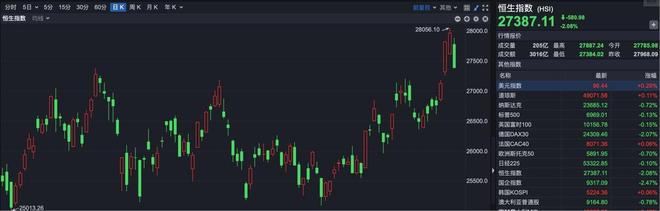
市场焦点方面,受国际贵金属价格大幅震荡影响,今日黄金股集体遭遇重挫。其中,山东黄金 (HK01787)跌超14%,江西铜业股份(HK00358)、中国黄金国际(HK02099)、紫金黄金国际 (HK02259)跌超10%,紫金矿业、招金矿业跌超9%。 其他方面,盘面上,科网股普跌,快手、小米跌超3%,腾讯、阿里巴巴跌超2%,百度、联想、美团、 京东、哔哩哔哩跌超1%。石油股普遍下跌,中石油跌超1%。光伏太阳能股走弱,福莱特玻璃跌超6%; 创新药概念多数下跌,石药集团跌超10%。 1月30日,是港股市场结束1月行情的最后一个交易日。尽管今日市场出现调整,但恒指月涨幅依旧接近 7%,周四更是创下近4年半来新高。 截至收盘,恒生指数报收27387.11点,下跌580.98点,跌幅2.08%。 恒生科技指数报收5718.18点,下跌122.92点,跌幅2.10%。 展望后市: 中信证券认为,2025年四季度导致港股下跌的业绩预期调整和资金面扰动已告一段落。展望2026年2 月,港股业绩预期已有显著调整,叠加内外部资金面的扰动因素也已告一段落,该行判断港股2025年12 月下旬以来的春季行情或将延续,整体呈现春节前大盘 ...
美国一纸关税,狙击越南光伏,博威合金10亿利润一夜蒸发
市值风云· 2026-01-30 10:09
Core Viewpoint - The article discusses the significant impact of U.S. policies on the photovoltaic (PV) business of Bowei Alloy, leading to a drastic decline in profits and a strategic shift away from the solar sector towards new materials [4][10]. Group 1: Financial Impact - Bowei Alloy's projected net profit for 2025 is expected to plummet to between 100 million to 150 million yuan, a staggering decline of 88.92% to 92.61% compared to 1.354 billion yuan in 2024 [5]. - The company has to account for a total asset impairment provision of 1.0252 billion yuan, which includes credit impairment losses, inventory write-downs, and fixed asset impairments [9]. Group 2: U.S. Policy Changes - In mid-2025, the U.S. Department of Commerce imposed a 307.78% anti-dumping and countervailing duty on PV products exported from Vietnam, directly affecting Bowei Alloy's 3GW battery project aimed at the U.S. market [6]. - The introduction of the "Inflation Reduction Act" in July 2025 requires Chinese-controlled companies to reduce their ownership stake below 25% to qualify for federal subsidies, which Bowei Alloy does not meet [8]. Group 3: Strategic Shift - In response to the unfavorable U.S. policies, Bowei Alloy has decided to divest its U.S. solar projects and exit the renewable energy sector entirely, refocusing on its core new materials business [12][13]. - The new materials segment, which accounted for 74.62% of revenue in 2024, is expected to be the primary growth driver moving forward, despite the higher profit margins previously associated with solar products [16]. Group 4: Market Position and Future Prospects - Bowei Alloy specializes in high-performance copper-based alloys, with applications in high-growth sectors such as electric vehicles, semiconductors, and 5G communications [18]. - The company has shown consistent revenue growth, with a compound annual growth rate of nearly 20% from 2019 to 2024, indicating a solid foundation for future expansion in the new materials market [16][18].
中美AI不同路径下的产业机会
淡水泉投资· 2026-01-30 07:32
Core Viewpoint - The article emphasizes that artificial intelligence (AI) has become a central investment theme in global capital markets, significantly impacting stock performance across major indices since the launch of ChatGPT in late 2022 and DeepSeek in early 2025 [1][3]. Group 1: Different Paths of AI Development in China and the U.S. - The U.S. focuses on exploring capability boundaries with strong foundational computing power, leading to significant capital expenditures by leading firms in a closed-source model arms race [5][6]. - China, constrained by geopolitical factors and relative chip capabilities, adopts an open-source strategy aimed at optimizing under resource constraints, promoting inclusivity in AI development [6][7]. Group 2: Technical Approaches - The U.S. primarily employs a closed-source strategy, emphasizing performance breakthroughs through increased parameter scales and resource investment, driving commercial returns [7][8]. - China embraces an open-source ecosystem, with models like DeepSeek and Qianwen focusing on creating efficient, low-cost technology systems that adapt to domestic computing power [8][10]. Group 3: Business Models - The U.S. market has a mature paid software ecosystem, with strong enterprise willingness to invest strategically in AI applications, driven by tech giants and unicorns [14]. - In contrast, China's model leans towards monetizing traffic, integrating AI with existing internet platforms, and relying on indirect consumer payments through transactions and advertising [14]. Group 4: Structural Opportunities in the Global AI Industry - The global AI industry is undergoing structural changes driven by technological breakthroughs and application deepening, creating investment opportunities due to dynamic supply-demand relationships [15][16]. - The demand for AI applications is leading to shortages in specific products, such as storage, and creating a new cycle of growth in the semiconductor industry [16][19]. Group 5: Investment Opportunities in China - Domestic AI investment is expected to accelerate as local computing power improves, with advancements in products like domestic GPUs enhancing stability and performance for large model inference [19]. - Innovations in edge AI hardware and applications are anticipated, with potential breakthroughs in consumer products like AI smartphones and smart glasses [19]. - The C-end AI application market is projected to see significant growth, with a focus on platforms that possess comprehensive advantages in models, ecosystems, and scenarios [19].

奇德新材:在机器人领域主要提供高分子改性塑料及碳纤维制品解决方案
Ge Long Hui· 2026-01-30 07:28
Core Viewpoint - The company focuses on high-performance composite materials, specialty engineering plastic modification, and carbon fiber products, with applications in emerging fields such as new energy vehicles, robotics, and low-altitude aircraft [1] Group 1: Automotive Industry - The company has established partnerships with major automotive component manufacturers and OEMs, including Magna, Yanfeng, and BYD, providing precision molds, modified plastics, and carbon fiber products [1] - The automotive sector has become the company's largest application area, with increasing revenue contribution from this segment [1] Group 2: Carbon Fiber Business - The company offers a full-chain service in carbon fiber products, entering the supply systems of new energy vehicle manufacturers like BYD and Xiaomi, with applications in critical components such as hoods and interior parts [1] - The company is actively expanding its capacity and optimizing processes to meet future market demand [1] Group 3: Robotics Industry - The company provides polymer modified plastics and carbon fiber solutions for the robotics sector, with a recent small-scale order for a humanoid robot shell project [1] - Current projects in the robotics field are in early stages, with small order amounts that do not significantly impact the company's financial performance [1] Group 4: Strategic Layout and Outlook - The company aims to continue focusing on strategic emerging fields such as new energy vehicles, robotics, and low-altitude aircraft, enhancing R&D and market expansion efforts [1] - The goal is to become a leading enterprise in the domestic high-performance carbon fiber product sector [1]

奇德新材:公司汽车板块营收占比不断攀升,已跃居为公司第一大应用领域
Zheng Quan Ri Bao Wang· 2026-01-30 06:46
Core Viewpoint - The company, Qide New Materials (300995), is actively collaborating with major automotive parts manufacturers and OEMs, indicating a strong position in the automotive supply chain [1] Group 1: Partnerships and Collaborations - The company has established partnerships with automotive parts companies such as Magna, Yanfeng, Adient, and Dongjian, as well as OEMs like BYD (002594), Xiaomi, and Leap Motor [1] - These collaborations enable the company to provide precision molds, modified plastics, and carbon fiber products to the automotive industry [1] Group 2: Product Applications - The company's products are supplied directly to OEMs or through first-tier parts suppliers, ultimately being used in vehicles from brands like BYD, Xiaomi, XPeng, Seres (601127), GAC Trumpchi, Aion, and Mercedes-Benz [1] Group 3: Revenue Growth - The automotive sector has become the largest application area for the company, with its revenue share in this segment continuously increasing in recent years [1] - Further details on the company's performance will be disclosed in upcoming periodic reports [1]