极氪

Search documents
骁龙数字底盘强势领跑,高通智能体 AI 重塑未来驾乘生态
Huan Qiu Wang· 2026-01-07 11:05
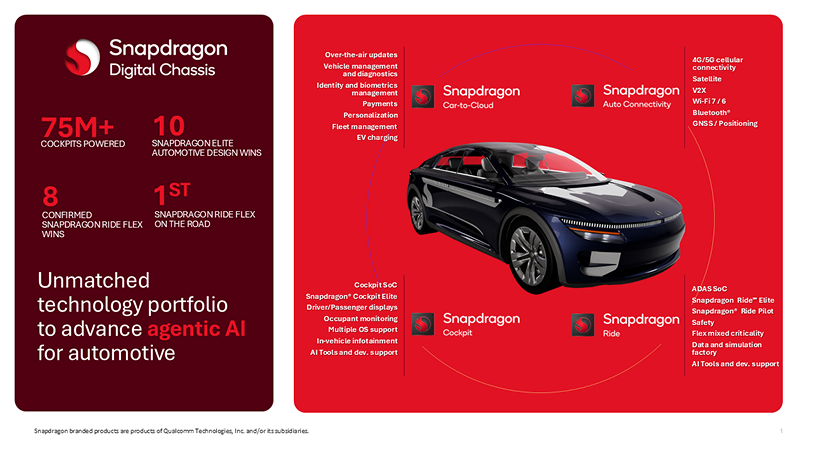
Core Insights - Qualcomm solidified its industry leadership at CES 2026 with the global adoption of its Snapdragon digital chassis solutions, integrating AI and high-performance computing into the automotive sector, thus accelerating the transition to software-defined vehicles [1][3] Group 1: Partnerships and Collaborations - Qualcomm announced a deepened long-term collaboration with Google to integrate Snapdragon digital chassis solutions with Google automotive software, facilitating faster market deployment of new AI features for automakers [3] - The company has established new or expanded collaborations with several automotive manufacturers, including Li Auto, Leap Motor, Geely, Great Wall Motors, NIO, and Chery, achieving a total of 10 model designations [4] - Qualcomm is collaborating with leading driving assistance software providers such as Yuanrong Qixing, Momenta, and others to create a diverse competitive ecosystem for AI technologies [5] Group 2: Product Innovations - Qualcomm's Snapdragon cockpit platform and Snapdragon Ride platform have gained widespread recognition among global automakers for their high-performance computing capabilities and AI acceleration [4] - The Snapdragon Ride Flex chip, which supports both digital cockpit and advanced driver assistance system workloads, has been successfully deployed in eight production vehicle projects globally [4] - The Snapdragon Ride platform has secured 20 model designations, becoming one of the most trusted and efficient driving assistance platforms in the industry [5] Group 3: AI Integration and User Experience - Qualcomm's integration of AI technology into its cockpit platform has enhanced the in-car experience, supporting over 75 million vehicles globally by mid-2025 [6] - The new generation Snapdragon cockpit platform will be featured in Toyota's RAV4 model, utilizing AI to anticipate driver and passenger needs for real-time adjustments [6] - Qualcomm introduced the A10 5G modem, designed for automotive applications, which offers low power consumption and cost advantages while supporting critical vehicle services [6]


打破“信息差”,华为与高德落地30省份超充地图
高工锂电· 2026-01-07 10:11
Core Viewpoint - The collaboration between Huawei and Gaode Map aims to enhance the efficiency and convenience of charging services for new energy vehicle owners by providing real-time information on charging station locations and availability [3][4]. Group 1: Collaboration and Integration - Huawei's supercharging alliance has integrated with Gaode Map, allowing users to find charging stations more easily and transparently [3]. - This partnership addresses the "information gap" faced by new energy vehicle owners regarding public charging stations, which often suffer from a lack of transparency in location, status, and pricing [4]. - The collaboration transforms the charging experience from a cumbersome process into a seamless one, reducing issues like queuing and wasted trips to malfunctioning stations [4][5]. Group 2: Market Dynamics and Demand - There is a current supply-demand gap between the number of vehicles compatible with the 800V high-voltage platform and the rapidly increasing number of supercharging stations, with only about 16% of vehicles supporting this technology as of mid-2025 [6]. - Huawei's strategy includes integrating vehicles, charging stations, and platforms, indicating a mature synergy in supercharging technology [6]. Group 3: Future Developments - The supercharging business is expected to evolve into a model of cooperation amidst competition, with various players in the market, including Tesla and BYD, also investing in supercharging infrastructure [7]. - Huawei plans to expand its supercharging alliance to include heavy-duty trucks by 2025, indicating a broader strategy that encompasses both passenger and commercial vehicles [8][9]. - The company aims to establish 20 megawatt supercharging stations in Shenzhen by 2025 and expand to 500 stations in the Bay Area by 2026 [8].

宝马开年即官降:豪华车溢价神话的终场哨
Zhong Guo Qi Che Bao Wang· 2026-01-07 10:05
Core Viewpoint - BMW's significant price cuts in the Chinese luxury car market signal a shift in the competitive landscape, indicating the collapse of the premium pricing strategy that has long defined luxury brands in China [1][2][3] Group 1: Price Adjustments and Market Dynamics - BMW announced price reductions for 31 models, with 24 models seeing cuts exceeding 10% and 5 models over 20%, with entry-level models dropping to 208,000 yuan [1] - The price cuts are a response to declining sales and inventory pressures, marking a retreat from previous attempts to maintain high pricing strategies [1][2] - Other luxury brands like Mercedes-Benz and Audi are also offering significant discounts, indicating a broader trend among luxury brands to lower prices in response to competitive pressures from Chinese brands [2][3] Group 2: Competitive Landscape and Consumer Preferences - Chinese brands have gained a foothold in the 300,000 to 500,000 yuan price range, offering advanced features that challenge traditional luxury brands [3][4] - The shift in consumer preferences towards technology and experience over brand prestige is reshaping the luxury car market, with younger consumers prioritizing features like intelligent driving and user experience [3][5] - The luxury car market is experiencing a structural shift, with traditional luxury brands losing market share to Chinese competitors who are innovating rapidly in electric and smart vehicle technologies [4][5] Group 3: Industry Transformation Signals - The price cuts by BMW represent a breakdown of the price barrier between luxury and regular brands, fundamentally altering consumer perceptions of luxury pricing [4][6] - The traditional rules of the luxury car market, previously dictated by brands like BMW, are being redefined by Chinese brands that focus on rapid product iteration and customer-centric service models [4][5] - The ongoing transformation in the luxury car market is not merely a price war but a comprehensive restructuring of value systems, emphasizing the need for luxury brands to adapt to changing market dynamics [6][7] Group 4: Strategic Recommendations for Luxury Brands - Luxury brands must embrace electric and smart technologies, moving away from a "technology neutrality" stance to remain competitive in the evolving market [5][6] - A shift from brand-centric to user-centric product development is essential, focusing on local market needs and preferences rather than global models [5][6] - Establishing a new value system that prioritizes transparency in pricing and configuration will be crucial for rebuilding consumer trust and avoiding the pitfalls of price wars [6][7]
钱交了、单锁了、承诺却没了?极氪「食言」购置税兜底,数百车主怒斥「言而无信」
Xin Lang Ke Ji· 2026-01-07 01:13
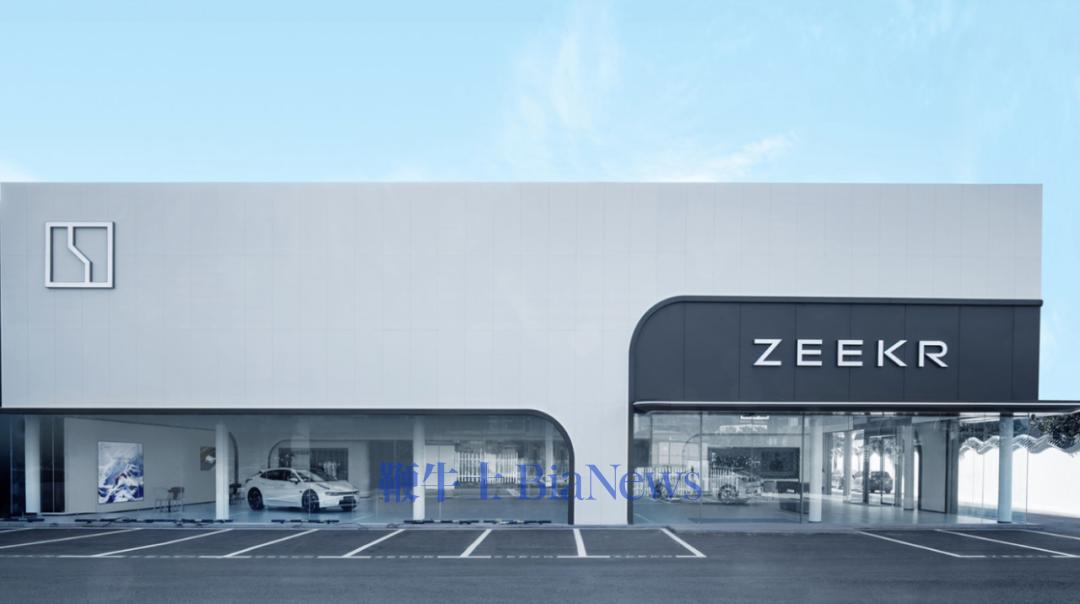
Core Viewpoint - The adjustment of the new energy vehicle purchase tax policy from full exemption to a 5% tax rate starting January 1, 2026, has led to significant dissatisfaction among customers of Zeekr, particularly regarding the company's failure to honor its tax subsidy promises [2][4][19]. Group 1: Tax Policy Changes and Customer Reactions - Starting January 1, 2026, the purchase tax for new energy vehicles will be halved, increasing costs for consumers by approximately 5% of the vehicle price, which translates to around 10,000 yuan for vehicles priced over 200,000 yuan [2][4]. - Zeekr had previously launched a "cross-year purchase tax subsidy" program, promising to cover the tax if orders were locked by December 31, 2025, but later retracted this commitment, offering only points as compensation instead [2][3][6]. - Many customers, feeling deceived, have formed groups to demand the original tax subsidy, expressing frustration over the company's change in policy and lack of communication [3][8]. Group 2: Customer Complaints and Company Response - Numerous customers have reported issues with Zeekr's sales practices, where they were pressured to pay the final amount without seeing the vehicle, raising concerns about the company's integrity [6][7]. - Customers have expressed dissatisfaction with the compensation offered, which they view as inadequate compared to the promised tax subsidy [8][14]. - The company has not provided a clear response to these complaints, leading to further frustration among affected customers [3][14]. Group 3: Broader Implications for Zeekr - In 2025, Zeekr's total sales reached 224,133 units, a mere 1% increase year-on-year, falling short of the 300,000 unit target set at the beginning of the year [17]. - The company is undergoing significant restructuring, having merged with Geely and delisted from the NYSE, which raises questions about its operational stability [17][18]. - Zeekr is also involved in a 2.314 billion yuan lawsuit against a battery supplier over quality issues, further complicating its operational challenges [18][19].


钱交了、单锁了、承诺却没了? 极氪“食言”购置税兜底,数百车主怒斥“言而无信”
Xin Lang Cai Jing· 2026-01-07 00:34
Core Viewpoint - The adjustment of the new energy vehicle purchase tax policy from full exemption to a 5% tax rate starting January 1, 2026, has led to significant dissatisfaction among customers of Zeekr, particularly regarding the company's failure to honor its tax subsidy promises [2][3][12]. Group 1: Tax Policy Changes and Customer Reactions - Starting January 1, 2026, the purchase tax for new energy vehicles will be halved, increasing costs for consumers by approximately 5% of the vehicle price, which translates to around 10,000 yuan for vehicles priced over 200,000 yuan [3][17]. - Zeekr had previously launched a "cross-year purchase tax subsidy" program, promising to cover the tax if orders were locked by December 31, 2025, but later retracted this commitment, offering only points as compensation instead [2][5][19]. - Many customers, feeling deceived, have formed groups to demand the original tax subsidy, expressing their frustration over the company's failure to deliver on its promises [6][20][21]. Group 2: Customer Complaints and Company Response - Customers reported being pressured to pay the remaining balance on their vehicles without having seen them, raising concerns about the legitimacy of the tax subsidy promises [5][19][20]. - Some customers received compensation in the form of points equivalent to 3,000 yuan, which they deemed inadequate compared to the promised tax subsidy of over 10,000 yuan [6][20][21]. - Zeekr has not provided a clear response to the complaints, leading to further dissatisfaction among customers [6][20][21]. Group 3: Broader Issues Facing Zeekr - In 2025, Zeekr's total vehicle deliveries reached 224,133 units, a mere 1% increase year-on-year, falling short of the 300,000 unit target set at the beginning of the year [10][26]. - The company underwent a significant restructuring, merging with Geely and becoming a wholly-owned subsidiary, which raised questions about operational stability [10][11][26]. - Zeekr is also embroiled in a 2.314 billion yuan lawsuit against a battery supplier over quality issues, further complicating its operational challenges [10][27][28].
“新国补+车企限时促销”点燃2026年开年车市
Mei Ri Jing Ji Xin Wen· 2026-01-06 12:40
Core Viewpoint - The introduction of the "New National Subsidy" policy for 2026 has led to a surge in consumer interest and promotional activities among various automotive brands, aiming to stimulate sales in the electric vehicle market. Group 1: Consumer Behavior and Market Response - Many consumers are waiting for the "New National Subsidy" to finalize their vehicle purchases, as evidenced by increased foot traffic in showrooms during the New Year holiday [1] - Sales personnel report a significant rise in daily customer visits, with some stores exceeding a thousand visitors [1] - Automotive brands are launching various promotional strategies, including tax subsidies and cash discounts, to attract buyers [1] Group 2: Promotional Strategies by Automotive Brands - Several brands, including Zhiji and Extreme Kr, are offering vehicle purchase tax subsidies, with amounts reaching up to 12,000 yuan [2] - Zhiji's promotional campaign requires customers to place orders by January 3 to benefit from tax subsidies, highlighting the urgency of the offer [2] - Extreme Kr is also providing tax subsidies ranging from 7,000 to 12,000 yuan for its vehicles [2] Group 3: Price Adjustments and Market Strategy - BMW has announced price reductions for several models, with the i7M70L seeing a decrease of 301,000 yuan, while the iX1eDrive25L's price dropped by 71,900 yuan, reflecting a strategic response to market demand [4][5] - BMW emphasizes that these price adjustments are not a price war but a strategic move to align with customer needs and market dynamics [5] - The adjustments in pricing are expected to enhance the competitiveness of BMW's offerings in the market [5] Group 4: Policy Changes and Implications - The 2026 policy changes include a reduction in the vehicle purchase tax from full exemption to a 5% rate, which is expected to impact consumer purchasing behavior [6][7] - The new subsidy structure shifts from fixed amounts to a percentage of the vehicle price, maintaining the upper limits for subsidies [7] - The maximum subsidy for scrapping old vehicles is set at 20,000 yuan, while the maximum for replacing vehicles is 13,000 yuan [7] Group 5: Regional Implementation of Subsidy Policies - Various regions, including Jiangxi and Hebei, have begun implementing the new subsidy policies, allowing consumers to apply for up to 20,000 yuan in subsidies [9][10] - The central government has allocated 62.5 billion yuan for the first batch of subsidies, aimed at supporting the "old for new" vehicle replacement program [10] - The "old for new" policy has significantly contributed to the growth of the domestic automotive market, with over 1.15 million vehicles replaced in 2025 alone [10] Group 6: Future Market Outlook - The automotive industry is expected to experience positive growth in the first quarter of 2026, driven by the new policies and consumer incentives [11] - The government aims to promote green consumption and support the development of the automotive industry chain, including second-hand vehicles and new consumption models [11]
车圈下半场在复购口碑
3 6 Ke· 2026-01-06 05:07
Core Viewpoint - The focus for the electric vehicle (EV) industry in 2026 will shift from price wars to customer repurchase rates, which are crucial for long-term sustainability [4][14]. Group 1: Customer Experience and Reputation - The reputation of a car brand is directly linked to its repurchase rate, making it essential for companies to monitor customer feedback and satisfaction [1][6]. - Negative feedback from existing customers can significantly harm a brand's image, leading to a loss of potential new customers [2][3]. - Companies must address the issue of "backstabbing" customers, where dissatisfaction leads to negative online reviews and word-of-mouth [8][10]. Group 2: Market Dynamics and Consumer Behavior - The EV market is experiencing a shift where companies are now competing for the loyalty of existing EV owners rather than traditional fuel vehicle owners [3][5]. - The average replacement cycle for family cars in China is five years, which, combined with advancements in technology, will trigger a wave of vehicle replacements [5][12]. - The cost of acquiring a new customer is significantly higher than retaining an existing one, emphasizing the importance of repurchase rates [14][15]. Group 3: Strategic Recommendations for Companies - Companies should stop all "fast-moving consumer goods" thinking that leads to customer dissatisfaction and negative experiences [12]. - Establishing a robust customer experience management system is vital for addressing customer issues effectively and reducing negative feedback [13]. - Companies should prioritize repurchase rates over sales volume, as high repurchase rates indicate better product quality and customer satisfaction [14][15]. Group 4: Marketing and Consumer Expectations - Companies need to manage consumer expectations by avoiding exaggerated marketing claims that can lead to disappointment [16][18]. - A shift in marketing strategy from over-promising to setting realistic expectations can enhance customer satisfaction and loyalty [19]. - The success of brands like Zero Run is attributed to their ability to lower customer expectations while still delivering satisfactory products [18][19].
高通与谷歌深化汽车合作
Zhong Guo Qi Che Bao Wang· 2026-01-06 01:41
Core Insights - Qualcomm and Google are deepening their decade-long collaboration in the automotive sector, integrating Snapdragon digital chassis solutions with Google's automotive software and cloud services to accelerate the deployment of software-defined vehicles and promote AI-enabled smart mobility experiences [1] Group 1: Partnership Development - The collaboration began in 2016, initially focusing on supporting embedded Android infotainment systems with Snapdragon processors [1] - The scope of the partnership has expanded to include AI cockpit, voice control, navigation, and has facilitated the widespread adoption of Android Automotive OS (AAOS), enhancing smart in-car experiences for millions of vehicles globally [1] Group 2: Technological Integration - The enhanced partnership focuses on intelligent AI agents and edge-cloud collaboration capabilities, creating end-to-end automotive technology solutions [1] - Snapdragon digital chassis will deeply integrate with Google's automotive AI agents and cloud services, utilizing a hybrid edge-cloud architecture for immediate response on the device side and continuous evolution on the cloud side, supporting multimodal interaction and personalized experiences [1] Group 3: AI Development - Based on Google's Gemini model, a dedicated automotive AI agent will be developed, covering conversational navigation, media entertainment, and vehicle control scenarios, enabling interaction through voice, touch, and visual methods to meet diverse driver needs [1] Group 4: Market Reach - Over 75 million vehicles globally have installed the Snapdragon cockpit platform, with the Snapdragon digital chassis covering more than 400 million vehicles [2] - The platform includes several new automotive companies such as Li Auto, Leapmotor, and Zeekr, with Leapmotor set to launch a central domain controller based on dual Snapdragon 8797 [2]

极氪欣旺达对簿公堂背后,是国内车企普遍存在的生存焦虑
Xin Lang Cai Jing· 2026-01-06 01:12
Core Viewpoint - The legal dispute between Xinjingda and Geely highlights the survival anxieties faced by both automakers and suppliers in the electric vehicle industry, revealing three major issues: the restructuring of power dynamics in the supply chain, profit distribution in the automotive manufacturing industry, and the balance among consumers, automakers, and suppliers [1][21]. Group 1: Restructuring of Power Dynamics in the Supply Chain - The automotive industry has witnessed a shift in power dynamics, where suppliers now hold significant influence, contrasting with the past when automakers dominated the market [21][23]. - Data indicates that by Q4 2025, the domestic market for power battery installations is expected to grow by over 10%, with leading companies like CATL and BYD operating at over 70% capacity utilization, while second-tier manufacturers struggle with utilization rates below 30% [3][21]. - The inability of battery manufacturers to meet the demands of new energy vehicle companies signifies a loss of the traditional dominance held by automakers, leading to suppliers gaining absolute power [23][24]. Group 2: Profit Distribution in the Automotive Manufacturing Industry - The balance of profit distribution has been disrupted in the new energy era, where suppliers have gained more leverage and are now able to demand a larger share of profits, breaking the previous equilibrium [6][24]. - Historically, during the fuel vehicle era, automakers maintained a harmonious relationship with suppliers by allowing reasonable profit margins, but this balance has been upset in the current market [6][24]. - The shift to a competitive market has forced automakers to lower prices to maintain competitiveness, significantly reducing their profit margins [6][24]. Group 3: Balance Among Consumers, Automakers, and Suppliers - The new automotive era necessitates a reevaluation of the balance among consumers, automakers, and suppliers, as consumer expectations for value must align with the realities of market competition and supplier power [30][31]. - Successful examples of vertical integration in the industry, such as those by Geely and BYD, demonstrate the effectiveness of combining production capabilities from batteries to intelligent driving systems to enhance product competitiveness [31][33]. - Collaborative models, like those seen with Huawei's HarmonyOS, illustrate the potential for deep partnerships between suppliers and automakers to create high-quality products that meet consumer demands [31][35].
王石回应离婚传闻:假的;雷军回应“小米续航电耗超特斯拉”:标题不完整容易引误解;豆包相关负责人否认“豆包AI眼镜”即将出货丨邦早报
创业邦· 2026-01-06 00:07
Group 1 - ByteDance's "Doubao" AI glasses are rumored to be entering the shipping stage, but the company denies any sales plans at this time [2] - Xiaomi's founder Lei Jun clarified that his statement regarding Xiaomi's performance in battery life and energy consumption compared to Tesla was misrepresented [3] - Alibaba is launching a service to help restaurants utilize AI for showcasing their environments, aiming to compete with Meituan in the dining sector [8] Group 2 - Tesla's Shanghai Gigafactory is projected to contribute over 50% of Tesla's global deliveries in 2025, with an estimated 851,000 units delivered from this facility [10] - Xpeng Motors announced that the 2026 model of the P7+ has completed trial assembly in Austria and will be launched in China on January 8 and in Europe on January 9 [10] - Honor's executive responded to skepticism about Android's capability to produce better products than Apple's Air, asserting that Honor has achieved comparable results [9] Group 3 - McDonald's in Hong Kong announced an average salary increase of 3% for management staff and will distribute HKD 500 bonuses to over 12,000 employees [11] - Beijing's AI core industry is expected to reach a scale of 450 billion yuan by 2025, with over 2,500 companies in the sector [23] - The film "Zootopia 2" has become the highest-grossing imported film in Chinese history, surpassing 4.2502 billion yuan in total box office [23]