华硕

Search documents
联想赌对了AI:高端PC与AI PC全面爆发
Ge Long Hui· 2025-11-21 07:07
Core Insights - Lenovo's PC market share reached a historic high of 25.6%, up from 23.7% in the previous fiscal year, driven by strong performance in high-margin segments and AI PCs contributing 33% of total shipments [1][2] - The company's Intelligent Devices Group (IDG) reported a 12% year-over-year revenue increase to $15.1 billion, with operating profit rising 11% to $1.1 billion [2] - Lenovo's AI PCs are expected to drive a market upgrade, with an estimated 10% of PCs being replaced by AI PCs this year [5] Market Position - Lenovo is the leading global PC manufacturer, with a shipment increase of 17.3% year-over-year, maintaining a significant lead over competitors like HP, Dell, Apple, and ASUS [2][3] - The company has evolved from being the sixth-largest PC vendor in 2001 to a dominant player, with quarterly shipments nearing 20 million units [2] AI Integration - Lenovo is positioning itself as a technology company that integrates hardware, software, and services, focusing on Hybrid AI that combines public and private intelligence [4] - The average weekly active rate of AI features in Lenovo's AI PCs reached 42% in the second fiscal quarter [3] Future Developments - Lenovo plans to launch a personal super-intelligent assistant at the CES in January 2026, enhancing device capabilities significantly [7] - The company is investing in a new factory in Saudi Arabia, expected to start production in mid-2026, which will reduce import tariffs and logistics costs, potentially increasing EBITDA by 2%-3% [6] Strategic Vision - Lenovo's mission for the next decade includes leading the AI transformation, with a focus on creating a unified ecosystem across various devices [4] - The company emphasizes innovation, rapid product launches, and a unique "global + localization" business model as key structural advantages for future growth [6]

美国ITC发布对具有视频功能具有视频功能的电子设备作出337部分终裁,宏碁、华硕、海信为列名被告
Xin Lang Cai Jing· 2025-11-21 01:16
Core Points - The U.S. International Trade Commission (ITC) issued a final ruling on November 20, 2025, regarding certain video-capable devices, terminating investigations based on the withdrawal of the applicant [1] - The ITC's earlier preliminary rulings on September 5 and September 22, 2025, were also not reviewed, leading to the termination of investigations related to multiple patent claims [2] - Nokia Technologies Oy and Nokia Corporation filed a complaint with the ITC on April 11, 2025, alleging patent infringement against several companies [3] - The defendants named in the case include Acer America Corporation, Acer Inc., ASUSTeK Computer Inc., Hisense Group, and Hisense USA Corporation [4] Summary by Category ITC Rulings - The ITC's final ruling on November 20, 2025, confirmed the termination of investigations into specific patent claims due to the applicant's withdrawal [1] - The ITC did not review preliminary rulings made on September 5 and September 22, 2025, which also resulted in the termination of investigations into various patent claims [2] Patent Infringement Claims - Nokia Technologies Oy and Nokia Corporation initiated a 337 investigation on April 11, 2025, claiming that certain products violated U.S. patent laws [3] Defendants - The companies named as defendants in the investigation include Acer America Corporation, Acer Inc., ASUSTeK Computer Inc., Hisense Group, and Hisense USA Corporation [4]
陈立武讲中文!英特尔中国区董事长亮相,晒AI“全家福”
Sou Hu Cai Jing· 2025-11-20 11:02
Core Insights - Intel is celebrating its 40th anniversary in China with a special exhibition at the Technology Innovation and Industry Ecosystem Conference held in Chongqing, where CEO Pat Gelsinger shared the company's strategic vision and blessings for the Chinese market [2][4]. Group 1: Company Strategy and Market Position - Intel aims to create a more powerful, focused, and execution-oriented organization to help customers tackle critical challenges and gain market advantages [4][6]. - The company has partnered with over 15,000 industry partners in China and has significantly contributed to the PC and cloud computing markets, with approximately 1 billion PCs shipped since 2001 [4]. - Intel's future CPU designs will utilize Chiplet architecture, emphasizing a commitment to innovation and collaboration with local partners [4][6]. Group 2: Product Innovations and Technology Advancements - Intel plans to launch new products, including the Panther Lake at CES next year, which will feature the Intel 18A technology, promising over 15% performance improvement per watt and a 25% reduction in power consumption compared to Intel 3 [8][14]. - The Panther Lake platform will combine high efficiency and performance, achieving over 50% improvement in multi-core and graphics performance, while reducing power consumption by 40% [16][21]. - Intel's XeSS technology will enhance gaming experiences by upscaling 1080p to 4K quality, with over 300 games already supporting this technology [21]. Group 3: AI and Data Center Solutions - The AI-driven data center market is expected to grow significantly, with a projected 3.5 times increase in the next five years, necessitating robust data center solutions [28]. - Intel's Xeon 6 processors are positioned as the preferred CPU for data centers, offering significant upgrades in memory and I/O bandwidth, with performance improvements of over 20% for various applications [30][33]. - The Gaudi 2E accelerator is tailored for generative AI inference and is compatible with Chinese open-source models, facilitating the deployment of large models in various sectors [40][42]. Group 4: Ecosystem Collaboration and Industry Impact - Intel's collaboration with industry partners has led to the introduction of over 1,600 components, achieving a 100% local component satisfaction rate [25]. - The company hosted over 3,000 industry partners at the conference, showcasing more than 10,000 innovative solutions and sharing practical application experiences [47].



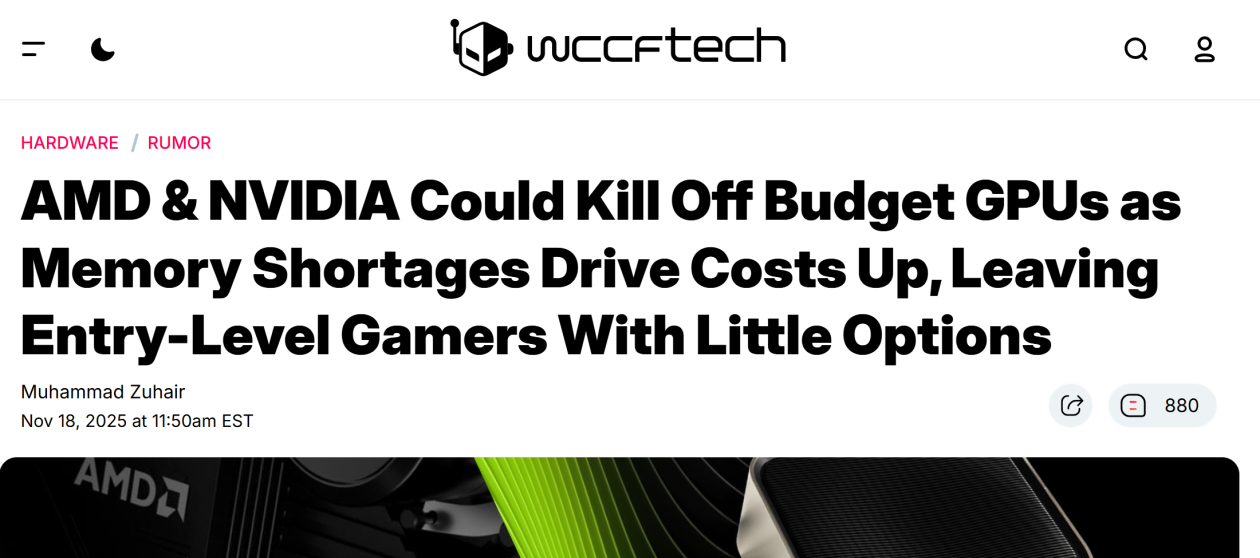
内存供应短缺,英伟达、AMD中低端游戏显卡或面临停产
Huan Qiu Wang· 2025-11-20 02:35
Core Insights - The global DRAM memory supply shortage is prompting GPU manufacturers Nvidia and AMD to consider halting production plans for entry-level and mid-range gaming graphics cards, potentially leading to supply adjustments and price fluctuations in the market [1][3] Group 1: Supply Chain Impact - The significant increase in GDDR memory module prices has sharply raised the material costs for graphics cards, causing a supply chain strain [3] - Current global DRAM production capacity is heavily shifting towards data center construction, resulting in a continued tight supply of consumer-grade memory [3] Group 2: Product Focus - Nvidia's "60 series" (e.g., RTX 4060/3060) and "50 series" (e.g., RTX 4050/3050) graphics cards, which focus on cost-performance ratio, are most likely to be affected by production adjustments due to their relatively thin profit margins [3] Group 3: Market Reactions - The memory shortage is causing a ripple effect in the electronics industry, leading to increased hardware component costs and significant price hikes in memory modules [3] - Manufacturers like Asus have indicated that if the DRAM shortage persists, consumer electronics prices may need to be raised, with a risk of mainstream graphics card prices "soaring" in the coming weeks, directly impacting gaming consumers' purchasing decisions [3]


内存价格暴涨成“电子黄金”,雷军都顶不住了
3 6 Ke· 2025-11-20 01:12
Core Insights - The recent surge in memory prices is primarily driven by increased demand from AI companies for HBM storage, which is squeezing DRAM and NAND flash production capacity [1][8] - The supply shortage in the memory market is currently over 5%, leading to significant price pressures on downstream manufacturers across various sectors, including consumer electronics [1][4] - The memory industry is entering a new upward cycle, influenced by AI's growing demand and a shift in production focus towards higher-margin products like HBM and DDR5 [4][10] Group 1: Price Dynamics - Samsung has announced a 60% price increase for memory chips, impacting the pricing of consumer electronics such as smartphones, laptops, and tablets [1] - The current memory price surge is characterized by a "price inversion" where DDR4 prices have surpassed those of DDR5 due to supply constraints and panic buying [7][15] - Historical data indicates that a 5% supply shortage can lead to a doubling of memory prices, while a 5% surplus could halve them [4] Group 2: Demand Drivers - The demand for NAND flash has shifted significantly due to AI applications, with companies like OpenAI and Gemini generating massive API calls, leading to increased storage needs [8][10] - The average business tasks supported by AI in Chinese enterprises is projected to rise from 28% to 44% over the next two years, further driving demand for memory products [10] - The cloud computing sector's data backup mechanisms are contributing to exponential data growth, necessitating more DRAM and NAND storage [10] Group 3: Industry Impact - The memory supply-demand imbalance is causing significant pressure on consumer electronics manufacturers, with major brands only able to secure 60-80% of their storage needs for the upcoming year [15][16] - The hardware OEM/ODM sector is facing severe profit margin pressures due to skyrocketing NAND and DRAM prices, which have increased by 50% and 300% respectively over the past six months [16] - The shift in focus from consumer electronics to AI server clients for memory allocation is reshaping the competitive landscape, with companies like Dell, HP, and ASUS identified as particularly vulnerable [16] Group 4: Technological Developments - The introduction of HBF technology, which utilizes NAND chips to match the bandwidth of HBM, is expected to expand the application scenarios for memory in AI tasks [18][20] - HBF technology offers significant advantages in terms of cost and capacity, potentially enhancing the efficiency of AI applications [20][21] - However, challenges remain regarding the lifespan and environmental requirements of NAND compared to DRAM, suggesting a potential hybrid architecture of HBM and HBF in the future [23][24]
直辖市重大调整!一个史无前例的新“省会”,诞生了
商业洞察· 2025-11-19 09:55
Core Viewpoint - The article discusses the significant administrative restructuring in Chongqing, where the two existing districts, Jiangbei and Yubei, have been merged into the newly established Liangjiang New Area, marking a transition from an economic function zone to an official administrative district [5][6][9]. Group 1: Administrative Restructuring - On November 6, Chongqing announced a major administrative restructuring approved by the State Council, merging Jiangbei and Yubei districts into Liangjiang New Area, reducing the total number of districts from 38 to 37 [6]. - Liangjiang New Area, previously an economic function zone, now serves as a formal administrative district, addressing issues of management overlap and fragmentation that hinder regional development [9][10]. - The new Liangjiang New Area covers approximately 1,360 square kilometers and has a population of about 3.52 million, with a projected GDP exceeding 600 billion yuan, positioning it as the largest economic and population center in the central and western regions of China [10]. Group 2: Economic Significance - The restructuring is seen as a strategic move to enhance Chongqing's role as a "strong provincial capital," similar to Chengdu, which has seen significant economic growth and population influx due to its provincial capital status [12][13]. - Liangjiang New Area contributes around 20% of Chongqing's GDP while occupying less than 2% of the city's area, highlighting its importance as the economic heart of the city [14][15]. - The area is home to key infrastructure such as Jiangbei International Airport and Guoyuan Port, making it a central hub for Chongqing's development as an inland open gateway [15]. Group 3: Industrial Development - Chongqing's manufacturing sector is robust, producing nearly 50% of the world's laptops and ranking second in automotive production in China, with significant contributions from companies like Changan and Seres [16][17]. - The city is implementing a "33618" modern manufacturing cluster system, focusing on three trillion-level leading industries, three five-hundred billion-level supporting industries, six thousand billion-level characteristic industries, and eighteen emerging industries [18]. - Liangjiang New Area is pivotal in this strategy, housing two of the three leading trillion-level industries: intelligent connected new energy vehicles and next-generation electronic information manufacturing [20]. Group 4: Automotive and Electronics Industry - As the heart of Chongqing's automotive industry, Liangjiang New Area is expected to produce 1.25 million vehicles in 2024, with nearly 580,000 of those being new energy vehicles, accounting for about 58% of the city's total output [21][22]. - The area is also a hub for the new generation of electronic information manufacturing, with a complete industrial chain from display panels to smart terminals, driven by companies like BOE and Unisoc [26][28]. - The integration of the automotive and electronics sectors is anticipated to create a synergistic effect, particularly in the development of intelligent connected vehicles, which is projected to become a trillion-yuan market by 2025 [29][30].




疯狂的存储芯片,明年产能全部售罄
半导体行业观察· 2025-11-19 01:35
Core Viewpoint - The semiconductor industry is facing a significant supply shortage of memory chips, particularly DRAM and NAND flash, driven by the surging demand from artificial intelligence (AI) data centers and related infrastructure [2][5][11]. Group 1: Demand and Supply Dynamics - SK Hynix and Samsung Electronics are experiencing a surge in demand for memory chips, with clients from various sectors, including PC manufacturers and tech giants like OpenAI, seeking to secure supplies for upcoming product launches [2][5]. - The demand for DRAM and NAND is primarily fueled by server applications, with a notable increase in prices due to supply constraints [3][11]. - Major cloud service providers are projected to increase their spending on AI data center servers significantly, from $285 billion in 2024 to $621 billion by 2026 [6]. Group 2: Market Conditions and Price Trends - The memory chip market is nearing full capacity, with many manufacturers prioritizing AI-related demands, leading to concerns about supply shortages for other sectors [5][10]. - Prices for memory products have surged dramatically, with 16GB DDR4 DRAM prices increasing by 840% year-on-year, reaching approximately $30.30, while 16GB DDR5 prices rose by 316% to around $20 [10][15]. - The NAND flash market is also experiencing tight supply, with expectations of price increases of 10% to 25% in the first half of next year due to ongoing demand pressures [15][12]. Group 3: Competitive Landscape - Companies like NVIDIA and AMD are seeing a significant increase in order volumes, which is exacerbating the supply constraints for memory products and related components [9][12]. - The shift from older DDR4 products to DDR5 is being driven by the need to meet the high-performance requirements of AI servers, despite ongoing demand for lower-tier DRAM in consumer electronics [10][11]. - Smaller companies and white-box manufacturers are likely to face more significant challenges in securing memory supplies compared to larger tech firms [11][17]. Group 4: Future Outlook - The current demand surge is seen as a double-edged sword for memory manufacturers, as it could lead to over-investment and subsequent price volatility if supply exceeds demand [16][18]. - Analysts predict that the memory market will continue to experience fluctuations, with potential for significant profit margins in the near term, but concerns remain about the sustainability of this growth [15][16]. - The semiconductor industry is urged to adapt to the structural changes in demand driven by AI, as traditional supply chains may struggle to keep pace with the rapid evolution of technology [12][18].

DRAM已经疯狂
半导体行业观察· 2025-11-18 01:40
Core Viewpoint - The global AI investment surge is exacerbating the DRAM shortage, leading to a shift from monthly or quarterly pricing negotiations to long-term supply contracts of six months or more, with discussions even extending to contracts for 2027 due to supply challenges [2][5]. Group 1: Market Dynamics - The DRAM market is transitioning to a long-term contract-oriented market, with demand surpassing that of the 2017 supercycle, driven by the rise of AI technologies like ChatGPT [2]. - General DRAM demand is significantly increasing, particularly from US and Chinese companies, as major firms like OpenAI and Meta announce substantial AI infrastructure investments [3]. - The typical supply contracts for DRAM, which were previously monthly, are now shifting to six-month or longer contracts due to heightened demand and willingness to pay above market prices [3]. Group 2: Supply and Inventory Trends - Samsung Electronics reported a 14.6% decrease in its semiconductor inventory to 3.404 trillion KRW in Q3, while SK Hynix also saw a reduction in inventory [4]. - SK Hynix has completed all DRAM supply contracts for the upcoming year and is negotiating contracts for 2027, indicating a strong demand that has led to a sell-out of their DRAM [5]. Group 3: Pricing and Profitability - With the demand surge, Samsung Electronics is considering raising DRAM prices by over 40%, reflecting the market's shift to long-term contracts which are expected to enhance profitability [5]. - DRAM contract prices have increased approximately 170% year-on-year, primarily due to demand from AI server manufacturers, with forecasts for Q4 indicating a market growth of 18%-23% [6]. Group 4: Distribution and Sales Strategies - Some distributors in Taiwan are implementing unprecedented bundling sales strategies, requiring customers to purchase motherboards alongside DRAM modules, reflecting the tightening distribution of DRAM [6]. - This bundling strategy has reportedly led to a surge in motherboard sales, indicating a significant shift in the memory market dynamics since the beginning of the year [6]. Group 5: Impact on OEMs and Market Ratings - Morgan Stanley has downgraded ratings for major OEMs due to the ongoing DRAM shortage, predicting sustained price increases for computers and electronic devices over the next few years [7]. - Dell's rating was notably downgraded from OW to UW, while other companies like HP and ASUS also faced rating reductions, reflecting the severe impact of rising memory costs on their profitability [7][8].
存储芯片疯狂涨价,PC与服务器厂商受伤!大摩:每涨10%,OEM毛利率就下降45-150个基点
美股IPO· 2025-11-17 09:54
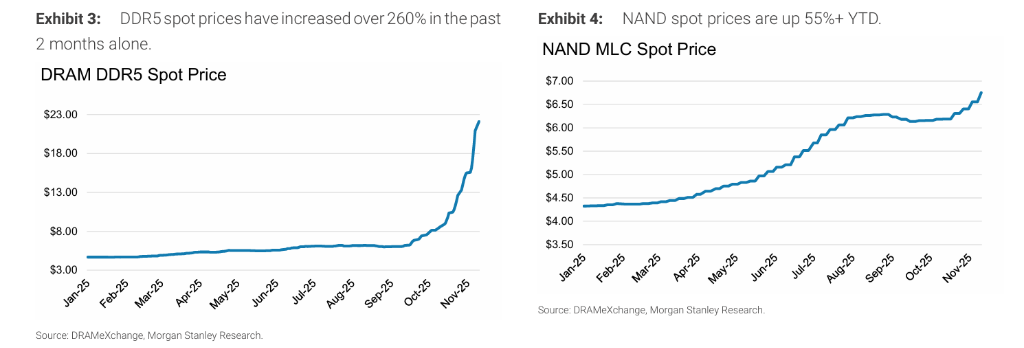
Core Viewpoint - The storage chip market is experiencing an unprecedented "super cycle" driven by AI demand and supply shortages, significantly impacting the profit outlook for PC and server manufacturers [1][3][4]. Group 1: Price Surge and Impact - Morgan Stanley warns that storage chip prices are skyrocketing due to AI demand and supply constraints, with DRAM spot prices soaring over 260% in just two months [1][5]. - The report indicates that the cost of storage chips (NAND and DRAM) constitutes 10%-70% of the BOM for high-end products, leading to a potential decline in hardware OEM gross margins by 45 to 150 basis points for every 10% increase in storage chip prices [3][6]. - The current price surge is unprecedented, with NAND flash prices rising over 50% since the beginning of the year [5][6]. Group 2: Drivers of Price Increase - The price surge is primarily driven by accelerated procurement from large cloud service providers for AI infrastructure, a spike in demand for high-bandwidth memory (HBM) for AI accelerators, and insufficient investment in NAND capacity over the past few years [6][10]. - Morgan Stanley predicts that contract prices for both NAND and DRAM could see double-digit percentage increases each quarter until 2026, far exceeding the previous cycle from 2016-2018 [6][10]. Group 3: Historical Context and Comparison - The previous storage super cycle from 2016 to 2018 serves as a reference point, where OEM margins and stock valuations began to decline 6 to 12 months after prices started to rise [8][10]. - Key differences in the current cycle include a more rapid price increase and a weaker demand environment for non-AI hardware compared to the previous cycle [10][11]. Group 4: Company Ratings and Vulnerabilities - Morgan Stanley has downgraded ratings for several major hardware companies, citing dual pressures on profits and valuations [12][13][14]. - Dell Technologies was downgraded from "Overweight" to "Underweight," with a target price cut from $144 to $110, due to significant impacts from rising storage costs [13]. - HP's rating was lowered from "Market Perform" to "Underweight," with a target price adjustment from $26 to $24, as profit margin pressures overshadow market recovery [14]. - Lenovo's rating was adjusted from "Overweight" to "Market Perform," as over 60% of its PC business targets the enterprise market, which is better positioned to pass on cost increases [17]. Group 5: Market Segmentation and Resilience - Different hardware manufacturers face varying levels of risk, with PC and server manufacturers more exposed due to their reliance on DRAM [18][20]. - Companies like Apple and Pure Storage are viewed as more resilient due to strong supply chain negotiation power and better pricing capabilities [20]. - Memory chip manufacturers such as Micron Technology, SK Hynix, and Samsung Electronics are expected to be direct beneficiaries of this super cycle [20].



存储芯片疯狂涨价,PC与服务器厂商受伤!大摩:每涨10%,OEM毛利率就下降45-150个基点
Hua Er Jie Jian Wen· 2025-11-17 09:01
Core Insights - A significant "super cycle" in storage chips is impacting the profit outlook for PC and server manufacturers, with Morgan Stanley warning of severe profit margin erosion due to skyrocketing storage chip prices [1][2][3] Price Surge and Market Dynamics - The current price surge in storage chips is driven by increased demand from AI infrastructure, a shift towards high bandwidth memory (HBM), and insufficient investment in NAND flash memory [2][7] - DRAM spot prices have surged over 260% in the past two months, while NAND flash prices have increased by over 50% since the beginning of the year [3][7] Historical Context and Comparison - The previous storage super cycle from 2016 to 2018 serves as a reference point, where OEM profit margins and stock valuations faced pressure after a similar price increase [9][11] - Key differences in the current cycle include a more rapid price increase and a weaker demand environment for non-AI hardware compared to the previous cycle [11][13] Impact on Hardware Manufacturers - Morgan Stanley has downgraded ratings for several global hardware giants, predicting dual pressure on profits and valuations [14] - PC and server manufacturers, particularly those heavily reliant on DRAM, are identified as the most vulnerable, with Dell, HP, Asus, and Acer being the most affected [15][17] Company-Specific Ratings Changes - Dell Technologies: Downgraded from "Overweight" to "Underweight," target price reduced from $144 to $110 due to severe impact from rising storage costs [17] - HP Inc.: Downgraded from "Market Perform" to "Underweight," target price lowered from $26 to $24 as profit margin pressures offset market recovery [17] - Asus: Downgraded from "Market Perform" to "Underweight," target price cut from NT$625 to NT$500 due to reliance on price-sensitive consumer markets [17] - Lenovo Group: Downgraded from "Overweight" to "Market Perform," with over 60% of its PC business targeting the enterprise market, which is better positioned to absorb cost increases [17]