阿里

Search documents
油价急速跳水失守60美元,黄金冲破4330美元,逼近历史新高
21世纪经济报道· 2025-12-16 14:53
Core Viewpoint - The article discusses the recent sharp decline in international oil prices, attributing it to a combination of disappointing U.S. employment data and ongoing concerns about global economic recovery, leading to a bearish outlook on oil demand [1][3][5]. Group 1: Oil Price Movement - On December 16, WTI crude oil futures fell by 2.06% to $55.65 per barrel, while ICE Brent crude dropped nearly 2% to $59.62 per barrel, marking the first time it fell below $60 since May [1]. - As of December 15, ICE Brent crude has seen a year-to-date decline of 19.13%, and WTI crude has dropped 20.97%, indicating a significant downward trend in oil prices [5]. Group 2: Economic Indicators - The U.S. non-farm payroll data for November showed an increase of 64,000 jobs, surpassing market expectations, but the unemployment rate rose to 4.6%, the highest since September 2021 [3]. - The International Monetary Fund (IMF) projects global economic growth rates of 3.2% for 2025 and 3.1% for 2026, which are lower than the growth expected for 2024 [6]. Group 3: Supply and Demand Dynamics - The article highlights a persistent oversupply in the oil market, with the International Energy Agency (IEA) reporting that global oil supply is expected to exceed demand by 3.84 million barrels per day [6]. - The U.S. Energy Information Administration (EIA) anticipates that U.S. crude oil production will reach a record high this year, further exacerbating supply concerns [7]. Group 4: Future Outlook - Despite short-term pressures on the oil market, there are potential long-term changes due to the rising demand for electricity driven by AI technology, which may impact oil demand dynamics [7]. - Analysts suggest that the rapid growth of AI data centers could lead to a significant electricity shortfall in the U.S. by 2028, potentially increasing natural gas demand and affecting oil prices in the long run [7].


大成恒生科技ETF:抛开争议,客观审视被动产品的价值
Shen Zhen Shang Bao· 2025-12-16 10:37
Core Viewpoint - The recent controversy surrounding the Dachen Fund's Hang Seng Technology ETF (159740) reflects a significant divergence in investor sentiment, occurring as the Hang Seng Technology Index has fallen over 16% from its year-to-date high, indicating a potential value reassessment phase for the asset [1] Group 1: Market Sentiment and Valuation - Investor opinions are sharply divided, with some believing that the valuation bottom has been reached and others cautioning against potential losses [1] - The current PE (TTM) of the Hang Seng Technology Index is 23.72, which is at a low percentile compared to the past decade, suggesting a window for rational investors to reassess their allocation [1][3] Group 2: Index Composition and Growth Potential - The Hang Seng Technology Index tracks leading technology stocks listed in Hong Kong, focusing on sectors such as internet, fintech, cloud computing, e-commerce, and digital business, representing core assets of China's new economy [2] - Historical data shows that the index's high growth is often accompanied by periodic adjustments, with a 45% increase in the first three quarters of 2025 followed by a normal market correction [2] Group 3: Investment Efficiency and Risk Management - The index employs a quarterly adjustment mechanism and an 8% weight cap for component stocks, ensuring a focus on quality technology assets while effectively diversifying investment risk [2] - The top ten constituents of the index include major companies like Meituan, Tencent, and Alibaba, with a balanced weight distribution [2] Group 4: Valuation Advantage and Long-term Support - The Hang Seng Technology Index's current valuation provides a safety margin for long-term investors, with a PE of 23.72 compared to the Nasdaq 100's 35.75, indicating a clear valuation advantage [3] - Factors such as accelerated AI commercialization, supportive policies from the 14th Five-Year Plan, and continuous inflow of southbound capital provide long-term support for the index [3] Group 5: Passive Investment Products and Timing Strategies - In a volatile market, passive investment products are becoming effective tools for investors to implement timing strategies due to their high liquidity [4] - The Dachen Hang Seng Technology ETF (159740) ranks first in trading volume in the Shenzhen market, with a circulating share count of 25.133 billion as of December 12 [4] Group 6: Benefits of High Liquidity - High liquidity offers three main advantages for investors: immediate trading capability, cost control through narrow bid-ask spreads, and price stability that aligns closely with index movements [5] - The ETF's closing price of 0.739 yuan on December 12 indicates a minimal tick change of 0.135%, facilitating frequent adjustments without significant transaction costs [5] Group 7: Transparency and Decision-making - The transparency of passive investment products reduces the complexity of timing decisions, allowing investors to focus on market trends rather than product uncertainties [6] - The dynamic optimization mechanism of the index, with a maximum individual stock weight of 8%, ensures it accurately reflects the performance of core technology assets, serving as a reliable market indicator [6]
“寒武纪卖早了”
投资界· 2025-12-16 07:52
Core Insights - The article discusses the annual venture capital conference in Shenzhen, focusing on the theme of "missed opportunities and heavy investments" in the context of investment strategies and industry shifts in China [2][3]. Group 1: Investment Institutions Overview - Tang Capital, founded in 2019, focuses on hard technology, particularly in electronic information, advanced manufacturing, and new materials, managing over 3 billion [3]. - Huakong Fund, established in 2007, has over 10 billion under management, emphasizing hard technology sectors such as advanced manufacturing and AI [4]. - Huaying Capital, founded in 2008, has invested in over 280 companies, with over 50% of investments related to AI [4]. - Guozhong Capital, established in 2015, manages 16 billion across multiple funds, focusing on supporting small and medium-sized enterprises [5]. - Lenovo Star, since 2008, has invested in over 400 companies, primarily in technology and healthcare [6]. - Linghang New Frontier, founded in 2019, manages approximately 2.8 billion, focusing on smart technology and biomedical sectors [7]. - Tiantang Silicon Valley, established in 2000, has invested in over 230 projects, with over 50% achieving exits, focusing on technology and healthcare [8]. Group 2: Investment Strategies and Shifts - Investment strategies have evolved due to industry cycles, with institutions adjusting their focus based on market conditions and technological advancements [9][16]. - Huaying Capital's investment methodology adapts to different stages of technology development, focusing on disruptive technologies and market leadership [12]. - Institutions like Tang Capital and Huakong Fund emphasize AI and advanced technologies as key future investment areas, reflecting a shift towards more innovative sectors [29][30]. - Guozhong Capital aligns its investment strategy with national development plans, focusing on emerging industries as outlined in the "14th Five-Year Plan" [19]. Group 3: Missed Opportunities and Lessons Learned - Many institutions shared experiences of missed opportunities in sectors like quantum computing and commercial aerospace, highlighting the importance of timely decision-making [25][27]. - The article emphasizes the need for continuous learning and adaptation in investment strategies to avoid missing out on emerging trends [26][28]. - Institutions reflect on past mistakes, such as underestimating the potential of the solar energy sector, which has since become a leading industry [26]. Group 4: Future Focus Areas - Future investment focus areas include AI, embodied intelligence, and commercial aerospace, with expectations for significant growth in these sectors [29][30]. - Institutions are also looking at advanced materials and renewable energy as key investment opportunities over the next five years [32][33].
国产射频芯片龙头昂瑞微登陆科创板 股价首日高开188.95%
Zhong Zheng Wang· 2025-12-16 07:00
Core Viewpoint - Beijing Angrui Microelectronics Technology Co., Ltd. has successfully listed on the Shanghai Stock Exchange's Sci-Tech Innovation Board, marking a significant advancement in the domestic RF chip sector [1][2] Company Overview - Founded in 2012, Angrui Micro is a national-level "little giant" enterprise focused on the design of RF and analog integrated circuits, specializing in RF front-end chips, RF SoC chips, and other analog chip development, design, and sales [1] - The company has developed high-integration 5G L-PAMiD products that meet international advanced and domestic leading standards, breaking the long-standing monopoly of international manufacturers [1] Market Position and Growth - Angrui Micro's RF front-end chips are now part of the supply chains for major terminal brands such as Honor, Samsung, Vivo, Xiaomi, and OPPO, while its RF SoC chips have entered the supply chains of Alibaba, Pinduoduo, BYD, and others [2] - The company anticipates a revenue of approximately 2.1 billion yuan in 2024, with a compound annual growth rate of over 50% in revenue over the past three years [2] IPO and Fund Utilization - The IPO is expected to raise a total of 2.067 billion yuan, which will primarily be used for the R&D and industrialization of 5G RF front-end chips and modules, RF SoC chips, and the construction of headquarters and R&D centers [2] - Notable investors participating in the strategic placement include Lenovo, BAIC, and several well-known financial institutions [2]
射频芯片“攀登者”昂瑞微,开启科创板上市新篇章
Zheng Quan Shi Bao Wang· 2025-12-16 02:15
Core Viewpoint - Angrui Microelectronics officially listed on the Sci-Tech Innovation Board, marking a significant step for domestic high-end RF chips in the capital market and enhancing the self-sufficiency of China's semiconductor industry [1] Group 1: Market Position and Technology - RF chips are essential for wireless communication in various fields, including 5G, smartphones, IoT, and smart vehicles, yet the market has been dominated by international giants like Broadcom and Qualcomm, with domestic market share remaining low [1][2] - Angrui Micro has achieved significant milestones in the high-end RF front-end module market, specifically with its 5G L-PAMiD module, which has been successfully mass-produced and shipped in flagship models of major smartphone brands, breaking international monopolies [2][3] - The company has established a comprehensive layout in satellite communication, launching products for handheld terminals and positioning itself favorably in the upcoming satellite communication market, which is expected to grow significantly [3][4] Group 2: Financial Performance and Growth - Angrui Micro's revenue from RF front-end products grew by 9.26% year-on-year, while its RF SoC business saw a 22.38% increase, indicating strong performance despite challenges from client procurement strategies [7] - The company has diversified its customer base, significantly increasing direct supply revenue from brand clients, which has reached levels comparable to the previous year's total, showcasing resilience and adaptability [7] Group 3: Strategic Initiatives and Future Outlook - The timing of Angrui Micro's IPO aligns with a critical window for domestic RF chip replacement, as global geopolitical changes drive local brands to adopt domestic suppliers, particularly in high-end modules [8] - The company plans to raise 2.067 billion yuan through its IPO to invest in R&D and industrial upgrades for 5G RF front-end chips and modules, as well as RF SoC projects [8] - To capitalize on the domestic replacement trend, Angrui Micro must enhance its supply chain autonomy, expand into high-value markets like automotive electronics and industrial IoT, and develop comprehensive system-level capabilities [9]
【12月16日IPO雷达】江天科技申购,锡华科技、天溯计量缴款,昂瑞微上市
Xuan Gu Bao· 2025-12-16 00:07
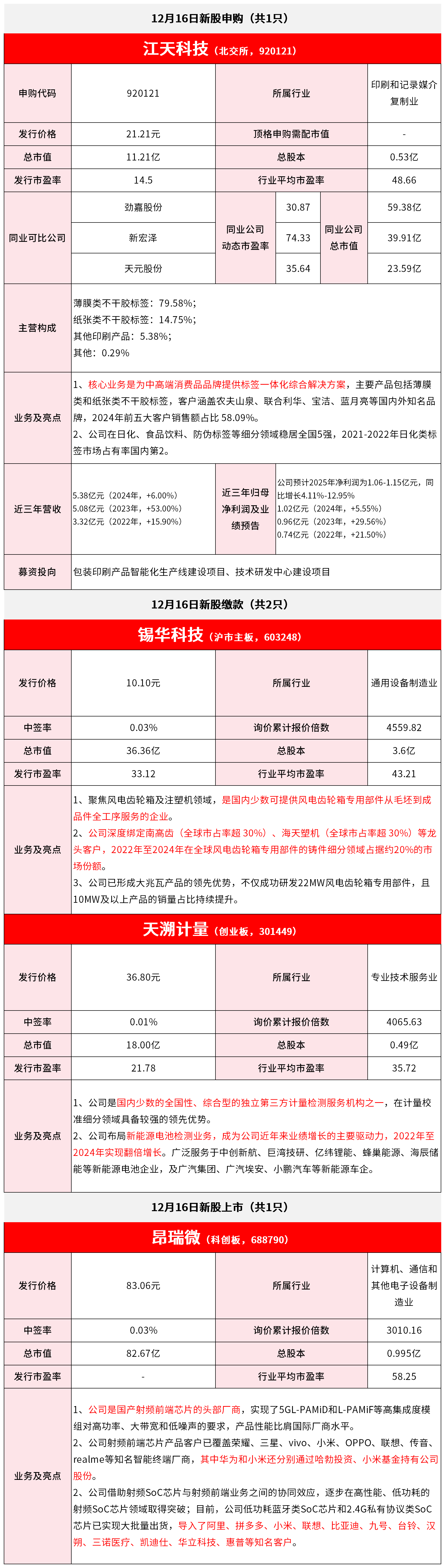
Group 1 - The core business of Jiangtian Technology is to provide label integration for mid-to-high-end consumer brands, with a focus on self-adhesive labels for various sectors [2][3] - The company has a total market capitalization of 1.121 billion yuan and an issuance price of 21.21 yuan, with a price-to-earnings ratio of 14.5 [2] - In the past three years, the company's revenue has shown significant growth, with 2023 revenue at 508 million yuan (+53.00%) and a projected net profit of 538 million yuan for 2024 (+6.00%) [3] Group 2 - The company has a market share of 58.09% from its top five customers in 2024, indicating strong customer reliance [3] - The main revenue sources include 79.58% from film-based self-adhesive labels, 14.75% from paper-based self-adhesive labels, and 5.38% from other printing products [2] - The fundraising will be directed towards the construction of intelligent production lines for packaging printing products and technology research and development [3]
大行评级丨花旗:预计明年中环和西九龙写字楼表现将优于香港其他区域 利好恒基地产和新鸿基地产
Ge Long Hui· 2025-12-15 05:27
Group 1 - Citigroup expects that demand from Chinese enterprises will continue to support the Hong Kong office market, driven by factors such as more Chinese tech giants and industry leaders considering purchasing office properties in Hong Kong [1] - An increasing number of A-share companies are dual-listing in Hong Kong and establishing regional headquarters or R&D centers, further boosting demand [1] - The launch of the GoGlobal Task Force in October aims to assist mainland companies in expanding into international markets, contributing to the demand for office space [1] Group 2 - Citigroup notes that the average capital value of Hong Kong office properties has declined by 52% from its peak, indicating a potential bottom-fishing behavior among buyers [1] - The company predicts that by 2026, office performance in Central and West Kowloon will outperform other regions, with rental rates stabilizing for major landlords like Hongkong Land and Henderson Land by the end of next year [1] - New quality supply in West Kowloon, such as IGC, is expected to be competitive in attracting demand, with rental levels comparable to those in the Eastern District of Hong Kong Island, benefiting New World Development [1]
跨越科技奇点,布局AI新机
Ping An Securities· 2025-12-15 02:09
Group 1: Industry Overview - The computer industry has shown steady revenue growth and improved profit margins, with total revenue reaching 939.34 billion yuan in the first three quarters of 2025, a year-on-year increase of 9.4% [11] - The software development sub-industry has seen significant profit improvements, while the computer equipment sub-industry remains relatively high in terms of market sentiment [11] - The industry has experienced a volatile upward trend since the beginning of 2025, with the computer industry index rising by 18.54% as of November 28, 2025, outperforming the CSI 300 index by 3.5 percentage points [18] Group 2: Algorithm and Applications - The global landscape of large models is rapidly evolving, with significant competition among closed-source models from companies like Google, Anthropic, and OpenAI, while domestic open-source models like Kimi K2 and MiniMax-M2 maintain a leading position [27][30] - The focus of large model applications is shifting towards programming, enterprise services, and office productivity tools, indicating a convergence in the market [42] - The integration of multi-modal capabilities and AI agents is becoming a competitive focal point in the large model market, expanding the boundaries of model tasks [32][34] Group 3: Computing Power - The AI computing power market is experiencing high demand, with the global AI server market projected to grow at a CAGR of 15.5% from 2024 to 2028, while China's market is expected to grow at a CAGR of 30.6% during the same period [10] - The domestic AI computing power chip industry is poised for growth due to strong policy support and increasing downstream demand, with a clear trend towards self-sufficiency [10][22] Group 4: Intelligent Driving - The penetration rate of Navigate on Autopilot (NOA) features is increasing, indicating a rapid commercialization of the intelligent driving industry in China, with the market size expected to exceed 300 billion yuan by 2030 [4] - Major players like Tesla and Xpeng are advancing their intelligent driving technologies, with significant updates and new model releases enhancing their market positions [4][5] Group 5: Investment Recommendations - The report maintains a "stronger than market" rating for the computer industry, highlighting investment opportunities in AI computing power, algorithms, and intelligent driving sectors [5] - Specific stock recommendations include companies like Zhongke Chuangda, Haiguang Information, and Industrial Fulian in the AI computing power segment, and companies like Daotong Technology and Kingsoft Office in the AI algorithm and application space [5][6]




音频 | 格隆汇12.15盘前要点—港A美股你需要关注的大事都在这
Ge Long Hui A P P· 2025-12-14 23:00
Group 1 - The National Development and Reform Commission (NDRC) is accelerating the implementation of policies to boost consumption in areas such as the economy, sports events, e-commerce, and "AI+" consumption [1] - China's social financing increased by 2.49 trillion yuan in November, with new RMB loans of 390 billion yuan, and the M2-M1 scissors difference has expanded [1] - The People's Bank of China conducted a 600 billion yuan reverse repurchase operation on December 15 [1] - The Ministry of Industry and Information Technology emphasized the need to stabilize the industrial base and integrate existing and new policies effectively [1] - The Ministry of Finance aims to maintain necessary fiscal deficits and total debt levels while improving policy precision and effectiveness [1] Group 2 - The launch of "Douyin Buy" introduces a new competitor to Alipay and WeChat Pay [2] - Several listed companies plan to increase prices for lithium iron phosphate products [2] - The stock private equity positions have reached a new high for the year [2] - "Unicorn" Weilan New Energy has initiated listing guidance and is expected to become the first company in solid-state batteries [2] - A-share investment caution is advised for *ST Huake due to suspected information disclosure violations, leading to an investigation by the China Securities Regulatory Commission [2]
解码光模块“三剑客”发家史
Xin Lang Cai Jing· 2025-12-14 13:06
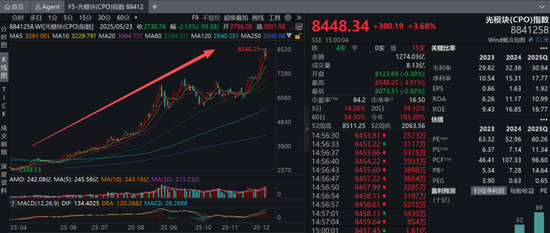
Core Viewpoint - The AI industry is experiencing significant growth, driven by advancements in AI computing power and the increasing demand for optical modules, which are essential for data transmission in AI applications. Major companies in the sector, including Google, Amazon, and Nvidia, are contributing to this momentum, leading to a surge in the stock prices of key players in the optical module market [1][3][13]. Industry Overview - The optical module sector is witnessing a robust expansion, with the CPO index reaching new highs, reflecting the high demand driven by AI computing needs. The leading companies in the A-share market, namely Zhongji Xuchuang, Xinyi Sheng, and Tianfu Communication, have all achieved market capitalizations exceeding 100 billion yuan [1][3][13]. - The global optical module industry is accelerating its upgrade towards 800G and 1.6T technologies, fueled by the explosive growth in AI computing power [1][3]. Company Highlights Zhongji Xuchuang - Zhongji Xuchuang transformed from a traditional manufacturing company to a leading global optical module provider through a strategic acquisition of Suzhou Xuchuang for 2.8 billion yuan in 2017, which significantly enhanced its market position [4][17]. - The company has successfully capitalized on the global 5G rollout and the upgrade of data centers, achieving a market-leading position in 800G optical modules, with a global market share exceeding 40% in 2024 [5][6][18][19]. - The projected net profits for Zhongji Xuchuang in 2027 are expected to reach 25.12 billion yuan, with a corresponding P/E ratio of 25.75 [3][16]. Xinyi Sheng - Xinyi Sheng began as a trading company and evolved into a manufacturer, achieving significant growth by focusing on high-speed optical modules. The company has strategically shifted its product line towards 100G and 400G solutions, aligning with the rising demand from cloud service providers [7][20]. - The company is set to scale up its 800G product line in the second half of 2024, with 1.6T products expected to contribute significantly to revenue by 2025 [9][21]. - Despite facing regulatory challenges, Xinyi Sheng continues to innovate and expand its technological capabilities, positioning itself as a strong competitor in the optical module market [8][20]. Tianfu Communication - Tianfu Communication has established a strong foothold in the optical communication sector by focusing on the production of critical components, achieving a gross margin exceeding 50% [11][22]. - The company has adopted a vertically integrated model, controlling the entire production process from raw materials to packaging, which allows it to maintain competitive pricing [12][23]. - Tianfu Communication is also advancing its capabilities in next-generation CPO technology, positioning itself as a key player in the AI-driven optical interconnect market [12][23].