
宝钢股份

Search documents
黑色金属投资价值分析-人间正道是沧桑
2026-01-20 01:50
Summary of Key Points from Conference Call Records Industry Overview - The analysis focuses on the **steel industry** and its investment value within the context of China's economic transition and industrialization phases [1][25]. Core Insights and Arguments - **Economic Transition**: China is transitioning from an industrialization maturity phase to a mass consumption phase, with economic growth increasingly reliant on consumer spending and government consumption rather than investment [2][26]. - **Capital Market Dynamics**: The current bull market is characterized by an oversupply of capital in society, with funds flowing into the stock market through various channels, including household savings, institutional asset allocation, corporate buybacks, and overseas hot money [14][9]. - **Investment Opportunities**: In a low-interest-rate environment, value investment opportunities arise, particularly in mature industries like steel, where companies are increasing dividends and buybacks, injecting new capital into the stock market [12][4]. - **Global Capital Flows**: The disarray in the U.S. monetary credit system may lead to a reallocation of global capital, potentially benefiting emerging markets like China if the Federal Reserve implements quantitative easing [13][14]. - **Valuation Methods**: Different stages of the industry lifecycle require different valuation methods. In mature phases, focus should be on the reset cost method rather than relying solely on PE or PB ratios [19][15]. Important but Overlooked Content - **Household Savings Impact**: The shift in household savings from real estate to stable income products like savings and dividend insurance has significantly impacted the capital market, leading to increased asset allocation in equities [10][11]. - **Insurance Sector Growth**: The insurance sector in China has substantial growth potential, with a projected increase in equity asset allocation as bond yields fail to match liabilities [11]. - **Steel Industry Competitiveness**: Evaluating steel companies' competitiveness involves analyzing metrics such as labor costs, production efficiency, and product pricing, which reflect their market positioning [17][18]. - **Investment Strategy**: A bottom-buying strategy for cyclical stocks should focus on reset costs rather than traditional valuation metrics, especially in volatile industries like steel [19][20]. Future Outlook - **Economic Growth Projections**: The overall economic growth rate is expected to stabilize around 3.5% in the coming years, with government consumption playing a crucial role in supporting demand-side reforms [2][41]. - **Steel Demand Trends**: Despite a decline in real estate demand, China's steel production remains robust due to upgrades in machinery and manufacturing, indicating resilience in the sector [27][54]. - **Investment Value in Steel Stocks**: Steel stocks are currently undervalued, with potential for significant returns if supply-side reforms are effectively implemented [56]. This summary encapsulates the key insights and arguments presented in the conference call records, highlighting the steel industry's dynamics and investment potential within the broader context of China's economic landscape.
现实?撑有限,板块表现偏弱
Zhong Xin Qi Huo· 2026-01-20 00:46
1. Report Industry Investment Rating - The mid - term outlook for the black building materials industry is "oscillation" [6] 2. Core Viewpoints of the Report - The fundamentals in the off - season are lackluster, and the market is expected to continue its weak adjustment in the short term. Before the Spring Festival, attention should be paid to the downstream restocking intensity. In January, the resumption of production by steel enterprises is expected to boost the restocking expectation, and there is an expectation of a low - level upward movement in the prices of furnace materials [6]. 3. Summary by Related Catalogs 3.1 Iron Element - **Iron Ore**: The expected increase in supply and inventory pressure are gradually rising. There are still expectations of disturbances on the supply side due to weather. The pre - holiday restocking on the demand side supports the ore price. The supply and demand on the ground still need verification, and it is expected to oscillate in the short term [2]. - **Scrap Steel**: The supply of scrap steel is low, the electric furnace profit is acceptable, and the daily consumption keeps increasing, which supports the demand. The overall fundamental contradiction is not prominent, and the spot price is expected to oscillate [2]. 3.2 Carbon Element - **Coke**: The cost side of coke has stabilized and rebounded, and the expectation of steel mill复产 still exists. As the mid - and downstream winter restocking gradually starts, the supply - demand structure of coke may gradually tighten, and the spot price increase is expected to be implemented. The futures market is expected to follow the trend of coking coal [2]. - **Coking Coal**: As the Chinese New Year approaches, the intensity of winter restocking gradually increases, and the subsequent coal mine supply will gradually decline due to the holiday. The fundamentals of coking coal will continue to improve marginally, and the spot price still has upward momentum. However, after the previous rally, the driving force for the futures market to continue rising is limited, and it is expected to oscillate [2]. 3.3 Alloys - **Manganese Silicon**: The cost push of manganese silicon is relatively weak, the market supply - demand pattern is loose, and the de - stocking pressure is large. The upward space of the futures price is limited. However, the current futures price valuation is low, and under the high - cost support, the risk of excessive short - selling should be guarded against [3]. - **Silicon Iron**: Currently, the silicon iron market has weak supply and demand, and the fundamental contradiction is relatively limited. In the short term, the futures price is expected to follow the trend of the sector [3]. 3.4 Glass and Soda Ash - **Glass**: There are still expectations of disturbances in glass supply, but the mid - and downstream inventories are moderately high. Fundamentally, the current supply and demand are still in surplus. If there is no more cold repair before the end of the year, the high inventory will always suppress the price, and it is expected to oscillate weakly; otherwise, the price will rise [3]. - **Soda Ash**: The overall supply and demand of soda ash are still in surplus, and it is expected to oscillate in the short term. In the long run, the pattern of supply surplus will further intensify, the price center will still decline, and capacity de - stocking will be promoted [3]. 3.5 Specific Product Analysis - **Steel**: The cost support is weakening, and the futures market is under pressure. The spot market trading is weak, the steel mill复产 rhythm slows down, the iron water output decreases, and the five major steel products' output growth slows down. The demand still has resilience, but there is seasonal weakening pressure later. The inventory is still being de - stocked, but the de - stocking speed is not obvious, and the inventory level is moderately high. It is expected to be under pressure in the short term [8]. - **Iron Ore**: The market sentiment has declined, with both shipments and arrivals decreasing. Overseas mine shipments have decreased month - on - month, arrivals have declined, and the supply side is expected to be disturbed by weather. The demand side has rigid support, and steel mills are restocking with weak enthusiasm. The port inventory is accumulating, and the supply pressure expectation has increased. It is expected to oscillate in the short term [8]. - **Scrap Steel**: The arrival volume has increased significantly, and the supply has recovered. The electric furnace profit is acceptable, and the daily consumption also keeps increasing, supporting the demand. The supply and demand are both increasing, and the overall fundamental contradiction is not prominent. The spot price is expected to oscillate following the finished products [10]. - **Coke**: The steel mill's rigid demand has declined, and the implementation of the price increase has been postponed. The cost side support is strong, but the steel mill's iron water output has slightly decreased, so the price increase implementation is delayed. The futures market is expected to follow the trend of coking coal [11]. - **Coking Coal**: The spot price is rising well, and the futures market is oscillating. The domestic supply is stable, and the Mongolian coal import has recovered. The demand side has seen an increase in winter restocking by coking enterprises, and the upstream coal mine inventory has been continuously digested. The spot price still has upward momentum, but the futures market's upward driving force is limited, and it is expected to oscillate [12]. - **Glass**: The futures price has corrected, and the spot and futures markets have started to sell. The supply is expected to decline in the long term, but it is difficult to have a large - scale cold repair in the short term. The demand is weak year - on - year, and the large inventory in the middle reaches always suppresses the glass valuation. It is expected to oscillate in the short term. If there is no more cold repair by the end of the year, it will oscillate weakly; otherwise, the price will rise [13]. - **Soda Ash**: The spot price has fallen at a low level, and the futures premium has decreased. The supply and demand fundamentals have not changed significantly, and the industry is still in the stage of clearing at the bottom of the cycle. The downstream demand is showing a downward trend, and the dynamic surplus expectation is further intensifying. It is expected to oscillate in the short term, and the price center will decline in the long run [13]. - **Manganese Silicon**: The cost support is loosening, and the de - stocking pressure still exists. The cost push is weak, the supply pressure is large, and the futures price is running weakly. The demand support in the off - season is limited, and the supply is difficult to achieve high - level inventory digestion. The upward space of the futures price is limited, but excessive short - selling risks should be guarded against [15]. - **Silicon Iron**: The supply - demand contradiction is limited, and it follows the sector's weakening. The market has weak supply and demand, and the overall contradiction is limited. The cost is at a relatively high level, which supports the price bottom. The demand support in the off - season is limited, and the supply is at a low level. In the short term, the futures market is expected to follow the black sector, and the downward space is limited [17]. 3.6 Index Information - **Comprehensive Index**: The commodity index is 2417.77, up 0.01%; the commodity 20 index is 2779.78, up 0.20%; the industrial products index is 2316.27, down 0.28% [103]. - **Plate Index**: The steel industry chain index on January 19, 2026, has a daily increase or decrease of - 0.82%, a five - day increase or decrease of - 1.37%, a one - month increase or decrease of + 1.16%, and an increase or decrease since the beginning of the year of + 1.07% [105].
可控核聚变迎利好,融资客抢筹这些概念股
Zheng Quan Shi Bao Wang· 2026-01-19 23:44
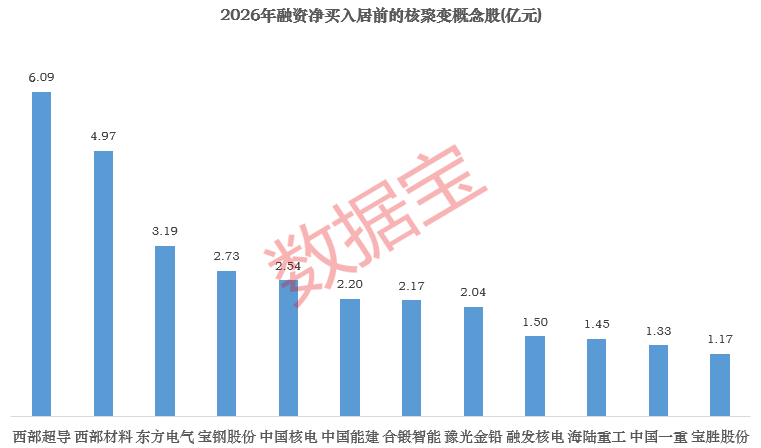
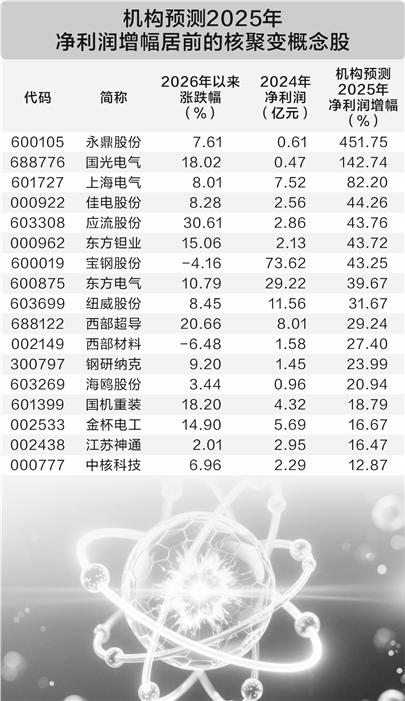
Group 1 - The controllable nuclear fusion industry is experiencing positive developments, with significant breakthroughs in high-temperature superconducting tokamak technology [1] - The global nuclear fusion market is projected to approach $500 billion by 2030, driven by substantial advancements in engineering and collaboration among key industry players [2][3] - The Chinese government has elevated controllable nuclear fusion to a national strategic priority, encouraging research and technological development in this field [2] Group 2 - Major investments are being made in nuclear fusion concept stocks, with significant net purchases recorded since the beginning of 2026 [4] - Companies like Western Superconducting and Western Materials are actively involved in producing superconducting materials for international fusion projects, enhancing their market influence [6] - A number of nuclear fusion concept stocks are expected to see substantial profit growth in 2025, with predictions indicating significant increases for companies like Yongding Co. and Guoguang Electric [7][8]



技术突破叠加政策红利 核聚变产业入机构法眼
Zheng Quan Shi Bao· 2026-01-19 18:12
Group 1 - The core viewpoint of the news highlights significant advancements in the controlled nuclear fusion industry, which has become a national strategic focus in China, with substantial growth potential anticipated in the coming years [4][5] - The "14th Five-Year Plan" suggests a forward-looking layout for future industries, promoting hydrogen and nuclear fusion energy as new economic growth points [4] - The first fundamental law in China's nuclear energy sector, the "Atomic Energy Law," was enacted on January 15, 2023, encouraging scientific research and technological development in controlled thermonuclear fusion [4] Group 2 - Energy Singularity announced a breakthrough in high-temperature superconducting Tokamak technology, achieving a stable long pulse plasma operation of 335 seconds in its 5609th experiment [3] - The company has been focusing on the development of compact high-temperature superconducting Tokamak devices and their operational control software since its establishment in 2021 [3] - The nuclear fusion energy engineering in China has entered a substantial and systematic phase of industrial collaborative efforts, with multiple joint laboratories being established to focus on key technologies [3] Group 3 - According to CITIC Securities, the nuclear fusion industry has vast growth potential, driven by significant events and orderly domestic capital expenditures, with expectations for overseas progress to exceed forecasts [5] - The market size for nuclear fusion is projected to reach $496.55 billion by 2030, with the potential to create a trillion-dollar industrial cluster by 2050 [5] - As of January 16, 2026, there are 12 nuclear fusion concept stocks with net inflows exceeding 100 million yuan, with Western Superconducting, Western Materials, and Dongfang Electric leading the rankings [5] Group 4 - 20 nuclear fusion concept stocks are expected to see profit growth in 2025, with notable predictions for Yongding Co. and Guoguang Electric, expecting profit increases of 451.75% and 142.74% respectively [7] - Shanghai Electric is forecasted to have a profit increase of over 80%, while several other companies are expected to see growth rates exceeding 40% [7] - The controlled nuclear fusion sector is experiencing a surge in investment opportunities, particularly in the mid-to-upstream segments, driven by technological breakthroughs and policy support [5][6]





钢铁行业周度更新报告:铁矿库存创历史新高
GUOTAI HAITONG SECURITIES· 2026-01-19 13:25
Investment Rating - The report maintains an "Overweight" rating for the steel industry [5]. Core Insights - Demand is expected to gradually stabilize, while supply-side constraints are anticipated to continue, leading to a potential recovery in the steel industry's fundamentals [3][4]. - The report highlights that despite a long period of micro-profitability in the industry, market-driven supply adjustments have begun, and if supply policies are implemented, the pace of supply contraction may accelerate [3][4]. Summary by Sections Steel Market Overview - The apparent consumption of the five major steel products was 8.2612 million tons, a decrease of 1.77% week-on-week but an increase of 4.33% year-on-year [6]. - The total steel inventory was 12.47 million tons, down 0.55% week-on-week, maintaining a low level [6]. - The average profit margin for rebar was 199.4 CNY/ton, down 15.2 CNY/ton from the previous week [6]. Production and Capacity Utilization - The production of five major steel products was 8.192 million tons, a slight increase of 0.08% week-on-week [6]. - The operating rate of blast furnaces in 247 steel mills was 78.84%, down 0.47 percentage points from the previous week [6][29]. - The capacity utilization rate for these mills was 85.48%, down 0.56 percentage points week-on-week [6][29]. Raw Material Prices - Iron ore spot prices remained unchanged, while futures prices decreased by 0.31% to 812 CNY/ton [48]. - The port inventory of iron ore rose to 165.55 million tons, an increase of 1.72% [52]. - The total shipment volume from major iron ore producers decreased, with Brazil's shipments down 7.37% and Australia's down 2.29% [53][61]. Recommendations - The report recommends focusing on companies with leading technology and product structures, such as Baosteel and Hesteel, as well as those with competitive advantages like CITIC Special Steel and Yongjin Materials [6].





印尼收紧供给预期强化,镍价维持偏强趋势
Shenwan Hongyuan Securities· 2026-01-19 12:46
Investment Rating - The report maintains a "Positive" outlook on the metals and new materials industry, particularly highlighting the strong trend in nickel prices due to tightened supply expectations from Indonesia [1]. Core Insights - The report indicates that the overall performance of the metals sector has been strong, with the non-ferrous metals index outperforming the broader market indices [4]. - Key price movements show significant increases in precious metals, particularly gold and silver, driven by geopolitical factors and changes in monetary policy [3][20]. - The demand for lithium and cobalt remains robust, with prices for lithium compounds experiencing substantial increases [3][16]. Weekly Market Review - The Shanghai Composite Index fell by 0.45%, while the Shenzhen Component rose by 1.14%. The non-ferrous metals index increased by 3.03%, outperforming the CSI 300 by 3.60 percentage points [4]. - Precious metals saw a weekly increase of 6.86%, while aluminum decreased by 0.57%. Energy metals rose by 1.47%, and small metals increased by 4.31% [8]. Price Changes - Industrial metals prices showed varied changes: copper decreased by 1.50%, aluminum by 0.06%, while zinc increased by 1.76% and tin by 5.32% [12]. - Lithium prices surged, with lithium hydroxide and carbonate increasing by 12.14% and 12.32%, respectively [16]. Key Company Valuations - Companies such as Zijin Mining, Shandong Gold, and Zhongjin Gold are highlighted for their strong earnings growth and favorable price-to-earnings ratios [17]. - The report emphasizes the potential for valuation recovery in state-owned enterprises within the steel sector, such as Baosteel and Shagang [19]. Metal Supply and Demand Dynamics - Copper supply is under pressure, with domestic social inventory increasing to 321,000 tons, while demand from the wire and cable sector shows a slight recovery [33]. - The aluminum sector is experiencing a tightening supply-demand balance, with production capacity constraints expected to support long-term price increases [48]. Growth Cycle Investment Analysis - The report suggests that after interest rate cuts, the valuation center is likely to shift upward, recommending investments in stable supply-demand sectors within the new energy manufacturing industry [3].




钢铁行业周度更新报告:铁矿库存创历史新高-20260119
GUOTAI HAITONG SECURITIES· 2026-01-19 12:32
Investment Rating - The report maintains an "Overweight" rating for the steel industry [6]. Core Insights - Demand is expected to gradually stabilize, while supply-side constraints are anticipated to continue, leading to a potential recovery in the steel industry's fundamentals [3][4]. - The report highlights that despite a long period of micro-profitability in the industry, market-driven supply adjustments have begun, which could accelerate the industry's upward progress if supply policies are implemented [3][4]. Summary by Sections Steel Market Overview - The apparent consumption of five major steel products was 8.2612 million tons, a decrease of 1.77% week-on-week but an increase of 4.33% year-on-year [6][20]. - Total steel inventory was 12.47 million tons, down 0.55% week-on-week, maintaining a low level [6][12]. - The average profit margin for rebar was 199.4 CNY/ton, down 15.2 CNY/ton from the previous week [6][41]. Production and Capacity Utilization - The operating rate of blast furnaces in 247 steel mills was 78.84%, a decrease of 0.47 percentage points from the previous week [6][29]. - The capacity utilization rate for these mills was 85.48%, down 0.56 percentage points week-on-week [6][29]. - The total steel production was 8.1921 million tons, a slight increase of 0.08% week-on-week [6][40]. Raw Materials - Iron ore inventory at ports reached 165.55 million tons, an increase of 1.72% week-on-week, marking a historical high [6][52]. - The spot price of iron ore remained unchanged, while futures prices decreased slightly [6][48]. - The total shipment volume of the four major iron ore producers decreased, with Brazil's shipments down 7.37% and Australia's down 2.29% [6][53][61]. Investment Recommendations - The report recommends focusing on companies with leading technology and product structures, such as Baosteel and Hualing Steel, as well as low-cost firms like Fangda Special Steel and New Steel [6]. - It also highlights the potential of upstream resource companies like Hebei Resources and Erdos, which may benefit from a recovery in demand [6].
钢铁12月数据跟踪:需求前高后低,材钢比持续扩大
GOLDEN SUN SECURITIES· 2026-01-19 12:24
Investment Rating - The report maintains a "Buy" rating for key steel companies, indicating a positive outlook for their stock performance in the coming months [10]. Core Insights - The steel industry has experienced a fluctuating demand pattern, with a peak in early 2025 followed by a decline, leading to an increase in the material-to-steel ratio, which reached 1.69 in December [2]. - China's apparent steel consumption grew by 2.9% year-on-year in 2025, although December saw a 5.0% decline compared to the previous year [2]. - The net export of steel in 2025 reached 11.296 million tons, a year-on-year increase of 8.7%, driven by strong exports in the automotive and home appliance sectors [3]. - The report highlights a shift in economic drivers from investment to consumption, with fixed asset investment declining by 3.8% year-on-year, while retail sales increased by 3.7% [2]. Summary by Sections Steel Production and Consumption - In December 2025, crude steel production was 68.18 million tons, a 10.3% year-on-year decrease, with an annual total of 960.81 million tons, down 4.4% [6]. - Steel production in December was 115.31 million tons, a 3.8% year-on-year decrease, while the annual total was 1,446.12 million tons, up 3.1% [6]. Export and Import Dynamics - December steel exports were 11.30 million tons, up 16.2% year-on-year, with total exports for the year at 11.902 million tons, a 7.5% increase [6]. - Steel imports in December were 520,000 tons, down 16.3% year-on-year, with total imports for the year at 6.06 million tons, down 11.1% [6]. Economic Context and Policy Implications - The report notes that the Chinese economy is transitioning to a more stable phase, with GDP growth projected at 5% for 2025, reflecting a pattern of high demand followed by a decline [2]. - Recent structural interest rate cuts by the central bank are expected to support credit flow to specific industries, indicating a potential for economic stabilization [8]. - The valuation of the steel sector has improved, moving from absolute undervaluation to a moderately low position, suggesting room for further gains [8]. Recommended Stocks - The report recommends several stocks, including: - Hualing Steel (华菱钢铁) [10] - Nanjing Steel (南钢股份) [10] - Baosteel (宝钢股份) [10] - New Steel (新钢股份) [10] - Jiuli Special Materials (久立特材) [10] - Yongjin Co., Ltd. (甬金股份) [10] - Changbao Steel (常宝股份) [10]


12月数据跟踪:需求前高后低,材钢比持续扩大
GOLDEN SUN SECURITIES· 2026-01-19 12:02
Investment Rating - The report assigns a "Buy" rating for several steel companies, including Xining Steel, Hualing Steel, Nanjing Steel, and Baosteel, indicating a positive outlook for their stock performance in the coming months [10]. Core Insights - The steel industry has experienced a fluctuating demand pattern, with a peak in early 2025 followed by a decline. The material-to-steel ratio has reached a new high of 1.69 in December, with an annual average of 1.51, suggesting a shift in consumption patterns [2]. - China's apparent steel consumption increased by 2.9% year-on-year in 2025, although December saw a decline of 5.0% compared to the previous year. The economic growth rate is projected to be 5% for 2025, with a quarterly breakdown showing a decreasing trend [2]. - The net export of steel reached 11.296 million tons in 2025, a year-on-year increase of 8.7%, driven by strong demand in the automotive and home appliance sectors. Exports to ASEAN countries have significantly increased, despite a decline in exports to the U.S. [3]. Summary by Sections Production and Consumption - In December 2025, crude steel production was 68.18 million tons, a decrease of 10.3% year-on-year, while the total for the year was 960.81 million tons, down 4.4%. Steel production in December was 115.31 million tons, down 3.8% year-on-year, with an annual total of 1,446.12 million tons, up 3.1% [6]. - The apparent consumption of steel in China is expected to be more accurately estimated by using steel production growth rates instead of crude steel production growth rates [2]. Economic Indicators - Fixed asset investment in 2025 is projected to be 48.5186 trillion yuan, a decrease of 3.8% from the previous year, while retail sales of consumer goods are expected to grow by 3.7% [2]. - The report highlights a transition from investment-driven growth to consumption-driven growth as China's economy matures [2]. Market Outlook - The recent structural interest rate cuts by the central bank are expected to support credit growth in specific sectors, indicating a potential for economic stabilization. The steel sector's valuation has improved, moving from absolute undervaluation to a moderately low position, suggesting room for further gains [8]. - Recommended stocks include Hualing Steel, Nanjing Steel, Baosteel, and others, which are expected to benefit from various economic cycles and trends [8].

CBAM冲击来袭,中国钢企成本压力几何?
2 1 Shi Ji Jing Ji Bao Dao· 2026-01-19 10:40
Core Viewpoint - The EU's Carbon Border Adjustment Mechanism (CBAM) will officially start charging fees on January 1, 2026, targeting high-carbon industries like steel, which is significantly impacted due to its large trade volume and high carbon emissions [1][2]. Group 1: CBAM Implementation and Challenges - The steel industry accounts for 7%-9% of global carbon emissions, with China’s steel sector being the second-largest emitter, contributing about 15% of the country's total emissions [1]. - The complexity of CBAM goes beyond simple tariffs; it aims to extend EU internal carbon costs to imported products to prevent "carbon leakage" [2][3]. - The default carbon emission intensity values set by the EU for steel products may pose significant challenges for Chinese exporters, as they could be forced to use higher default values if they cannot provide recognized carbon verification data [2][3]. Group 2: Economic Viability and Technological Pathways - The transition to greener steel production in China faces economic feasibility challenges, with various technological pathways identified, including increasing the proportion of electric arc furnaces and exploring hydrogen metallurgy [6][7]. - The cost of implementing these technologies is high, with specific projects like hydrogen carbon cycle blast furnace modifications estimated to increase production costs significantly [7]. - The availability of resources such as scrap steel and low-cost green hydrogen is critical for the successful transition to green steel, but current supply chains and costs present significant barriers [7][8]. Group 3: Market Dynamics and Competitive Landscape - The legal obligation to pay CBAM costs falls on EU importers, but the market dynamics will likely shift costs back to Chinese exporters, influencing procurement decisions based on carbon intensity [5]. - Large state-owned enterprises like Baowu and Ansteel are taking the lead in green transformation, while many private firms struggle with survival and lack the resources for significant technological upgrades [8]. - The industry is witnessing a bifurcation, with larger firms investing in green technologies while smaller firms face more severe challenges, potentially reshaping the market landscape [8].