
陕西煤业

Search documents
2025年负增长后,2026年进口煤量何去何从?
Changjiang Securities· 2026-01-18 09:45
Investment Rating - The report maintains a "Positive" investment rating for the coal sector [10] Core Insights - In 2025, China's total coal and lignite imports reached 490 million tons, a year-on-year decrease of 9.6% (52.43 million tons), marking the second year of negative growth in the past decade, excluding 2022. The outlook for 2026 suggests that coal imports are likely to decrease due to rising domestic coal prices, supply disruptions, and increasing costs [2][7] - The coal price is expected to remain stable in the short term, supported by seasonal demand and cost factors, despite high inventory levels limiting price increases. The report highlights the importance of monitoring supply changes and inventory replenishment rates [6][25] Summary by Sections Import Data and Trends - In 2025, coal imports from major countries showed varying trends: Indonesia (-15%), Russia (-9%), Mongolia (+5%), and Australia (-8%). The average price difference for Australian coal was negative 25 yuan/ton, indicating a deeper price inversion compared to 2024 [7][18] - The report anticipates a contraction in coal supply from major exporting countries in 2026, particularly from Indonesia, where production quotas may be reduced to around 600 million tons, down from 790 million tons in 2025 [7][8] Market Performance - The coal index (Yangtze) fell by 3.12%, underperforming the CSI 300 index by 2.55 percentage points. The report notes that the thermal coal market price as of January 16 was 695 yuan/ton, a decrease of 4 yuan/ton week-on-week [6][25] - The report identifies potential investment opportunities in the coal sector, emphasizing companies with strong fundamentals and those positioned for growth amid inflationary pressures [8] Supply and Demand Analysis - As of January 15, the daily coal consumption in 25 provinces was 6.3 million tons, with a slight year-on-year increase of 7.1%. The report indicates that power plant inventories have decreased, suggesting a tightening supply situation [25][44] - The report highlights that the supply of coking coal is stabilizing, with an increase in production capacity utilization rates, while the demand from steel mills remains steady [26][53]
信用利差周度跟踪20260116:信用债跟随利率下行超长信用二永表现强势-20260117
Huafu Securities· 2026-01-17 14:02
1. Report Industry Investment Rating There is no information provided in the content about the report industry investment rating. 2. Core Viewpoints of the Report - This week, the sentiment of interest - rate bonds was strong with slightly declining yields, and credit bond yields generally followed suit. The 10 - year ultra - long - term credit bonds performed strongly, and the spreads of secondary perpetual (Two - Perpetual, or "Two - Yong") bonds narrowed across the board. The excess spreads of industrial and urban investment perpetual bonds decreased slightly. [3][4] - Vanke's debt extension plan was better than expected, leading to an increase in the secondary prices of its outstanding bonds. However, due to the lack of unexpected industry support policies and the will to ensure rigid payment, the market remains cautious about central and state - owned enterprise real - estate bonds with the "high - debt, high - leverage, and high - turnover" model. It is recommended to maintain a wait - and - see attitude towards real - estate bonds in the short term. [5][40] - After the New Year, the performance of Two - Yong bonds was strong. The growth of dividend - insurance premium income may have increased the demand for ultra - long - term Two - Yong bonds, causing a significant decline in yields. Considering the central bank's strong intention to support the market, there may still be room for the spreads of Two - Yong bonds to compress. [5][40] 3. Summary According to the Table of Contents 3.1 Credit Bonds Follow Interest Rates Downward, Ultra - Long - Term Credit Bonds Perform Strongly - Interest - rate bond yields: The yields of 3Y, 5Y, 7Y, and 10Y China Development Bank bonds decreased by 2BP, 4BP, 3BP, and 1BP respectively, while the 1Y yield increased by 2BP. [3][11] - Credit bond yields: Overall, they followed the decline in interest rates. The yields of 1Y AA+ and above - grade credit bonds remained flat, while those of other grades decreased by 1BP; 3Y AA+ and above - grade yields decreased by 1BP, and other grades decreased by 3 - 4BP; 5Y AA+ grade yields decreased by 5BP, and other grades decreased by 1 - 2BP; 7Y credit bond yields of all grades decreased by 2 - 3BP; 10Y AA+ and above - grade yields decreased by 4 - 5BP, and AA grade decreased by 2BP. [3][11] - Credit spreads: Generally stable, with the 10 - year ultra - long - term credit performing strongly. The spreads of 1Y all grades narrowed by 1 - 2BP; 3Y AA+ and above spreads remained flat, and other grades narrowed by 2 - 3BP; 5Y AA+ spreads narrowed by 2BP, and other grades widened by 1 - 2BP; 7Y AAA spreads remained flat, and other grades widened by 1BP; 10Y AA+ and above spreads narrowed by 3 - 4BP, and AA grade spreads narrowed by 1BP. [3][11] 3.2 Urban Investment Bond Spreads Mostly Decline by 0 - 1BP - By external rating: The credit spreads of external - rated AAA - level urban investment platforms generally remained flat, while those of AA and AA+ levels generally decreased by 1BP. [4][16] - By administrative level: The credit spreads of provincial and municipal - level platforms generally remained flat compared with last week, while those of district - county - level platforms decreased by 1BP. [4][22] 3.3 Industrial Bond Spreads Remain Stable Overall, Vanke's Spreads Compress Significantly - Real - estate bonds: Central - state - owned enterprise real - estate bond spreads widened by 9BP, state - owned enterprise real - estate bond spreads widened by 4BP, mixed - ownership real - estate bond spreads converged significantly by 451BP, and private - enterprise real - estate bond spreads increased by 14BP. Vanke's spreads decreased by 4285BP. [4][27] - Other industrial bonds: AAA - grade coal bond spreads remained flat, and other grades decreased by 1BP; AA+ steel bond spreads decreased by 3BP, and AAA remained flat; the spreads of all grades of chemical bonds remained flat. [4][27] 3.4 Two - Yong Bond Spreads Narrow Across the Board, Yields of Medium - and Long - Term Varieties Decline Significantly - 1Y Two - Yong bonds: Yields of all grades decreased by 1BP, and spreads compressed by 2BP. - 3Y Two - Yong bonds: Yields of all grades decreased by 5 - 6BP, and spreads compressed by 3 - 5BP. - 5Y Two - Yong bonds: Yields of all grades decreased by 5 - 6BP, and spreads compressed by 1 - 2BP. [35] 3.5 Excess Spreads of Industrial and Urban Investment Perpetual Bonds Decrease Slightly - Industrial AAA - grade 3Y perpetual bonds: Excess spreads converged by 0.43BP to 14.41BP, at the 36.98% quantile since 2015. - Industrial 5Y perpetual bonds: Excess spreads remained the same as last week at 13.20BP, at the 32.28% quantile since 2015. - Urban investment AAA - grade 3Y perpetual bonds: Excess spreads decreased by 0.13BP to 4.51BP, at the 3.52% quantile. - Urban investment 5Y perpetual bonds: Excess spreads decreased by 0.79BP to 10.13BP, at the 18.64% quantile. [38] 3.6 Vanke's Extension Plan is Better than Expected, Two - Yong Bond Spreads Still Have Compression Space - Vanke: Its debt extension plan was better than expected, and the secondary prices of its outstanding bonds increased. However, due to the lack of relevant policies, the market is still cautious about central and state - owned enterprise real - estate bonds, and it is recommended to maintain a wait - and - see attitude in the short term. [5][40] - Two - Yong bonds: After the New Year, they performed strongly. The growth of dividend - insurance premium income may have increased the demand for ultra - long - term Two - Yong bonds. Considering the central bank's support, there may still be room for spread compression. [5][40] 3.7 Credit Spread Database Compilation Instructions - Market credit spreads, Two - Yong spreads, and urban investment/industrial perpetual bond spreads are calculated based on ChinaBond medium - and short - term note and ChinaBond perpetual bond data, with historical quantiles starting from the beginning of 2015. - Urban investment and industrial bond - related credit spreads are compiled and statistically analyzed by Huafu Securities Research Institute, with historical quantiles starting from the beginning of 2015. - Sample selection criteria: Industrial and urban investment bonds select medium - term notes and public - offering corporate bonds, excluding guaranteed bonds and perpetual bonds. Bonds with a remaining term of less than 0.5 years or more than 5 years are excluded from the statistical sample. Industrial and urban investment bonds use external entity ratings, while commercial banks use ChinaBond implied debt ratings. [46]

供需仍有改善空间,重视权益配置价值
Huafu Securities· 2026-01-17 12:20
Investment Rating - The coal industry is rated as "stronger than the market" [7] Core Views - The report emphasizes that the coal industry is currently experiencing a transformation, with policies aimed at energy security and a shift in supply dynamics. The coal price is expected to stabilize, with potential fluctuations in the short term [5][6] - The report highlights the limited elasticity of coal supply due to strict capacity controls and increasing mining difficulties, particularly in eastern regions. This is expected to lead to a concentration of production in western areas, raising supply costs [5] - The report suggests that despite weak macroeconomic conditions affecting coal demand, the rigid supply and rising costs will support coal prices, which are anticipated to maintain a volatile upward trend [5] Summary by Sections 1. Market Overview - The coal index experienced a slight decline of 3.11%, underperforming the Shanghai and Shenzhen 300 index by 2.54 percentage points. Year-to-date, the coal index has increased by 2.96% [13] 2. Thermal Coal - As of January 16, the Qinhuangdao 5500K thermal coal price is 695 CNY/ton, down 4 CNY/ton week-on-week, with a year-on-year decrease of 66 CNY/ton [3][32] - Daily average production from 462 sample mines is 5.467 million tons, a week-on-week increase of 15,000 tons but a year-on-year decrease of 6.2% [3][42] - The report notes a significant drop in daily consumption at major power plants, with inventory levels slightly increasing [3][46] 3. Coking Coal - The price of main coking coal at Jingtang Port has risen to 1,770 CNY/ton, reflecting a week-on-week increase of 150 CNY/ton [4][76] - Daily average production from 523 sample mines is 769,000 tons, with a year-on-year decrease of 2.7% [4][76] - The report indicates that the coking coal market is experiencing upward price adjustments, driven by supply constraints and increased demand from steel production [4][76] 4. Investment Recommendations - The report suggests focusing on companies with strong resource endowments and stable operating performance, such as China Shenhua, China Coal Energy, and Shaanxi Coal and Chemical Industry [6] - Companies with production growth potential and those benefiting from a bottoming coal price cycle are also highlighted, including Yanzhou Coal Mining, Huayang Co., and Gansu Energy [6] - The report recommends considering companies with integrated coal and power operations to mitigate cyclical volatility, such as Shaanxi Energy and Xinji Energy [6]




寒潮有望提振需求,逢低布局低位个股
ZHONGTAI SECURITIES· 2026-01-17 11:40
Investment Rating - The report maintains an "Overweight" rating for the coal industry, indicating a positive outlook for investment opportunities in this sector [5]. Core Insights - The coal market is expected to experience a recovery in demand due to a cold wave, which may stimulate heating needs and lead to increased procurement [7]. - The report highlights that the coal price is likely to stabilize and potentially increase in the latter part of January, driven by a combination of steady supply and moderate demand recovery [7]. - The investment strategy suggests positioning in coal stocks that have shown resilience and potential for growth, particularly those with strong dividend yields and low valuations [8]. Summary by Sections Basic Conditions - The coal industry comprises 37 listed companies with a total market capitalization of 1,905.163 billion yuan and a circulating market value of 1,857.669 billion yuan [2]. Key Company Performance - Major companies such as China Shenhua, Yancoal Energy, and Shanxi Coking Coal are highlighted for their strong earnings per share (EPS) and price-to-earnings (PE) ratios, with recommendations to buy or hold based on their growth potential [5]. Coal Price Tracking - The report notes fluctuations in coal prices, with a recent increase in coking coal prices by 150 yuan/ton, while thermal coal prices have seen a slight decline [8]. - The average daily production of thermal coal from sample mines is reported at 5.467 million tons, reflecting a week-on-week increase of 0.28% [8]. Inventory and Supply Chain - Coal inventory levels at major ports have increased, with a total of 27.012 million tons reported as of January 17, indicating a year-on-year increase of 5.50% [7]. - The report anticipates a tightening supply in the near term due to ongoing safety inspections and the upcoming holiday season affecting production [7]. Investment Opportunities - The report identifies three main investment lines: 1. Companies with strong dividend yields and low valuations, such as China Shenhua and Zhongmei Energy [8]. 2. Companies with growth potential based on their production capacity, such as Yancoal Energy and Shanxi Coking Coal [8]. 3. Companies positioned for recovery in coking coal prices, including Lu'an Huanneng and Pingmei Shenma [8].


煤炭周报:寒潮来袭叠加节前补库,煤价或震荡偏强运行-20260117
Minsheng Securities· 2026-01-17 09:12
Investment Rating - The report maintains a "Recommended" rating for several companies in the coal industry, including 晋控煤业, 山煤国际, 潞安环能, 华阳股份, 兖矿能源, 中国神华, 陕西煤业, 中煤能源, and 中广核矿业 [3][4]. Core Insights - The coal prices are expected to remain strong due to a combination of cold weather and pre-holiday stockpiling, with prices projected to fluctuate between 750-1000 RMB/ton [10][12]. - The report highlights a recovery in coal prices post-New Year, driven by reduced production and low inventory levels at ports [10][12]. - The focus is on companies with high spot market exposure and improved balance sheets, particularly those in Shanxi province, which has completed overproduction governance for 2024 [10][12]. - The report suggests that downstream replenishment has begun, leading to a stable to slightly strong outlook for coking coal prices [10][12]. - The first round of price increases for coke is anticipated due to rising raw material costs and improved steel mill profitability [10][12]. Summary by Sections Weekly Market Review - The coal sector experienced a weekly decline of 3.3%, underperforming compared to the broader market indices [18][21]. - The best-performing stocks included 云维股份 and 江钨装备, while 大有能源 faced the largest decline [24][26]. Industry Dynamics - The report notes that Mongolia's coal exports increased by 7.11% year-on-year, while Australia's coal export value decreased by 13.48% [28][32]. - China's coal imports rose by 11.94% in December 2025 compared to the previous year, indicating a recovery in demand [34][34]. Company Performance - New集能源 reported a 3.01% increase in raw coal production for 2025, while 中煤能源 saw an 8.0% decrease in December's coal production [44][45]. - 大有能源 projected a significant net loss for 2025, highlighting the challenges faced by the company in the current market environment [46][51].


险资系私募基金加速布局 11只产品已入市
Zheng Quan Ri Bao· 2026-01-16 16:41
Core Insights - The trial for long-term stock investment by insurance funds is accelerating, with the recent operation of the Honghu Fund Phase 3, increasing the total number of Honghu series funds to five and the total number of insurance-related private equity funds to eleven [1][2] Group 1: Fund Expansion - The long-term investment trial for insurance funds has three batches with a total amount of 222 billion yuan [2] - Seven insurance-related private equity fund management companies have been established, with Zhongyou Insurance Asset Management Company potentially becoming the eighth [2] - Guofeng Xinghua, the first insurance-related private equity fund management company, manages five Honghu series funds, with a total scale of 925 billion yuan across three funds [2] Group 2: Investment Strategy - The Honghu series private equity funds focus on high-dividend stocks, with ten out of eleven stocks having a dividend yield of over 3.4% in the past twelve months [4] - The investment strategy emphasizes stable, low-risk assets, targeting sectors like high-end manufacturing, artificial intelligence, and biomedicine to support the real economy [4][5] - Insurance funds are utilizing private equity to address low-interest environments and asset shortages, with high-dividend stocks providing stable cash dividends [5] Group 3: Future Outlook - The future expansion of insurance-related private equity funds is expected, supported by ongoing policy optimization to enhance the investment environment [6] - The foundation laid by the first three trial phases is anticipated to facilitate further expansion, with more small and medium-sized insurance companies applying for long-term stock investment trials [6]
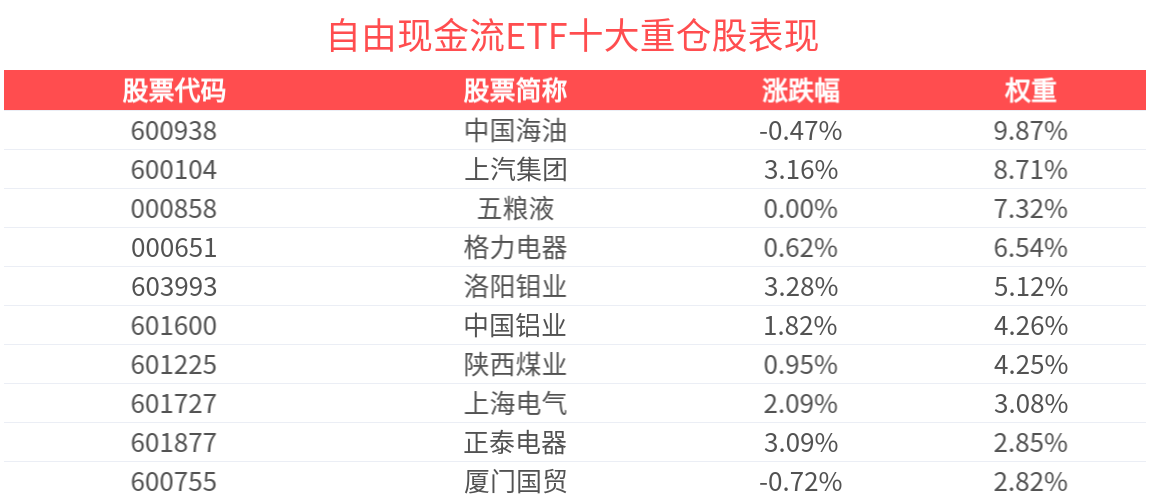
资金持续布局,聚焦自由现金流ETF(159201)长期配置价值
Sou Hu Cai Jing· 2026-01-16 02:27
| 股票代码 | 股票简称 | 涨跌幅 | 权重 | | --- | --- | --- | --- | | 600938 | 甲国海海 | -0.47% | 9.87% | | 600104 | 上汽集团 | 3.16% | 8.71% | | 000858 | 五粮液 | 0.00% | 7.32% | | 000651 | 格力电器 | 0.62% | 6.54% | | 603993 | 洛阳辑业 | 3.28% | 5.12% | | 601600 | 中国铝业 | 1.82% | 4.26% | | 601225 | 陕西煤业 | 0.95% | 4.25% | | 601727 | 上海电气 | 2.09% | 3.08% | | 601877 | 正泰电器 | 3.09% | 2.85% | | 600755 | 厦门国贸 | -0.72% | 2.82% | 截至2026年1月16日9:42,国证自由现金流指数上涨0.94%,成分股亚翔集成上涨7.69%,平高电气上涨6.69%,白银有色上涨4.47%,神火股份上涨3.68%, 三生国健上涨3.55%。自由现金流ETF(159201)上涨0. ...

陕西煤业1月15日获融资买入6052.61万元,融资余额7.68亿元
Xin Lang Cai Jing· 2026-01-16 01:33
Group 1 - The core viewpoint of the news is that Shaanxi Coal Industry has experienced a decline in stock performance and financial metrics, with a notable decrease in revenue and net profit year-on-year [2][3] - On January 15, Shaanxi Coal Industry's stock fell by 0.71%, with a trading volume of 624 million yuan, and a net financing purchase of 20.82 million yuan [1] - As of January 15, the total balance of margin trading for Shaanxi Coal Industry was 778 million yuan, indicating a low level compared to the past year [1] Group 2 - For the period from January to September 2025, Shaanxi Coal Industry reported an operating income of 118.08 billion yuan, a year-on-year decrease of 5.86%, and a net profit attributable to shareholders of 12.71 billion yuan, down 20.26% year-on-year [2] - The company has distributed a total of 81.64 billion yuan in dividends since its A-share listing, with 47.33 billion yuan distributed in the last three years [3] - As of September 30, 2025, the number of shareholders of Shaanxi Coal Industry increased to 105,000, while the average circulating shares per person decreased by 2.02% to 92,312 shares [2]
中信建投:A股预计迎来可观量级的增量资金,有望推动慢牛持续
Xin Lang Cai Jing· 2026-01-16 00:00
Core Viewpoint - The A-share market is expected to welcome a significant amount of incremental funds in 2026, which may sustain a slow bull market. The first quarter is projected to be the peak period for the maturity of fixed deposits, with funds likely flowing from insurance and wealth management channels into the equity market, marking the most abundant time for incremental funds throughout the year [3][4][62]. Group 1: Incremental Funds Sources - Incremental funds are primarily sourced from the migration of household deposits and pressures from asset scarcity, with insurance premium income continuing to grow significantly. By Q3 2025, the equity allocation ratio is expected to rise to 15.5%, nearing historical highs, which could release over 840 billion yuan into the market [4][6][66]. - The total amount of fixed deposits maturing in 2026 is estimated to be around 45 trillion yuan, which will likely lead to increased allocations in wealth management and "fixed income+" products, contributing over 900 billion yuan in medium to long-term funds to the A-share market [4][14][17]. - Public funds are expected to see a net inflow of approximately 230 billion yuan in 2026, driven by the recovery of fund net values and the enhanced motivation of individual investors to enter the market [4][33][34]. Group 2: Market Dynamics - The market's main contradictions in 2026 will shift towards verifying economic prosperity and performance realization, with medium to long-term funds providing a safety net. Active funds from public and private sectors are anticipated to further strengthen the "technology + resource products" dual mainline market, with accelerated sector rotation [4][62][64]. - The "national team" funds are expected to see a significant reduction in inflows, with a projected net inflow of about 200 billion yuan in 2026, as their role shifts in a bull market environment [19][22][23]. - High-risk funds, represented by margin trading and private equity, are expected to remain active, with margin trading net inflows estimated at around 450 billion yuan and private equity assets projected to grow to 8.5 trillion yuan, contributing approximately 700 billion yuan in incremental funds [4][26][31]. Group 3: Global and Domestic Influences - Overseas funds are anticipated to strategically allocate to Chinese assets, with northbound capital expected to net inflow around 100 billion yuan in 2026, although this impact on the overall market is expected to be limited [4][36][39]. - The macro liquidity environment is favorable, with a global interest rate cut cycle entering its later stages, but the marginal improvement in policies is expected to gradually converge. The micro-funding situation is likely to improve significantly, supporting a strong performance in equities over fixed income [4][45][49].


纯碱期价持续回落,短期或仍将承压?
Xin Lang Cai Jing· 2026-01-15 14:15
Core Viewpoint - The soda ash futures market has experienced a significant decline after a previous surge, primarily due to weakening supply-demand fundamentals, soft downstream demand, and rising inventory levels [1][15]. Supply Side Pressure - Recent soda ash production has shown a notable increase, reaching 775,300 tons for the week ending January 15, up from 753,600 tons the previous week, marking a 2.88% week-on-week growth [4][17]. - The capacity utilization rate has also improved, rising from 84.39% on January 9 to 86.82%, an increase of 2.43 percentage points [4][17]. - In East China, a major production area, soda ash output is projected to reach 1,779,500 tons in Q4 2025, reflecting a 1.89% increase from Q3, indicating ample regional supply [4][17]. Demand Side Weakness - The downstream glass industry has seen a decline in soda ash demand, with daily melting volume for float glass decreasing from 151,865 tons at the end of last year to 150,745 tons [6][19]. - The glass sector is facing significant supply-demand imbalances and rising cost pressures, leading to reduced procurement willingness for soda ash, with many companies adopting a just-in-time purchasing strategy [6][19]. - The supply-demand gap for dense soda ash has widened, with daily demand from float and photovoltaic glass at 47,600 tons, while daily production reached 58,800 tons, resulting in a surplus of 11,200 tons [6][19]. Inventory Levels - Inventory levels have reversed a previous downward trend, showing a clear accumulation. As of January 15, soda ash inventory stood at 1,575,000 tons, a slight increase from 1,572,700 tons on January 9 [9][22]. - The inventory of dense soda ash rose from 736,200 tons on January 9 to 738,000 tons [9][22]. - The number of available inventory days increased from 11.68 days on January 2 to 13.06 days on January 16, indicating growing inventory pressure [9][22]. Market Outlook - In the short term, the soda ash market is facing a "strong expectation versus weak reality" scenario, with supply expected to remain high and production anticipated to exceed 770,000 tons next week, maintaining an operating rate above 86% [12][25]. - Demand is constrained by the weak glass industry, with no significant improvement expected [12][25]. - The increase in inventory and decline in sales rates suggest that the weak fundamental landscape is unlikely to change soon. Current prices have fallen below 1,200 yuan per ton, with limited further downside expected [12][25].
