
英飞凌

Search documents
公司深度 | 无锡振华:冲压客户结构质变 电镀半导体双轮驱动【民生汽车 崔琰团队】
汽车琰究· 2025-07-10 12:47
Core Viewpoint - The company is positioned for growth through a dual strategy of traditional business intelligence and the scaling of new energy business, targeting a significant increase in revenue from electric vehicle components and precision electroplating by 2025 and 2030 [2][6]. Group 1: Automotive Stamping Business - The company has been deeply involved in the automotive stamping business for over 30 years, with a focus on expanding its customer base to include major players like Tesla, Li Auto, and Xiaomi, alongside its long-term partnership with SAIC Group [3][11]. - The domestic passenger car stamping market is projected to reach approximately 270 billion yuan by 2025, with a compound annual growth rate (CAGR) of 2.6% from 2025 to 2030 [3][40]. - The competitive landscape of the stamping industry is fragmented, with the top five companies holding a market share of about 9.5%, indicating potential for increased concentration as major manufacturers seek suppliers with strong responsiveness and cost control capabilities [3][45]. Group 2: Precision Electroplating Business - The acquisition of Wuxi Kaixiang in 2022 allowed the company to enter the precision electroplating sector, which has become a significant growth driver, contributing 7% of total revenue and 33% of net profit in 2023 [5][22]. - The company has established itself as a key supplier in the precision electroplating market, achieving over 50% market share domestically and a net profit margin of approximately 60% [5][15]. - The company is actively expanding its technology and customer base in the power semiconductor sector, having secured a partnership with Infineon, a leading player in the industry [5][15]. Group 3: Financial Performance and Projections - The company is expected to achieve revenues of 35.2 billion yuan, 44.5 billion yuan, and 52.8 billion yuan from 2025 to 2027, with net profits projected at 5.0 billion yuan, 6.5 billion yuan, and 8.0 billion yuan respectively [6][8]. - The earnings per share (EPS) are forecasted to increase from 2.01 yuan in 2025 to 3.18 yuan in 2027, reflecting a strong growth trajectory [6][8]. - The company maintains a competitive edge with a projected price-to-earnings (PE) ratio of 16, 12, and 10 for the years 2025 to 2027, indicating favorable valuation metrics [6][8]. Group 4: Management and Corporate Structure - The company has a stable ownership structure, with the controlling shareholders holding 62.49% of the shares, which supports long-term strategic execution [17][21]. - The management team is characterized by a blend of family leadership and professional expertise, enhancing operational stability and strategic direction [21][22]. - The implementation of stock incentive plans aims to align the interests of the core team with the company's growth objectives, fostering a motivated workforce [18][21].





无锡振华(605319):深度报告:冲压客户结构质变,电镀半导体双轮驱动
Minsheng Securities· 2025-07-10 12:07
Investment Rating - The report maintains a "Recommended" rating for the company, with a closing price of 31.65 CNY as of July 10, 2025 [6]. Core Insights - The company has entered a pivotal point in its stamping customer structure, with the electroplating business catalyzing new growth. The goal is for the new energy business to account for 25% and 60% of total revenue by 2025 and 2030, respectively [1][3]. - The company has a strong foothold in the automotive stamping parts sector, expanding its customer base and national production capacity, which is expected to drive growth [2][3]. - The acquisition of the electroplating business has created a second growth curve, with the company becoming a key supplier in the precision electroplating sector, particularly in the power semiconductor field [3][19]. Summary by Sections 1. Introduction - The report focuses on the company, which has over 30 years of experience in the automotive parts industry, forming four main business segments: stamping parts, assembly parts, precision electroplating, and molds. The company has established solid partnerships with major automotive manufacturers [10][12]. 2. Stamping Parts and Electroplating Business - The company is a leading supplier of automotive stamping parts, leveraging its long-standing relationship with SAIC Group and expanding into new energy vehicle manufacturers like Tesla and Li Auto [20][32]. - The precision electroplating business, acquired in 2022, has significantly contributed to revenue and profit, with a projected contribution of 1.8 billion CNY in revenue and 1.1 billion CNY in net profit for 2024 [29][45]. 3. Industry Overview - The automotive stamping parts market is projected to reach approximately 270 billion CNY by 2025, with a CAGR of 2.6% from 2025 to 2030. The industry is characterized by a fragmented competitive landscape [47][63]. - The report highlights the increasing demand for lightweight components in the automotive sector, driven by the rise of new energy vehicles, which is expected to enhance the market for stamping parts [46][63]. 4. Financial Forecast and Investment Recommendations - Revenue forecasts for 2025, 2026, and 2027 are estimated at 35.2 billion CNY, 44.5 billion CNY, and 52.8 billion CNY, respectively, with net profits projected at 5.0 billion CNY, 6.5 billion CNY, and 8.0 billion CNY [3][5]. - The report emphasizes the company's strong management capabilities and cost control, which are expected to lead to sustained improvements in net profit margins [2][39].
GaN,风云骤变
半导体行业观察· 2025-07-10 01:01
Core Viewpoint - The GaN market is experiencing significant changes, with TSMC announcing its exit from GaN foundry services, while other companies like Power Semiconductor Manufacturing Corporation (PSMC) and Infineon are ramping up their GaN production capabilities. This shift indicates a competitive landscape where companies are vying for dominance in the GaN semiconductor market, particularly in high-power applications like electric vehicles [1][2][3]. Group 1: TSMC's Exit and Market Dynamics - TSMC has decided to phase out its GaN semiconductor foundry business over the next two years due to declining profit margins caused by competition from Chinese manufacturers [3]. - Navitas, which previously relied on TSMC for production, will transition its manufacturing to PSMC, with plans to produce GaN products rated from 100V to 650V starting in 2026 [4]. - Infineon is increasing its investment in GaN technology, aiming to produce scalable GaN on 300mm wafers, with initial customer samples expected by Q4 2025 [5]. Group 2: Shift in Focus from SiC to GaN - Renesas Electronics has halted its SiC project and is shifting its focus to GaN, driven by a slowdown in the electric vehicle market and an oversupply of SiC chips [7]. - Renesas is leveraging its acquisition of Transphorm to enhance its GaN product offerings, introducing new high-voltage GaN FETs that improve efficiency and reduce costs [8]. Group 3: Strategic Investments and Collaborations - STMicroelectronics has extended its lock-up period for its investment in Innoscience, indicating strong confidence in the latter's future and the GaN market [10][11]. - Innoscience has emerged as a key player in the GaN market, achieving significant revenue growth and expanding its wafer production capacity [13]. Group 4: Market Growth and Challenges - The GaN semiconductor market is projected to grow significantly, with a compound annual growth rate (CAGR) of 98.5% from 2024 to 2028, potentially exceeding $6.8 billion by 2028 [14]. - However, challenges remain for GaN to transition from niche applications like fast charging to core applications in electric vehicles, which require higher reliability and ecosystem maturity [15][16]. Group 5: Competitive Landscape and Future Outlook - The GaN industry is at a critical juncture, with companies like Navitas, Infineon, and others actively working to commercialize high-power GaN solutions [17]. - The next two years will be crucial for GaN manufacturers to prove their strategies and for the market to determine if GaN can penetrate core power applications effectively [17].

芯片,好了吗?
半导体芯闻· 2025-07-08 10:23
Core Viewpoint - Artificial intelligence (AI) is considered the most exciting technological transformation of this generation, with semiconductor companies leading the innovation wave. AI accelerators for large language models are expected to account for 20% of the total semiconductor market in 2024, with this share projected to grow further. Nvidia is at the core of the AI boom, and both Nvidia and AMD are expected to perform well in the AI sector despite challenges in the Chinese market due to U.S. restrictions [1][20][16]. Semiconductor Industry Overview - The semiconductor demand is experiencing a broad surge, with digital semiconductors for AI leading the trend, while automotive and industrial semiconductors are gradually rebounding [8]. - Global semiconductor trade data indicates strong revenue growth driven by AI, with a projected 23% increase in chip industry sales in the first half of 2025 [9]. AI Semiconductor Demand - Nvidia's AI accelerators are projected to account for 20% of semiconductor revenue in 2024, with significant growth expected in 2025. Despite losing over $10.5 billion in revenue from the Chinese market, Nvidia's sales remain strong in non-China markets [20][16]. - Data center spending is expected to account for 25% of semiconductor end-market demand in 2024, with Nvidia maintaining a leading position in AI infrastructure [17]. Analog/Mixed-Signal Semiconductor Outlook - The severe cyclical downturn in the analog/mixed-signal semiconductor sector is nearing its end, with inventory levels dropping to a point where reordering is necessary. The long-term trend of increasing chip content in automotive and industrial applications remains solid [2][45]. - The median valuation of analog/mixed-signal chip manufacturers is considered undervalued by 13%, while digital chip stocks are undervalued by 3% [5]. Automotive Semiconductor Market - Automotive semiconductors are projected to account for 12% of chip industry revenue in 2024, with an increase in chip content per vehicle, especially in electric vehicles [49][53]. - The Chinese electric vehicle market is expected to grow by 25% in 2024, further driving demand for automotive semiconductors [53]. Industrial Semiconductor Market - Industrial semiconductors, which include military, aerospace, and medical applications, are expected to recover from a cyclical low, despite concerns over tariffs [56]. - The revenue growth of industrial semiconductors is anticipated to outpace U.S. manufacturing activity due to increasing chip content in devices [58]. Wireless Semiconductor Market - The wireless semiconductor market, primarily used in smartphones, is recovering from overordering during the pandemic, with a projected 28% market share in 2024 [36]. - The growth of wireless semiconductors is expected to be modest, with concerns over tariffs and a lack of a strong rebound in the consumer electronics sector [60]. Financial Performance and Margins - Nvidia's gross margin remains unmatched, peaking at 78%, while AMD's gross margin is gradually improving, expected to reach around 40% due to market restrictions [41][42]. - The gross margins for analog/mixed-signal semiconductors are anticipated to rebound as revenue growth resumes following the cyclical downturn [62].


损失17亿美元、目标延后,这家MCU大厂发生了啥?
芯世相· 2025-07-08 06:21
Group 1 - Renesas has recently announced the abandonment of its SiC power semiconductor production and disbanded its SiC chip production team at the Takasaki factory, leading to an expected loss of approximately $1.7 billion (about 250 billion yen) in the first half of the year [2][3][14] - The company has postponed its strategic goals set in 2022, including becoming one of the top three embedded semiconductor solution providers by 2030, exceeding $20 billion in sales, and increasing its market value sixfold by 2022, now aiming for 2035 [4][14] - The bankruptcy restructuring of its SiC partner, Wolfspeed, has significantly impacted Renesas, as Wolfspeed is a key supplier of SiC substrates [5][6][8] Group 2 - Renesas experienced a surge in revenue during 2021-2022 due to the global chip shortage and acquisitions, with 2022 revenue reaching 1.5 trillion yen, a 51% year-on-year increase, but growth has since slowed [23][25] - The company announced a major layoff of about 5% of its workforce, approximately 1,000 employees, and postponed salary increases due to performance pressures [24][29] - Financial results for the first quarter of 2025 showed a 12.2% year-on-year decline in sales to 308.8 billion yen, with automotive revenue also down 12.8% [26][27][41] Group 3 - The automotive semiconductor market is facing a downturn, with a projected 1.2% revenue decline in 2024, attributed to inventory adjustments by suppliers and OEMs [38] - Renesas has adjusted its strategy to focus on its core strengths in embedded processing and computing technologies, while also planning to increase investments in hardware and related peripherals [29][30] - The company is expected to continue its presence in the SiC market through design and outsourcing manufacturing, despite halting its own production [21][44]


1200亿灰飞烟灭,半导体鼻祖破产
商业洞察· 2025-07-07 09:21
Core Viewpoint - Wolfspeed, a pioneer in the semiconductor industry, has filed for bankruptcy due to overwhelming debt and inability to adapt to market changes, particularly the rise of Chinese competitors [3][22]. Group 1: Company Background - Wolfspeed was once the largest manufacturer of silicon carbide (SiC) substrates, with a peak market value of $16.5 billion (approximately 120 billion RMB) [3]. - The company originated from Cree Research, founded in 1987, and became a leader in the LED market before transitioning to SiC technology [8][12]. - Wolfspeed's market share in SiC substrates was as high as 80% in the past, but it has significantly declined to 33.7% by 2024 due to increased competition from Chinese firms [16]. Group 2: Financial Struggles - As of March, Wolfspeed had approximately $1.33 billion in cash reserves but faced $6.5 billion in debt, leading to severe liquidity issues [20]. - The company has reported net losses for ten consecutive years, with losses escalating from $280 million in FY 2018 to $864 million in FY 2024 [21]. - In May 2025, Wolfspeed's stock plummeted by 57%, resulting in a market value loss exceeding $1 billion [21]. Group 3: Market Dynamics - The demand for SiC semiconductors surged in sectors like electric vehicles and renewable energy, with over 60% of the demand coming from the EV market [20]. - Despite the high demand, Wolfspeed's expansion efforts did not yield the expected orders, particularly as the EV market faced a slowdown [20]. - The company's strategy of aggressive capacity expansion did not align with market realities, leading to underutilization of its new facilities [22][23]. Group 4: Competitive Landscape - Chinese competitors have leveraged their mature manufacturing capabilities to challenge Wolfspeed, which failed to adequately address the Chinese market's dynamics [3][24]. - Other global players, such as STMicroelectronics and Infineon, have pursued vertical integration and partnerships with Chinese firms, further intensifying competition [17].

报道称,美国计划在AI芯片方面对马来西亚设限
news flash· 2025-07-04 14:11
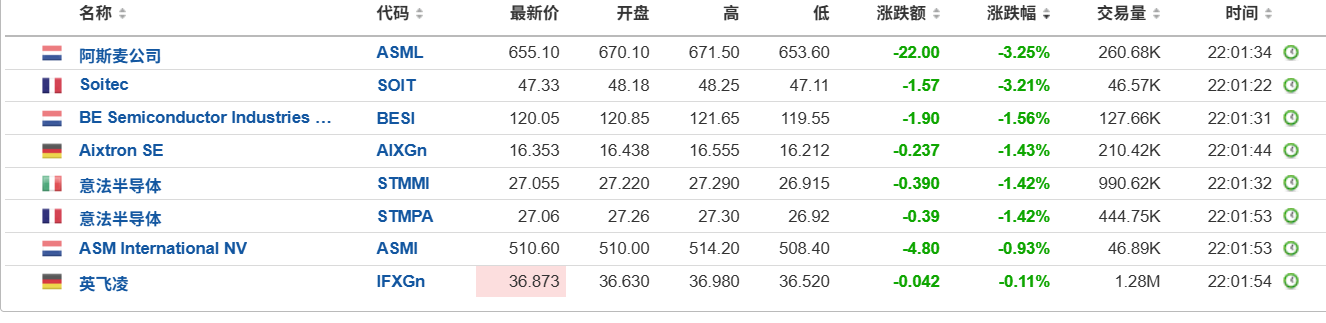
Group 1 - European semiconductor stocks experienced a broad decline, with ASML and Soitec dropping over 3% [1] - BE Semiconductor Industries, Aixtron SE, and STMicroelectronics saw declines of up to 1.5%, while ASM International fell by over 0.9% [1] Group 2 - ASML's latest price was 655.10, down by 22.00 or 3.25% from the previous price [2] - Soitec's latest price was 47.33, down by 1.57 or 3.21% [2] - BE Semiconductor Industries' latest price was 120.05, down by 1.90 or 1.56% [2] - Aixtron SE's latest price was 16.353, down by 0.237 or 1.43% [2] - STMicroelectronics' latest price was 27.055, down by 0.390 or 1.42% [2] - ASM International's latest price was 510.60, down by 4.80 or 0.93% [2] - Infineon's latest price was 36.873, down by 0.042 or 0.11% [2]
电源芯片,迎来革命
半导体芯闻· 2025-07-04 10:00
Core Viewpoint - The article discusses the significant upgrade in data center power infrastructure driven by the increasing demand for AI computing power, particularly focusing on NVIDIA's 800V High Voltage Direct Current (HVDC) technology, which is expected to reshape the third-generation semiconductor foundry landscape by 2027 [1][2]. Group 1: HVDC Technology and Market Dynamics - NVIDIA's 800V HVDC technology allows for an 85% increase in power transmission through the same size of wire compared to traditional architectures, with a key difference being the conversion of 800V DC to 54V DC [1]. - The demand for Power ICs in Compute Trays is expected to rise, with memory voltage needing to shift from 54V to 12V, creating opportunities for Taiwanese companies like Dazhong (8081) and Maida (6138) to capture market share [2]. - The collaboration between NVIDIA and Navitas involves the use of GaN and SiC technologies; however, TSMC's decision to gradually exit the GaN market raises questions about the future application of GaN in data centers due to safety concerns [2]. Group 2: Semiconductor Industry Implications - TSMC is optimizing its production capacity by reallocating workforce from older plants to support advanced packaging, which may create opportunities for other foundries like Lijidian to fill the gap in certain mature and specialized process nodes [2]. - The semiconductor industry is expected to see overseas PMIC manufacturers adjust their product offerings based on customer needs, providing Taiwanese supply chains with opportunities to penetrate Tier 1 customers [3].
汽车芯片,遇冷
半导体行业观察· 2025-07-04 01:13
Core Viewpoint - The automotive chip market is experiencing a cooling phase after a rapid growth driven by the "new four modernizations" in the automotive industry, leading to strategic exits and adjustments from major players in the sector [2][21]. Group 1: Industry Trends - The demand for automotive chips surged due to the rise of smart vehicles, creating a hotbed for investment and entrepreneurship in various chip categories such as image processing chips, automotive-grade MCUs, and radar chips [1]. - However, since 2025, both Silicon Valley giants and local companies have begun to signal a contraction in their automotive chip businesses, indicating a market cooling [2]. Group 2: Major Company Actions - Intel announced plans to gradually shut down its automotive business, focusing instead on its core client and data center products, reflecting a cautious approach towards the automotive chip market due to long return cycles and intense competition [4][6]. - Ambarella, once a leader in AI chip startups, is reportedly seeking to sell its business as it struggles to achieve profitability, with a significant net loss reported for the fiscal year 2025 [7][8]. - Infineon has postponed the expansion of its "megafab" in Malaysia and reduced investment by about 10% due to market uncertainties, highlighting the cautious sentiment in the automotive sector [9]. Group 3: Domestic Market Dynamics - In China, the automotive chip market has seen intensified competition, leading to a price war that has compressed profit margins and resulted in a decline in product value [10]. - Companies like Broadcom Integrated have adjusted their project timelines and funding allocations due to slow customer validation and increased complexity in AI and autonomous driving requirements [11][13]. Group 4: Future Outlook - Despite the current challenges, the long-term outlook for the automotive chip market remains positive, with projections indicating significant growth driven by the electrification and automation of vehicles [16][19]. - The global automotive chip market is expected to grow from $48.5 billion in 2024 to $187.8 billion by 2034, with a compound annual growth rate of 14.5% [16]. - Certain segments, such as power devices and high-security MCUs, continue to show strong demand, while the market is experiencing structural differentiation, with some companies facing funding challenges and project delays [19][21].


中芯国际、华虹半导体基本面更新&投资价值分析
2025-07-02 01:24
Summary of Key Points from Conference Call Records Company and Industry Overview - **Companies Involved**: SMIC (中芯国际) and Hua Hong Semiconductor (华虹半导体) - **Industry**: Semiconductor industry, focusing on advanced and mature process technologies Core Insights and Arguments SMIC (中芯国际) 1. **Performance Outlook**: SMIC expects Q2 2025 to be the bottom for performance, with Q3 revenue projected to grow over 10% sequentially, driven by the completion of equipment debugging and increased demand for mobile and AI chips [1][9][10] 2. **Order Visibility**: The visibility of orders has improved, covering levels beyond August 2025, alleviating concerns about Q4 performance [1][5] 3. **AI Product Shipments**: SMIC has begun large-scale shipments of AI-related products, with expectations for significant monthly increases in the second half of 2025 [1][6] 4. **Revenue Growth Forecast**: Revenue growth is expected to maintain a range of 15% to 25% over the next three years, with a gross margin forecast of approximately 22% for 2025 [11] 5. **Valuation Methodology**: A price-to-book (PB) ratio is deemed more appropriate for valuation than price-to-earnings (PE) due to the company's growth phase [14] Hua Hong Semiconductor (华虹半导体) 1. **Price Increase Impact**: Hua Hong finalized a price negotiation in May 2025, with expected price increases of 6-8% in Q3, significantly boosting performance [1][17] 2. **Demand Recovery**: Downstream demand is stabilizing, particularly in AI and industrial control sectors, with strong demand for analog and power management products [1][18][19] 3. **Capacity Expansion**: Hua Hong plans to release nearly 40,000 wafers of capacity in 2025, increasing to 83,000 wafers by mid-2026, focusing on 40nm to 55nm process technologies [3][21][22] 4. **Future Revenue Growth**: Revenue growth is projected at 10%, 17%, and 19% over the next three years, with net profit growth potentially exceeding 30% in 2025 [26] Additional Important Insights 1. **Local Production Trends**: The trend towards local production and domestic substitution is expected to enhance market positions for both companies, particularly in the context of geopolitical factors affecting supply chains [7][30] 2. **Market Sentiment**: The semiconductor market is showing signs of recovery, with improved order visibility and reduced uncertainty for the second half of 2025 [8][31] 3. **Catalysts for Stock Price Increase**: Key catalysts for stock price increases include improved fundamentals, the release of new AI models, and potential asset injections that could enhance valuations [16][29] This summary encapsulates the essential insights from the conference call records, highlighting the performance expectations, market dynamics, and strategic initiatives of SMIC and Hua Hong Semiconductor within the semiconductor industry.
