上美股份

Search documents
海外消费行业年度投资策略:2025扩品类、卡位全球,2026深度经营、品质、心智决胜
KAIYUAN SECURITIES· 2025-11-07 01:42
Group 1: Market Overview - The consumer service, retail, and media sectors in Hong Kong have shown significant performance, with the consumer service sector down by 17.34%, retail up by 94.61%, and media up by 50.98% as of October 24, 2025 [13][10][12] - The strong valuation recovery in Hong Kong stocks is attributed to a combination of global interest rate cuts, inflows of foreign and southbound capital, and the revaluation of core internet assets like Tencent and Alibaba [13][10] - The new consumption leaders in IP toys, tea drinks, and beauty sectors are showing positive fundamentals, leading to structural market trends [13][10] Group 2: IP Economy - The global licensed consumer goods market is projected to reach $307.9 billion in 2024, with a year-on-year growth of 10% [28] - Fashion apparel is identified as the category with the highest growth potential at 70%, followed by toys at 54% and food and beverages at 52% [31] - Disney, Pokémon, and Sanrio are leading in licensed retail sales, with Disney achieving $62 billion in 2024 [29][31] Group 3: Health and Wellness - The ready-to-drink beverage segment is expected to see significant penetration growth globally, with companies like Mixue Group and Guming benefiting from a positive operational cycle [4] - The return of home-cooked meals and increased health awareness are driving demand for traditional and healthy food options [4] Group 4: Beauty Sector - The cosmetics sector in China is experiencing slower growth compared to overall retail, with Douyin (TikTok) emerging as a key player in marketing and sales [4] - New ingredients and concepts are gaining traction, with a rise in oral beauty and health products [4] Group 5: Globalization Trends - The demand for spiritual entertainment in the Middle East is surging, with companies like Red Child City Technology seeing over 60% of their revenue from this region [4] - The cross-border e-commerce landscape is expanding, with companies like J&T Express capitalizing on the growth in Southeast Asia, where parcel volumes increased by 79% year-on-year [4] Group 6: Consumer Behavior Changes - The shift in consumer behavior towards more personalized and experiential consumption is evident, with a focus on self-fulfillment and value realization [4] - The education sector is adapting to changing perceptions, with new products targeting high school and college graduates to address employment challenges [4] Group 7: Entertainment and Leisure - The live music and sports sectors are expected to outperform the broader service consumption market, with companies like Ctrip and Damai Entertainment positioned to benefit [4] - The domestic concert market is maintaining high growth, with ticket sales and attendance showing significant year-on-year increases [73]




全面下滑,这家巨头恐跌出全球美妆十强
3 6 Ke· 2025-11-07 00:21
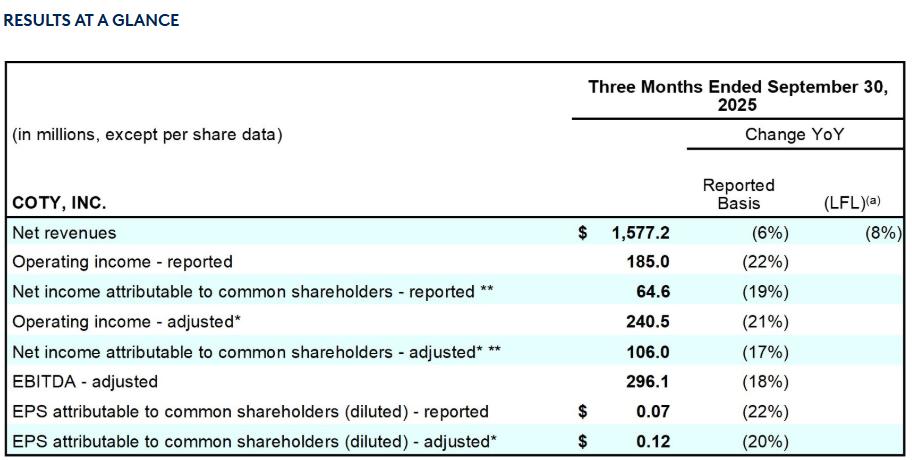
Core Viewpoint - Coty Inc., a century-old French perfume giant, is facing significant challenges, including declining performance across all business segments, plans to divest its mass cosmetics division, and the potential loss of the Gucci brand license, which could severely impact its revenue and profitability [1][28]. Financial Performance - For Q1 of fiscal year 2026, Coty's net revenue was $1.577 billion, a decrease of 6% year-over-year, and an 8% decline on a like-for-like basis [2][9]. - The reported net income was $64.6 million, down 19%, with a net profit margin of 4.1% [2][9]. - The mass beauty segment reported an operating loss of $7.7 million, with a loss rate of 1.5%, and an adjusted operating profit margin of 0.3%, down from 4.3% the previous year [9][28]. Business Segment Analysis - The high-end beauty segment generated $1.07 billion in net revenue, accounting for 68% of total sales, with a reported decline of 4% and a like-for-like decline of 6% [6][9]. - The mass beauty segment's net revenue was $508 million, representing 32% of total sales, with a reported decline of 9% and a like-for-like decline of 11% [6][9]. Regional Performance - All three major regions reported declines, with the Asia-Pacific region experiencing the largest drop of 9%, although there are signs of gradual improvement in the Chinese market [10][12]. - The European, Middle Eastern, and African markets, as the largest revenue source, saw a reported decline of 4% and a like-for-like decline of 9% [21][12]. Competitive Landscape - Coty is losing market share in the competitive global beauty landscape, particularly in the high-end fragrance segment, where it faces intense competition from companies like L'Oréal and Estée Lauder [24][28]. - The potential loss of the Gucci Beauty license, which contributes approximately 8% to Coty's sales and 11% to its profits, poses a significant risk to its future as an independent company [28][30]. Strategic Focus - Coty is focusing on optimizing its remaining high-end beauty operations and exploring new partnerships, while also emphasizing its core strength in the fragrance category [29][30]. - The company has appointed a new president for its mass beauty division, indicating a strategic shift aimed at addressing its current challenges [29].


上美股份(02145):2026年度投资峰会速递:韩束维持快增,多品牌势能强劲
HTSC· 2025-11-06 07:37
Investment Rating - The report maintains a "Buy" rating for the company with a target price of HKD 121.67 [7]. Core Insights - The main brand, Han Shu, continues to grow rapidly, with the GMV of the Hongbai waist set products optimized to below 50% in October, and the annual GMV of the secondary products category nearing 15% [2]. - The company has a strong multi-brand potential, with significant growth expected from brands like Newpage, 聚光白, 安敏优, and 极方, contributing to overall revenue growth [3]. - The organization is efficient and flexible, with a robust online capability and a well-structured team that supports the continuous incubation of differentiated multi-brands [4]. - The overseas expansion is progressing steadily, with plans to enter the Indonesian market in 2026, leveraging local strategies and the brand's competitive advantages [4]. Summary by Sections Brand Performance - Han Shu maintains rapid growth, with a diversified product structure and significant contributions from various categories, including men's care and cosmetics [2]. - New product launches, such as the upgraded 白蛮腰 series, are anticipated to drive future growth [2]. Multi-Brand Development - Newpage achieved over HKD 100 million in GMV in October, with a target of HKD 800-1,000 million for 2025 [3]. - 聚光白 has shown profitability and potential in the whitening segment, while 安敏优 is experiencing accelerated growth post-adjustment [3]. Organizational Efficiency - The company emphasizes a strategy of attracting top talent and building a strong organizational culture, which supports its multi-brand strategy [4]. - The self-broadcasting system on platforms like Douyin has been established with a large team, achieving a self-broadcasting ratio of nearly 85% in 2025 [4]. Overseas Strategy - The company is preparing for its entry into the Southeast Asian market, particularly Indonesia, with a focus on localized operations and leveraging the brand's quality-price advantage [4]. Financial Forecast - The company forecasts net profits of RMB 1.101 billion, RMB 1.379 billion, and RMB 1.717 billion for 2025, 2026, and 2027 respectively, with corresponding EPS of RMB 2.77, RMB 3.46, and RMB 4.31 [5].
华泰证券今日早参-20251106
HTSC· 2025-11-06 01:40
Key Insights - The report discusses the potential bubble in AI investments, indicating that the AI sector may be transitioning from the acceleration phase to the frenzy phase, with signs of irrational valuations and performance under expectations [2][4][5] - The report highlights the resilience of Chinese exports, which grew by 6% year-on-year in Q2 despite tariffs reaching 145%, and anticipates continued strong growth in exports through 2026 [4] - The report emphasizes the strong performance of large brokerage firms, with a 62% year-on-year increase in net profit for the first nine months of 2025, driven by asset expansion and increased investment activity [8] - The report notes the positive outlook for the airline industry, particularly for China National Aviation, as it benefits from improving supply-demand dynamics [11] - The report indicates that Spotify's revenue for Q3 2025 reached €4.272 billion, a 7% year-on-year increase, with a strong performance in user growth and profitability [12] - The report mentions that YUM China achieved a revenue of $3.2 billion in Q3 2025, reflecting a 4% year-on-year growth, supported by strong same-store sales [19] Group 1: AI Sector - The report outlines concerns regarding the AI bubble, suggesting that the sector is moving towards a potential frenzy phase characterized by irrational valuations [2][5] - It notes that AI-related investments contributed approximately 1 percentage point to U.S. economic growth in the first half of 2025, indicating significant economic impact [5] Group 2: Chinese Exports - The report highlights the resilience of Chinese exports, which grew by 6% year-on-year in Q2 2025, despite high tariffs [4] - It anticipates that the structural improvements in the export sector will continue to support growth through 2026 [4] Group 3: Brokerage Firms - The report indicates that large brokerage firms experienced a 62% increase in net profit year-on-year for the first nine months of 2025, driven by asset growth and increased investment activity [8] - It suggests that the operating environment for brokerages is improving, with enhanced performance elasticity and sustainability [8] Group 4: Airline Industry - The report discusses the positive outlook for China National Aviation, which is expected to benefit from improving industry supply-demand dynamics [11] - It highlights the company's recent engagement with investors regarding operational performance and future growth strategies [11] Group 5: Spotify - The report states that Spotify's Q3 2025 revenue reached €4.272 billion, a 7% year-on-year increase, with strong user growth and profitability [12] - It emphasizes the company's ongoing innovation in content and product features, which are expected to drive future growth [12] Group 6: YUM China - The report notes that YUM China achieved a revenue of $3.2 billion in Q3 2025, reflecting a 4% year-on-year growth, supported by strong same-store sales [19] - It highlights the company's effective cost management and expansion strategies as key drivers of its performance [19]
第一家市值500亿的本土美妆公司要出在上海?
3 6 Ke· 2025-11-06 00:26
Core Viewpoint - Shanghai is positioning itself as a leader in the cosmetics industry through the introduction of significant policies aimed at fostering high-quality development and innovation in the sector [1][5][14]. Group 1: Policy Measures - Shanghai released the "Measures for Further Promoting High-Quality Development of the Cosmetics Industry," which includes financial support of up to 30 million yuan for each project [1][5]. - The policy focuses on four key areas: technological innovation, service system innovation, ecological development, and industrial layout optimization, with 11 targeted initiatives to cultivate high-end and emerging brands [5][14]. - The measures include substantial financial support for innovative raw materials, with up to 2 million yuan for new registered raw materials and 500,000 yuan for new filed raw materials [5][14]. Group 2: Development Goals - Shanghai aims to cultivate one enterprise with a market value of 50 billion yuan, two enterprises with a market value of 10 billion yuan, and twelve enterprises with a production value exceeding 1 billion yuan within three years [7][8]. - The current highest market value for domestic beauty companies is held by Maogeping at approximately 38.27 billion yuan, followed by Juzhibio and Shangmei, both below 40 billion yuan [10][11]. Group 3: Competitive Landscape - The competition among major cities in China's cosmetics industry is intensifying, with Shanghai, Guangzhou, and Hangzhou being the primary contenders [2][11]. - Hangzhou has emerged as a strong competitor due to its e-commerce advantages and favorable business environment, housing top domestic brands like Proya and Maogeping [2][11]. - Shanghai's local beauty companies include Shangmei and Shanghai Jahwa, while brands like Lin Qingxuan and Natural Hall are targeting the Hong Kong stock market for IPOs [2][10]. Group 4: Industry Trends - The Chinese cosmetics market is experiencing a shift towards brand-driven and high-end products, with domestic brands capturing a growing market share [11][12]. - The market size for Chinese cosmetics is projected to be approximately 774.65 billion yuan in 2024, with domestic brands accounting for 55.74% of sales [11]. - Shanghai is actively developing live-streaming and cross-border e-commerce to enhance its competitive edge in the beauty sector [13][14]. Group 5: Regional Strategies - Different districts in Shanghai are focusing on specific segments of the cosmetics industry, such as functional skincare and AI integration in beauty health [14][15]. - The Jing'an district aims to create a billion-level beauty health industry cluster by 2028, attracting local beauty companies and establishing partnerships with major players [14][15].

中金2026年展望 | 轻工零售美妆:分化延续,优选成长(要点版)
中金点睛· 2025-11-05 23:52
Core Viewpoint - The light industry retail beauty sector is experiencing a weak recovery since 2025, with significant differentiation among sub-sectors and companies due to varying attributes and policy sensitivities. Domestic demand remains weak, while certain segments like trendy toys and beauty products show growth. International trade policies are slowing export growth. Looking ahead to 2026, government policies are expected to support consumption stabilization, but the marginal effects may diminish, leading to differentiated growth across sub-sectors [3]. Beauty and Aesthetic Medicine - The beauty sector is projected to achieve mid-single-digit growth in 2026, driven by domestic demand recovery. Ingredient upgrades and product innovations, particularly with emerging components like collagen and PDRN, are expected to enhance consumer purchasing needs. Competition is intensifying, leading to a concentration of market share among leading brands. The industry is anticipated to exhibit three trends: 1) National brands are moving towards globalization and group development; 2) Channel efficiency and operational capabilities are becoming more critical; 3) Market share is increasingly concentrated among top-performing brands [6]. - The aesthetic medicine sector is expected to see double-digit growth in 2026, supported by increased penetration rates and continuous market education. The supply side is becoming richer, stimulating demand. Two key trends are anticipated: 1) Midstream institutions are focusing on premium products and marketing capabilities; 2) Leading institutions are expanding through enhanced user operations and solutions [7]. Personal Care - The personal care sector is expected to benefit from increased online penetration and the rise of self-care demands, leading to a restructuring of the market. Product structures are anticipated to upgrade towards efficacy and premiumization. The rise of content e-commerce platforms is reshaping consumer access and marketing, providing opportunities for domestic brands to gain market share, particularly in segments like baby care, women's hygiene, and oral care [8]. Commercial New Retail - The retail sector is expected to continue its steady recovery into 2026, characterized by three trends: 1) Consumers are increasingly valuing cost-performance ratios, prompting businesses to focus on differentiated product offerings; 2) The clearance of outdated retail formats is nearing completion, with improved operational efficiency leading to profitability; 3) New consumption trends driven by emotional value are creating demand, supported by innovative product categories and localized operations [10]. Light Industry Manufacturing - The light manufacturing sector is facing weak overall demand but presents structural opportunities. Companies that can leverage industry transformation to develop new business models are expected to thrive. Key opportunities include: 1) Industry transformation driven by technological advancements, particularly in AI applications; 2) Export opportunities as companies enhance resilience through diversified global production and capitalize on improving overseas demand [13][14].

上美股份(02145) - 截至2025年10月31日止股份发行人的证券变动月报表
2025-11-05 08:47
股份發行人及根據《上市規則》第十九B章上市的香港預託證券發行人的證券變動月報表 截至月份: 2025年10月31日 狀態: 新提交 致:香港交易及結算所有限公司 本月底法定/註冊股本總額: RMB 398,107,102 備註: 第 1 頁 共 11 頁 v 1.1.1 公司名稱: 上海上美化妝品股份有限公司 (於中華人民共和國註冊成立的股份有限公司) 呈交日期: 2025年11月5日 I. 法定/註冊股本變動 | 1. 股份分類 | 普通股 | 股份類別 | H | | | 於香港聯交所上市 (註1) | | 是 | | | --- | --- | --- | --- | --- | --- | --- | --- | --- | --- | | 證券代號 (如上市) | 02145 | 說明 | | | | | | | | | | | 法定/註冊股份數目 | | | 面值 | | | 法定/註冊股本 | | | 上月底結存 | | | 206,354,542 | RMB | | | 1 RMB | | 206,354,542 | | 增加 / 減少 (-) | | | 0 | | | | RMB | | ...
85后“创二代”带珀莱雅赴港上市,能破局吗?
Da Zhong Ri Bao· 2025-11-05 03:13
Core Viewpoint - Proya, a leading Chinese cosmetics company, has submitted an application for a listing on the Hong Kong Stock Exchange, aiming to become the first domestic beauty brand to achieve an "A+H" share listing, amidst increasing competition in the domestic beauty market [1][5]. Financial Performance - In the first half of 2025, Proya's main brand generated revenue of 3.979 billion yuan, a slight decrease of 0.08% year-on-year. Despite overall revenue and net profit growth in the first three quarters of this year, the growth rates have dropped to single digits, with both metrics showing a year-on-year decline in the third quarter [1][7]. - Proya's revenue for 2022, 2023, and 2024 was 6.385 billion yuan, 8.905 billion yuan, and 10.778 billion yuan, respectively, while net profit for the same years was 817 million yuan, 1.194 billion yuan, and 1.552 billion yuan [6]. Market Position and Strategy - Proya's stock price has decreased by 13.30% from the beginning of the year to November 4, 2023, with an average price-to-earnings ratio of 21.21 times, compared to significant increases in the stock prices of other beauty companies listed in Hong Kong [1]. - The company is focusing on a multi-brand strategy, with significant revenue growth from brands like Caitang (21.11% increase), Yuanshe Bota (80.18% increase), and Off&Relax (102.52% increase) in the first half of 2025 [7]. Research and Development - Proya has prioritized "research and product innovation" as the primary use of funds raised from the Hong Kong listing, aiming to enhance its research capabilities to overcome growth bottlenecks [9]. - Research and development expenses from 2022 to 2025 have been 128 million yuan, 174 million yuan, 210 million yuan, and 95 million yuan, representing 2%, 1.95%, 1.95%, and 1.77% of revenue, respectively [9]. Management Changes and Internationalization - Proya has undergone significant management changes since the second generation took over, with new appointments aimed at injecting fresh energy into the company and accelerating its internationalization strategy [11][12]. - The company has introduced a "Double Ten Strategy," aiming to rank among the top ten global cosmetics companies in the next decade, which reflects its ambition to transition from mere scale growth to becoming a strong industry benchmark [13].


上美股份(02145.HK):11月4日南向资金增持19.87万股
Sou Hu Cai Jing· 2025-11-04 21:00
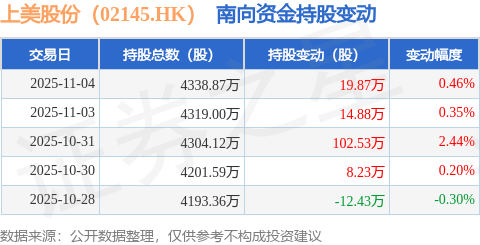
Core Insights - Southbound funds increased their holdings in Shangmei Co., Ltd. by 198,700 shares on November 4, 2025, marking a 0.46% increase in total shares held [1][2] - Over the past five trading days, there have been four days of net increases in holdings, totaling 1,330,800 shares [1][2] - In the last twenty trading days, there were ten days of net increases, amounting to 1,400,500 shares [1][2] - As of now, southbound funds hold 43,388,700 shares of Shangmei Co., Ltd., which represents 21.02% of the company's total issued ordinary shares [1][2] Company Overview - Shangmei Co., Ltd. is primarily engaged in the production and sale of cosmetics in China [2] - The company markets brands such as "Han Shu," "Yi Ye Zi," and "Red Elephant," focusing on skincare and maternal and infant care products [2] - Products are sold through both online and offline channels, with a primary focus on the domestic market [2]
自然堂 “增长悖论”:渠道效率提升,品牌价值停滞
晚点LatePost· 2025-11-04 15:59
Core Viewpoint - The article discusses the growth logic and investment value of the cosmetics company Chando, highlighting its operational efficiency improvements through inventory management and offline strategy optimization, while noting that its brand equity and consumer perception have not kept pace with these changes [4][5]. Group 1: Industry Overview - The domestic cosmetics industry is transitioning from foreign brand dominance to the rise of domestic brands, driven by increased consumer recognition of domestic quality and brand value, as well as a significant shift towards online sales channels [5][6]. - Online sales in the cosmetics sector have surged from approximately 30%-35% in 2020 to over 65% by 2024, benefiting domestic brands that have heavily invested in online channels [5][6]. Group 2: Chando's Performance - From 2022 to the first half of 2025, Chando's revenue growth was only 3%-6%, significantly lagging behind competitors like Proya and Shiseido, which have seen higher growth rates [7]. - Chando's market share in 2024 was 1.7%, ranking third among domestic brands, while Proya and Shiseido held 3.3% and 1.9%, respectively [7]. Group 3: Financial Metrics - Chando's online channel revenue share increased from 59.7% in 2022 to 68.8% in the first half of 2025, while its marketing expenses as a percentage of revenue rose from 39.8% in 2022 to 44.8% in 2024 [12][19]. - Despite an increase in gross margin from 66.5% in 2022 to 69.4% in 2024, Chando's net margin only slightly improved from 3.2% to 4.1% during the same period [18][19]. Group 4: Operational Strategies - Chando has implemented a "one inventory" system to enhance operational efficiency, which has improved inventory turnover rates from 2.5 in 2022 to 3.5 in the first half of 2025 [30]. - The company is expanding its offline retail presence, with a focus on increasing the number of retail partners and optimizing credit terms to attract more distributors [24][28]. Group 5: Future Outlook - Chando's strategy to enhance offline channels may provide better economic benefits as online growth effects appear to be diminishing [19]. - The company is also expanding production capacity, with a projected increase of 40% by the end of 2025, indicating a focus on volume growth through cost reduction and market share stabilization [35][36].