
陕西煤业

Search documents
陕西煤业股价连续6天上涨累计涨幅6%,诺安基金旗下1只基金持15万股,浮盈赚取19.2万元
Xin Lang Cai Jing· 2026-01-12 07:51
Group 1 - The core point of the news is that Shaanxi Coal Industry has seen a continuous increase in its stock price, rising 0.04% to 22.60 CNY per share, with a total market capitalization of 219.1 billion CNY and a cumulative increase of 6% over the past six days [1] - Shaanxi Coal Industry Co., Ltd. is primarily engaged in coal mining, washing, transportation, sales, and production services, with self-produced coal accounting for 55.83% of its revenue, including raw selected coal at 39.02% and trade coal at 31.85% [1] - The company was established on December 23, 2008, and was listed on January 28, 2014 [1] Group 2 - According to data from the top ten holdings of funds, one fund under Nuoan Fund holds shares in Shaanxi Coal Industry, specifically the Nuoan New Power Flexible Allocation Mixed A fund, which has maintained its holding of 150,000 shares, representing 4.01% of the fund's net value [2] - The fund has generated a floating profit of approximately 19,200 CNY during the six-day increase, with a total floating profit of about 192,000 CNY [2] - The Nuoan New Power Flexible Allocation Mixed A fund was established on March 5, 2012, and has a current scale of 72.09 million CNY, with a year-to-date return of 1.75% and a one-year return of 18.36% [2]

供给约束再起,重视煤炭景气回暖与价值重估 | 投研报告
Zhong Guo Neng Yuan Wang· 2026-01-12 02:53
Core Viewpoint - The coal industry is entering a new upward cycle, with fundamental and policy factors aligning, making it an opportune time to invest in coal stocks [5] Price Trends - As of January 10, the market price for Qinhuangdao port thermal coal (Q5500) is 696 RMB/ton, an increase of 17 RMB/ton week-on-week [2] - The price for Shanxi-produced coking coal at Jingtang port remains stable at 1650 RMB/ton as of January 9 [3] - International thermal coal prices show mixed trends, with Newcastle NEWC5500 at 71.8 USD/ton (up 0.3 USD) and ARA6000 at 95.3 USD/ton (down 1.8 USD) [2] Supply and Demand Dynamics - The utilization rate for thermal coal mines is 90.3%, up 8.2 percentage points week-on-week, while coking coal mine utilization is at 85.34%, up 5.7 percentage points [3] - Coastal provinces show an increase in daily coal consumption by 29.90 thousand tons/day (+15.11%), while inland provinces see a decrease of 7.40 thousand tons/day (-1.81%) [4][5] - Chemical coal consumption has increased by 8.36 thousand tons/day (+1.13%) [4] Inventory Levels - As of January 8, coal inventory in coastal provinces decreased by 111.60 million tons (-3.17%), while inland provinces saw a larger drop of 409.00 million tons (-4.15%) [4] Investment Strategy - The coal sector is characterized by high performance, cash flow, and dividends, with a recommendation to invest in quality coal companies [7] - Companies such as China Shenhua, Shaanxi Coal, and others are highlighted for their stable operations and strong performance [7] - The coal market is expected to remain tight in the next 3-5 years, with a focus on the potential for price increases and valuation recovery [6][7]



陕西煤业1月9日获融资买入2547.69万元,融资余额7.24亿元
Xin Lang Cai Jing· 2026-01-12 01:45
Group 1 - On January 9, Shaanxi Coal Industry's stock increased by 0.49% with a transaction volume of 783 million yuan, while the financing net purchase was -44.38 million yuan, indicating a low financing balance compared to the past year [1] - As of September 30, 2025, Shaanxi Coal Industry reported a revenue of 118.08 billion yuan, a year-on-year decrease of 5.86%, and a net profit attributable to shareholders of 12.71 billion yuan, down 20.26% year-on-year [2] - The company has distributed a total of 81.64 billion yuan in dividends since its A-share listing, with 47.33 billion yuan distributed in the last three years [3] Group 2 - As of September 30, 2025, the number of shareholders of Shaanxi Coal Industry increased by 2.07% to 105,000, while the average circulating shares per person decreased by 2.02% to 92,312 shares [2] - Among the top ten circulating shareholders, China Securities Finance Corporation holds 195 million shares, unchanged from the previous period, while Hong Kong Central Clearing Limited reduced its holdings by 10.7 million shares to 133 million shares [3]
陕西:构建支撑有力的全域开放格局
Shan Xi Ri Bao· 2026-01-12 00:20
Core Insights - The first cross-Caspian China-Europe freight train departed from Xi'an, significantly reducing transit time from 15-23 days to approximately 11 days, enhancing trade efficiency [1] - Shaanxi's foreign trade has shown resilience, with an average annual growth of 4.7% during the 14th Five-Year Plan period, and a 13.7% year-on-year increase in total import and export value for the first 11 months of 2025 [1][2] - The province's export of electromechanical products reached 281.24 billion yuan, accounting for 86.1% of total exports, with significant growth in integrated circuits, automobiles, and data processing equipment [2] Trade and Investment Growth - Shaanxi's trade with countries along the Belt and Road Initiative has grown at an average annual rate of 11.7%, with notable increases in exports to ASEAN, Taiwan, and the EU [2] - The province's foreign direct investment and contract engineering revenues reached $1.585 billion and $7.64 billion respectively during the 14th Five-Year Plan period, indicating deepening international cooperation [4] - The actual use of foreign capital in Shaanxi has accumulated to $5.55 billion, with an annual growth rate of 18.4%, and 1,889 new foreign enterprises established [8] Foreign Investment Landscape - The establishment of foreign enterprises in Shaanxi, such as Eaton Electric Group's investment of 100 million yuan, reflects the province's attractive investment environment and robust industrial support [5][6] - Major foreign projects have been launched in Shaanxi, enhancing the province's investment appeal and fostering local industry growth [6] - The provincial government has implemented measures to optimize the business environment and support foreign investment, including the establishment of coordination mechanisms and service initiatives for multinational companies [7] Economic Policy and Future Outlook - Shaanxi's government emphasizes expanding openness as a key driver for high-quality development, with strategic plans to enhance its role as a significant node in the Belt and Road Initiative [7][9] - The province aims to further integrate into global cooperation and explore new development opportunities, positioning itself as a competitive player in the international market [9]

供给约束再起,重视煤炭景气回暖与价值重估
Xinda Securities· 2026-01-11 15:32
Investment Rating - The report maintains a "Positive" investment rating for the coal mining industry, consistent with the previous rating [2]. Core Insights - The current phase is viewed as the beginning of a new upward cycle for the coal economy, with a focus on the recovery of coal market conditions and value reassessment [3][5]. - Supply constraints are expected to re-emerge, with domestic coal production potentially declining due to regulatory checks and safety inspections [5][13]. - Demand for coal is projected to see slight growth in 2026, driven by a 5% economic growth rate and increased coal consumption in non-electric sectors [5][13]. - Short-term coal prices are expected to stabilize and potentially rise due to seasonal demand increases and inventory reductions at coastal ports [5][13]. Summary by Sections 1. Coal Prices - As of January 10, the market price for Qinhuangdao port thermal coal (Q5500) is 696 CNY/ton, up 17 CNY/ton week-on-week [4][32]. - The price for coking coal at Jingtang port remains stable at 1650 CNY/ton [34]. - International thermal coal prices show slight increases, with Newcastle coal at 71.8 USD/ton, up 0.3 USD/ton week-on-week [4][32]. 2. Supply and Demand Dynamics - The capacity utilization rate for thermal coal mines is reported at 90.3%, an increase of 8.2 percentage points week-on-week [5][13]. - Demand from coastal provinces has increased, with daily consumption rising by 29.9 thousand tons (+15.11%) [5][13]. - Chemical coal consumption has also increased, with a weekly rise of 8.36 thousand tons (+1.13%) [5][13]. 3. Market Outlook - The report emphasizes the importance of coal supply as a stabilizing factor in the market, with expected regulatory constraints leading to a tighter supply environment [5][13]. - The anticipated recovery in coal prices and the potential for value reassessment in the sector are highlighted as key investment themes [5][13]. - The report suggests that the coal sector remains an attractive investment opportunity, particularly for high-quality coal companies with strong cash flows and dividend yields [5][15].


“机”已至:伺机而动
GOLDEN SUN SECURITIES· 2026-01-11 12:59
Investment Rating - The industry rating has been upgraded to "Overweight" [9] Core Insights - The report emphasizes that the coal market requires a "black swan" event to stimulate coal prices, with a focus on the exit of domestic capacity increases as a critical factor [2] - The report highlights the tightening of regulations in Indonesia, which could lead to reduced exports and support coal prices [3] - The report notes that the coal price has started to rebound due to increased daily consumption and cost support [31] Summary by Sections Market Review - The CITIC Coal Index reached 3818.02 points, up 6.26%, outperforming the CSI 300 Index by 3.48 percentage points, ranking 7th in the CITIC sector performance [73] Key Events - Since September 2021, over 500 million tons of coal production capacity have been added, which must be replaced by the end of 2025 to avoid risks of revocation of approvals [2] - The report indicates that the domestic coal market's supply-demand imbalance could be reversed if the exit of increased capacity is implemented [2] International Market Focus - Indonesia's new regulations aim to reduce production and increase domestic consumption, which could lead to a decrease in exports and support coal prices [3] - The report mentions that Indonesia's coal consumption is expected to grow by 9% in 2024, reaching 247 million tons, with significant consumption from the mining and power sectors [3] Investment Strategy - The report suggests that the implementation of fiscal and financial policies to stimulate domestic demand will positively impact the coal industry [9] - The report recommends focusing on companies with strong fundamentals and potential for growth, such as China Shenhua and Shaanxi Coal and Chemical Industry [12]
煤炭行业周报(1月第1周):焦煤供应下降,看好焦煤弹性-20260111
ZHESHANG SECURITIES· 2026-01-11 11:17
Investment Rating - The industry rating is "Positive" [1] Core Views - The report highlights a decrease in coking coal supply, indicating a potential for price recovery due to low inventory levels and reduced supply [6][25] - The coal sector outperformed the CSI 300 index, with a weekly increase of 6.26% compared to the index's 2.79% rise, marking a 3.47 percentage point advantage [2] - The report suggests that the current policy environment is balancing between "checking overproduction and ensuring supply," which may lead to stronger policy support as coal prices decline [6][25] Supply and Demand Summary - Supply: Key monitored enterprises reported an average daily coal sales volume of 7.05 million tons for the week ending January 8, 2026, a week-on-week increase of 17.1% but a year-on-year decrease of 0.4% [2] - Demand: The power and chemical industries showed mixed results, with coal consumption in the power sector decreasing by 0.1% year-on-year, while the chemical sector increased by 9.2% [2][23] - Inventory: Total coal inventory (including port storage) stood at 23.48 million tons, unchanged week-on-week but down 11% year-on-year [2][23] Price Summary - Coking coal prices at major ports showed a decline, with the main coking coal price at Jing-Tang Port at 1,650 CNY/ton, down 2.9% week-on-week [4] - The report notes that the futures settlement price for coking coal increased by 6.5% week-on-week to 1,188 CNY/ton, indicating market volatility [4][6] Investment Recommendations - The report recommends focusing on high-dividend thermal coal companies and resilient coking coal companies, with specific companies highlighted for investment [6][25] - Notable companies in thermal coal include China Shenhua, Shaanxi Coal and Chemical Industry, and others, while coking coal companies include Huabei Mining, Shanxi Coking Coal, and others [6][25]
煤炭与消费用燃料行业周报:供给收缩预期升温,布局正当时-20260111
Changjiang Securities· 2026-01-11 10:44
丨证券研究报告丨 行业研究丨行业周报丨煤炭与消费用燃料 [Table_Title] 供给收缩预期升温,布局正当时 报告要点 [Table_Summary] 如何看待后续煤价走势和 2026 年煤炭配置机会?我们认为,本轮煤炭行情的驱动因素主要来 自供给收缩预期升温、寒潮需求支撑与中长期高股息配置价值的共振,煤价反弹仍有空间。不 过,后续仍需关注政策落实情况以及其他地区核减产能是否跟进。整体来看,尽管 2026 年煤 价改善之路或并非一帆风顺,但我们认为,考虑到 2026 年煤炭需求改善可期、反内卷大背景 下存量供给产能利用率依旧受限,供需改善下煤价中枢仍有望提升。岁末年初险资有望增配煤 炭板块,当前时点建议继续重视煤炭红利配置机会。 分析师及联系人 [Table_Author] 肖勇 赵超 叶如祯 庄越 韦思宇 SAC:S0490516080003 SAC:S0490519030001 SAC:S0490517070008 SAC:S0490522090003 SAC:S0490524120007 SFC:BUT918 SFC:BUY139 请阅读最后评级说明和重要声明 %% %% %% %% researc ...
兴业证券:如何看待A股本轮开门红的结构与延续性?
智通财经网· 2026-01-11 10:36
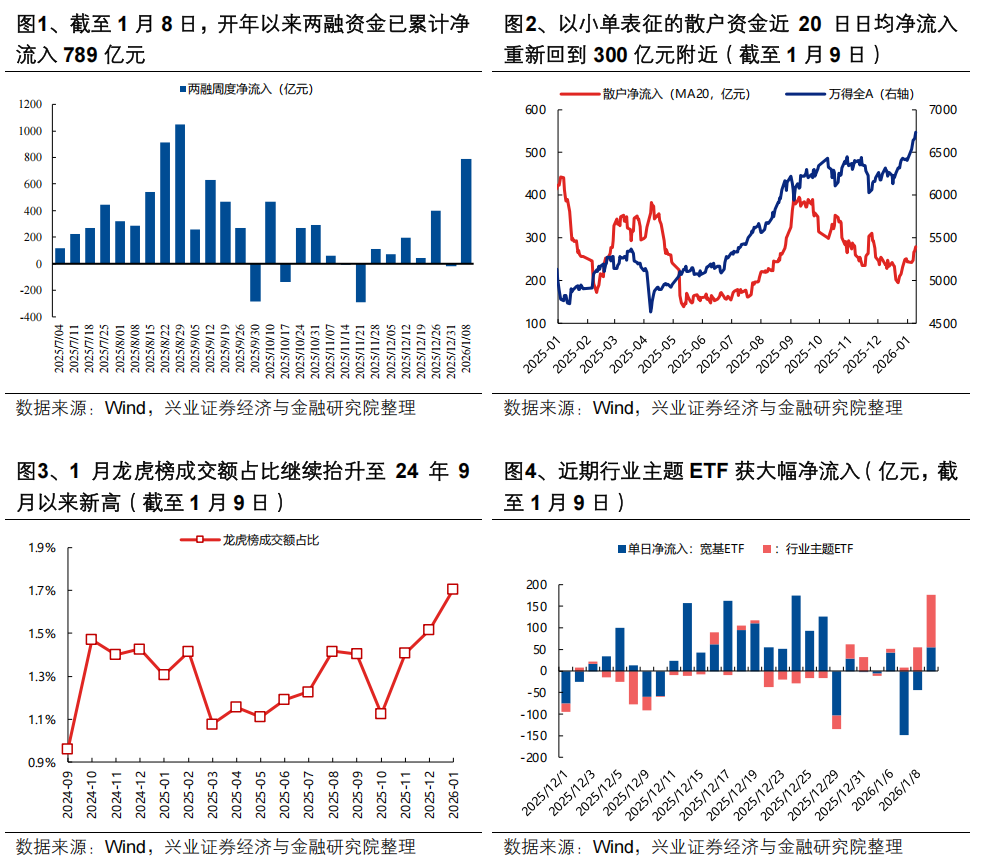
Core Viewpoint - The recent "opening red" in the A-share market reflects a favorable macroeconomic environment and abundant liquidity, which supports market risk appetite and attracts incremental capital inflow, creating a positive feedback loop between capital inflow and market rise [2][18]. Group 1: Market Dynamics - The A-share market has experienced a strong start with the Shanghai Composite Index breaking key levels and achieving a "sixteen consecutive days" rise, exceeding many investors' expectations [1][19]. - Historical data indicates that after a single-day trading volume exceeds 3 trillion yuan, there is typically at least a monthly-level market rally [19]. - Various types of trading funds have shown signs of accelerated entry, including a net inflow of 78.9 billion yuan in margin financing since the beginning of the year and a return of retail investor net inflow to around 30 billion yuan daily [2][5]. Group 2: Structural Characteristics - The inflow structure of different funds shows a strong consensus on key themes, primarily focusing on TMT (storage, AI applications), military industry (commercial aerospace), non-ferrous metals, new energy (controlled nuclear fusion), machinery (robots), and pharmaceuticals (innovative drugs, brain-machine interfaces) [5][36]. - The global stock market has also seen a strong start in 2026, driven by macroeconomic and industrial narratives, with A-shares reflecting similar trends [13][18]. Group 3: Future Directions - As companies begin to disclose annual reports, earnings will become a key factor driving market dynamics, leading to a structural adjustment where previously hot sectors face performance validation, while some low-performing sectors may attract new capital inflows [36]. - Industries with significant upward revisions in profit forecasts since November include technology (consumer electronics, computing), advanced manufacturing (new energy, military), cyclical sectors (building materials, non-ferrous metals), and consumer sectors (food processing, retail) [37][38].


信用利差周度跟踪20260109:信用利差全线收窄二永债表现强势-20260111
Huafu Securities· 2026-01-11 05:25
Fixed Income - The report indicates that credit spreads have narrowed across the board, demonstrating resilience in credit despite rising interest rates. During the week from January 4 to January 9, government bond yields generally increased, with 1Y, 3Y, and 10Y government bonds rising by 3 basis points (BP), while the 5Y bond rose by 4 BP and the 7Y bond by 2 BP. In contrast, credit bonds outperformed government bonds, with 1Y AA+ and above credit bond yields decreasing by 2 BP, while other grades increased by 1 BP. For 3Y AAA and AA grades, yields remained stable, while other grades decreased by 1-2 BP. The 5Y AA+ and above grades saw yields rise by 1 BP, while other grades increased by 3 BP. The 7Y AAA grade yields remained stable, while other grades decreased by 2 BP. The 10Y AAA credit bonds decreased by 1 BP, with other grades remaining stable. Overall, credit spreads narrowed, with 1Y AA+ and above credit spreads decreasing by 5 BP, and other grades down by 2 BP. For 3Y, spreads decreased by 3-5 BP across grades, while for 5Y, AA+ and above spreads decreased by 3 BP, and other grades down by 1 BP. The 7Y AAA grade spreads decreased by 2 BP, with other grades down by 4 BP, and for 10Y, spreads decreased by 3-4 BP across grades [3][9][20]. City Investment Bonds - The report notes that city investment bond spreads mostly decreased by 3-4 BP. The overall credit spread for AAA-rated platforms decreased by 3 BP, while AA and AA+ platforms saw a 4 BP decrease. By administrative level, provincial platform credit spreads generally decreased by 3 BP, while city and county-level platform spreads decreased by 4 BP. Specifically, AAA-rated spreads mostly decreased by 3-4 BP, with Inner Mongolia down by 2 BP, and Yunnan, Hainan, and Gansu down by 5-6 BP. AA+ rated platforms mostly saw decreases of 3-5 BP, with Xinjiang and Guizhou down by 1-2 BP, and Ningxia and Gansu down by 6-7 BP. AA-rated platforms mostly decreased by 4-5 BP, with Shaanxi down by 3 BP and Tianjin down by 6 BP [4][13][16]. Industry Bonds - The report highlights that while most industry bond spreads decreased, real estate bond spreads continued to widen. Specifically, the spreads for central state-owned enterprise real estate bonds widened slightly by 1-3 BP, while mixed-ownership real estate bonds saw a significant increase of 702 BP. In contrast, private enterprise real estate bond spreads decreased by 30 BP. Notable changes include Longfor's spread decreasing by 6 BP, CIFI's increasing by 55 BP, Vanke's decreasing by 974 BP, Midea's decreasing by 4 BP, Huafa's increasing by 17 BP, and Poly's increasing by 5 BP. Additionally, spreads for coal bonds decreased by 2-3 BP across grades, while steel and chemical bonds saw a decrease of 3 BP [20][21]. Perpetual Bonds - The report indicates that the spreads for secondary capital bonds and perpetual bonds have significantly narrowed, with yields for 1Y secondary capital bonds decreasing by 2-3 BP and perpetual bonds down by 3-4 BP, compressing spreads by 5-6 BP. For 3Y, AA+ and above secondary bonds saw yields decrease by 1 BP, while AA secondary bonds and all grades of perpetual bonds saw yields decrease by 1-2 BP, compressing spreads by 4-5 BP. In the 5Y category, AAA- secondary capital bond yields increased by 1 BP, AA+ remained stable, and AA decreased by 1 BP, with perpetual bond yields remaining stable and spreads compressing by 3-5 BP [5][25]. Excess Spreads - The report notes that the excess spread for industry AAA-rated 3Y perpetual bonds remained stable at 14.84 BP, positioned at the 40.79% percentile since 2015. The 5Y perpetual bond excess spread slightly decreased by 0.01 BP to 13.20 BP, at the 32.21% percentile. Conversely, the excess spread for city investment AAA-rated 3Y perpetual bonds increased by 1.93 BP to 4.64 BP, at the 3.74% percentile, while the 5Y excess spread increased by 1.52 BP to 10.92 BP, at the 18.64% percentile [27][28].