
韵达股份

Search documents
“无人物流车”第一股即将诞生,但依然难过上路关
3 6 Ke· 2025-11-28 08:03
Core Insights - The article discusses the rapid growth and challenges in the unmanned logistics vehicle sector, highlighting significant investments exceeding 8 billion yuan and the industry's response to public sentiment amid controversies surrounding technology and safety [2][6][18]. Investment and Market Growth - The unmanned logistics vehicle sector has seen unprecedented funding, with over 8 billion yuan disclosed in investments as of now [2][6]. - Major funding rounds include 1 billion USD for Jiusi Intelligent and over 600 million USD for New Stone Technology, marking significant transactions in China's private equity landscape [2][6]. - The market is projected to reach 263.4 billion yuan by 2030, a 5.4-fold increase from 2025 [8][11]. Technological Advancements and Cost Reduction - The cost of unmanned logistics vehicles has drastically decreased from over 1 million yuan in 2018 to as low as 20,000 yuan in 2023, driven by domestic production of key components [10][11]. - The industry is transitioning from a "sell vehicles" model to a "software subscription" model, enhancing revenue potential through ongoing service fees [12][13]. Industry Dynamics and Competition - A price war has emerged among companies, with aggressive pricing strategies being employed to capture market share [12][13]. - Companies like Jiusi Intelligent and New Stone Technology are competing on price and financing options, with Jiusi offering vehicles at 1.98 million yuan and New Stone providing zero down payment plans [12][13]. Regulatory and Safety Concerns - Despite the rapid growth, there are significant concerns regarding the safety and reliability of unmanned logistics vehicles, highlighted by several accidents and public skepticism [14][15][18]. - The lack of uniform road rights across cities poses a challenge for widespread deployment, with companies like New Stone Technology actively working to secure necessary permits [16][18]. Future Outlook - The industry is expected to evolve, with projections indicating that unmanned logistics vehicles could replace traditional delivery vehicles, achieving a penetration rate of nearly 15% by 2030 [17][18]. - The ongoing competition and regulatory hurdles will shape the future landscape of the unmanned logistics vehicle market, as companies strive to balance innovation with public trust [18][20].


看科技如何重构快递服务新生态
Huan Qiu Wang Zi Xun· 2025-11-28 02:09
Core Insights - The express delivery industry in Zhejiang is undergoing a profound transformation driven by technological innovation, integrating digital and physical economies [1] - Zhejiang serves as a model for high-quality development in the postal industry, showcasing practices that can be replicated nationwide [1] Group 1: Unmanned Delivery Vehicles - Unmanned delivery vehicles have significantly reduced operational costs, with daily electricity expenses dropping from 50 yuan to 15 yuan, leading to a 70% increase in efficiency at the Tonglu sorting center [2] - The introduction of unmanned vehicles allows for earlier dispatch of deliveries, improving overall delivery efficiency and increasing the proportion of home deliveries by over 30% [2] - In Jinhua, 34 unmanned vehicles have been deployed, covering over 100,000 kilometers and transporting more than 1 million items, with plans to expand the fleet to over 200 vehicles by 2026 [3] Group 2: Integrated Logistics Solutions - The "Rail + Low Air" logistics model in Jinhua combines drone and rail transport, enhancing delivery speed by over 50% and reducing costs by approximately 35% [4] - This innovative logistics network allows for same-day delivery of fresh produce, with a total transit time of under one hour for certain routes [4][5] - The integration of rail and drone services is set to expand, with plans for additional routes and improved service coverage [5] Group 3: Drone Delivery Innovations - Drones are being utilized to solve last-mile delivery challenges in mountainous areas, significantly reducing delivery times from 90 minutes to just 15 minutes [7] - The establishment of a drone delivery network includes a command center and multiple takeoff and landing sites, covering key areas and enhancing service efficiency [8] - Drones are also being used for emergency services, such as delivering firefighting supplies, showcasing their versatility beyond traditional logistics [8] Group 4: Industry Growth and Statistics - The express delivery market in China is projected to handle approximately 1.75 trillion packages in 2024, with a year-on-year growth of 21.5% [10] - Zhejiang province accounts for 18.5% of the national express delivery volume, with a robust network of over 30,000 service points and 930 logistics routes [10] - The province has seen significant advancements in smart logistics and regulatory frameworks, positioning itself as a leader in the express delivery sector [11] Group 5: Cultural and Historical Context - Tonglu is recognized as the birthplace of China's private express delivery industry, with a rich history of entrepreneurial spirit and innovation [9] - The local government and industry leaders are fostering a collaborative environment to enhance logistics capabilities and workforce development [12][13] - The integration of logistics with urban development aims to create a sustainable ecosystem that benefits both the industry and local communities [13]


电商快递集体涨价,9块9包邮的时代要结束了?
36氪· 2025-11-27 10:02
Core Viewpoint - The recent price increase in the express delivery industry, although seemingly minor at 0.2-0.8 yuan per order, signifies a shift towards a new adjustment phase for the industry, impacting e-commerce operators and consumers significantly [6][10][20]. Price Increase Impact - The price hike began in July 2023 in Yiwu and has spread to 22 provinces, affecting e-commerce users while not impacting individual senders [6][5]. - The increase translates to an 8% loss in profit for low-margin products, particularly those priced at 9.9 yuan with free shipping [6][20]. - The average price per express delivery in the first half of 2025 was 7.52 yuan, down 7.7% from 8.15 yuan in 2024, indicating a trend of "increased revenue without increased profit" among major logistics companies [9][10]. Industry Dynamics - The express delivery sector has been characterized by a "price-for-volume" strategy, leading to unsustainable low pricing that has harmed both workers and service quality [10][12]. - The rise of "express delivery gray market" and "delivery scalpers" has emerged due to price discrepancies across regions, complicating the competitive landscape [14][15][16]. Reactions from Stakeholders - E-commerce operators are adjusting their pricing strategies, with some removing discounts to offset increased logistics costs, leading to a significant drop in order volumes [20][21]. - Consumers are experiencing changes in service quality, with many reporting that delivery personnel are less likely to deliver to their doors, opting instead for collection points [9][18]. - Despite the price increase, many delivery workers have not seen corresponding wage increases, raising concerns about the sustainability of their livelihoods [21][22]. Future Outlook - Analysts suggest that the industry needs to leverage technology such as AI and big data to optimize operations and improve service quality, while also exploring innovative delivery methods like unmanned delivery systems [21][22]. - The overarching goal of the price adjustments is to create a healthier industry environment that benefits both workers and consumers, fostering a more sustainable business model [22].

快递价格修复外的预期差:龙头优势回归,份额重回分化
2025-11-26 14:15
快递价格修复外的预期差:龙头优势回归,份额重回分化 20251125 摘要 2025 年下半年,电商平台税收合规加强、监管部门严查刷单以及快递 涨价(广东省最低价涨至 1.4 元以上,物流成本同比增约 40%)等多重 因素叠加,导致快递行业需求增速显著放缓,高基数效应亦有影响。 展望 2026 年,快递行业预计维持高个位数增长,告别过去十多年的高 速增长。头部公司市场份额有望提升,业务量增速或超 10%,价格保持 平稳,推动单票盈利提升,头部公司 EPS 增速预计达 15%左右,估值 修复潜力大。 反内卷背景下,低价电商萎缩,中通、圆通等龙头公司服务优势显现, 10 月业务量明显跑赢大盘,而申通、极兔、韵达等二梯队公司面临增长 压力。挤出低价电商后,龙头公司不再依赖价格战,估值溢价有望修复。 顺丰通过优化包裹价格结构,实现盈利改善。9 月和 10 月单票价格跌幅 加速收窄,表明收入质量提高,降本增效措施见效。预计四季度将继续 通过建量结构优化,实现盈利能力持续提升。 东南亚和南美洲人均包裹量分别相当于中国十年前及十五年前水平,未 来或将经历类似中国的高速增长阶段。以东南亚与南美洲为代表的新兴 市场具备超预期发 ...
丰巢核心业务商业模式遭质疑?巨额亏损、创始人立场、对赌协议触发连锁反应IPO停滞
Xin Lang Zheng Quan· 2025-11-26 09:54
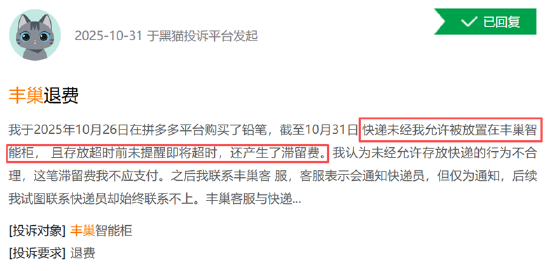
Core Viewpoint - The resignation of Fengchao's founder and CEO Xu Yubin has raised concerns among investors about the company's future prospects, interpreted as a loss of confidence in the IPO outlook [1][10]. Business Model Challenges - Fengchao's core business model of last-mile delivery services is facing significant scrutiny, with over 37,000 complaints on the Black Cat Complaints platform regarding issues such as lost packages, unreasonable fees, and system malfunctions [2][6]. - Complaints highlight that delivery personnel often place packages in smart lockers without recipient consent, violating regulations that require prior agreement [2][3]. Financial Performance - Fengchao's financials reveal a weak profitability trend, with revenues of 2.526 billion, 2.891 billion, and 3.812 billion yuan from 2021 to 2023, while net losses totaled 2.078 billion yuan over the same period [7][10]. - The company's primary revenue source, last-mile delivery services, generated 1.455 billion, 1.686 billion, and 1.836 billion yuan from 2021 to 2023, with a compound annual growth rate of 8% [7]. Legal and Operational Issues - A lawsuit with investor Asia Investment Capital has stalled Fengchao's IPO plans, as the company failed to submit required documents on time, leading to the expiration of its prospectus [1][12]. - The company has incurred significant liabilities due to a revised agreement with Asia Investment Capital, increasing current liabilities from 3.196 billion yuan to 6.618 billion yuan [10][11]. Management Changes - The departure of Xu Yubin, who has been with the company for a decade, is seen as a critical blow to Fengchao, coinciding with ongoing operational and financial challenges [10][12].
韵达的ESG答卷:绿色与智能,如何驱动快递业穿越同质化竞争?
Jing Ji Guan Cha Wang· 2025-11-26 09:14
Core Insights - The express delivery industry in China has seen a significant growth in business volume, reaching 1,626.8 billion packages from January to October, a year-on-year increase of 16.1% [1] - The industry faces challenges such as increasing carbon emissions and intense price competition, prompting companies like Yunda to integrate ESG principles into their core strategies [1][6] - Yunda is leveraging AI technology to enhance operational efficiency and address environmental concerns, viewing sustainability as a long-term asset rather than a cost [2][10] ESG Integration - Yunda's approach to environmental sustainability is comprehensive, involving significant investments in infrastructure, such as 18 photovoltaic transfer centers, which have reduced greenhouse gas emissions by 40.38% and cut carbon emissions by over 13,000 tons [2] - The company promotes automation and smart technology in daily operations, improving package processing efficiency and reducing energy consumption [2][3] - Yunda's ESG strategy has evolved from a passive response to an integrated approach, emphasizing the importance of ESG governance in maintaining competitiveness and attracting quality clients [6] Value-Added Services - Yunda focuses on user-centric design to meet diverse consumer demands, offering personalized solutions for common delivery needs and emerging trends [7][8] - The company has introduced green packaging options and customized packaging services to cater to environmentally conscious consumers and enhance emotional value [8][9] - Specific service enhancements, such as "Zhicheng Network" for clothing and "Zhicheng Fresh" for perishable goods, have improved delivery efficiency by 20%-40% while reducing costs by 20%-50% [8] Technological Empowerment - Yunda is implementing AI across its operations, transitioning from experience-driven to data-driven decision-making [10][12] - The use of large models allows for improved forecasting and planning, optimizing delivery routes based on real-time data [10][11] - The company is creating a unified data platform to enhance information sharing and operational transparency, integrating IoT devices for real-time monitoring of packages [11] Workforce Transformation - Yunda emphasizes a "technology for people" philosophy, ensuring that AI enhances rather than replaces human roles in the workforce [12] - The company is investing in employee training and skill development to adapt to new technological roles, promoting a collaborative growth environment [12]
人均每月收寄超过10件!中国快递包裹市场规模连续十一年全球第一【附快递行业市场分析】
Qian Zhan Wang· 2025-11-26 07:11
Core Insights - The Chinese express delivery industry has achieved a remarkable milestone, reaching a monthly average of 10 billion packages, significantly contributing to the global express delivery market [2][3]. Industry Overview - In 2024, China's express delivery volume is projected to reach 175.08 billion packages, accounting for 65% of the global total of approximately 267.9 billion packages, with a year-on-year growth of 21.5% [2]. - The revenue from express delivery services in China is expected to hit 1.40335 trillion yuan, reflecting a year-on-year increase of 13.8% [2]. - As of October 11, 2025, the total express delivery volume has already surpassed 150 billion packages, 37 days ahead of the previous year [2]. Growth Drivers - The growth of the express delivery industry is driven by three main factors: 1. The booming e-commerce ecosystem, with new business models such as live-streaming sales and community group buying expanding consumption from urban to rural areas [3]. 2. The extensive coverage of logistics infrastructure, with over 95% of administrative villages in China having express delivery services, particularly in central and western regions [3]. 3. Technological advancements leading to efficiency improvements, including automated sorting centers and smart delivery solutions, which have reduced costs per package [4]. Competitive Landscape - Major players in the Chinese express delivery market include SF Express, ZTO Express, YTO Express, and Yunda Express, each excelling in various segments such as e-commerce and business express services [4]. - In the high-end express market, SF Express and EMS have maintained leadership due to their established market presence and quality service [5]. Consumer Trends - There is a growing demand for diverse express delivery services, with consumers seeking not only speed but also quality. Companies are encouraged to enhance service quality, including packaging and customer service, to meet these evolving consumer expectations [6].


东兴证券晨报-20251125
Dongxing Securities· 2025-11-25 09:06
Economic News - The call between Chinese President Xi Jinping and US President Trump highlighted the positive trajectory of China-US relations since their meeting in Busan, emphasizing mutual benefits and cooperation [2] - The Ministry of Industry and Information Technology has proposed a new safety standard for mobile power supplies, which is significantly stricter than previous standards, potentially impacting production capabilities of many factories [2] - The successful launch of the Shenzhou-22 spacecraft marks China's first emergency launch mission in its manned space program, carrying essential supplies for the space station [2] - A new quantum computer factory in Shenzhen has been established, capable of producing a quantum computer with 1000 qubits, aiming for standardized and large-scale manufacturing [2] - The Heilongjiang provincial government is focusing on developing emerging industries and enhancing innovation in its 14th Five-Year Plan, including sectors like aerospace and new materials [2] Company Insights - Industrial Fulian reported that its fourth-quarter operations are proceeding as planned, with no adjustments to profit targets, indicating strong customer demand [6] - Tianqi Lithium's chairman noted a significant increase in demand for lithium materials driven by renewable energy and electric vehicles, predicting a balanced supply-demand scenario by 2026 [7] - Lianrui New Materials has received approval for its convertible bond issuance, which is set to be listed on the Shanghai Stock Exchange [7] Industry Analysis - The banking sector is experiencing a decline in social financing growth, with October's social financing increasing by only 8.5% year-on-year, reflecting a decrease in government bond financing and overall credit demand [8][9] - The credit market is showing signs of seasonal decline, with a year-on-year increase in RMB loans of only 6.5%, indicating weaker corporate credit demand and a shift towards retail lending [10] - The logistics industry is facing a slowdown in growth, with the volume of express deliveries in October increasing by only 7.9% year-on-year, attributed to changing consumer behavior during promotional events [13][14] - The express delivery sector is witnessing a divergence in strategies among major companies, with some focusing on market share while others prioritize price increases, impacting overall revenue dynamics [16]
交通运输行业周报:原油运价高位上行,长龙航空启动IPO-20251124
Bank of China Securities· 2025-11-24 02:09
Investment Rating - The transportation industry is rated as "Outperform" [2] Core Insights - Crude oil freight rates are rising while ocean freight rates are declining. The China Import Crude Oil Comprehensive Index (CTFI) reached 2325.40 points on November 20, up 4.2% from November 13. VLCC market activity remains strong, but overall market activity is expected to decline without actual cargo support [3][14] - Changlong Airlines has initiated its IPO process, and VOLANT has signed a confirmation order for the VE25-100 eVTOL aircraft with a state-owned investment group, with the order amount exceeding 100 million yuan [3][16] - The China-Europe Railway Express has surpassed 3500 trips this year, marking a historical high. A new "passenger-cargo-mail integration" model has been launched in cooperation between Rizhao Public Transport and SF Express [3][22] Summary by Sections Industry Hot Events - Crude oil freight rates are high while ocean freight rates are declining. The Shanghai port export price to Europe was $1367/TEU, down 3.5%, and to the US West and East Coast was $1645/FEU and $2384/FEU, down 9.8% and 8.3% respectively [3][15] - Changlong Airlines is preparing for its IPO, with a focus on expanding its operational capacity and market reach [3][16] - The China-Europe Railway Express has achieved a record of over 3500 trips this year, with a focus on high-value goods transportation [3][23] High-Frequency Data Tracking - The Baltic Air Freight Price Index has increased both month-on-month and year-on-year, indicating a positive trend in air freight pricing [4][28] - Domestic express delivery volume increased by 7.90% year-on-year in October 2025, with total express delivery volume reaching 176 billion pieces [4][50] - The national highway freight truck traffic increased by 2.57% week-on-week, indicating a recovery in road logistics [4][18] Investment Recommendations - Focus on the equipment and manufacturing export chain, recommending companies like COSCO Shipping, China Merchants Energy Shipping, and Huamao Logistics [5] - Attention to the low-altitude economy sector, with recommendations for CITIC Offshore Helicopter [5] - Investment opportunities in the road and rail sectors, recommending companies such as Gansu Expressway and Beijing-Shanghai High-Speed Railway [5]





全球市场回调,周期怎么看?
2025-11-24 01:46
Summary of Conference Call Notes Industry Overview - **Global Market Trends**: Recent adjustments in global risk assets, particularly in US stocks and Bitcoin, with significant declines noted. The Shanghai Composite Index fell below its upward trend line, but the Federal Reserve's signals of easing have reduced the risk of further declines in the short term [3][1]. Key Points by Industry Transportation Sector - **Impact of Japan-China Relations**: The transportation sector faced challenges due to reduced flights on Japan-China routes. However, the three major airlines were minimally affected as this route only accounts for a small percentage of their total flights. Spring Airlines and Juneyao Airlines experienced larger adjustments, while Huaxia Airlines remained unaffected [5][1]. Express Delivery Industry - **October Data and Financial Performance**: The express delivery sector showed positive trends with October data and ZTO's Q3 financial report. YTO Express had the fastest growth rate at 13%, while Shentong Express grew by over 4%, and Yunda Express saw a decline of 5%. The overall outlook for the sector remains optimistic, with expectations of continued growth into Q1 2026 [6][1]. Shipping Industry - **Freight Rates and Future Outlook**: The shipping sector saw freight rates reach multi-year highs before a slight correction. The peak season may last longer than expected, with further potential for rate increases. Key companies to watch include China Merchants Energy Shipping and Hainan Airlines [7][8]. Chemical Industry - **Current Market Conditions**: The CCPI index remained stable, while crude oil prices fell, leading to a decline in the chemical output index. The fourth quarter is typically a demand lull, with price sustainability needing validation in Q1 2026. Key sub-sectors include polyester filament and viscose staple fiber, with specific companies recommended for investment [11][12][17]. Lithium and Battery Materials - **Price Increases and Demand**: Lithium hexafluorophosphate prices surged to 167,000 CNY/ton, with significant increases in electrolyte and additive prices. The demand for energy storage is expected to drive profitability, with a recovery anticipated in 2026. Recommended companies include Sinoma Technology and Lianhua Technology [14][12]. Coal Industry - **Market Performance and Future Expectations**: The coal sector experienced a significant drop of 5.67%, with some companies like China Shenhua showing resilience. Despite short-term declines, the long-term fundamentals remain unchanged, and there are opportunities in quality stocks [21][22]. Organic Silicon and Soda Ash - **Market Dynamics**: The organic silicon industry reached a consensus on production cuts, with prices rising. The soda ash market saw price increases following production halts. Both sectors are expected to improve significantly by 2026, with key companies highlighted for investment [16][12]. Additional Insights - **Investor Confidence**: Jitu International's management has been actively repurchasing shares to bolster investor confidence, particularly in Southeast Asia and emerging markets [9][10]. - **Investment Recommendations**: The call emphasized focusing on high dividend-paying coal companies and other resilient sectors, suggesting a strategic approach to navigating potential market fluctuations [25][10]. This summary encapsulates the key insights and recommendations from the conference call, providing a comprehensive overview of the current market landscape across various industries.