零跑汽车

Search documents
海外市场成车企销量关键支撑
Jin Rong Shi Bao· 2026-02-05 02:31
Core Insights - In January 2026, the Chinese automotive market entered a traditional off-season, with new energy vehicle (NEV) companies facing significant sales pressure and a reshuffling of the sales rankings [1][2] New Energy Vehicle Sales Dynamics - Hongmeng Zhixing topped the new energy vehicle sales in January with 57,915 units delivered, marking a 65.6% year-on-year increase [2] - Xiaomi Auto delivered over 39,000 units, with a focus on the YU7 model as the initial SU7 model has been phased out [2] - Leap Motor delivered 32,059 units, a 27% year-on-year increase, but showed a notable month-on-month decline [2] - Li Auto's deliveries were 27,668 units, experiencing both year-on-year and month-on-month declines due to delays in the i6 model's delivery [3] - NIO delivered 27,182 units, a 96.1% year-on-year increase, with the new ES8 model performing exceptionally well [3] - XPeng Motors delivered 20,011 units, facing declines as it is in a product iteration phase [3] Traditional Automakers' Performance - BYD achieved total NEV sales of 210,051 units in January, with exports reaching 100,482 units, a 51.47% year-on-year increase [4] - Chery Group exported 119,605 vehicles, a 48.1% year-on-year increase, maintaining its position as a leading exporter [4] - SAIC Group sold 327,413 vehicles, a 23.9% year-on-year increase, with a significant rise in overseas sales [4] - Geely's total sales reached 270,167 units, with a notable increase in exports, achieving a doubling in export numbers [4] - Great Wall Motors sold 90,312 vehicles, with overseas sales growing by 43.77% [5] Market Trends and Future Outlook - The decline in market demand is attributed to changes in the new energy vehicle purchase tax policy and the release of pent-up demand from 2025 [5] - Analysts suggest that the domestic passenger car market's growth momentum will shift towards overseas markets, with companies focusing on international expansion as a core growth strategy [5]

比亚迪1月德国销量同比激增10倍,超特斯拉两倍
Huan Qiu Wang· 2026-02-05 02:27
Group 1 - The core point of the article highlights that BYD, a Chinese electric vehicle brand, sold 2,629 new cars in Germany in January, marking a year-on-year increase of over 1,000% compared to 235 units sold in the same month last year, and surpassing Tesla's sales in Germany during the same period, which were 1,301 units [1][3] - Germany is identified as the largest electric vehicle market in Europe, becoming a critical battleground for global new energy vehicle companies [3] - BYD has further expanded its competitive advantage in the European market after surpassing Tesla's sales in Germany and the UK last year, while other Chinese brands like SAIC MG, Leap Motor, and Xpeng are also accelerating their presence in Europe [3] Group 2 - Tesla's sales in Germany only increased by 1.9% in January, which is based on a low base from a significant drop in sales at the beginning of last year [3] - Tesla's performance in the European market is showing signs of weakness, with registrations in France hitting a three-year low and sales in Norway plummeting by 88% in January [3]


全世界都在抢的车,中国却开始嫌弃
汽车商业评论· 2026-02-04 23:06
Core Viewpoint - The article discusses the significant decline in the growth rate of plug-in hybrid vehicles (PHEVs) in the Chinese automotive market, highlighting the competitive pressure from pure electric vehicles (EVs) and the changing consumer preferences that have led to this shift [4][6][7]. Group 1: Market Trends - In 2025, the growth rate of PHEVs dropped to 8.8%, with range-extended vehicles seeing a mere 6% increase, marking the first instance of consecutive monthly declines in this segment [6][7]. - The penetration rate of PHEVs in the new energy vehicle market surged from 17% in 2021 to 40% in 2024, but the market dynamics shifted dramatically in 2025 [4][6]. - The average price of pure electric vehicles fell by 15% from 168,000 yuan in 2024 to 143,000 yuan in 2025, while mainstream PHEVs remained in the 150,000 to 180,000 yuan range, erasing the price advantage previously held by PHEVs [11]. Group 2: Consumer Behavior - The average range of pure electric vehicles exceeded 528 kilometers in 2025, with many mainstream models surpassing 600 kilometers, significantly reducing consumer anxiety regarding range [15]. - The rapid development of charging infrastructure, with a car-to-charging station ratio of 2.5:1 and a total of 20.09 million charging facilities by the end of 2025, has made pure electric vehicles a more reliable choice for consumers [15]. - Consumers are increasingly viewing pure electric vehicles as a dependable option, leading to a decline in the perceived necessity of PHEVs, which were initially chosen to alleviate range anxiety [15][19]. Group 3: Technological Shifts - PHEVs are experiencing a shift towards larger battery capacities and faster charging solutions, with many manufacturers adopting battery sizes exceeding 60 kWh to enhance their appeal [27][29]. - The introduction of 800V high-voltage platforms and ultra-fast charging technologies is becoming standard, allowing for significant improvements in charging efficiency [15][27]. - The trend of integrating larger batteries into PHEVs is raising production costs, which could undermine their competitive pricing advantage [32][35]. Group 4: Regulatory Environment - New regulations set to take effect in 2026 will tighten the eligibility criteria for tax exemptions for PHEVs, making it more challenging for lower-end models to compete [39][40]. - The shift from a "universal" tax exemption policy to one that favors stronger models will further complicate the market landscape for PHEVs [37][41]. Group 5: Future Outlook - Despite the current challenges, the article suggests that PHEVs will maintain a significant market share, with a projected penetration rate of 36% in 2025, corresponding to 4.669 million units [51]. - The global market for PHEVs is expected to grow, with predictions indicating that their growth rates will surpass those of pure electric vehicles in the coming years [60][66]. - The unique energy structure and market conditions in China suggest that PHEVs will continue to play a crucial role in the automotive landscape, particularly in regions with less developed charging infrastructure [52][54].


Qualcomm(QCOM) - 2026 Q1 - Earnings Call Transcript
2026-02-04 22:47
Financial Data and Key Metrics Changes - The company reported record revenues of $12.3 billion and non-GAAP earnings per share (EPS) of $3.50 for fiscal Q1 2026, with non-GAAP EPS at the high end of guidance [6][16] - QCT revenues reached a record $10.6 billion, driven by strong performance in automotive and IoT segments [6][16] - Licensing business revenues were $1.6 billion, with an EBT margin of 77%, reflecting higher units and favorable mix [16] Business Line Data and Key Metrics Changes - QCT handset revenues reached a record $7.8 billion, benefiting from recently launched flagship smartphones [16] - QCT IoT revenues grew 9% year-over-year to $1.7 billion, driven by demand across consumer and networking products [16] - QCT Automotive revenues grew to $1.1 billion, up 15% year-over-year, driven by increased demand for Snapdragon Digital Chassis platforms [17] Market Data and Key Metrics Changes - Global consumer demand for handsets, particularly in the premium and high-tier segments, exceeded expectations, with healthy sell-through observed [6][7] - The handset industry is expected to face constraints due to memory availability and pricing, particularly DRAM, as suppliers redirect capacity to meet AI data center demand [7][18] - The company anticipates that the overall size of the handset market will be defined by memory availability throughout the fiscal year [39][69] Company Strategy and Development Direction - The company is focused on expanding its presence in the premium and high-tier smartphone segments, with a dual flagship product strategy that has been well received [8][42] - The company is investing in AI-native smartphones and intelligent wearables, positioning Snapdragon platforms as the choice for the industry [8][12] - The company aims to strengthen its leadership in automotive and robotics, with multiple design wins and collaborations with major automakers [10][22] Management's Comments on Operating Environment and Future Outlook - Management expressed confidence in the fundamentals of the handset business despite near-term challenges related to memory supply [18][39] - The company expects to return to prior growth trajectories for QCT handset revenues once memory supply conditions normalize [18] - Management remains optimistic about the long-term growth potential in automotive and IoT, with combined growth expected to outpace long-term revenue targets [21][22] Other Important Information - The company returned $3.6 billion to stockholders, including $2.6 billion in stock repurchases and $949 million in dividends [17] - The company completed the acquisition of Alphawave Semi, enhancing its data center solutions [14] Q&A Session Summary Question: What factors are driving the weakness in handset outlook beyond memory pricing? - Management indicated that the weakness is entirely related to memory availability, with strong microeconomic indicators and handset demand observed [26][27] Question: Is the automotive revenue growth driven by ADAS wins? - Management confirmed that the automotive pipeline continues to translate into revenue, with new car launches contributing to record revenues [30] Question: How is the company progressing with data center customers? - Management reported positive progress with customers, including shipping to Humane and engagement with major hyperscalers [34] Question: What is the company's strategy regarding memory shortages? - Management clarified that they do not purchase memory directly but work with customers who do, ensuring flexibility in memory sourcing [67][69] Question: How does the company plan to navigate the memory allocation challenges with larger OEMs? - Management acknowledged that larger OEMs may have better access to memory but emphasized that the issue is industry-wide and not limited to specific customers [73]

造车新势力2026开年洗牌,AI军备赛已打响
2 1 Shi Ji Jing Ji Bao Dao· 2026-02-04 16:04
Core Insights - The new energy vehicle (NEV) market did not experience the expected strong start in early 2026, with a significant month-on-month decline in delivery volumes due to seasonal factors and policy transitions, leading to a reshuffling of the industry landscape [1][7] Group 1: Market Performance - In January, the majority of car manufacturers saw a substantial month-on-month drop in delivery volumes, but year-on-year performance showed significant divergence among leading players [2][7] - Hongmeng Zhixing led the market with 57,915 units delivered, a year-on-year increase of 65.6%, supported by strong brand and technology integration [2] - Xiaomi and Leap Motor followed with deliveries of over 39,000 and 32,000 units respectively, while the previously dominant "Wei Xiaoli" trio struggled, with Li Auto and NIO delivering around 27,000 units each, and XPeng just over 20,000 units, showing significant declines [1][4] Group 2: Strategic Shifts - Leading NEV companies are increasingly focusing on AI and robotics for future growth, with Li Auto transitioning to a "embodied intelligence" company and establishing a dedicated team for humanoid robots as a second growth driver [1][5] - XPeng has identified 2026 as a critical year for the commercialization of physical AI, aiming to make AI a core driver of growth across its automotive and robotics businesses [1][5] - NIO is also investing in AI, establishing a company-level "Artificial Intelligence Technology Committee" to enhance its capabilities across various operational areas [6] Group 3: Market Challenges - The automotive market faced a significant decline in consumer demand in January, with a 28% year-on-year drop in retail sales, including a 16% decrease in NEV sales [7][8] - The expiration of the NEV purchase tax exemption at the end of 2025 has led to a preemptive depletion of demand, while new subsidy policies have yet to be fully implemented, creating a consumption "vacuum" [7][8] - Companies like Tesla, Xiaomi, Li Auto, and NIO have initiated financial strategies, including low-interest loan offers, to stimulate consumer purchases amid declining demand [7][8]
销量暴增1000%、特斯拉的两倍多,比亚迪在德国卖爆了
Feng Huang Wang· 2026-02-04 14:03
继去年在德国和英国市场的销量超过特斯拉后,比亚迪正在进一步拉大对特斯拉的优势。在国内电动车 价格战激烈的背景下,中国品牌上汽名爵、零跑和小鹏汽车近几个月持续在欧洲扩张,加大了对老牌车 企的竞争压力。作为欧洲最大的市场,德国成为关键战场。 由于特斯拉CEO埃隆.马斯克(Elon Musk)的政治活动引发消费者反感,特斯拉在整个欧洲市场一直面临 困境。该公司需要应对中国品牌和本土品牌不断加剧的竞争,大众汽车、雷诺和宝马等车企纷纷扩大电 动车产品阵容。 比亚迪柏林经销商展出的海豹和Atto2电动汽车 根据德国联邦机动车运输管理局周三公布的数据,比亚迪今年1月在德国售出2629辆新车,较一年前的 仅235辆增长超过1000%,而且是特斯拉1301辆注册量的两倍多。 尽管特斯拉今年1月的德国销量较去年同期微增1.9%,但这一增长建立在去年初销量骤降的低基数之 上。事实上,特斯拉在欧洲市场的疲软态势已延续至新年,法国市场注册量跌至三年多来最低点,而去 年的亮点市场挪威更在1月遭遇销量暴跌88%的滑铁卢。(作者/箫雨) 凤凰网科技讯北京时间2月4日,据彭博社报道,随着比亚迪(002594)继续在德国这个欧洲最大电动汽 车市 ...

Ford and Geely discuss European production and tech tie-up
Yahoo Finance· 2026-02-04 13:03
US-based automaker Ford and China’s Geely are ‘in talks’ over a potential collaboration that would combine manufacturing in Europe with shared vehicle technologies, reported Reuters, citing sources. People familiar with the discussions said the two groups are weighing whether Ford’s European plants could assemble vehicles for Geely to sell locally, while also examining collaboration on in-vehicle technologies such as automated driving systems. Two sources described the European manufacturing element as ...


加税谣言小作文,就像过敏性鼻炎
3 6 Ke· 2026-02-04 12:40
Core Viewpoint - The rumors regarding a 32% tax rate on the internet industry are unfounded and lack a basis in the current tax system, which does not allow for such arbitrary adjustments [3][8]. Group 1: Tax Rumors and Market Impact - Since February 2, rumors about increased taxes in the internet sector have caused significant volatility in the tech sector, despite the illogical nature of these claims [1]. - Previous instances of tax rumors have led to market downturns, such as the 2021 speculation about the cancellation of a 10% preferential tax rate for internet companies [5][6]. Group 2: Tax Rate Structure - The current VAT rates in China are 6%, 9%, and 13%, with no provision for a 32% rate, which is incompatible with the existing tax framework [3][4]. - The nature of the internet gaming industry, characterized by high human resource costs and low deductibility of input taxes, justifies a lower VAT rate [3][4]. Group 3: Policy Stability and Economic Growth - The stability of tax laws is crucial for economic foundations, and any changes to tax rates require extensive negotiation and cannot be made arbitrarily [8]. - The overarching goal of China's macroeconomic policy is to maintain growth, which necessitates consistent policies that support the digital economy and technology sectors [8][11]. Group 4: Role of Technology in Economic Development - The internet and gaming sectors are increasingly recognized as vital components of technological advancement, contributing to various fields, including military training and AI development [9][11]. - Continuous investment in AI and other cutting-edge technologies by internet companies indicates that significant policy adjustments are unlikely to occur suddenly [11].
富特科技(301607):车载电源头部企业 HVDC技术同源潜力十足
Xin Lang Cai Jing· 2026-02-04 10:38
Core Viewpoint - The company, a leading third-party provider of onboard high-voltage power supply systems, is experiencing rapid growth driven by increased sales from major clients like Xiaomi and NIO, as well as expansion into overseas markets [1][2]. Group 1: Financial Performance - The company was established in 2011 and achieved a market share of 8% in the domestic OBC industry by the first half of 2025, ranking fourth in the sector [1]. - Revenue for the years 2022, 2023, and 2024 was reported at 1.65 billion, 1.83 billion, and 1.93 billion yuan respectively, reflecting year-on-year growth of 71%, 11%, and 5% [1]. - For 2025, the company forecasts revenue exceeding 4 billion yuan and a net profit attributable to shareholders between 210 million and 250 million yuan, representing a year-on-year increase of 122% to 164% [1]. Group 2: Market Expansion and Client Relationships - The company maintains a strong focus on R&D, which has allowed it to lead in product capabilities and establish deep partnerships with key clients such as Xiaomi, NIO, and Leap Motor [2]. - The company is actively expanding into overseas markets, with the overseas market projected to reach 42.5 billion yuan by 2030, and a CAGR of 18% from 2025 to 2030, significantly outpacing the domestic market's 6% [2]. - In the first half of 2025, the company achieved overseas revenue of 260 million yuan, accounting for over 17% of total revenue, with expectations for continued growth driven by projects with Renault and Stellantis [2]. Group 3: Technological Advancements and Future Outlook - The trend towards HVDC (High Voltage Direct Current) solutions is evident, with a projected market space exceeding 100 billion yuan, driven by increased capital expenditure in the AIDC sector [3]. - The company has developed charging modules that are highly compatible with HVDC technology and possesses significant experience with key power devices like SiC, providing a competitive edge [3]. - Profit forecasts for 2025 to 2027 indicate net profits of 230 million, 365 million, and 535 million yuan respectively, with year-on-year growth rates of 143%, 58%, and 47% [3].
恒生指数收涨0.05%,煤炭、内房股走高,科网股低迷
Jin Rong Jie· 2026-02-04 09:58
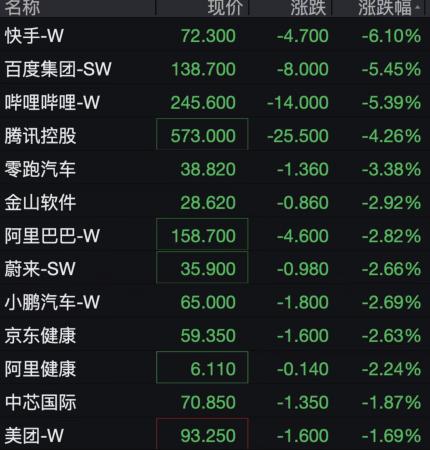
Market Overview - The Hang Seng Index closed up 0.05% at 26,847.32 points, while the Hang Seng Tech Index fell by 1.84% to 5,366.44 points [1]. Sector Performance - Coal stocks led the gains, with Yanzhou Coal Mining rising over 10% and China Shenhua Energy increasing by over 5% [1]. - Chip stocks showed weak performance, with Shanghai Fudan down over 5% and Huahong Semiconductor declining nearly 5% [1]. - The technology sector overall performed poorly, with Tencent Holdings down nearly 4% and Bilibili falling over 3% [1]. - Domestic property stocks collectively rose, with Shimao Group increasing over 14% and Sunac China rising over 8% [1]. Individual Stock Movements - Among the Hang Seng Index constituents, Xinyi Glass, China Shenhua, and China Resources Land had the highest gains [1]. - Conversely, Ctrip Group, Tencent Holdings, and NetEase saw the largest declines [1]. - In the Hang Seng Tech Index, Li Auto, Leapmotor, and Haier Smart Home showed the most significant increases [1]. - On the downside, Kingdee International, Ctrip Group, and Tongcheng Travel experienced the largest drops [1].