
小米

Search documents
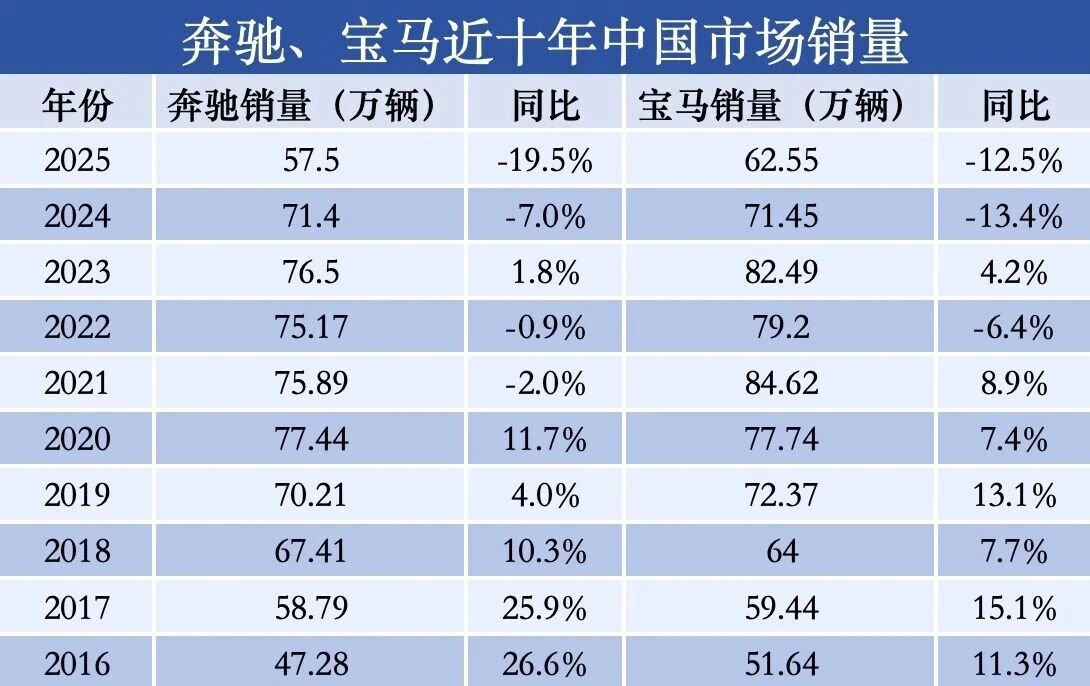
奔驰宝马,销量目标退回十年前
3 6 Ke· 2026-01-20 03:32
Core Insights - Mercedes-Benz and BMW are projected to have annual sales in China below 500,000 units by 2026, a level comparable to their sales in 2016 [2] - Both companies are experiencing a decline in sales for the second consecutive year, with Mercedes-Benz expected to sell 551,900 units in 2025, down 19%, and BMW 625,500 units, down 12.5% [2] - The competitive landscape is shifting, with domestic electric vehicle brands increasingly encroaching on the luxury segment, affecting traditional luxury brands [2][4] Sales Performance - Mercedes-Benz and BMW's sales in China have fluctuated over the past decade, with a notable decline in recent years [1] - In 2023, Mercedes-Benz sold 765,000 units, a slight increase of 1.8%, while BMW sold 824,900 units, up 4.2% [1] - The sales figures for 2025 indicate a significant drop compared to previous years, highlighting a concerning trend for both brands [2] Market Dynamics - The Chinese luxury car market is witnessing a resurgence in domestic brands, with several setting ambitious sales targets for 2026, such as Aito aiming for 500,000 units and Xpeng targeting 550,000 to 600,000 units [4] - The overall passenger car market in China is projected to reach 24.065 million units in 2025, reflecting a recovery from previous years [4] Strategic Initiatives - Mercedes-Benz plans to launch over 15 new models in 2026, focusing on both traditional and electric vehicles, while also enhancing collaborations with local tech companies [4][6] - BMW aims to introduce around 20 new products, including the iX3 long-wheelbase model, leveraging new electric platforms and advanced technologies [6] - Both companies face challenges in adapting to the rapidly changing market, as new domestic competitors continuously innovate [6]

恒生科技指数开盘下跌,智谱、MiniMax股价回涨后走低
第一财经· 2026-01-20 02:59
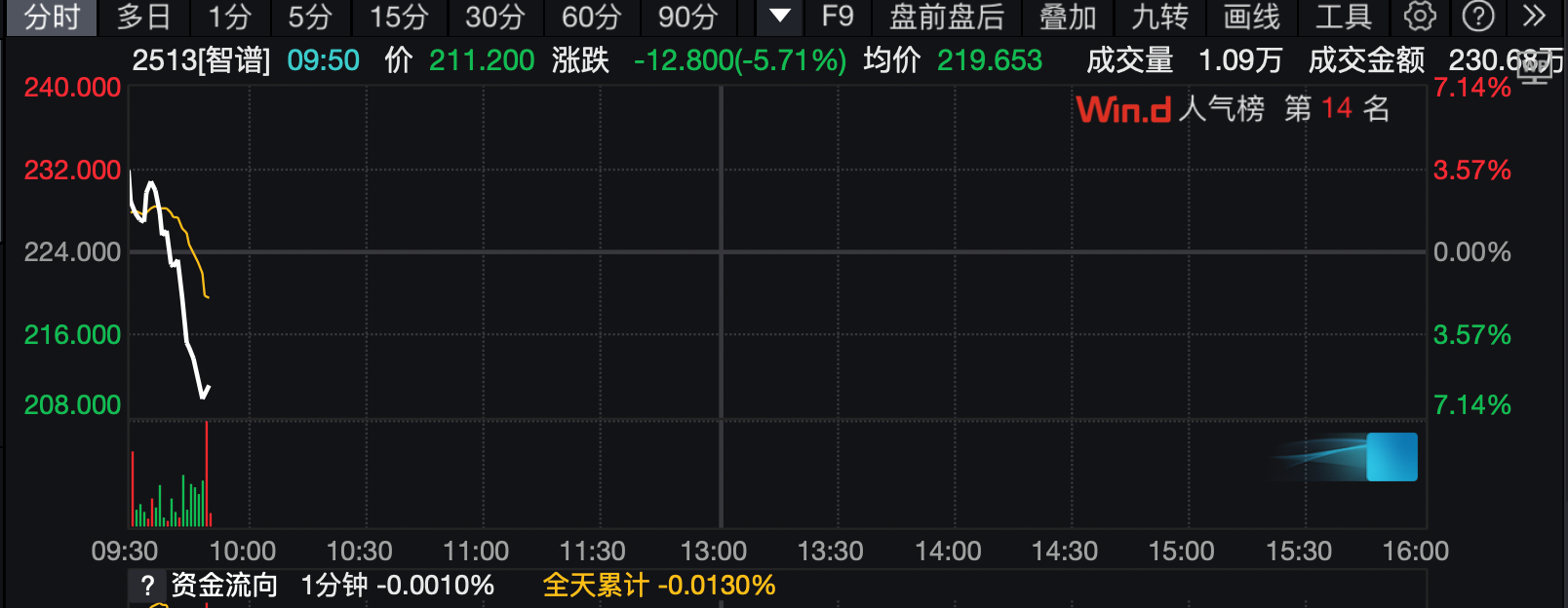
2026.01. 20 作者 | 第一财经 吕倩 中金公司研究部分析认为,2025年初DeepSeek发布以来,港股七家科技龙头股(阿里、腾讯、小米、中芯国际、网易、快手、百度)最高一度贡献了恒 生指数37%回报中的14ppt(百分点),占到四成。经过三年的突飞猛进,目前已经很少有人会从底层质疑AI产业本身的前景,但仍会担心最终兑现速度 和投资之间可能存在差距。 中金团队认为,泡沫本身并非坏事,也推动了产业发展,讨论是否会变成泡沫也没有太多意义,更重要的是确认所处的阶段。 微信编辑 | 七三 本文字数:833,阅读时长大约1.5分钟 1月20日,港股开盘,恒生科技指数跌0.22%,大型科技股多数下跌。昨日股价下跌的智谱(2513.HK)与MINIMAX-WP(0100.HK)开盘股价短暂上 行,之后迅速走低,截至发稿,智谱跌8.48%,MINIMAX-WP微涨0.79%。 19日,智谱收跌10.4%,MiniMax收跌13.7%。原因既有昨日港股普跌因素影响,也在基本面上受大模型公司高投入、高亏损特征拖累。财务数据显 示,2022年至2025年上半年,智谱累计亏损超62亿元;2022年至2025年9月,Min ...

南京人工智能国际社区建设三年行动计划发布
Nan Jing Ri Bao· 2026-01-20 02:39
Core Insights - The Nanjing Hexi Central Innovation Zone is focusing on the development of the artificial intelligence industry, with a three-year action plan (2026-2028) aimed at creating a significant AI ecosystem [1][2] - The plan includes the establishment of 2-3 landmark AI companies, over 10 excellent industry models, 100 new generation smart products, and the introduction of over 1,000 AI enterprises and teams, targeting a trillion-level "AI+" industry cluster by 2028 [1] - The initiative emphasizes the importance of building a robust innovation ecosystem, with significant projects from major companies like Alibaba and Xiaomi already underway [2] Group 1 - The Nanjing Hexi Central Innovation Zone's action plan includes six major actions focusing on energy upgrades, element iteration, and breakthrough challenges [1] - The 2026 key tasks cover three main areas: industrial technology, innovation ecology, and infrastructure development, aiming to create a "10,000 square meters, 1,000 enterprises" community cluster [1][2] - The establishment of various OPC communities, such as the largest "Qin Cheng OPC Community" and the first game and animation OPC community, highlights the focus on specific industry segments [2] Group 2 - The OPC model is recognized as an effective entrepreneurial form in the AI era, allowing young innovators to transform ideas into products more quickly and cost-effectively [3] - The rapid establishment of major research centers and the swift project execution by companies like JD.com demonstrate the effectiveness of the region's development strategy [2]
中泰国际每日晨讯-20260120
ZHONGTAI INTERNATIONAL SECURITIES· 2026-01-20 02:28
Market Overview - On January 19, Hong Kong stocks showed weak upward momentum, with the Hang Seng Index falling by 281 points (1.1%) to close at 26,563 points[1] - The Hang Seng Tech Index decreased by 72 points (1.2%), closing at 5,749 points, with total trading volume at HKD 225.7 billion[1] - Xiaomi, OPPO, vivo, and Transsion lowered their annual shipment forecasts, impacting stock prices, with Xiaomi (1810 HK) down 1.7% and Sunny Optical (2382 HK) down 2.3%[1] Sector Performance - The aviation sector strengthened, with Eastern Airlines (670 HK) and Southern Airlines (1055 HK) rising by 6%-9% due to expected record-high passenger transport during the Spring Festival[1] - The power equipment sector benefited from a planned investment of HKD 4 trillion by the State Grid during the 14th Five-Year Plan, with stocks like Dongfang Electric (1072 HK) and Harbin Electric (1133 HK) increasing by 5%-6%[1] Macroeconomic Insights - The GDP growth for Q4 2025 is projected at 4.5%, with an annual growth rate of 5.0%, meeting expectations[2] - Exports for 2025 are expected to increase by 5.5%, despite a 20% decline in exports to the U.S., showing resilience with an annual trade surplus of USD 1.2 trillion, a historical high[2] Real Estate Sector - Real estate development investment fell by 36.9% year-on-year to RMB 419.7 billion, a larger decline than November's 31.4%[3] - New housing starts decreased by 19.3% to 53.13 million square meters, while the average price index for new residential properties in 70 cities dropped by 3.0% year-on-year[3] Industry Developments - The automotive sector saw Chery Automobile (9973 HK) rise by 4.5% after announcing its AI strategy, marking a shift towards smart vehicles[4] - The renewable energy sector is encouraged to adopt zero-carbon practices, with companies like CIMC Enric (3899 HK) expected to benefit from new policies[4] Pharmaceutical Sector - Most pharmaceutical stocks declined alongside the Hang Seng Index, but leading reproductive health company Jinxin Fertility (1951 HK) rose by 5.3%[5] - The number of newborns is projected to drop from 9.54 million in 2024 to 7.92 million in 2025, prompting government support for childbirth[5]
恒生科技指数开盘下跌,智谱、MiniMax股价回涨后走低
Di Yi Cai Jing· 2026-01-20 02:24
Group 1 - The Hong Kong stock market is currently experiencing a volatile upward trend, but faces short-term challenges [1][3] - The Hang Seng Technology Index opened down 0.22%, with major tech stocks mostly declining; notable declines include Zhizhu (down 8.48%) and MiniMax (up 0.79%) [3] - Zhizhu and MiniMax reported significant losses, with cumulative losses of over 6.2 billion yuan and approximately 9.2 billion yuan respectively from 2022 to mid-2025 [3] Group 2 - Google DeepMind's CEO highlighted that Chinese teams, represented by DeepSeek and Alibaba, are rapidly approaching the technological frontier, with only a few months' gap compared to Western teams [4] - The research team from China International Capital Corporation noted that seven leading tech stocks in Hong Kong contributed significantly to the Hang Seng Index, with a peak contribution of 14 percentage points to a 37% return [4] - The discussion around potential bubbles in the AI industry is deemed less important than confirming the current stage of development, as bubbles can drive industry growth [4]
关于..2026 年中国互联网的思考 --- Thoughts on.. China Internet 2026
2026-01-20 01:50
Summary of Key Points from Conference Call Records Industry Overview China Internet 2026 - 2026 is identified as a pivotal year for AI investments and defending core positioning in the China Internet sector [8][10] - Key themes include EPS delivery/growth, narrative changes in AI, and shareholder returns [10][11] Greenland Tariff Implications - The US will impose a 10% tariff on imports from eight European countries starting February 1, which may lower real GDP in these countries by 0.1-0.2% [2] - Potential EU retaliatory measures include stalling the implementation of the EU-US trade deal, imposing counter-tariffs, and launching the Anti-Coercion Instrument [2] Company-Specific Insights GDS & VNET - Positive order outlook for GDS and VNET, with expectations of significant new orders in 2026 [10][25] - GDS is projected to receive 500MW in new orders, while VNET is expected to secure 300MW [25] Alibaba - Alibaba is noted for normalizing food delivery competition, which may positively impact its EPS growth [10] Kuaishou - Revenue forecast for Kuaishou's Kling business is raised to USD 280 million for 2026, with an expected annual recurring revenue (ARR) of USD 350-400 million [16][18] Bilibili - Bilibili's ad revenue growth is expected to reach nearly 20% year-over-year in 2026, supported by new game launches [16][18] NetEase - Adjustments to NetEase's quarterly sales trajectory indicate expected sequential acceleration throughout 2026 [16][18] Tencent Music Entertainment (TME) - Target P/E for TME is lowered to 22X due to intensifying competition and slower margin expansion, although recent share price corrections are viewed as overdone [16][18] Market Dynamics Investor Sentiment - Current market conditions reflect a low volatility environment, reminiscent of the Trump presidency, with significant gross exposure in US fundamental long-short strategies [4][6][7] - There is a notable demand for cyclical assets, while macro products are facing substantial short positions [7] Data Center Sector - Anticipated dual-track expansion in China's data center market, focusing on chip supply, computing power demand, and infrastructure capacity [22][24] - Increased certainty in utilization against favorable demand may lead investors to look beyond 2026E EBITDA for valuation [25] Conclusion - The China Internet sector is poised for significant developments in AI and shareholder returns, while the impact of tariffs on European economies could lead to strategic shifts in trade relations. Companies like GDS, VNET, and Kuaishou are expected to benefit from favorable market conditions and growth opportunities in 2026.
最重要的宏观数据公布了
Xin Lang Cai Jing· 2026-01-20 01:31
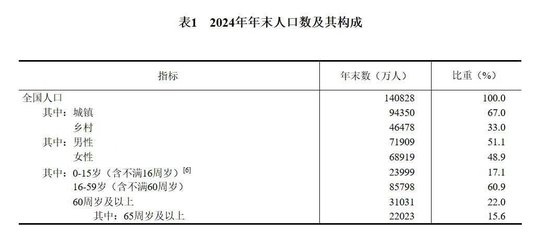
Demographic Trends - By the end of 2025, the national population is projected to be 1,404.89 million, a decrease of 3.39 million from the previous year. The population has been declining for three consecutive years, with a reduction of 1.39 million in 2024 and 2.08 million in 2023, marking the first negative growth in 2022 with a decrease of 0.85 million [1][9] - The number of newborns is expected to decline, with 9.02 million in 2023, 9.54 million in 2024, and 7.92 million in 2025, indicating the importance of encouraging childbirth [1][9] - The age structure shows that the population aged 16-59 is 851.36 million, accounting for 60.6% of the total population, while those aged 60 and above are 323.38 million, making up 23.0% [1][9] Aging Population - The aging trend is deepening, with projections indicating that by around 2032, the proportion of individuals aged 65 and above will exceed 20%, leading to a super-aged society that will significantly impact various aspects of the economy, culture, consumption, and production [2][12] Urbanization and Economic Structure - The urban population reached 953.80 million, an increase of 10.30 million from the previous year, while the rural population decreased by 1.37 million. The urbanization rate is now 67.89%, up by 0.89 percentage points [5][15] - The economic structure shows that the primary industry added value is 93,347 billion yuan, growing by 3.9%; the secondary industry added value is 499,653 billion yuan, increasing by 4.5%; and the tertiary industry added value is 808,879 billion yuan, rising by 5.4% [5][15] Investment Strategy - The company proposes a "technology + dividend" investment structure with a rebalancing strategy as a foundation for investment, based on the macroeconomic fundamentals of low interest rates and low inflation [6][17] - Considering the potential for U.S. interest rate cuts, opportunities in the Hong Kong stock market are viewed as higher than in the A-share market. Defensive strategies may include the Hong Kong large-cap 30 ETF, which tracks the 30 largest companies listed in Hong Kong [7][17] - For aggressive strategies, the Hong Kong internet ETF is recommended, which includes major players like Alibaba and Tencent, involved in the full AI application chain, indicating a shift from concept to commercialization in AI [7][17][18]
A股又多了一个很炸裂的数据...
表舅是养基大户· 2026-01-19 13:35
Core Viewpoint - The article discusses the current market trends, focusing on the impact of rising component prices, particularly storage chips, on companies like Xiaomi, and highlights the ongoing divergence between margin financing and broad-based ETF selling. Group 1: Market Trends and Company Impact - The price of a 512GB SD card has doubled recently, affecting downstream manufacturers like automotive and smartphone companies negatively, particularly Xiaomi, which is facing a "double kill" scenario due to its dual role in both sectors [3][4]. - Xiaomi's stock has dropped by 1.7% to a closing price of 36.48, nearing a critical support level that could erase its gains since 2025 if it continues to decline [4]. - The financing margin rules have changed, with the margin ratio increasing from 80% to 100%, which may have led to a rush in financing activities before the new regulations took effect [6][12]. Group 2: Market Data and Performance - The number of stocks priced over 100 yuan in A-shares has reached a historical high of 222, with many being technology stocks, indicating a significant valuation trend in the market [17]. - The A-share market has seen a notable increase in trading volumes for certain ETFs, with the CSI 300 ETF showing a 124.20% increase in trading volume over the past few days [9]. - The electric grid equipment sector has experienced a surge, with related ETFs rising nearly 8%, indicating strong market sentiment in this area [27][28]. Group 3: Institutional Investment and Fundraising - Insurance companies are launching new private equity funds, with the establishment of the third phase of a major fund indicating a potential influx of institutional capital into the market [34][37]. - The trend of private equity funds from insurance companies is becoming more routine, which could provide significant incremental capital to the market [37]. Group 4: Risk Events and Market Reactions - Several stocks mentioned in previous analyses have all seen declines, confirming short-term negative sentiment in the market [19]. - Regulatory scrutiny is expected to increase, particularly concerning the entry of credit funds into the stock market, which may impact market dynamics [13][21].

刚因“电芯”遭23亿天价索赔,欣旺达又卷入沃尔沃全球召回风波
Guo Ji Jin Rong Bao· 2026-01-19 13:00
Core Viewpoint - The recent recall of Volvo's electric vehicle EX30 due to battery safety issues has raised concerns about the responsibility of the battery supplier, A123, and has compounded existing sales pressures on Volvo [2][3][5]. Group 1: Volvo's Recall and Sales Performance - Volvo has initiated a global recall of its EX30 electric model due to high-voltage battery overheating risks, affecting markets including the US, Canada, South Africa, and Australia [2]. - In the UK, 10,440 units of the EX30 are confirmed to be affected, covering models from 2024 to 2026 [2]. - Volvo's global sales in 2024 are projected at 763,400 units, an 8% increase year-on-year, but sales in China, its largest market, have dropped to 156,400 units, the lowest in five years [4]. Group 2: Financial Impact and Battery Supplier Issues - In Q3 2023, Volvo's global sales fell to 160,500 units, a 7% year-on-year decline, with revenues of 86.4 billion Swedish Krona, down 6% [5]. - The recall has sparked controversy over battery supply responsibilities, with reports indicating that the problematic battery cells were produced by a joint venture involving A123 [5][6]. - A123's chairman stated that the battery packs were supplied through a different factory, distancing the company from direct responsibility for the issues [5]. Group 3: A123's Challenges and Market Position - A123 is facing significant challenges, including a recent lawsuit from Zeekr over battery quality issues, which has intensified scrutiny on the company's reliability [6][9]. - The company has seen a reduction in orders from key clients like Li Auto and Xiaomi, with the number of models supported by A123 for Li Auto dropping from 10 to 3 [9]. - A123's aggressive pricing strategy has led to declining profit margins, with a gross margin of only 9.77% in H1 2025, significantly lower than competitors [10]. Group 4: Financial Health and Future Outlook - A123 reported a loss of 1.87 billion Yuan in 2024, with cumulative losses exceeding 4.5 billion Yuan from 2023 to H1 2025 [10]. - The company's debt levels have risen sharply, with a debt-to-asset ratio of 67.62% and total liabilities reaching 67.9 billion Yuan [10]. - Concerns about ongoing litigation and financial losses may hinder A123's plans for an IPO in Hong Kong, which was anticipated for 2026 [10].

港股再融资迎“开门红”,募资超270亿港元
2 1 Shi Ji Jing Ji Bao Dao· 2026-01-19 12:37
Core Viewpoint - The Hong Kong capital market has seen a significant increase in refinancing activities at the beginning of 2026, with over HKD 27 billion raised, marking a more than 20-fold increase compared to the same period in 2025, setting a vibrant tone for the year ahead [1][2]. Group 1: Market Activity and Trends - As of January 18, 2026, Hong Kong listed companies have raised over HKD 27 billion through various refinancing methods, a substantial increase from HKD 1.1 billion in the same period of 2025 [1]. - The 2025 Hong Kong refinancing market reached a historic high of HKD 325.32 billion, surpassing the IPO fundraising scale for the first time [1][2]. - The active refinancing market is attributed to a 27.77% increase in the Hang Seng Index in 2025, which improved market sentiment and valuation [2]. Group 2: Structural Characteristics of Financing - The refinancing activities in early 2026 show a diverse industry distribution, including sectors such as oil and petrochemicals, construction, software services, and healthcare [3]. - Notable companies like SF Express and Jitu Express raised over HKD 10 billion each, while 10 other companies raised over HKD 1 billion [3]. - The primary use of raised funds is aligned with core business strategies, including international expansion, technology R&D, and financial structure optimization [3]. Group 3: Financing Methods and Innovations - Placement remains the dominant method for refinancing, with 27 out of 36 cases in 2026 utilizing this approach, highlighting its efficiency and flexibility [3]. - A notable trend in 2026 is the diversification of financing methods, including strategic mutual holdings through consideration issuance, which promotes industry chain integration [4][5]. - The issuance of convertible bonds, particularly zero-coupon convertible bonds, is becoming increasingly active, with financing concentrating on leading enterprises [6]. Group 4: Future Outlook - The Hong Kong refinancing market is expected to maintain high activity levels, with a stable growth rate and continued demand from capital-intensive industries [6]. - The flexible and efficient issuance system is likely to attract more listed companies, with refinancing volumes expected to exceed IPOs [6]. - The importance of hard technology and biotechnology companies is anticipated to rise, while the participation of cross-border capital is expected to enhance market liquidity [6].