
国泰基金

Search documents
基金双周报:ETF市场跟踪报告-20260119
Ping An Securities· 2026-01-19 08:47
1. Report Industry Investment Rating - Not provided in the content 2. Core Viewpoints of the Report - As of January 16, recent two - week ETF products performed well. Among domestic major broad - based ETFs, Science and Technology Innovation 100 had the largest increase, and among industry and thematic products, technology - themed ETFs had the largest increase. The Science and Technology Innovation 100ETF had net capital inflows, while the CSI 300ETF had significant net capital outflows. Also, in the past two weeks, cyclical and pharmaceutical ETFs had accelerated capital inflows, technology, consumer, military, and financial real - estate ETFs turned to net capital inflows, dividend and other large - manufacturing ETFs turned to net capital outflows, and new - energy ETFs had accelerated capital outflows. For bond ETFs, credit - bond, treasury - bond, and local - bond ETFs turned from net inflows to net outflows, convertible - bond ETFs turned to net inflows, and policy - financial - bond and short - term - financing ETFs had accelerated net outflows [2][9][16] 3. Summary According to the Table of Contents 3.1 ETF Market Review - **Performance and Capital Flow**: As of January 16, in the past two weeks, among domestic major broad - based ETFs, Science and Technology Innovation 100 had the largest increase, and among industry and thematic products, technology - themed ETFs had the largest increase. The Science and Technology Innovation 100ETF had net capital inflows, while the CSI 300ETF had significant net capital outflows. Cyclical and pharmaceutical ETFs had accelerated capital inflows, technology, consumer, military, and financial real - estate ETFs turned to net capital inflows, dividend and other large - manufacturing ETFs turned to net capital outflows, and new - energy ETFs had accelerated capital outflows. For bond ETFs, credit - bond, treasury - bond, and local - bond ETFs turned from net inflows to net outflows, convertible - bond ETFs turned to net inflows, and policy - financial - bond and short - term - financing ETFs had accelerated net outflows [2][9][16] - **Product Structure Distribution**: As of January 16, in the past two weeks, 9 new ETFs were established, with a total issuance of 5607 million shares, all being stock ETFs. Compared with the end of 2025, the scales of industry + dividend ETFs, commodity ETFs, and QDII - ETFs increased by 14.33%, 9.87%, and 6.05% respectively, while the scales of bond ETFs and broad - based ETFs decreased by 9.78% and 3.98% respectively [2][23] - **Fund Manager Scale Distribution**: As of January 16, China Asset Management had the largest on - exchange ETF scale of 96.4259 billion yuan. The ETF management scales of China Asset Management and E Fund expanded by over 26 billion yuan compared with a year ago [24] 3.2 Classification of ETF Tracking - **Technology - Themed ETF**: Products tracking semiconductor materials and equipment had the highest net capital inflows in the past two weeks, while products tracking the National Securities Chip index had net capital outflows [28] - **Dividend - Themed ETF**: Products tracking the low - volatility dividend had the highest net capital inflows in the past two weeks, while products tracking the CSI Dividend index had net capital outflows [31] - **Consumer - Themed ETF**: Products tracking the S&P 500 Consumer Select Index had a relatively high premium rate. ETFs tracking the CSI 800 Consumer index had the highest net capital inflows in the past two weeks, while products tracking the CSI Liquor index had net capital outflows [34] - **Pharmaceutical - Themed ETF**: ETFs tracking medical devices had the highest net capital inflows in the past two weeks, while products tracking the CSI Medical index had net capital outflows [37] - **Large - Manufacturing - Themed ETF**: Products tracking the satellite industry had the highest net capital inflows in the past two weeks, while products tracking robots had net capital outflows [40] - **QDII ETF**: Products tracking the Hang Seng Technology index had the highest net capital inflows in the past two weeks, while ETF products tracking the Hang Seng Healthcare index had net capital outflows [43] 3.3 Popular Themed ETF Tracking - **AI - Themed ETF**: AI - themed products mostly rose in the past two weeks, with an average return of 10.88%. Products tracking cloud computing had the largest increase. Since 2025, there has been an overall net capital inflow, with a large inflow from mid - February to April, a continuous outflow from May to August, and a large inflow since mid - August. In the past two weeks, there was a significant net capital inflow of 18.301 billion yuan [55] - **Robot - Themed ETF**: Robot - themed products performed well in the past two weeks, with an average return of 7.17%. Products tracking the robot index had the largest increase. After February 2025, capital showed a rapid inflow trend as a whole, and there was a net capital outflow of 3.909 billion yuan in the past two weeks [59] - **New - Energy - Themed ETF**: New - energy - themed products mostly rose in the past two weeks, with an average return of 4.10%. Products tracking the CSI New Energy index had the largest increase. There was a continuous outflow before August 2025, a large inflow from August to October, and a large outflow since late October. In the past two weeks, there was a net capital outflow of 3.111 billion yuan [65] - **Satellite and Commercial Space - Themed ETF**: Satellite and commercial space - themed products mostly rose in the past two weeks, with an average return of 14.38%. Products tracking the satellite industry had the largest increase. There was a small inflow in late August 2025 and a large inflow since mid - December. In the past two weeks, there was a significant net capital inflow of 17.542 billion yuan [70] - **Central Huijin, Guoxin, and Chengtong - Held ETF**: As of June 30, 2025, the scale of ETFs held by Central Huijin, Guoxin, and Chengtong totaled 39.1336 billion shares. In the past two weeks, there was a net capital outflow of 172.9 billion yuan. In the past two weeks, China AMC CSI 500 ETF, Harvest CSI 500 ETF, and Guotai SSE 180 Financial ETF had the highest capital inflows [74]
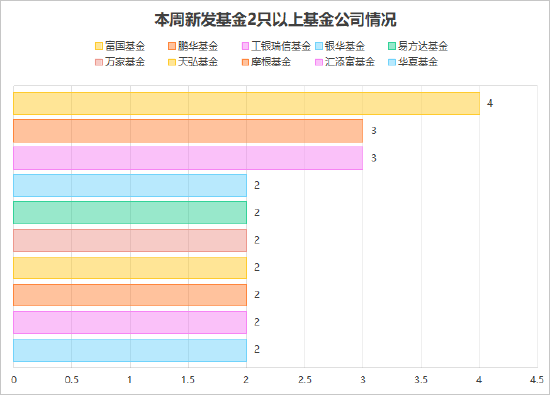
本周40只新基扫描:富国、鹏华、工银瑞信、华夏、易方达等26家公募PK 主题指数、FOF稳健、混合成长齐上阵
Xin Lang Cai Jing· 2026-01-19 08:17
Group 1 - The public fund market is experiencing a new round of product issuance starting from January 19, with 40 new funds launched for subscription, involving 26 fund management companies [1][14] - The distribution of new funds includes 15 stock funds, 12 FOF funds, 9 mixed funds, and 4 bond funds [1][14] Group 2 - Among the 15 stock funds, theme index funds are the main focus, covering sectors such as engineering machinery, non-ferrous metals, chip design, healthcare, photovoltaic, animal husbandry, and artificial intelligence [3][16] - New funds are closely aligned with current market hotspots and policy directions, particularly in technology innovation and high-end manufacturing, with specific funds targeting semiconductor and AI industries [3][16] - The new funds also focus on renewable energy, industrial metals, and resource sectors, reflecting ongoing investment in energy transition and infrastructure [3][16] Group 3 - The 12 FOF funds launched are characterized by a "stable" positioning and set minimum holding periods of 3 to 6 months, aiming to provide clear styles and strong operational discipline for medium to long-term investment [6][19] - The overall strategy for the new FOFs emphasizes "fixed income+" with a significant allocation to bond assets, typically between 70% to 85%, serving as a stability component for returns [7][20] - Many FOF products include gold as a standard asset, highlighting its role as an inflation hedge and risk management tool in the current macroeconomic environment [7][20] Group 4 - The 9 mixed funds exhibit diverse strategies, focusing on themes such as quantitative stock selection, healthcare innovation, and consumer sectors in Hong Kong, with most funds having equity allocations between 60% to 90% [10][12] - The majority of mixed funds incorporate Hong Kong stock indices in their performance benchmarks, indicating a focus on valuation recovery opportunities in the Hong Kong market [10][12] Group 5 - The 4 newly issued bond funds primarily adopt a "fixed income+" strategy, suitable for investors with moderate to low risk tolerance, with most having low subscription thresholds [12][13] - The bond funds are designed to provide a stable income while allowing for some equity exposure, with varying subscription periods to accommodate investor preferences [12][13]

十大宽基ETF,单周净流出近2000亿元
3 6 Ke· 2026-01-19 07:29
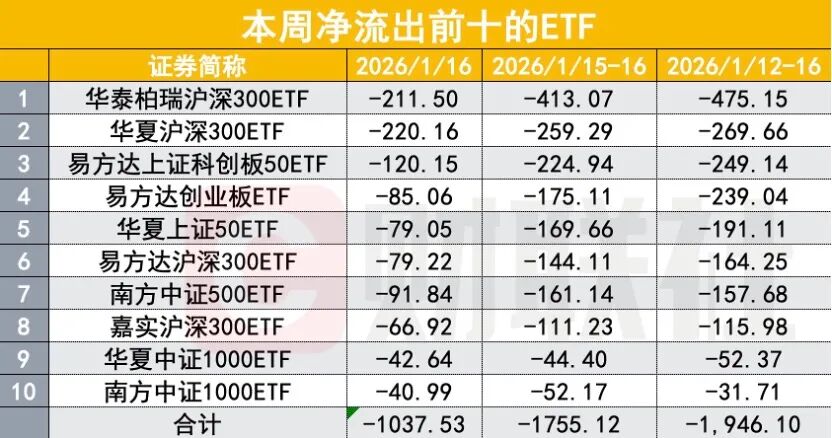
Core Viewpoint - The recent data reveals a significant outflow of funds from broad-based ETFs, with a total net outflow of 191.4 billion yuan during the week of January 12-16, marking a historical high for domestic ETFs [1][2]. Summary by Category Fund Flows - Broad-based ETFs experienced a net outflow of 1,914 billion yuan, with the CSI 300 ETF, ChiNext ETF, and SSE 50 ETF being the main contributors to this outflow [1]. - The CSI 300 ETF led the outflow with 1,037.5 billion yuan, where 935.24 billion yuan was withdrawn in the last two trading days, accounting for 90% of the total outflow [1][2]. - Eight ETFs recorded a net outflow exceeding 10 billion yuan, with the total outflow from the top ten broad-based ETFs reaching 1,946.1 billion yuan, setting a new record in the history of domestic ETFs [2][3]. Specific ETF Performance - The top outflowing ETFs included: - Huatai-PB CSI 300 ETF: -475.15 billion yuan - Huaxia CSI 300 ETF: -269.66 billion yuan - E Fund Sci-Tech 50 ETF: -349.14 billion yuan - E Fund ChiNext ETF: -239.04 billion yuan - Huaxia SSE 50 ETF: -191.11 billion yuan [2][3]. - The A500 ETF, the second-largest broad-based ETF, saw a net outflow of 74 billion yuan, dropping its scale below 300 billion yuan [5]. Industry ETFs - In contrast, industry-specific ETFs saw a net inflow of nearly 600 billion yuan, with significant investments in the Hong Kong Stock Connect Internet ETF, Software ETF, Satellite Communication ETF, and Non-ferrous Metals ETF [1][7]. - Specific industry ETFs that attracted substantial inflows included: - E Fund Sci-Tech Chip ETF: nearly 20 billion yuan - Guotai Semiconductor Materials Equipment ETF: over 10 billion yuan - Southern Non-ferrous Metals ETF: over 10 billion yuan [7][8]. Market Context - The total scale of domestic ETFs approached 6.3 trillion yuan as of January 12, despite the significant outflow, the current scale remains around 6.1 trillion yuan [3]. - The regulatory environment is tightening, with measures aimed at cooling down the overheated market, including increased margin requirements and scrutiny of stocks with excessive short-term gains [9][10].
中证A500的优势似乎越来越明显了
Xin Lang Cai Jing· 2026-01-19 06:07
Core Viewpoint - The market is increasingly favoring the CSI A500 index, which has shown significant outperformance compared to the CSI 300 index, particularly driven by high-tech sectors like communication semiconductors and AI applications [1][2][3]. Performance Summary - In 2025, the CSI 300 index rose by 17.66%, while the CSI A500 index increased by 22.43%, resulting in an excess return of nearly 5% [1]. - As of January 16, 2026, the CSI 300 index gained 17.74% over the last six months, whereas the CSI A500 index surged by 24.83%, leading to an excess return exceeding 7% [3]. - Since its inception on December 31, 2004, the CSI 300 index has appreciated by 371.31%, while the CSI A500 index has risen by 488.94%, yielding an excess return of over 110% [3][16]. Fund Flow and Investment Strategy - In the past 20 days, the CSI A500 ETF has seen a net inflow of over 11.2 billion, indicating strong investor interest and confidence in its value [3][17]. - The CSI A500 index is designed to be more balanced, reducing weight in traditional sectors like finance and food & beverage, while increasing exposure to emerging sectors such as computing, electronics, pharmaceuticals, and military [3][17]. - The index incorporates ESG evaluations and industry-neutral strategies, focusing on leading companies within each sector, thus providing a well-rounded investment approach [3][17]. Market Outlook and Strategy - The current market environment suggests that while there may be short-term adjustments, the overall bullish trend remains intact, with potential for further upward movement [20]. - A "broad-based core and satellite enhancement" strategy is recommended to navigate market fluctuations effectively, allowing for both stability and growth [22][24]. - The satellite allocation should focus on sectors that are either recovering or innovating, creating a balanced portfolio that can withstand volatility while maximizing returns [25].
化工行业ETF易方达、化工ETF、化工龙头ETF涨超3%,化工ETF、化工50ETF强势吸金
Sou Hu Cai Jing· 2026-01-19 05:48
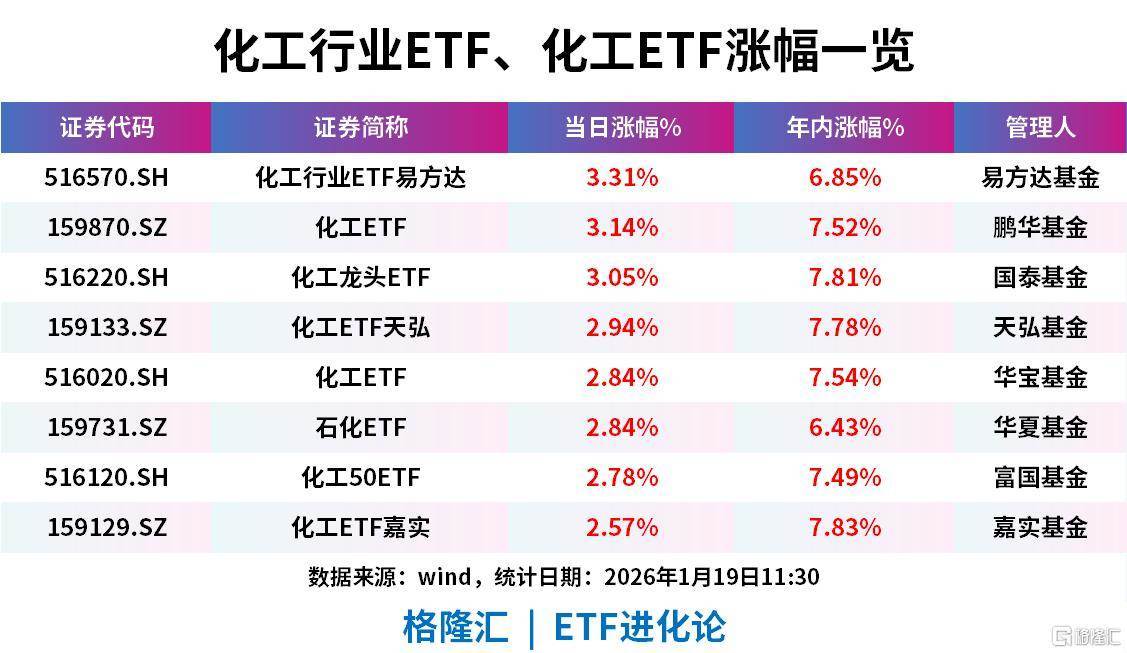
Group 1 - The chemical sector ETFs have shown positive performance, with the top performers being the Chemical Industry ETF by E Fund, which increased by 3.31% on the day and 6.85% year-to-date, and the Chemical ETF by Penghua, which rose by 3.14% and 7.52% respectively [2] - In the past 10 trading days, significant net inflows were observed in the chemical sector, totaling 45.71 billion yuan for the Chemical ETF and 15.23 billion yuan for the Chemical 50 ETF [4][6] - The Chemical ETF tracks the CSI Sub-Industry Chemical Theme Index, with nearly 50% of its holdings concentrated in large-cap leading stocks, including Wanhua Chemical and Salt Lake Industry, while the remaining 50% is diversified across various sub-sectors [8] Group 2 - The chemical industry is expected to experience a recovery in profitability by 2026, following a period of bottoming out in earnings and valuations, with supply-demand rebalancing as a new starting point [8] - According to Tianfeng Securities, the chemical industry is entering a phase of capacity release, with a potential reversal in supply-demand dynamics expected by 2026 [8] - Huatai Securities indicates that the chemical raw materials and products sector is at a turning point, transitioning from active destocking to passive restocking, with a recovery in domestic and international demand anticipated in 2026 [9]
ETF午评 | 电网设备领涨,电网设备ETF、电网ETF涨5%
Ge Long Hui· 2026-01-19 04:16
Market Performance - The A-share market showed mixed performance in the morning session, with the Shanghai Composite Index up by 0.13%, the Shenzhen Component down by 0.01%, and the ChiNext Index down by 0.64% [1] - The Northbound 50 Index increased by 0.32%, while the total trading volume in the Shanghai and Shenzhen markets reached 180.65 billion yuan, a decrease of 20.37 billion yuan compared to the previous day [1] - Over 3,300 stocks in the market experienced gains [1] Sector Performance - The top-performing sectors included electric grid equipment, precious metals, tourism and hotels, glyphosate, minor metals, airport and shipping, and military equipment [1] - Conversely, sectors that saw declines included insurance, cultural media, state-owned cloud services, computing power leasing, and weight loss drugs [1] ETF Performance - The electric grid concept ETFs performed strongly, with Huaxia Fund's electric grid equipment ETF, Guotai Fund's electric grid ETF, and GF Fund's electric grid ETF rising by 5.27%, 5.13%, and 5.1% respectively [1] - The tourism sector also saw gains, with the Fortune Fund's tourism ETF and Huaxia Fund's tourism ETF increasing by 3.92% and 3.5% respectively [1] - The chemical sector was active, with Penghua Fund's chemical ETF and Guotai Fund's leading chemical ETF rising by 3% and 2.94% respectively [1] Hong Kong Market - The Kexin 100 ETF enhanced index fund fell by 5% [2] - The Hong Kong innovative drug sector declined, with the Hong Kong Stock Connect innovative drug ETF and the Hong Kong Stock Connect medical ETF from Fortune both dropping by 3.07% and 3.02% respectively [2]
开年两个“万亿”,ETF“非对称”优势如何突围?
券商中国· 2026-01-19 02:31
Core Viewpoint - The article highlights the significant growth and evolution of ETFs in China, with two major records achieved in early 2026, indicating a robust and competitive market landscape. The focus is on the "Matthew Effect," where leading players like Huaxia and E Fund continue to dominate, while smaller firms carve out niches through differentiated strategies [1][2]. Group 1: ETF Market Overview - As of January 16, the total size of all listed ETFs reached 6.07 trillion yuan, managed by 58 fund companies. Huaxia Fund's ETF surpassed 1 trillion yuan on January 12, later adjusting to 964.82 billion yuan due to market fluctuations [2]. - The top five fund companies account for 53.21% of the total ETF market size, with E Fund and Huatai-PB following Huaxia in scale [2][3]. Group 2: Competitive Dynamics - The article discusses the "liquidity moat" and "institutional allocation preference" as key factors contributing to the scale disparity among ETF managers. Larger ETFs tend to attract more institutional investments due to better liquidity, reinforcing the dominance of leading firms [3][5]. - The analysis indicates that the competition among ETF managers is shifting from simple scale to a more complex ecosystem approach, focusing on product differentiation and comprehensive solutions for investors [8][9]. Group 3: Product Differentiation and Strategy - Smaller fund companies are encouraged to focus on niche markets and innovative strategies to compete effectively against larger firms. The article emphasizes the importance of creating unique products that meet specific investor needs [6][10]. - The future of ETFs is seen as moving towards "solution-oriented competition," where the emphasis is on providing complete investment solutions rather than just tracking indices [8][9]. Group 4: Future Trends and Innovations - The article notes that the global market for actively managed ETFs is expected to grow significantly, with a projected size of 1.84 trillion USD by the end of 2025, indicating a shift in investor preferences towards active management strategies [10]. - Companies like Pengyang Fund are exploring new product categories, such as long-term bond ETFs, to enhance their offerings and meet evolving market demands [6][10].

先导基电股价涨9.46%,国泰基金旗下1只基金位居十大流通股东,持有641.21万股浮盈赚取1173.41万元
Xin Lang Cai Jing· 2026-01-19 01:52
Core Viewpoint - XianDao Jidian's stock price has increased by 9.46% on January 19, reaching 21.18 CNY per share, with a total market capitalization of 19.711 billion CNY, indicating a cumulative increase of 4.54% over three consecutive days [1] Group 1: Company Overview - XianDao Jidian Technology Co., Ltd. is located at Longhua Vanke Center, Shanghai, and was established on October 28, 1991, with its listing date on April 7, 1993 [1] - The company's main business areas include integrated circuits and photovoltaic core equipment, as well as real estate [1] - Revenue composition: 75.14% from bismuth deep processing and compounds, 14.57% from real estate, 10.18% from specialized equipment manufacturing, and 0.11% from other sources [1] Group 2: Shareholder Information - Guotai Fund's Guotai Zhongzheng Semiconductor Materials Equipment Theme ETF (159516) entered the top ten circulating shareholders of XianDao Jidian in Q3, holding 6.4121 million shares, which is 0.69% of the circulating shares [2] - The ETF has generated a floating profit of approximately 11.7341 million CNY today and 5.3862 million CNY during the three-day increase [2] - The ETF was established on July 19, 2023, with a current scale of 8.299 billion CNY and has achieved a year-to-date return of 27.32% [2] Group 3: Fund Performance - Guotai Guozheng Real Estate Industry Index A (160218) holds 627,600 shares of XianDao Jidian, accounting for 2.62% of the fund's net value, ranking as the eighth largest holding [3] - The fund has realized a floating profit of approximately 114.85 thousand CNY today and 52.72 thousand CNY during the three-day increase [3] - The fund was established on January 1, 2021, with a current scale of 358 million CNY and a year-to-date return of 3.47% [3]

机构研究周报:重视业绩与性价比,A股或优于港股
Wind万得· 2026-01-18 23:55
Focus Review - The People's Bank of China has lowered the interest rates of various structural monetary policy tools by 0.25 percentage points, with the one-year re-lending rate now at 1.25% [3] - This policy is seen as the start of a monetary easing process, with potential for further adjustments if economic conditions worsen [3] Equity Market - Huatai Securities emphasizes the importance of focusing on performance and cost-effectiveness as the earnings forecast period approaches, suggesting two main categories for investment: themes with catalysts and relatively low crowding, such as media (gaming) and service consumption (duty-free), and sectors benefiting from external demand recovery, like batteries and engineering machinery [5] - Fuguo Fund highlights that in a low-interest-rate environment, dividend assets are gaining attention due to their stable cash flow and high dividend yield, making them a mature investment strategy globally [6] - CICC predicts that A-shares are likely to outperform Hong Kong stocks in 2026, while investors should focus on unique structural opportunities in Hong Kong, particularly in sectors like dividends, internet, innovative pharmaceuticals, and new consumption [7] Industry Research - GF Fund suggests that resource products may become a key investment theme in 2026, driven by macroeconomic conditions and AI demand, with a focus on non-ferrous metals and certain chemicals [11] - Huatai Securities notes a significant recovery in the liquidity of the Hong Kong innovative pharmaceutical sector, driven by unexpected BD transactions and overseas interest rate cuts, recommending increased allocation to this sector [12] - Fuguo Fund reports that surging AI demand is causing a supply-demand imbalance in the memory industry, leading to significant price increases, with expectations of a strong cycle lasting until the second half of 2026 [13] Macro and Fixed Income - Guohai Franklin Fund indicates that the bond market may experience volatility in 2025, with a focus on stable growth and price recovery policies, while remaining cautious of potential upward risks from stimulus measures [18] - Guotai Fund believes that the recent interest rate cuts by the central bank have boosted market sentiment, although the direct impact on credit and the bond market is limited [19] -招商基金 suggests a defensive approach in the first quarter, anticipating stabilization in the bond market as supply shocks are absorbed [19] Asset Allocation - HSBC Jintrust Fund highlights that global liquidity easing will create diverse asset allocation opportunities, with A-shares expected to show a low valuation and technology-driven market [21]



流出超2000亿元!ETF资金迁移路线图曝光
Zheng Quan Shi Bao Wang· 2026-01-18 23:36
Group 1 - The core viewpoint of the article highlights a significant internal shift in the ETF market, with funds moving away from broad-based ETFs to narrower, high-volatility products [1][2][5] - Year-to-date, over 200 billion yuan has been withdrawn from broad-based ETFs, with 14 ETFs experiencing a net outflow exceeding 30 billion yuan, all of which are broad-based ETFs [2][4] - The largest stock ETF in China has seen its scale drop from 400 billion yuan to 300 billion yuan, while the second-largest has decreased from 300 billion yuan to 200 billion yuan [2] Group 2 - In contrast, narrow-based ETFs, cross-border ETFs, and commodity ETFs have attracted significant inflows, with cross-border ETFs growing by 746.32 billion yuan, surpassing the 1 trillion yuan mark for the first time [4][6] - The South China Nonferrous ETF has become the only product to receive over 10 billion yuan in net inflows this year, driven by rising base metal prices [6][8] - The active trading environment in the A-share market and the structural differentiation in performance have led to increased demand for high-elasticity assets, further supporting the inflow into narrow-based ETFs [7][9] Group 3 - Fund companies focusing on narrow-based ETFs are experiencing significant growth, with companies like GF Fund and Yongying Fund expanding their ETF scales rapidly [7][8] - The current market dynamics suggest that narrow-based ETFs are becoming a key driver of growth in the ETF sector, especially for smaller fund companies looking to compete against larger institutions [9][10] - There is a concern that narrow-based ETFs may be used as speculative tools rather than for long-term asset allocation, which could lead to increased trading costs and volatility for investors [10]