汇丰银行

Search documents
避险情绪降温,国内足金饰品跌破千元
3 6 Ke· 2025-05-13 08:33
Core Viewpoint - The recent decline in gold prices is attributed to reduced risk aversion following the U.S.-China trade agreement, which has led to a more balanced market dynamic for gold [3][4][5]. Group 1: Gold Price Movement - On May 13, gold prices in the Asian market opened at $3,239.25 per ounce for spot London gold and $3,240.70 per ounce for New York futures, reflecting a drop of 2.69% and 2.76% respectively from the previous day [1]. - Major Chinese gold retailers, such as Chow Tai Fook and Lao Miao, have reduced the price of gold jewelry to below 1,000 yuan per gram, with significant decreases of 16 yuan and 13 yuan per gram respectively over two days [1][2]. Group 2: U.S.-China Trade Relations - The U.S. has committed to canceling 91% of tariffs on Chinese goods and suspending 24% of the remaining tariffs for 90 days, while China has reciprocated by canceling 91% of its counter-tariffs [4]. - This trade agreement is expected to alleviate pressure on both countries' export sectors and reduce uncertainty for Chinese manufacturing, positively impacting investor sentiment [4][5]. Group 3: Economic Indicators and Predictions - The U.S. dollar has seen its largest increase since the November 2024 presidential election, and U.S. Treasury yields have risen, which poses a challenge for gold prices as it increases the cost of holding non-yielding assets like gold [4][5]. - Goldman Sachs has pushed back its forecast for the first interest rate cut by the Federal Reserve to December, while Citibank has also delayed its prediction from June to July [5][6]. Group 4: Central Bank Gold Purchases - As of April, China's gold reserves increased to 73.77 million ounces, marking a continuous six-month increase, with a total rise of nearly 1 million ounces (approximately 28 tons) over this period [7]. - Global central banks purchased 244 tons of gold in the first quarter, aligning with the average quarterly purchase levels over the past three years, indicating sustained demand for gold as a reserve asset [7]. Group 5: Future Outlook for Gold - The low proportion of gold in China's foreign exchange reserves (5.5% as of December 2024) compared to the global average of around 15% suggests a continued trend of increasing gold purchases by the People's Bank of China [8]. - The ongoing geopolitical instability and the need to optimize reserve structures are driving central banks to enhance their gold holdings, which is expected to support gold prices in the long term [7][8].


金十整理:机构预期今晚20:30公布的美国4月未季调核心CPI年率(前值:+2.8%)
news flash· 2025-05-13 08:18
金十整理:机构预期今晚20:30公布的美国4月未季调核心CPI年率(前值:+2.8%) 凯投宏观:+2.7%;道明证券:+2.7%;荷兰银行:+2.8%;澳新银行:+2.8%; 法巴银行:+2.8%;巴克莱银行:+2.8%;美国银行:+2.8%;帝商银行:+2.8%; 花旗银行:+2.8%;丹斯克银行:+2.8%;高盛集团:+2.8%;野村证券:+2.8%; 劳埃德银行:+2.8%;加皇银行:+2.8%;法兴银行:+2.8%;丰业银行:+2.8%; 摩根士丹利:+2.8%;渣打银行:+2.8%;富国银行:+2.8%;汇丰银行:+2.9%; 荷兰国际:+2.9%;摩根大通:+2.9%;瑞银集团:+2.9%。[路透调查:+2.8%] ...
每日投资策略-20250509
Guodu Securities Hongkong· 2025-05-09 01:45
Market Overview - The Hang Seng Index rose by 84 points, marking a six-day consecutive increase totaling 803 points, closing at 22,775 points [3][4] - The total market turnover was 185.9 billion HKD, with net selling from northbound trading at 2.38 billion HKD [3][4] Macro & Industry Dynamics - Hong Kong's foreign exchange reserves decreased by 3.8 billion USD in April, totaling 408.7 billion USD, which is over five times the currency in circulation [7] - The three major note-issuing banks in Hong Kong maintained their prime rates, with HSBC's prime rate at 5.25% [8] - In April, China's retail sales of new energy vehicles increased by 37% year-on-year, with a retail penetration rate of 52.3% [9] Company News - Semiconductor company SMIC reported a 162% year-on-year increase in Q1 net profit, amounting to 188 million USD, with revenues of 2.247 billion USD, up 28.4% [12] - China Merchants Bank announced plans to establish a financial asset investment company with an investment of 15 billion RMB, pending regulatory approval [13] - Dongfeng Group's vehicle sales fell by 21% in the first four months of the year, with new energy vehicle sales increasing by 27.73% [14] - Hua Hong Semiconductor reported an 88% decline in Q1 profit, with revenues of 541 million USD, up 17.6% year-on-year [15]

银行财报中的选股线索
2025-05-06 02:27
Summary of Key Points from Conference Call Records Industry Overview - The conference call discusses the performance of Chinese banks in Q1 2025, highlighting the differences in profitability among state-owned banks, joint-stock banks, and regional banks. State-owned banks and joint-stock banks experienced a decline in net profit by 1.9% and 2.0% respectively, while regional banks saw a growth of 5.1% due to favorable economic conditions in their operating areas [1][4][6]. Core Insights and Arguments - **Profitability Trends**: The overall net profit of Chinese banks decreased by 1.1% year-on-year in Q1 2025, primarily due to weak credit demand, continuous pressure on interest margins, and rising credit risks in retail loans [3][6]. - **Credit Demand and Asset Growth**: Joint-stock banks faced weak credit demand, particularly in personal loans, leading to a slowdown in credit and asset growth. In contrast, regional banks benefited from higher asset growth rates of around 13% due to operating in economically favorable regions [8][9]. - **Non-Interest Income**: Non-interest income for listed banks showed a negative growth of 3.2%, with joint-stock banks experiencing a significant decline of 18%. This was largely attributed to reduced floating profits from the bond market [16]. - **Asset Quality**: Overall asset quality remained stable, but there was an increase in non-performing loans (NPLs) in credit cards and consumer loans, which could hinder profit growth due to increased provisioning needs [18][20]. - **Provision Coverage**: The provision coverage ratio for listed banks remained stable at around 240%, indicating a buffer for potential losses. However, if retail asset quality deteriorates, the need for additional provisions could impact profitability [19][22]. Important but Overlooked Content - **Regional Bank Performance**: Regional banks showed resilience with stable net interest income around 7%, benefiting from reduced deposit pressure as deposits shifted from large banks to smaller ones [10][14]. - **Market Conditions**: The banks' performance is influenced by macroeconomic factors, including trade policies and monetary policy adjustments, which could affect overall profitability in 2025 [6][22]. - **招商银行 (China Merchants Bank) Specifics**: Despite a 3% decline in revenue and a 2% drop in profit, 招商银行 maintained a high provision coverage ratio of 410%, indicating strong risk management capabilities. The bank's net interest margin was 1.91%, the highest among national banks, reflecting effective cost control [23][27][28]. - **渣打银行 (Standard Chartered Bank) Performance**: 渣打银行 reported an 8% increase in net profit and a 5% increase in revenue, with strong growth in non-interest income driven by wealth management and trading services, despite an increase in credit impairment charges [32][38]. - **汇丰银行 (HSBC) Strategy**: HSBC maintained a diversified income source and a robust balance sheet, allowing it to navigate uncertainties without adjusting its long-term performance guidance [36][38]. This summary encapsulates the key points from the conference call records, providing insights into the banking industry's current state and future outlook.
AMD(AMD.US)8亿美元出口限制拖累业绩预期 汇丰大砍20%目标价至70美元
智通财经网· 2025-04-29 01:59
Group 1 - AMD is expected to meet its Q1 financial targets, but an $800 million impairment loss due to U.S. AI chip export controls is negatively impacting its future performance outlook [1][2] - HSBC has significantly lowered AMD's target price from $90 to $70 and reiterated a "reduce" rating, citing concerns over revenue and gross margin [1] - AMD's Q2 revenue is projected to decline by 3% quarter-over-quarter, contrasting with the market's expectation of a 3% increase [1] Group 2 - HSBC forecasts AMD's Q2 gross margin to drop to 40.4%, well below the market consensus of 52.5%, marking the largest expected deviation in nearly two years [1] - Despite increased demand for low-cost AI chips following the release of the DeepSeek model, AMD's AI GPU business has not shown growth momentum in the past 3-4 months [1] - AMD's advanced packaging capacity is expected to remain stagnant at 35,000 wafers per year by the end of FY2025, raising concerns about the production schedule for the MI355 chip and the delivery of the MI400 server platform [1] Group 3 - Intel's aggressive pricing strategy for its CPU product line may further compress AMD's market share and profit margins [2] - NVIDIA, a key competitor, is also facing export control challenges, with potential costs related to its H20 chip export issues estimated at $5.5 billion [2] - AMD is set to release its Q1 earnings report on May 6, with market expectations for revenue at $7.12 billion and adjusted EPS at $0.94 [2]

数字战略驱动下商业银行风险治理的实践和思考
Jin Rong Shi Bao· 2025-04-21 02:42
Core Viewpoint - The transformation of risk governance in commercial banks is shifting from an "experience-driven" model to a "data intelligence-driven" paradigm, necessitating a balance between innovation and risk control in the digital economy era [1][2][3] Group 1: Digital Strategy Driving Logic - The dual pressure from external and internal environments compels commercial banks to reconstruct their risk governance systems [3][4] - External pressures include the digital migration of customer behavior, reshaping market competition, and rigid regulatory policies [3][4] - Internal efficiency drives banks to adopt digital strategies, with AI automation significantly improving operational efficiency [4][5] Group 2: Challenges of Traditional Risk Governance Paradigm - Traditional risk governance faces systemic flaws, including delayed information processing, narrow risk coverage, and inefficient collaboration mechanisms [5][6] - Information processing is hindered by reliance on static data, leading to delayed risk identification [5][6] - Risk coverage is limited, focusing primarily on large enterprises while neglecting small and medium-sized enterprises [5][6] Group 3: Intelligent Leap in Risk Governance Paradigm - Digital technology is fundamentally restructuring the risk governance framework of commercial banks, transitioning from experience-based to data-driven models [7][8] - Risk identification is evolving from static experience to dynamic penetration, utilizing non-structured data and behavior modeling [8][9] - Risk assessment is shifting from linear approval processes to intelligent control across the entire chain, enhancing efficiency and reducing operational risks [9][10] Group 4: Emergence of New Risks - Traditional risks are becoming more complex, with credit risk evolving into ecosystem-wide contagion and market risk transforming into algorithmic resonance shocks [14][15] - New risks are emerging, characterized by data sovereignty and security risks, as well as vulnerabilities due to over-reliance on technology [16][17] Group 5: Regulatory Response - A dual framework of agile regulation and resilient governance is proposed to address the complex risk ecology of the digital economy [18][19] - Agile regulation focuses on rule restructuring driven by technology, enhancing regulatory efficiency and transparency [19][20] - Resilient governance emphasizes adaptive rules and collaborative mechanisms to strengthen the system's ability to withstand shocks [21][22]
彭博独家 | 2025年第一季度彭博中国债券承销排行榜
彭博Bloomberg· 2025-04-11 03:24
Core Insights - The 2025 Q1 Bloomberg China Bond Underwriting Rankings reveal significant trends in the bond market, highlighting the performance of various banks and securities firms in the issuance of bonds [2][3]. Group 1: Market Overview - The total issuance of Panda bonds in 2024 exceeded 208.25 billion RMB, while in Q1 2025, the issuance by foreign institutions in the domestic market reached 41.6 billion RMB, showing a decrease of 38.28% compared to the same period last year [4]. - The overall issuance of domestic credit bonds in Q1 2025 was approximately 3.77 trillion RMB, reflecting a decline of about 12.61% year-on-year [6]. - The issuance of interbank certificates of deposit increased to approximately 8.35 trillion RMB in Q1 2025, up 11.97% from the previous year [10]. Group 2: Rankings and Performance - In the Bloomberg Q1 2025 China Bond Rankings, the top three positions were held by Bank of China (5.918%), CITIC Bank (5.675%), and Industrial Bank (5.297%) [7]. - For corporate bonds, CITIC Securities (13.450%), CITIC Jiantou (9.988%), and former Guotai Junan Securities (8.053%) maintained their top three positions [7]. - In the offshore RMB bond rankings (excluding certificates of deposit), the top three were held by Amundi (12.248%), HSBC (7.117%), and Standard Chartered Bank (5.021%) [7]. Group 3: Local Government Bonds - The issuance of local government bonds in Q1 2025 was approximately 2.66 trillion RMB, a significant increase of about 78.26% year-on-year [12]. - The issuance included about 0.38 trillion RMB in general bonds and approximately 2.28 trillion RMB in special bonds, with debt resolution remaining a key focus [12]. Group 4: Offshore Bond Market - The issuance of offshore bonds (excluding certificates of deposit) by Chinese enterprises exceeded 401.4 billion RMB in Q1 2025, marking a year-on-year growth of approximately 35.36% [16]. - The issuance of "Kung Fu Bonds" surpassed 30 billion USD (approximately 219.2 billion RMB), showing a significant increase of over 122.20% compared to the previous year [16].

【环球财经】一周前瞻:经济前景不确定性加剧,市场或迎“血雨腥风”
Xin Hua Cai Jing· 2025-04-06 05:00
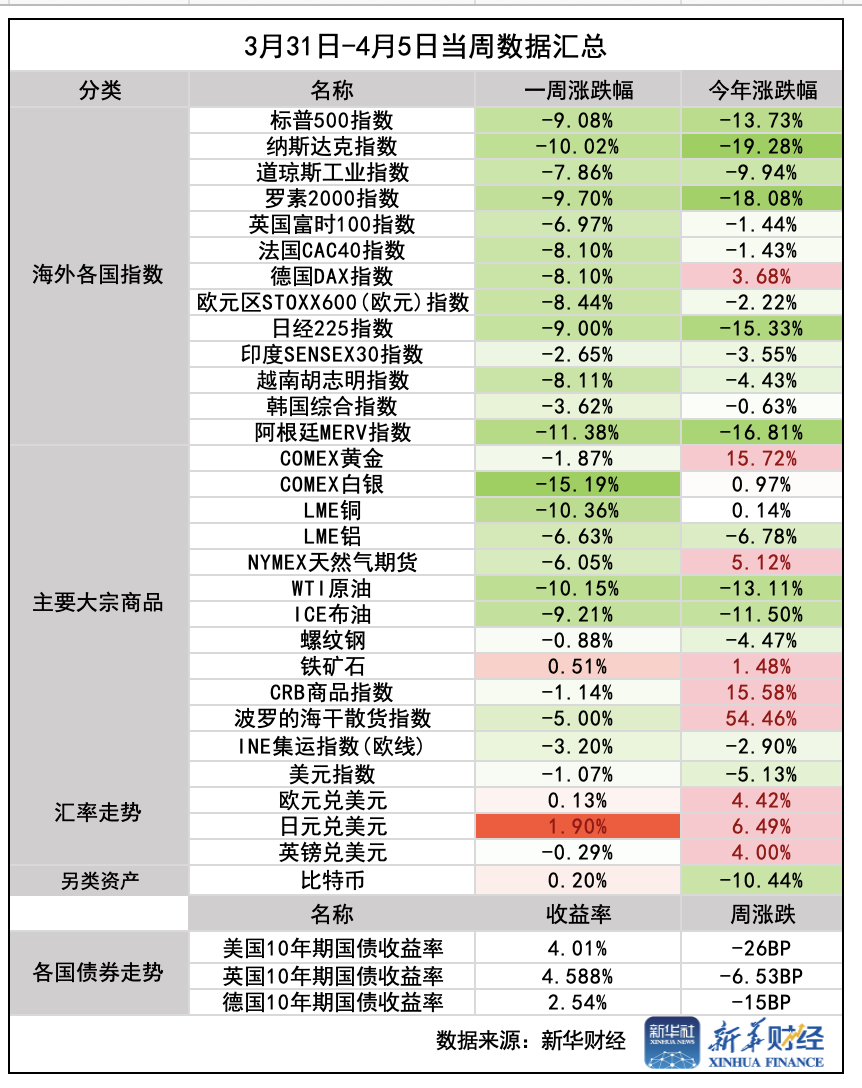
Market Overview - Global markets experienced a severe sell-off during the week of March 31 to April 5, with major stock indices and commodities facing significant declines, marking it as a "black week" [1] - The Nasdaq Composite fell over 10%, entering bear market territory, while the Dow Jones Industrial Average dropped 7.86%, and the S&P 500 fell 9.08% [1][4] - The Cboe Volatility Index (VIX) surged over 88%, reaching its highest level since March 2020, indicating heightened market fear [1] U.S. Stock Market - The "Big Tech" companies collectively lost $1.4 trillion in market value, the largest single-week decline on record, with notable drops in Nvidia, Apple, Meta, and Amazon, all down over 10% [1] - The S&P 500 index is down 13.73% year-to-date, while the Nasdaq is down 19.28% [4] European Stock Market - The Eurozone STOXX 600 index fell 8.44% for the week, marking its largest decline since 2020, and is down nearly 11.9% from its March 3 high [2] - Major European indices such as Germany's DAX and France's CAC40 both dropped 8.1% [2][4] Asia-Pacific Stock Market - The Nikkei 225 index fell below 34,000 points, with a weekly decline of 9%, while the South Korean Composite Index dropped 3.62% [2] - The Indian SENSEX30 index saw a decline of 2.65% for the week [2][4] Commodity Market - International crude oil prices hit four-year lows, with WTI crude down 10.15% to $62.32 per barrel, and Brent crude down 9.21% to $66.06 per barrel [3] - Precious metals experienced widespread declines, with gold down 1.52% and silver down 13.26% for the week [2][4] Economic Outlook - The probability of a recession in the U.S. has increased, with estimates rising from 25% to 30-35% according to S&P Global [7] - Concerns over the impact of tariffs on trade and economic growth have led to a cautious outlook among investors, particularly regarding corporate earnings forecasts [11][12]
中资企业“走出去”提速,金融机构如何助力投融资服务?
Di Yi Cai Jing Zi Xun· 2025-03-25 12:56
中资企业"走出去"提速,金融机构如何助力投融资 服务? 近年来,随着中国经济的持续增长和全球化进程加速,中资企业加快了拓展海外市场的步伐,在"一带 一路"倡议的推动下,中资企业"走出去"提速。数据显示,2024年,我国全行业对外直接投资11592.7亿 元,同比增长11.3%。 然而,企业在海外并购等"走出去"活动中,常常遭遇资金短缺与融资难题,同时面临着财务风险、金融 风险以及法律和合规风险等诸多挑战。为应对上述挑战,来自银行和专业机构的人士在上海陆家嘴金融 沙龙第四期的圆桌环节,围绕风险管控和效能提升两大主题,聚焦于中资企业"走出去"过程中面临的投 融资相关问题展开深入讨论。 法律和合规风险是中资企业"走出去"过程中除财务风险、金融风险以外面临的最大风险。北京大成(上 海)律师事务所高级合伙人余承志指出,大成律师事务所通过与国际律所合作、培养涉外律师、搭建新 网络等方式,为企业提供全球法律服务,满足不同层次需求。同时,商业银行也需为企业提供金融方面 的合规风险服务。通过全球布局、搭建新网络、培养年轻律师等举措,大成所全方位管控中资企业出海 的法律合规风险,为企业提供更优质、全面的法律服务,助力其顺利拓展海 ...
上调股市评级!外资“看好中国”的信心从何而来?
新浪财经· 2025-03-19 01:02
Group 1 - Capital flows are seen as a "thermometer" of economic vitality and a "weather vane" of economic confidence, with multiple foreign institutions recently optimistic about Chinese assets [1] - Goldman Sachs reports that China's stock market has had its best start in history this year, driven by breakthroughs in artificial intelligence and supportive technology policies [1][2] - Citigroup and HSBC have upgraded their ratings on Chinese stocks from "neutral" to "overweight," indicating a positive outlook for the market [1][2] Group 2 - The current environment is viewed as the best time to increase holdings in Chinese technology stocks, with significant advancements in AI, humanoid robots, quantum communication, and semiconductors [2] - Morgan Stanley and Goldman Sachs suggest that now is the optimal time for global investors to increase their allocation to Chinese equities [3] - The average annual return for Chinese technology stocks is projected to reach 7.8% over the next 10 to 15 years, according to JPMorgan [3] Group 3 - Foreign institutions are intensifying their research efforts in China, with several major firms conducting investigations into listed companies [5] - In February, South Korean investors' trading volume in Chinese stocks reached $782 million, nearly doubling from the previous month and surpassing investments in European and Japanese markets [5][6] - As of the end of February, Chinese index ETFs listed on the Korean exchange numbered 44, with the top-performing ETF achieving a return of 62.8% in the past month [6] Group 4 - China's stable economic growth is a cornerstone of foreign investment confidence, with a target GDP growth of around 5% for 2024 [8] - Recent economic indicators show a positive trend, with the SME development index reaching 89.8, the highest in nearly four years, and a notable increase in the manufacturing PMI [8] - The Chinese government is focusing on nurturing emerging industries and promoting green transformation, which enhances the investment appeal for foreign enterprises [9]