
国投电力

Search documents
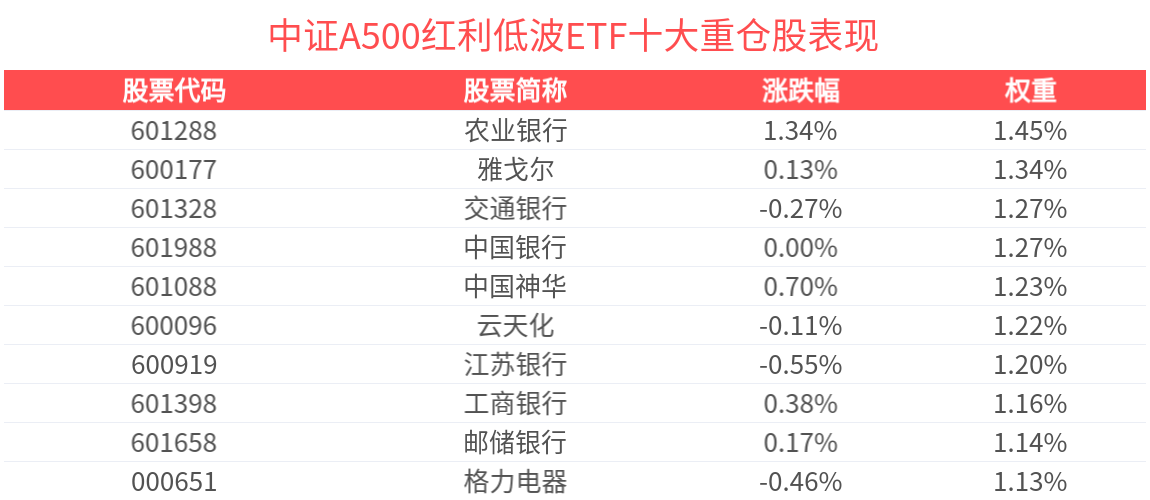
债券收益率大幅下行,红利类ETF在低利率时代具备配置价值,中证A500红利低波ETF(561680)备受关注
Sou Hu Cai Jing· 2025-10-28 02:08
Core Viewpoint - The China Securities A500 Dividend Low Volatility Index (932422) experienced a slight decline of 0.23% as of October 28, 2025, with mixed performance among constituent stocks [1] Group 1: Index Performance - The China Securities A500 Dividend Low Volatility ETF (561680) also fell by 0.29%, with the latest price at 1.02 yuan [1] - Over the past week, the ETF has accumulated a rise of 1.90%, ranking in the top third among comparable funds [1] Group 2: Trading and Liquidity - The ETF had a turnover rate of 0.2% during the trading session, with a transaction volume of 500,900 yuan [1] - The average daily transaction volume for the ETF over the past year was 31,027,800 yuan [1] Group 3: Profitability and Drawdown - Since its inception, the ETF has a monthly profit probability of 60.00% [1] - The maximum drawdown since inception is 3.42%, with a relative benchmark drawdown of 0.23% and a recovery period of 30 days [1] Group 4: Fee Structure and Tracking Accuracy - The management fee for the ETF is 0.50%, and the custody fee is 0.10% [2] - The tracking error for the ETF over the past month is 0.024%, the highest among comparable funds [2] Group 5: Index Composition - The index selects 50 securities from the China Securities A500 Index sample based on continuous dividends, high dividend yield, and low volatility [2] - As of September 30, 2025, the top ten weighted stocks in the index include Agricultural Bank of China (601288), Yageo (600177), and China Shenhua (601088), accounting for a total of 30.72% of the index [2]

2026-2032年中国电力市场研究与市场年度调研报告
Sou Hu Cai Jing· 2025-10-27 05:46
Core Insights - The report provides a comprehensive analysis of the Chinese electricity market from 2026 to 2032, focusing on industry trends, market dynamics, and investment opportunities [2][3][11]. Chapter Summaries Chapter 1: Overview of the Electricity Industry - Defines the electricity industry and its classifications, including regulatory frameworks and data sources used in the report [2][3]. Chapter 2: Global Electricity Industry Development - Analyzes the political and legal environment, historical development, market conditions, and competitive landscape of the global electricity sector [3][4]. - Discusses market size and forecasts, highlighting consumption and supply dynamics [3][4]. Chapter 3: Current State of the Chinese Electricity Industry - Examines technological advancements, historical development, and import/export conditions of the Chinese electricity sector [4][5]. - Analyzes market participants, supply and demand conditions, and identifies market pain points [4][5]. Chapter 4: Market Competition and Investment in China - Details the competitive landscape, including major players and their strategic positioning within the market [5][6]. - Discusses investment trends, mergers, and acquisitions in the electricity sector [5][6]. Chapter 5: Industry Chain and Supporting Layout - Provides an overview of the electricity industry chain, including resource distribution and supply conditions for various energy sources [6][7]. - Analyzes the market for upstream generation, transmission, and distribution equipment [6][7]. Chapter 6: Development of Sub-markets - Reviews the current state of various sub-markets, including thermal, hydro, wind, solar, nuclear, and biomass power generation [7][8]. Chapter 7: Regional Market Development - Analyzes the development patterns of the electricity market in key regions, focusing on generation and consumption metrics [8][9]. Chapter 8: Case Studies of Global and Chinese Enterprises - Compares the strategic positioning and operational performance of major electricity companies in China and globally [9][10]. Chapter 9: Environmental Insights and SWOT Analysis - Evaluates the economic, social, and policy environments affecting the electricity industry in China, along with a SWOT analysis [11][12]. Chapter 10: Market Prospects and Trends - Assesses the potential for growth in the Chinese electricity market and forecasts future trends [11][12]. Chapter 11: Investment Strategies and Recommendations - Discusses barriers to entry and exit, investment risks, opportunities, and strategic recommendations for investors in the electricity sector [11][12].





9月二产用电持续修复原煤供给边际回升 | 投研报告
Zhong Guo Neng Yuan Wang· 2025-10-27 01:33
Core Insights - The overall electricity consumption in September increased by 4.5% year-on-year, with a total of 888.6 billion kilowatt-hours, but showed a decline in growth rate compared to previous months, primarily due to weather impacts [1][2] - The electricity consumption growth rates for the primary, secondary, and tertiary industries, as well as urban and rural residents, were +7.3%, +5.7%, +6.3%, and -2.6% respectively, indicating a notable decline in the tertiary sector and residential consumption [2][4] - The coal production in September was 41.15 million tons, a year-on-year decrease of 1.8%, but the price of coal has been rising significantly, indicating a persistent supply-demand gap [4][5] Electricity Sector - The electricity consumption growth rate in September was 4.5%, with a month-on-month and year-on-year decline of 0.5 and 4.0 percentage points respectively, mainly due to the drop in the tertiary sector and residential consumption [2][4] - The average temperature in September decreased by 0.4 and 3.9 degrees Celsius year-on-year and month-on-month, which likely contributed to the decline in electricity consumption in the tertiary sector and among residents [2] - Recommendations include focusing on dividend stocks with third-quarter performance catalysts and high-quality hydropower companies such as Yangtze Power and Guotou Power [2][3] Coal Sector - The coal supply showed a marginal recovery in September, but prices continued to rise, indicating a strong supply-demand gap that is expected to persist through the winter [4][5] - The average price of Qinhuangdao 5500 kcal thermal coal increased from 699 yuan/ton on September 30 to 770 yuan/ton by October 23, reflecting the significant supply gap [5] - The coal and lignite import volume in September was 46 million tons, a year-on-year decrease of 3.3%, but the decline rate has narrowed compared to previous months [5][6] - Recommendations for coal investments include stable leading thermal coal companies like China Shenhua and high-elasticity coal companies such as Yanzhou Coal Mining [6]
申万公用环保周报:第二产业用电回暖,冷冬预期有望提升销气增速-20251026
Shenwan Hongyuan Securities· 2025-10-26 13:13
Investment Rating - The report maintains a positive outlook on the power and gas sectors, indicating a "Buy" recommendation for several companies within these industries [3][4]. Core Insights - The second industry is the main driver of electricity consumption growth, with a notable increase in electricity demand due to seasonal factors and high temperatures in Q3 [4][9]. - Global gas prices are rebounding, and expectations of a cold winter may enhance gas sales growth [18][19]. - The report highlights various investment opportunities across different energy sectors, including hydropower, green energy, nuclear power, thermal power, and gas [16][40]. Summary by Sections 1. Electricity: Q3 Second Industry Drives National Electricity Consumption - In September, total electricity consumption reached 888.6 billion kWh, a year-on-year increase of 4.5% [10]. - The second industry contributed significantly to this growth, with a 5.1% increase in electricity consumption, accounting for 51% of the total growth [4][9]. - The cumulative electricity consumption from January to September was 7767.5 billion kWh, reflecting a 4.6% year-on-year growth [13]. 2. Gas: Global Gas Price Rebound and Cold Winter Expectations - As of October 24, the Henry Hub spot price was $3.21/mmBtu, showing a weekly increase of 13.96% [19][20]. - The report notes a seasonal demand increase and geopolitical factors supporting gas prices, particularly in Europe [25][37]. - The anticipated La Niña phenomenon may lead to colder winter conditions, potentially boosting gas consumption [37]. 3. Weekly Market Review - The report indicates that the power equipment sector outperformed the Shanghai and Shenzhen 300 index, while the public utility, gas, and environmental protection sectors lagged [42]. 4. Company and Industry Dynamics - The report discusses significant developments in the energy sector, including the launch of innovative products in wind energy and updates on national energy policies [50][51]. - It highlights the performance of major companies, such as Huadian International, which reported a decrease in electricity generation due to increased renewable energy capacity [57].




二产用电贡献核心增量,水电增速转正火电承压
Changjiang Securities· 2025-10-26 13:13
Investment Rating - The report maintains a "Positive" investment rating for the utility sector [8] Core Insights - In September, the national electricity generation reached 826.2 billion kWh, a year-on-year increase of 1.5%, while total electricity consumption was 888.6 billion kWh, growing by 4.5% year-on-year [2][14] - The industrial economy is recovering, with the secondary industry contributing significantly to electricity consumption growth, showing a 5.7% increase in September [16][23] - Hydropower generation saw a significant year-on-year increase of 31.9% in September due to improved water inflow and a low base from the previous year, while thermal power generation faced a decline of 5.4% [2][46] Summary by Sections Electricity Generation and Consumption - In September, total electricity generation was 826.2 billion kWh, up 1.5% year-on-year, while total consumption was 888.6 billion kWh, up 4.5% year-on-year [14][15] - The secondary industry showed a 5.7% increase in electricity consumption in September, contributing significantly to overall growth [16][23] Sector Performance - Hydropower generation increased by 31.9% year-on-year in September, while thermal power generation decreased by 5.4% [2][46] - The first nine months of 2025 saw total electricity generation at 72,557 billion kWh, a 1.6% increase year-on-year, with thermal power down 1.2% [14][35] Investment Recommendations - The report recommends focusing on quality thermal power operators such as Huaneng International, Datang Power, and China Power [10] - For hydropower, it suggests investing in major players like Yangtze Power and Guotou Power [10] - In the renewable energy sector, it highlights opportunities in Longyuan Power, New Energy Technology, and China Nuclear Power [10]
公用事业行业周报(2025.10.20-2025.10.24):煤价上涨接近尾声,火电Q3业绩如期兑现-20251026
Orient Securities· 2025-10-26 04:43
Investment Rating - The report maintains a "Positive" investment rating for the utility sector in China [5] Core Insights - The rise in coal prices is nearing its end, with expectations of a peak in coal price increases. The average price of Q5500 thermal coal at Qinhuangdao port reached 770 RMB/ton, which is at the upper limit of the long-term contract price range set by the National Development and Reform Commission [8][14] - The Q3 performance of thermal power companies met expectations, with a total net profit of 3.68 billion RMB for four major thermal power companies, reflecting a year-on-year increase of 61% [8] - The report highlights the defensive attributes of utility assets, suggesting that low-priced utility assets are worth attention amid increasing market volatility [8] Summary by Sections Coal Price Trends - The pace of coal price increases has slowed, with the average price of Q5500 thermal coal at Qinhuangdao port increasing by 2.9% week-on-week [14] - The report anticipates that the current round of coal price increases is close to its peak, with coal prices expected to stabilize [8] Electricity Price Dynamics - The average electricity price in Shanxi province reached 758 RMB/MWh, a year-on-year increase of 164% [11] - The report notes that the market's pessimistic expectations regarding long-term electricity prices for thermal power are likely to ease [8] Sector Performance - The utility sector index rose by 1.1%, underperforming the CSI 300 index by 2.2 percentage points [38] - Among sub-sectors, thermal power showed the highest increase, indicating a positive trend in profitability [40] Investment Recommendations - The report recommends focusing on utility stocks, particularly in thermal, hydro, and nuclear power sectors, due to their strong dividend potential and favorable market conditions [8] - Specific stocks mentioned include Guodian Power (600795), Huadian International (600027), and China General Nuclear Power (003816) [8]
国内风电市场需求与整机价格调研
2025-10-23 15:20
Summary of Wind Power Industry Conference Call Industry Overview - The conference call focuses on the domestic wind power market in China, specifically addressing both onshore and offshore wind power sectors [1][2][3]. Key Points and Arguments Onshore Wind Power - The onshore wind power industry is experiencing a strong demand for price recovery after a low point in 2022, with companies needing to improve their financial statements [1][2]. - Despite a decline in bidding volume, the total onshore wind power capacity is expected to exceed 100 GW [3]. - The projected annual installed capacity for onshore wind power is set to be no less than 21.2 GW, which is 30-40% higher than the levels in 2024 [8]. Offshore Wind Power - Offshore wind power maintains a stable gross profit margin, with most projects ensuring over 15% profitability due to high technical barriers and strict certification processes [1][2]. - The overall bidding volume for offshore wind power is expected to grow by approximately 8-10% in 2025, despite a decline in the first half of the year [3]. - There are over 20 GW of offshore wind projects awaiting construction and delivery, with the main issues being construction rates and timeliness rather than turbine delivery or bidding progress [3]. Price Trends - The price of wind turbines is expected to stabilize by the end of 2026, driven by profitability needs, anti-competitive policies, and safety guarantees [3][9]. - The current market price for wind power equipment (excluding towers) is around 1,650 to 1,700 RMB per kW, with a gross profit margin hovering between 3% and 4% [14]. Challenges and Coordination Issues - The industry faces challenges in project coordination due to conflicts of interest among various government departments [6]. - Geopolitical factors and other adverse construction conditions are also hindering progress, although these issues are expected to gradually improve during the 14th Five-Year Plan period [4][5]. - The lack of a comprehensive national coordination mechanism complicates project advancement, relying heavily on local government efforts [6]. Future Outlook - The offshore wind power sector is projected to see significant growth, with annual new installed capacity expected to reach 15 GW or more during the 15th Five-Year Plan [18]. - Some provinces are initiating numerous offshore wind projects to meet investment subsidy requirements, which necessitate projects to be grid-connected by the end of 2025 [17]. - The overall sentiment regarding the future of both onshore and offshore wind power remains optimistic, with expectations of doubling industry growth compared to the past five years [8]. Changes in Bidding Mechanism - The trend towards larger wind turbines is influencing the bidding mechanism, with a shift towards comprehensive scoring rather than solely lowest price bids [10][11]. - Companies are reducing the weight of price factors in scoring to below 40% or 30%, aiming to enhance fairness and reduce vicious competition [10][11][13]. Additional Important Information - The deep-sea development notification released in January is expected to clarify future market directions and improve revenue through local consumption and hydrogen production [4]. - The industry is currently in a phase of internal discussions regarding the coordination mechanisms, which involve multiple stakeholders and require time for alignment [5].
重资产的轻包装:新加坡国资诉蔚来背后的矛盾螺旋
Hu Xiu· 2025-10-22 12:33
Core Viewpoint - The lawsuit initiated by Singapore's sovereign fund GIC against NIO for "securities fraud" centers around the control and financial boundaries of the company, rather than the technology or products themselves [1][2][5]. Group 1: Lawsuit Details - GIC accuses NIO of concealing its substantial control over its battery company, NIO Power, through the Battery as a Service (BaaS) model and complex corporate structures, leading to inflated revenue figures that misled investors [3][4]. - The lawsuit follows previous allegations from a short-selling report by a well-known firm in 2022 and a collective lawsuit from investors that year [4][31]. Group 2: Control and Financial Reporting - The core of the dispute lies in the definition of control, particularly regarding the BaaS model and whether NIO should consolidate NIO Power's financials into its own [6][9]. - GIC argues that NIO maintains effective control over NIO Power despite a minority ownership stake, which should necessitate financial consolidation under accounting rules [8][28]. Group 3: BaaS Model Analysis - The BaaS model allows NIO to sell battery assets to NIO Power, which then rents them to vehicle owners, reducing NIO's asset burden and improving financial metrics [11][12]. - This model aims to attract capital, lower vehicle costs for consumers, and enhance user retention, while also providing NIO Power with a steady cash flow [12][13]. Group 4: Accounting Standards and Implications - The lawsuit highlights the clash between GIC's interpretation of control under US GAAP and NIO's business structure, particularly regarding the treatment of variable interest entities (VIE) [24][25]. - The determination of whether NIO is the primary beneficiary of NIO Power hinges on who has decision-making authority and who bears the economic risks and rewards [26][27]. Group 5: Future Considerations - The outcome of this case could reshape how asset divestiture and financing structures are designed in capital-intensive industries, as well as how auditors and regulators define "substantial control" [33][34]. - The case serves as a reference point for understanding the complexities of financial reporting and corporate governance in innovative business models like BaaS [33].

川投能源(600674)2025年三季报点评:来水偏枯拖累单季业绩 大渡河水电放量在即
Xin Lang Cai Jing· 2025-10-22 12:25
Core Viewpoint - The company reported its Q3 2025 financial results, showing a slight increase in revenue but a decline in net profit compared to the previous year [1] Group 1: Financial Performance - For the first three quarters of 2025, the company achieved revenue of 1.14 billion yuan, a year-on-year increase of 4.95%, and a net profit attributable to shareholders of 4.22 billion yuan, a decrease of 4.54% [1] - In Q3 2025, the company reported revenue of 429 million yuan, a year-on-year decrease of 11.30%, and a net profit of 1.76 billion yuan, down 16.96% [1] Group 2: Power Generation and Pricing - The company’s hydropower and photovoltaic generation in Q3 2025 amounted to 2.579 billion kWh and 84 million kWh, representing year-on-year increases of 17.6% and a decrease of 24.3%, respectively [2] - The average on-grid electricity prices for hydropower and photovoltaic in Q3 2025 were 0.119 yuan/kWh and 0.439 yuan/kWh, reflecting year-on-year declines of 28.8% and 9.8% [2] - The total revenue from power generation in Q3 2025 was estimated at 344 million yuan, a decrease of 18.3% year-on-year [2] Group 3: Investment Performance - The company’s investment income in Q3 2025 was 1.762 billion yuan, a decrease of 15.8% year-on-year, primarily due to reduced water flow in the Yarlung Tsangpo River [3] - The company anticipates increased performance contributions from ongoing hydropower projects expected to commence operations in the near future [3] Group 4: Future Outlook - The company projects net profits attributable to shareholders of 4.767 billion yuan, 5.122 billion yuan, and 5.286 billion yuan for 2025, 2026, and 2027, respectively, with corresponding PE ratios of 15.06x, 14.02x, and 13.58x [3]
电力设备及新能源行业专题研究:新型储能产业链之河南概况(二)
Zhongyuan Securities· 2025-10-22 10:27
Investment Rating - The report maintains an "Outperform" rating for the electric power equipment and new energy sector [1] Core Insights - The new energy storage industry in China is transitioning from a policy-driven phase to a market-driven phase, with significant growth in installed capacity and supportive government policies [6][15][20] - The installed capacity of new energy storage in China reached 94.91 GW/222 GWh by mid-2025, accounting for over 40% of the global total [25][26] - The report highlights the rapid growth of new energy storage projects globally, with a 62.5% increase in newly installed capacity in 2024 [21][24] Summary by Sections 1. Current Development of China's New Energy Storage Industry - New energy storage, excluding pumped storage, is crucial for building a new power system dominated by renewable energy [13] - The industry is entering a market-driven phase, with policies emphasizing the development of new energy storage [15][16] 2. New Energy Storage Downstream Application Scenarios - The main applications of energy storage in China are categorized into three areas: power source side, grid side, and user side [39][40] - Power source side storage is primarily used in conventional power plants and renewable energy facilities to enhance stability and efficiency [43][44] - Grid side storage provides essential services such as peak shaving and frequency regulation, ensuring the reliability of the power system [48][51] - User side storage focuses on reducing electricity costs and enhancing supply reliability, with applications in commercial and industrial settings [53] 3. Development of New Energy Storage in Henan Province - Henan aims to achieve over 5 million kW of new energy storage capacity by 2025 and over 15 million kW by 2030, with strong government support [9][10] - The province is focusing on grid-side storage and independent storage projects to alleviate renewable energy consumption pressures [9][10] 4. Recommendations for the Development of New Energy Storage Industry in Henan - The report suggests promoting independent storage projects and enhancing price mechanisms to support the growth of the new energy storage sector in Henan [9][10]