
舍得酒业

Search documents
行业跟踪报告:CPI催化,白酒预期先行
Haitong Securities International· 2025-11-12 06:21
Investment Rating - The report suggests a positive outlook for the baijiu industry, indicating a potential market style shift benefiting the sector as CPI data improves [3][6][9] Core Insights - October CPI data shows a year-on-year increase of 0.2%, the highest since February 2025, indicating a recovery in domestic demand, particularly in the service sector [7][9] - The baijiu industry is expected to see a bottoming out of sales and inventory adjustments within the next 2-3 quarters, with Q3 reports showing significant revenue declines [8][9] - Valuations for baijiu companies are currently low, with a dividend yield of 3.74%, making them attractive compared to the broader market [9] Summary by Sections CPI and Market Sentiment - The October CPI data reflects a positive trend, with core CPI rising by 1.20% year-on-year, signaling improved market confidence and domestic demand expectations [7][9] Industry Performance - The baijiu industry is experiencing a phase of adjustment, with Q3 revenues down 18% year-on-year and net profits down 22%, indicating a need for several quarters for full recovery [8][9] Valuation and Investment Opportunities - Current valuations for baijiu stocks are at historically low levels, with the sector offering a higher dividend yield compared to the broader market indices, suggesting potential for capital appreciation [9]
国信证券:酒类渠道包袱加速去化 大众品品类表现分化
智通财经网· 2025-11-12 02:48
Group 1 - The core viewpoint of the report indicates that the liquor industry is entering a phase of adjustment, with a consensus on reduced growth rates for 2024 and an expansion of performance declines in Q3 reports [1][2] - The food and beverage sector is expected to show stable overall volume and structural differentiation by 2025, with Q1/Q2/Q3 revenues growing by +2.5%/+2.4%/-4.77% year-on-year, and net profits declining by +0.3%/-2.1%/-14.6% [1] - The report highlights that the macroeconomic policies in Q4 could catalyze stock price increases due to low expectations in the capital market and low institutional holdings [1] Group 2 - The liquor sector is recommended for investment, particularly companies with pricing power and regional influence, such as Luzhou Laojiao, Shanxi Fenjiu, and Kweichow Moutai, which are expected to achieve greater growth [2] - The consumer goods sector is anticipated to stabilize and improve in 2025, driven by inventory reduction and macroeconomic policy support, with leading companies in segments like sugar-free tea and functional beverages showing strong revenue growth [3] - The snack food segment reported a revenue increase of +22.4% and an 8.6% rise in profits in Q3 2025, despite rising costs from certain raw materials [3]

2025年第45周:酒行业周度市场观察
艾瑞咨询· 2025-11-12 00:06
Group 1: Industry Environment - The white liquor industry is experiencing a slowdown in performance and increasing differentiation, with 19 listed companies reporting a 7% year-on-year decline in total revenue by Q3 2025, while only Moutai and Fenjiu maintained growth [2] - The industry is entering a phase of volume competition, with intensified price wars and channel battles increasing cost pressures, particularly for small and medium-sized enterprises [2] - Future competitiveness will favor companies that actively transform and focus on long-term value, as the industry shifts towards rational development [2] Group 2: Consumer Trends - Young consumers are driving a trend towards mixed drinks, such as white liquor with cola, leading to a demand for lower alcohol content products [3] - Companies are responding with innovative products, including cross-industry collaborations like the "yellow wine + beer" from Guyue Longshan and Carlsberg's low-sugar sparkling fruit wine [3] - The industry is debating the definition of low-alcohol liquor, with a push towards maximizing flavor rather than adhering to strict alcohol content classifications [3] Group 3: Regional Enterprises - Regional liquor companies face significant challenges, including high inventory pressure and price inversions, as national brands dominate the market [4] - Strategies for regional companies include becoming provincial leaders, focusing on core markets, or considering exit strategies [4] - Key pathways for success involve brand premiumization, product structure optimization, and deepening distribution channels [4] Group 4: Policy and Development - The Ministry of Industry and Information Technology has included liquor production in the "historical classic industries," promoting cultural heritage and high-quality development [5] - Goals include cultivating over 50 billion-level leading enterprises and creating trillion-level industry clusters by 2028 [5] - The focus is on integrating culture, technology, and ecology to facilitate the transformation and upgrading of the liquor industry [5] Group 5: Brand Dynamics - Yanjing Beer reported a net profit of 1.77 billion yuan for Q3 2025, a 37.45% increase year-on-year, driven by a high-end strategy and cross-industry collaborations [15] - Luzhou Laojiao achieved revenue of 23.127 billion yuan and net profit of 10.762 billion yuan in the first three quarters of 2025, demonstrating resilience amid industry challenges [16] - Wuliangye's revenue reached 60.945 billion yuan with a net profit of 21.511 billion yuan, as the company adjusted its strategy to meet changing consumer demands [18] Group 6: Innovation and Sustainability - The first sustainable development report for the core sauce-flavored liquor production area was released, focusing on ecological protection and circular economy [9] - Moutai introduced a "date selection" service for consumers, enhancing personalization and emotional value in product offerings [23] - Niulanshan Chenxiang achieved significant sales milestones, selling 6 billion bottles over ten years, supported by strong brand recognition and market positioning [24]





“老登”板块曙光乍现?!白酒ETF是否布局正当时?
Sou Hu Cai Jing· 2025-11-11 09:28
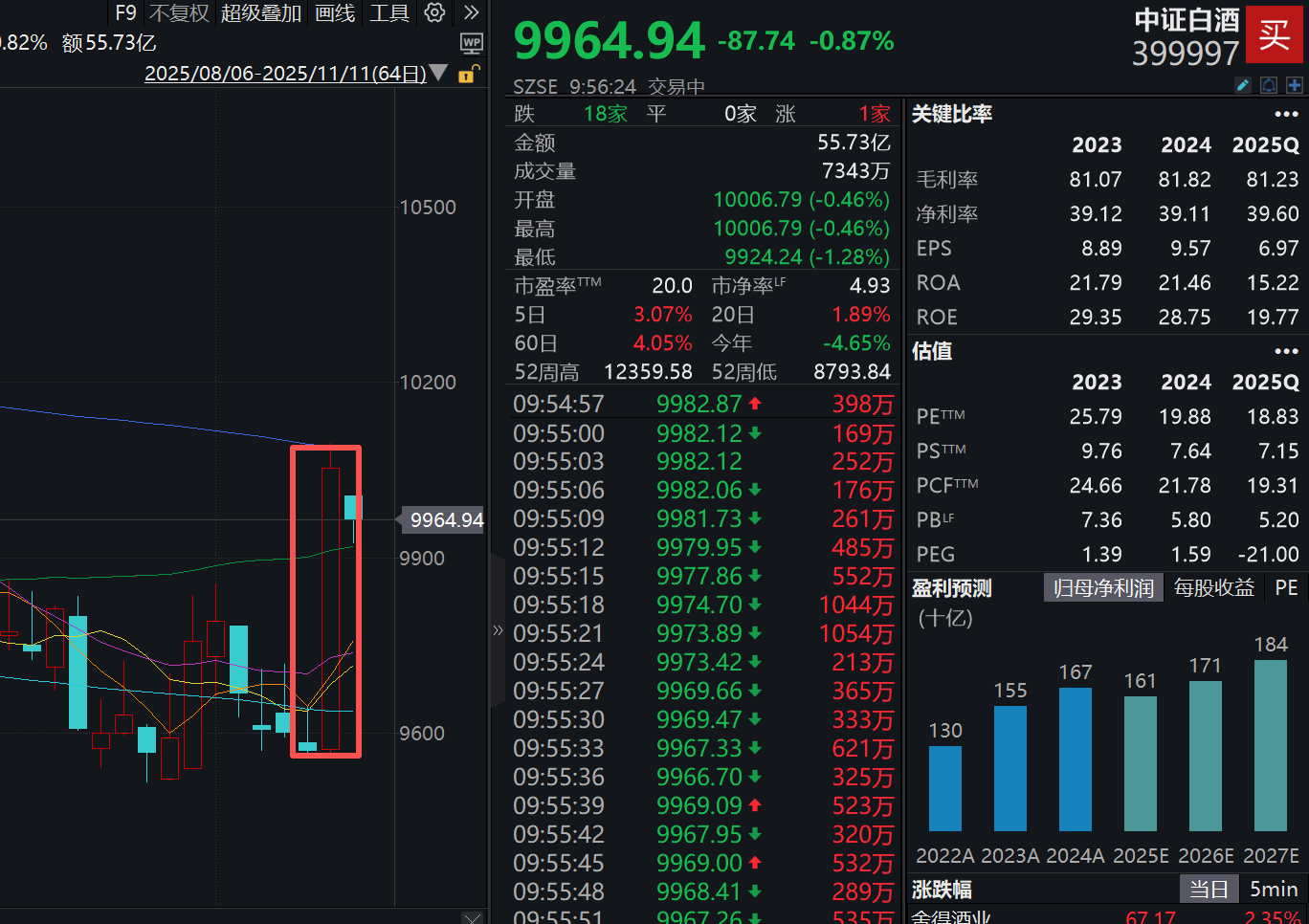
Core Viewpoint - The white liquor sector is experiencing a resurgence, with the Zhongzheng White Liquor Index showing significant gains, indicating renewed investor interest and confidence in the market [1][3]. Group 1: Market Performance - On November 10, the Zhongzheng White Liquor Index saw all constituent stocks rise, with notable gains from Shede Liquor and Jiugui Liquor, both hitting the daily limit, while leading brands like Luzhou Laojiao and Gujing Gongjiu rose over 5% [1]. - The current price-to-earnings ratio (PE-TTM) for the white liquor sector is approximately 18.7 times, which is at a low level compared to the past five years, indicating a clear valuation advantage [6]. Group 2: Economic Indicators - In October, the Consumer Price Index (CPI) rose by 0.2% month-on-month and year-on-year, while the Producer Price Index (PPI) also saw its first month-on-month increase of the year, suggesting a reduction in deflationary pressures and a mild recovery in consumer demand [3]. Group 3: Investment Opportunities - Analysts believe that the most challenging period for the white liquor industry has passed, with external constraints on consumption expected to ease, making it a favorable time for investment [6][15]. - The white liquor sector is seen as a more stable investment compared to other high-risk stocks, with expectations of steady performance and recovery in stock prices as inventory levels normalize and prices rebound [6][15].
白酒板块11月11日跌0.18%,水井坊领跌,主力资金净流出4.97亿元
Zheng Xing Xing Ye Ri Bao· 2025-11-11 08:37
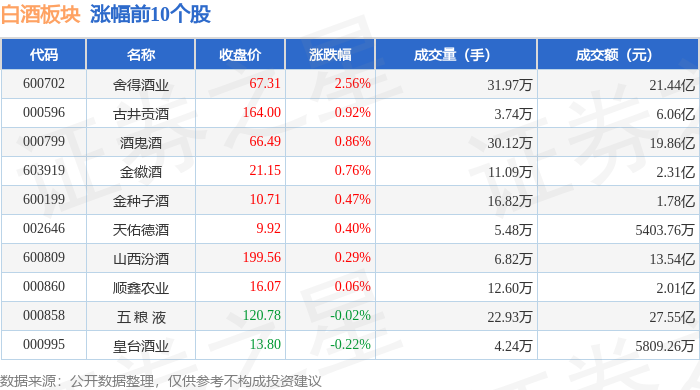
Market Overview - The liquor sector experienced a decline of 0.18% on November 11, with Shui Jing Fang leading the drop [1] - The Shanghai Composite Index closed at 4002.76, down 0.39%, while the Shenzhen Component Index closed at 13289.0, down 1.03% [1] Individual Stock Performance - Shede Liquor (600702) rose by 2.56% to a closing price of 67.31, with a trading volume of 319,700 shares and a transaction value of 2.144 billion [1] - Gujing Gongjiu (000596) increased by 0.92% to 164.00, with a trading volume of 37,400 shares and a transaction value of 606 million [1] - Shui Jing Fang (600779) fell by 1.13% to 42.87, with a trading volume of 48,200 shares and a transaction value of 206 million [2] - Moutai (600519) decreased by 0.23% to 1458.99, with a trading volume of 26,700 shares and a transaction value of 3.883 billion [2] Capital Flow Analysis - The liquor sector saw a net outflow of 497 million from institutional investors, while retail investors contributed a net inflow of 244 million [2] - The main capital inflow and outflow for selected stocks showed varied trends, with Shanxi Fenjiu (600809) experiencing a net inflow of 1.06 billion from main capital [3] - Shede Liquor (600702) had a net inflow of 46.2 million from main capital, while it faced a net outflow of 90.1 million from speculative capital [3]





直播间卖“超低价”茅台将被罚?最新回应
Xin Lang Cai Jing· 2025-11-11 06:20
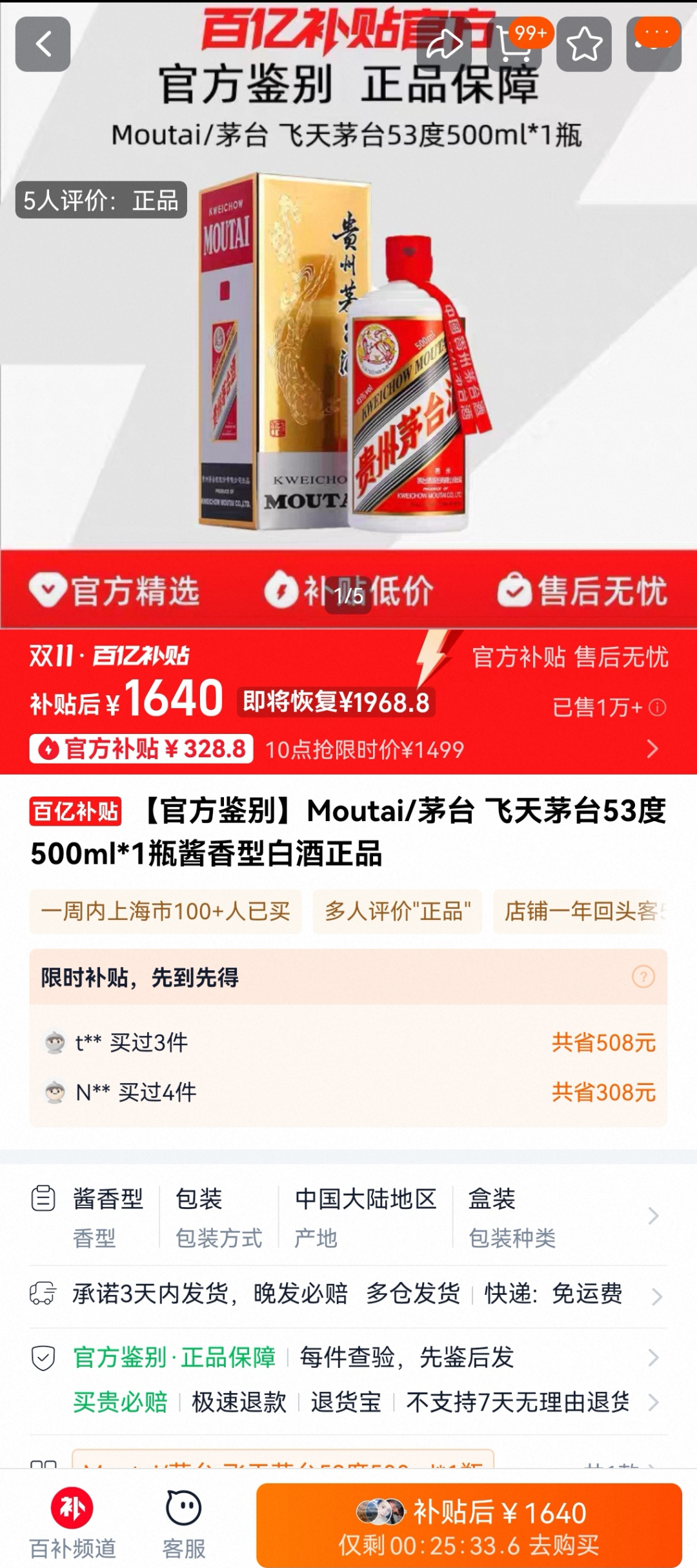
Core Viewpoint - The article discusses the significant price fluctuations of premium liquor brands like Moutai and Wuliangye during the recent "Double 11" shopping festival, highlighting the impact of e-commerce promotions on the liquor market and the responses from liquor companies to regulate pricing and sales channels [2][8][9]. Price Trends and Promotions - During the "Double 11" period, the price of 53-degree/500ml Moutai dropped below 1700 yuan, reaching as low as 1399 yuan in some promotions, while Wuliangye's price fell to 759 yuan [3][9]. - In comparison, last year's "Double 11" saw Moutai prices around 2000 yuan and Wuliangye prices above 850 yuan [5][7]. Regulatory Actions and Market Responses - E-commerce platforms like Douyin have initiated actions against sellers offering Moutai at prices below market value, responding to consumer complaints about false advertising and potential health risks [2][8]. - Liquor companies, including Moutai and Wuliangye, are actively working to establish official sales channels and combat counterfeit products, with Moutai's management emphasizing the importance of purchasing from recognized sources [16][17]. Industry Challenges - The liquor industry is currently facing significant challenges, including inventory clearance, price discrepancies, and pressure on distribution channels, leading to some companies reporting their worst quarterly performance in a decade [8][19]. - Analysts suggest that the aggressive discounting strategies employed during e-commerce events could undermine long-term brand value and disrupt established pricing structures [7][19]. Market Outlook - The industry is undergoing a deep adjustment phase, with expectations of a gradual recovery as companies manage inventory and pricing strategies more effectively [19][20]. - Recent data indicates that Moutai's wholesale prices have been consistently declining, reflecting broader market trends and pressures [18][19].
FICC日报:美政府“停摆”有望结束,风险资产走强-20251111
Hua Tai Qi Huo· 2025-11-11 03:01
Report Industry Investment Rating - The overall rating for commodities and stock index futures is neutral [4] Core Viewpoints - The US government shutdown is expected to end, and risk assets are strengthening. The domestic market has seen frequent positive news, but the economic foundation still needs to be consolidated. The release of the "15th Five-Year Plan" proposal has boosted market sentiment and economic expectations. The US has temporarily alleviated its liquidity risk, but its manufacturing index has declined, and employment and inflation situations are complex. Different commodity sectors have different investment opportunities and focuses [1][2][3] Summary by Related Catalogs Market Analysis - On October 28, the full text of the "15th Five-Year Plan" proposal was released. According to the per capita GDP target, the average GDP growth rate during the 15th Five-Year Plan period is expected to be around 5%. On October 30, the China-US economic and trade teams reached a three - aspect consensus, and on November 5, China officially postponed tariffs. In October, the national manufacturing PMI was 49, a month - on - month decrease of 0.8. China's exports in October decreased by 1.1% year - on - year, and the previous value increased by 8.3%. China's CPI in October increased by 0.2% year - on - year, and the core CPI reached the highest level since March 2024. The PPI increased month - on - month for the first time this year. On November 10, the State Council General Office issued measures to promote private investment. The A - share market fluctuated and diverged throughout the day, with the Shanghai Composite Index rising by 0.53%. Most commodities closed higher, with lithium carbonate rising by 7.36% and Shanghai silver rising by 2.85% [1] US Situation - The Fed cut interest rates by 25BP as expected and announced the end of balance - sheet reduction on December 1. On November 9, the US Senate passed a temporary appropriation bill to end the government shutdown, which will provide funds until January 30, 2026. The US ISM manufacturing index in October dropped to 48.7%, shrinking for eight consecutive months. The "small non - farm" ADP in October added 42,000 new jobs, exceeding expectations, but salary growth has stagnated [2] Commodity Analysis - In the current inflation expectation game stage, focus on non - ferrous metals and precious metals with high certainty. The black sector is still dragged down by downstream demand expectations. The long - term supply shortage in the non - ferrous sector has not been alleviated, and it has been boosted by the global easing expectation recently. The medium - term supply of the energy sector is considered relatively loose, with OPEC+ announcing an additional production increase of 137,000 barrels per day in November. In the chemical sector, the "anti - involution" space of methanol, caustic soda, urea and other varieties is worthy of attention. In the agricultural products sector, pay attention to China's procurement plan for US goods and next year's weather forecast. After the short - term sharp adjustment risk of precious metals is cleared, pay attention to the opportunity of buying on dips. On November 10, spot gold reached $4,100 per ounce for the first time since October 27, rising about 2.5% intraday [3] Key News - China's CPI in October increased by 0.2% year - on - year, and the previous value was - 0.3%. China's PPI in October was - 2.1% year - on - year, and the previous value was - 2.3%. The government encourages private capital to participate in key projects in various fields. The market fluctuated and diverged throughout the day, with about 3,400 stocks rising in the Shanghai, Shenzhen and Beijing stock markets, and the trading volume was 2.19 trillion. The Shanghai Composite Index rose by 0.53%, the Shenzhen Component Index rose by 0.18%, and the ChiNext Index fell by 0.92%. The large - consumption sector, financial stocks, chemical stocks and storage chip sectors performed strongly, while the robot concept stocks adjusted. Most commodity futures closed higher, with lithium carbonate rising by more than 7% and glass falling by more than 2%. Spot gold reached $4,100 per ounce [5]
大消费板块助力沪指重新站上4000点 机构认为市场或仍处于上行趋势中
Zhong Guo Zheng Quan Bao· 2025-11-11 02:16
Core Viewpoint - The A-share market experienced fluctuations with a strong performance in the consumer sector, leading the Shanghai Composite Index to rise by 0.53% and surpass the 4000-point mark again, indicating a potential recovery in consumer demand and economic growth [1][4][8]. Market Performance - On November 10, the A-share market saw all three major indices open higher, with the Shanghai Composite Index and Shenzhen Component Index increasing by 0.53% and 0.18%, respectively, while the ChiNext Index and other indices declined [2]. - The total number of rising stocks in the A-share market reached 3376, with 92 stocks hitting the daily limit up, and the market turnover was 2.19 trillion yuan, marking a significant increase from the previous trading day [2][3]. Sector Analysis - The consumer sector showed robust growth, with notable performances in dairy, liquor, lithium battery electrolyte, pet economy, and new economy sectors. The beauty care, food and beverage, and retail sectors led the gains, with increases of 3.60%, 3.22%, and 2.69%, respectively [3][4]. - Conversely, high-tech stocks experienced adjustments, with significant declines in companies like Guosheng Quantum and New Yi Sheng [4]. Fund Flow and Sentiment - Recent market activity indicated a divergence in fund sentiment, with a net outflow of main funds for six consecutive trading days, despite an increase in A-share financing balance by over 6 billion yuan [5][6]. - The financing balance for A-shares reached approximately 24.94 trillion yuan, with notable inflows in sectors such as power equipment and basic chemicals, while sectors like non-bank financials and metals saw significant net selling [5][6][7]. Future Outlook - Analysts suggest that the rise in core CPI, which increased by 1.2% year-on-year, signals a recovery in consumer demand, supporting the consumer sector's strength and laying a foundation for a gradual upward trend in the A-share market [4][8]. - The market is expected to experience a period of consolidation in the short term, with a focus on sectors like technology and cyclical industries benefiting from economic recovery [8].
宏观数据回升助力白酒板块上行,易方达白酒(03189.HK)单日大涨5.17%,估值修复机会备受关注
Xin Lang Cai Jing· 2025-11-11 01:49
Core Viewpoint - The E Fund Baijiu ETF (03189.HK) has surged by 5.17% as of November 10, 2025, nearing its September high, indicating strong market performance in the Chinese baijiu sector [1] Group 1: Fund Performance - The E Fund Baijiu ETF is the first exchange-traded fund in Hong Kong focused on the mainland baijiu industry, closely tracking the CSI Baijiu Index [1] - The CSI Baijiu Index selects stocks from listed companies involved in baijiu production, providing diverse investment options [1] - Major constituents of the ETF include leading baijiu companies such as Kweichow Moutai, Wuliangye, and Luzhou Laojiao [1] Group 2: Market Conditions - The National Bureau of Statistics reported a 0.2% year-on-year and month-on-month increase in the Consumer Price Index (CPI) for October [1] - The Producer Price Index (PPI) showed positive changes both year-on-year and month-on-month, influenced by improved supply-demand dynamics in certain domestic industries and international commodity price transmission [1] Group 3: Industry Outlook - Wanlian Securities noted that the baijiu industry is currently in a destocking phase, with performance under pressure in 2025; however, market pessimism has been largely priced in [1] - The combination of low valuations and high dividends is expected to support stock prices, with limited downside potential for the baijiu sector [1] - A rebound in the baijiu sector is anticipated under improved conditions [1]
白酒深度汇报:当下我们如何看待白酒行业
2025-11-11 01:01
Summary of the Baijiu Industry Conference Call Industry Overview - The Baijiu industry is expected to reach a turning point around the second quarter of 2026, with stock prices typically responding ahead of fundamentals, indicating a current bottoming expectation for the sector, which presents good absolute return potential [1][4] - The industry has undergone six quarters of adjustment, likely to bottom out by the second quarter of 2026, with a subsequent recovery in income and stock prices anticipated [1][13][16] Key Insights and Arguments - The current market structure for Baijiu has significantly changed compared to the 2013-2016 cycle, with increased industry concentration and improved market management capabilities among leading companies [1][3][14] - The wholesale price of Moutai has dropped to 1,650 RMB, which is equivalent to 34 bottles purchasable with the annual income of urban residents, indicating sufficient economic capacity for high-end Baijiu consumption [1][11] - The Baijiu sector is currently under pressure but is expected to enter a phase of recovery as new products and channels contribute to growth, creating a resonance effect between alpha and beta returns [1][5] Future Trends - The Baijiu industry is projected to see a recovery in revenue growth by the second quarter of 2026, with a potential for excess returns compared to the CSI 300 index [13][16] - The rise of sauce-flavored Baijiu and its increasing penetration rate are noted as significant trends, despite recent adjustments in this segment [14][15] Investment Recommendations - Companies are categorized into three main development lines: 1. Those that meet family demand and have competitive advantages in regional markets, such as Jinwei and Gujing [17] 2. Large enterprises with strong brand positions and operational capabilities, like Luzhou Laojiao and Moutai [17] 3. Companies that innovate in products and channels, such as Shede and Li Du, which are exploring new growth points [17] Challenges and Opportunities - Current challenges include inventory buildup and downward pricing pressures across the industry, but a recovery in demand and normalization of inventory levels are expected to lead to a turning point in revenue stabilization [20] - The valuation of Baijiu companies is at historical lows, suggesting significant upside potential once the market recovers, particularly for high-end products that remain in demand [19][21] Conclusion - The Baijiu industry is in a transitional phase, with expectations of recovery and growth in the coming years. The current low valuations present a favorable long-term investment opportunity as the market stabilizes and consumer demand rebounds [19][20]

