铠侠

Search documents
2025年中期电子行业投资策略报告:芯声澎湃,精彩纷呈-20250702
Wanlian Securities· 2025-07-02 13:10
Core Insights - The report indicates that the SW electronics industry has outperformed the CSI 300 index since the beginning of 2025, with a slight increase in valuation compared to recent years [1] - The performance in Q1 2025 shows record highs in revenue and net profit for the SW electronics sector, suggesting a positive outlook for the second half of 2025, particularly in semiconductor self-sufficiency, AI computing power construction, and terminal innovation [1][2] Semiconductor Self-Sufficiency - The intensifying US-China tech friction is accelerating the domestic substitution process in semiconductors, with China being the largest semiconductor equipment market globally [2] - The report highlights that the domestic market still has significant room for improvement in the localization of advanced process equipment, components, and materials, particularly in areas like photolithography machines and high-end photoresists [2][40] - The expansion of wafer fabs is expected to boost demand for semiconductor equipment, indicating a strong growth momentum in advanced processes [2] AI Computing Power Construction - The report notes that AI computing power construction has entered a competitive phase, with key segments including AI chips, advanced packaging, storage chips, and PCBs being critical to the computing power foundation [3] - Domestic internet companies are increasing their AI spending, supported by favorable policies for domestic AI innovation, leading to a gradual increase in the market share of domestic AI chips [3][39] - The storage chip market is expected to benefit from price increases due to adjustments in production plans by overseas manufacturers, with domestic storage companies likely to gain from this trend [3] Terminal Innovation - The report emphasizes that the combination of national subsidies and the AI innovation wave is driving growth in consumer terminals, with AI smartphones and AIPC expected to penetrate the market rapidly [4] - AI smartphones are projected to exceed a penetration rate of 30% in the smartphone market by 2025, with major brands like Apple, Huawei, and Xiaomi actively innovating in AI terminal products [4][39] - The report also mentions that the user base for AI applications is accelerating, with the potential for several billion-level AI application opportunities in the future [4][8] Investment Recommendations - The report suggests focusing on investment opportunities in semiconductor self-sufficiency, AI computing power construction, and terminal innovation [9] - Specific recommendations include investing in advanced process semiconductor industry chains, domestic AI chip leaders, and companies involved in advanced packaging and storage chips [9] - The report also highlights the importance of monitoring leading companies in the PCB sector and those involved in AI smartphone and AIPC developments [9]
2nm大厂,伸手要钱
半导体芯闻· 2025-07-02 10:21
Core Insights - Rapidus aims to mass-produce 2nm chips by 2027 and is seeking funding from semiconductor-related companies, including Fujifilm, to support this initiative [1][2] - The company has initiated trial production lines for 2nm chips and plans to report on the trial results to partners on July 18 [1][2] - Rapidus was established in August 2022 with investments from eight Japanese companies, and additional funding efforts are underway to secure a total of 1 trillion yen [2] Funding and Investment - Rapidus is targeting to raise 1 trillion yen, with existing shareholders and potential investors like Honda expressing interest in contributing [2] - The estimated funding requirement for achieving the 2nm chip production goal is approximately 5 trillion yen, with the Japanese government committing around 1.72 trillion yen, leaving a funding gap of over 3 trillion yen [2] Market Context - In the advanced wafer foundry sector, TSMC dominates the market, particularly in securing AI chip orders from Nvidia [3] - There is an increasing demand from U.S. clients for alternative suppliers due to the U.S.-China decoupling, highlighting the strategic importance of Rapidus in the semiconductor supply chain [3]

1Q25企业级SSD品牌营收季减,上海光机所超高并行光计算集成芯片取得突破性进展
Ping An Securities· 2025-06-23 03:53
Investment Rating - The industry investment rating is "Outperform the Market," indicating that the industry index is expected to perform better than the market by more than 5% over the next six months [30]. Core Insights - The revenue of the top five enterprise SSD brands decreased in Q1 2025 due to inventory destocking and challenges in AI product assembly, with average selling prices dropping nearly 20%. However, a recovery is anticipated in Q2 2025 driven by increased demand for AI infrastructure and new chip shipments from NVIDIA [2][3]. - The Shanghai Institute of Optics and Fine Mechanics has made significant progress in ultra-high parallel optical computing integrated chips, which could enhance computing density and performance, paving the way for low-power, low-latency, high-performance optical computers [6][7]. - BOE Technology Group announced plans to acquire a 30% stake in Rainbow Optoelectronics for a base price of 4.849 billion yuan, with the total equity valuation of Rainbow Optoelectronics estimated at 16.8 billion yuan [11][12]. Summary by Sections SSD Market Overview - The top five enterprise SSD brands experienced a significant revenue decline in Q1 2025, with Samsung, SK Group, Micron, Kioxia, and SanDisk reporting revenues of $1,889 million, $993.7 million, $852 million, $566.4 million, and $232 million respectively, reflecting quarter-over-quarter declines of 34.9%, 56.8%, 27.3%, 21.8%, and no change [4]. - The total revenue for the top five brands was $4,533.1 million, accounting for 95.1% of the market share [4]. Optical Computing Advances - The new optical computing chip system developed by the Shanghai Institute integrates multi-wavelength light sources and programmable optical computing algorithms, achieving a parallelism greater than 100 and a theoretical peak computing power of over 2560 TOPS with a power efficiency of over 3.2 TOPS/W [7]. Market Trends and Recommendations - The semiconductor manufacturing sector is benefiting from a clear trend towards domestic substitution, with ongoing investments in AI terminals expected to drive a new wave of demand for chips. Recommended companies include North Huachuang, Tuojing Technology, Huahai Qingshi, and others [25][29].


DRAM,三个方向
半导体行业观察· 2025-06-22 03:23
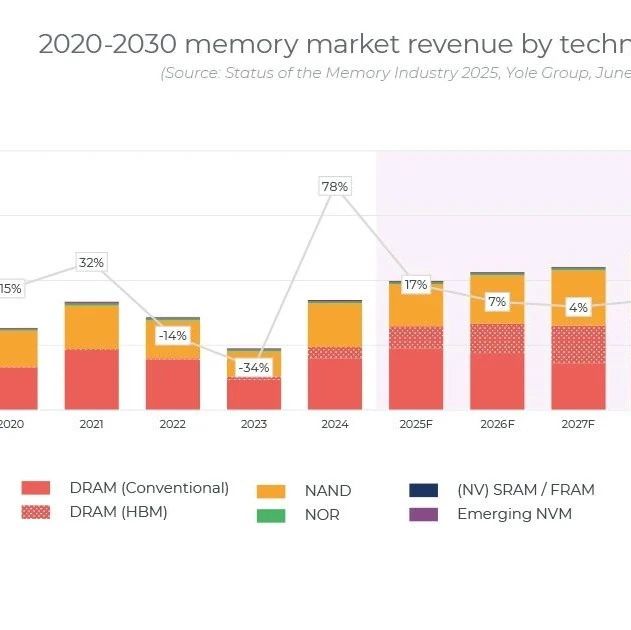
Core Insights - The memory market is expected to reach a record of $200 billion for the second consecutive year in 2025, driven by surging demand for AI training workloads in data centers, marking a strong rebound from the severe downturn experienced in 2022-2023 [2] - High Bandwidth Memory (HBM) is projected to dominate the market, with global HBM revenue expected to grow at an astonishing compound annual growth rate (CAGR) of 33% from 2024 to 2030, capturing an unprecedented 50% share of the DRAM market by 2030 [2] - The NAND industry continues to face headwinds due to weaker-than-expected consumer demand and rising inventory levels across the supply chain, prompting leading suppliers to implement aggressive supply-side adjustments [2] Market Dynamics - Major memory suppliers, including SK Hynix, Samsung, and Micron, are actively enhancing yields and expanding production capacity in anticipation of a shortage expected in 2025, intensifying competition in the high-capacity memory (HBM) market [6] - China is increasing its domestic memory manufacturing efforts to narrow the technology gap with global leaders, extending this strategy to personal computers and consumer electronics, thereby adding pressure to the global memory supply-demand landscape [6] Technological Innovations - Advanced packaging methods, such as CMOS bonding, are redefining memory innovations beyond planar scaling, with companies like Yangtze Memory Technologies achieving significant advancements in 3D NAND technology [7] - The transition to 3D DRAM architecture is seen as inevitable, with all major DRAM suppliers actively exploring various 3D integration pathways by 2025, including innovative unit architectures and advanced tool solutions to address unique manufacturing challenges [8]
半导体行业月报:美国半导体出口管制再升级,存储器价格持续回升-20250613
Zhongyuan Securities· 2025-06-13 08:27
Investment Rating - The semiconductor industry is rated as "Outperform" [2] Core Insights - The semiconductor industry is currently in an upward cycle, driven significantly by AI as a key growth engine [4][28] - Global semiconductor sales continued to grow year-on-year, with a 22.7% increase in April 2025, marking 18 consecutive months of growth [22][23] - The prices of DRAM and NAND Flash are expected to rise due to strong demand from AI-driven enterprise SSDs [5][29] Summary by Sections 1. Market Performance - In May 2025, the domestic semiconductor industry saw a decline of 5.65%, significantly underperforming the Shanghai Composite Index, which rose by 1.85% [4][10] - The Philadelphia Semiconductor Index increased by 12.48% in May 2025, outperforming the Nasdaq 100, which rose by 9.04% [12][18] 2. Sales Growth - April 2025 global semiconductor sales reached approximately $57 billion, with a year-on-year growth of 22.7% and a month-on-month increase of 2.5% [22][23] - China's semiconductor sales in April 2025 were $16.2 billion, reflecting a year-on-year growth of 14.4% [23] 3. Price Trends - The DRAM price index rose by approximately 33% and the NAND Flash index increased by about 11% from March to May 2025 [3][4] - TrendForce forecasts that NAND Flash prices will continue to rise in Q2 and Q3 of 2025 due to strong demand [5][29] 4. Industry Dynamics - The demand for consumer electronics is gradually recovering, with global smartphone shipments in Q1 2025 showing a slight year-on-year increase of 0.2% [4][22] - AI mobile penetration is expected to rise rapidly, reaching 34% in 2025, while AI PC penetration is projected to hit 35% [4][22] 5. Investment Opportunities - The report suggests focusing on sectors such as EDA software, AI computing chips, CPUs, FPGAs, analog chips, semiconductor equipment, and wafer manufacturing due to the acceleration of domestic semiconductor industry self-sufficiency [4][5]
芯片专利博弈后,长江存储再起诉美光散布诽谤信息
Nan Fang Du Shi Bao· 2025-06-10 11:16
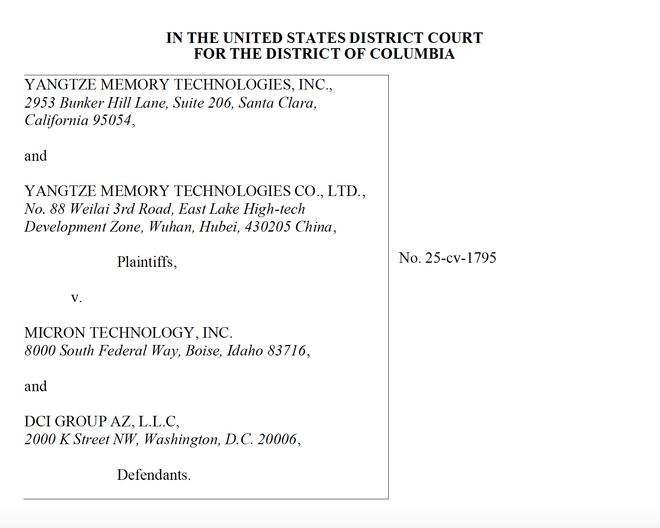
Core Viewpoint - Yangtze Memory Technologies Co. (YMTC) has filed a lawsuit against Micron Technology and a public relations firm, DCI, accusing them of conspiring to spread false information about YMTC's flash memory chips posing a data security threat [1][3]. Group 1: Allegations and Legal Actions - YMTC claims that since September 2020, DCI has disseminated false information on its "China Tech Threat" website, alleging that YMTC's chips could be used to monitor millions of American consumers, compromising data privacy and national security [3]. - The lawsuit argues that YMTC's chips lack essential components for remote control or wireless communication, such as antennas and modems, and asserts that Micron and DCI should have known these claims were false [3]. - YMTC alleges that Micron and DCI orchestrated a "pseudo-grassroots" misinformation campaign to damage YMTC's reputation and business interests, thereby protecting Micron's market share [3]. Group 2: Impact on Business - The false information has reportedly led to significant business losses for YMTC, including the loss of a deal with a leading original equipment manufacturer that planned to source 40% of its NAND flash chip needs from YMTC, resulting in hundreds of millions of dollars in losses [4]. - YMTC has experienced sales declines and market opportunity losses, which forced the company to implement a 10% workforce reduction in early 2023 to manage additional costs incurred from reputation recovery efforts [4]. Group 3: Ongoing Legal Disputes - In addition to the current lawsuit, YMTC previously filed a defamation lawsuit in California against a Danish consulting firm funded by Micron, alleging that it published false reports damaging to YMTC's market reputation [5]. - YMTC and Micron are also involved in a prolonged patent dispute, with YMTC accusing Micron of infringing on multiple patents related to 3D NAND Flash technology [5]. - Recent court rulings have required Micron to provide sensitive technical documents to YMTC, while Micron has sought to overturn these rulings citing national security concerns [5]. Group 4: Market Position - According to TrendForce, as of Q4 2024, Micron holds a 13.8% share of the global NAND Flash memory market, ranking fourth behind Samsung, SK Hynix, and Kioxia, which collectively control about 84% of the market [6]. - YMTC, established in 2016, has yet to significantly disrupt the existing market dynamics in the flash memory sector [6].

2025年中期策略会速递:半导体:需求分化,关注AI、先进制造演进
HTSC· 2025-06-09 01:35
Group 1: Semiconductor Manufacturing Trends - Manufacturing utilization rates continue to improve year-on-year, with downstream manufacturers focusing on Chiplet and advanced packaging technologies[1] - The storage market is showing signs of a price turning point, with an upward trend expected to continue until Q3 2025, driven by AI-related demand[1] - Design companies are experiencing differentiated downstream demand, with power and analog companies reporting a recovery in industrial and automotive sectors[1] Group 2: Equipment and Domestic Production - Global WFE is projected to reach $100 billion in 2025, with a year-on-year growth of 4%-5%[3] - Domestic equipment manufacturers are seeing significant growth in new orders, benefiting from downstream expansion and increased localization rates[3] - The verification speed of core new equipment by domestic companies is accelerating, indicating a positive trend for advanced node domestic equipment breakthroughs[3] Group 3: Storage Market Dynamics - The storage market is expected to see price increases, with predictions of 18-23% and 13-18% growth for Server and PC DDR4 modules respectively in Q2 2025[4] - The enterprise storage market is projected to grow from $23.4 billion in 2024 to $49 billion by 2028, reflecting a compound annual growth rate (CAGR) of 16%[25] - Domestic manufacturers are positioned to benefit from the increasing demand for enterprise-level storage driven by AI infrastructure investments[25] Group 4: Design Sector Insights - The power semiconductor sector in China is entering a mild upward cycle, with a 14.5% year-on-year increase in domestic passenger car production from January to April 2025[38] - The demand for SoC and MCU products is significantly driven by national subsidies and export opportunities, with performance expected to vary across companies in Q2 2025[26] - The analog chip sector is recovering, with industrial and communication sectors seeing a return to inventory restocking[29]
日本卷土重来,韩国芯片,慌了!
半导体行业观察· 2025-06-03 01:26
Core Viewpoint - Japan is taking bold measures to regain its dominance in the semiconductor industry, specifically targeting the AI storage chip sector, which is currently led by South Korean manufacturers [1][2]. Group 1: Japan's Initiative - Japan has launched a project to develop next-generation storage chips for AI applications, integrating funding from SoftBank, technology from Intel, and research capabilities from the University of Tokyo [1]. - A new company named Saimemory has been established by SoftBank and Intel to lead the development of low-power storage chips, aiming to create alternatives to high-bandwidth memory (HBM) currently dominated by South Korean firms [1][2]. - Saimemory plans to focus on developing "stacked DRAM chips" that significantly reduce power consumption, rather than directly competing in the HBM market [1][2]. Group 2: Company Structure and Funding - Saimemory will begin operations in July, with SoftBank as CFO, Intel as CTO, and the University of Tokyo as Chief Scientist [2]. - The initial funding for the project is 10 billion yen (approximately 69.7 million USD), with SoftBank contributing 3 billion yen and seeking additional support from the Japanese government [2]. - The project will leverage Intel's chip stacking technology and the University of Tokyo's data transmission patents, with potential partnerships including Shinko and RIKEN [2]. Group 3: Historical Context and Market Position - Japan's DRAM industry, once a global leader, has significantly declined over the past 13 years due to U.S. trade pressures and competition from South Korea, with the last major DRAM manufacturer, Elpida, going bankrupt in 2012 [2]. - Saimemory is positioned as a fabless chip design and intellectual property management company, contrasting with South Korean firms that integrate design and manufacturing [2]. Group 4: Competitive Landscape - South Korea currently dominates the global memory chip market, with Samsung and SK Hynix holding 73% of the DRAM market and 51% of the NAND flash market [4]. - SK Hynix recently overtook Samsung for the first time in global market share, holding 36% of the DRAM market, while Samsung's share dropped to 34% [5]. - The demand for HBM chips, crucial for AI accelerators, has surged, with SK Hynix capturing over 70% of global HBM sales in early 2023 [5].


高盛交易台:关于科技(Mag7, TSM, SPE, Kioxia & Memory)的思考
Goldman Sachs· 2025-06-02 15:44
市场洞察 - 重点报道 --- Market Insights - Marque e Market Insights | Markets | Equities 市场洞察 | 市场 | 股票 Thoughts on .. Tech (Mag7, TSM, SPE, Kioxia & Memory) 关于科技(Mag7、TSM、SPE、铠侠及 存储器)的思考 在同事休假期间代为⽀持销售⼯作,如有需要请告知 Backing up for our sales colleague while the y are out of office. Let me know if you need anything . Change of view on Hard data v Soft data . around six weeks ago, there was a conspicuous divergence between (surprisingly strong) hard data and (flagrantly weak) soft data. at that time, most folks (reasonably ...
“近一个月涨了50%!” 原厂停产引发备货潮,部分存储产品猛涨价
Di Yi Cai Jing· 2025-05-30 07:54
Core Insights - The storage industry is experiencing significant price increases for certain DRAM products, particularly DDR4 and DDR3, driven by production halts from manufacturers rather than increased demand [1][2][3] - Major manufacturers like Micron, Samsung, and SK Hynix are reportedly planning to cease production of DDR3 and DDR4 by the end of the year, leading to a supply shortage and subsequent price hikes [2][3][4] - The shift towards high-performance memory products, such as HBM and QLC NAND Flash, is becoming more pronounced as manufacturers adjust their production strategies to meet the demands of AI applications [7][8][9] Price Trends - Recent data indicates that various DDR4 products have seen significant price increases, with specific models experiencing rises of 3.95% to 15% in a single week [2] - The market has reacted to the news of potential production halts, resulting in a rush to stockpile DDR4 and LPDDR4 products, causing supply constraints and further price increases [3][4] Production Adjustments - Manufacturers are transitioning their production focus from older memory types like DDR3 and DDR4 to newer, more profitable products such as DDR5 and HBM, which are better suited for AI applications [7][8] - The NAND Flash market is also seeing price increases, particularly for MLC NAND Flash, due to reduced supply following production cutbacks by major players like Samsung [4][6] Market Outlook - Despite localized price increases, the overall storage market is expected to grow modestly by 1% to 2% this year, with some recovery anticipated in NAND Flash prices after a significant decline earlier in the year [6] - The emphasis on high-performance storage solutions is expected to continue, with companies like Micron and SK Hynix increasing their focus on HBM production to meet rising market demands [8][9]