抖音

Search documents
津城年味“云”端浓
Xin Lang Cai Jing· 2026-02-22 21:01
Group 1 - The core viewpoint of the articles highlights the transformation in consumer behavior during the Spring Festival in Tianjin, shifting from "pragmatism" to "emotional value" in purchasing decisions [1][3] - Traditional categories such as seafood, alcohol, dairy, and nuts have seen significant growth, indicating a robust demand for festive goods [1] - The popularity of DIY activities among younger consumers is rising, with handmade items like embroidery and flower lanterns gaining traction, reflecting a desire for personal involvement in celebrations [1] Group 2 - In the tourism sector, popular attractions during the Spring Festival include the Tianjin Eye and the National Ocean Museum, with hotel bookings in key areas like Binjiang Dao and Italian Style Street increasing by 20% year-on-year [2] - The concept of "atmosphere consumption" is prevalent, as consumers engage in various activities from purchasing festive goods to enhancing their home environments, contributing to a vibrant festive atmosphere [3]
来财了!超10亿元春节“礼包”持续发放!有奖发票“火了”
Xin Lang Cai Jing· 2026-02-20 05:14
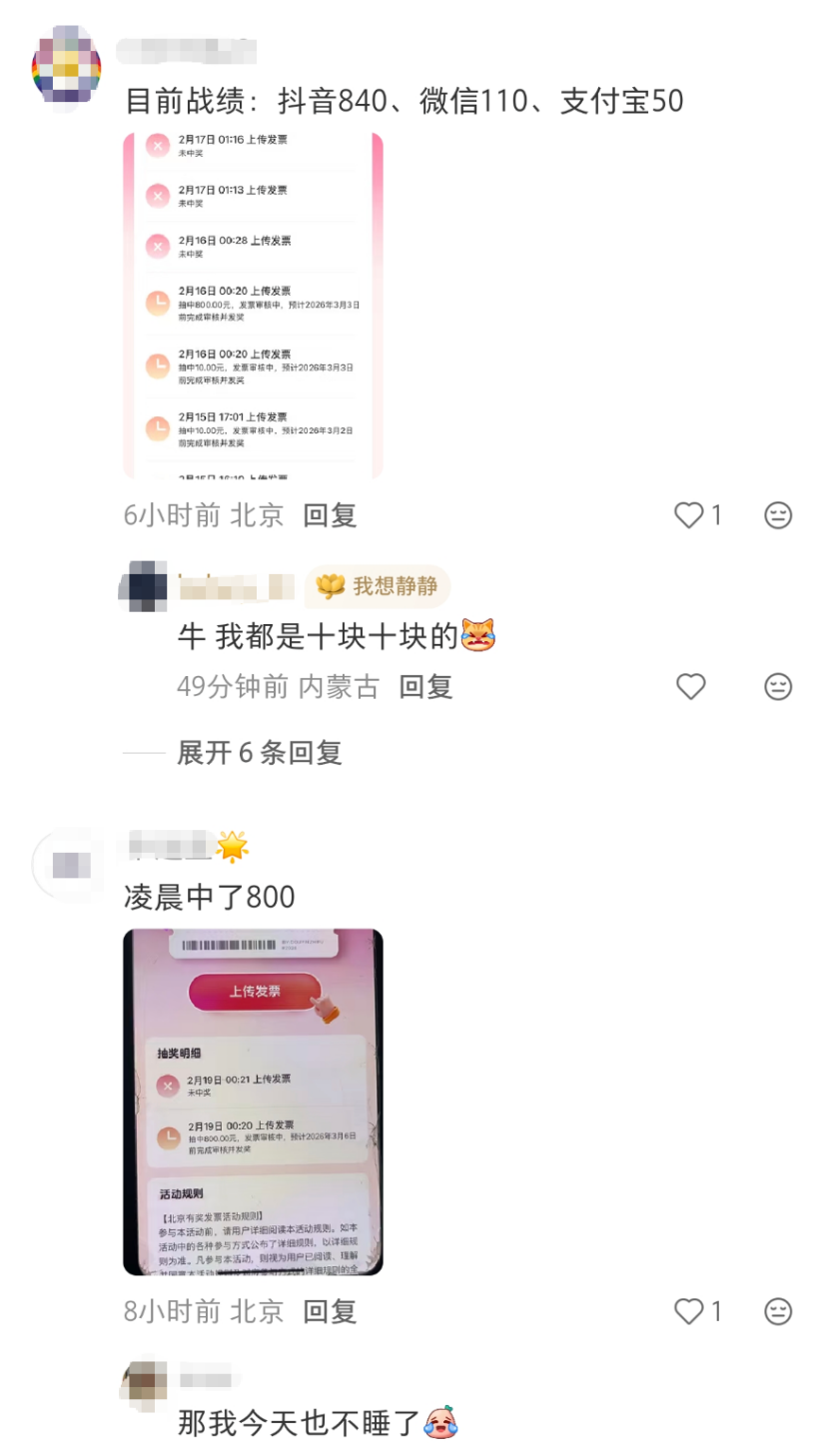
【导读】春节假期有奖发票"火了",多地公布领奖情况 这个春节假期,有奖发票"火了"! 近期,基金君在多个社交平台上发现,有大量网友晒出自己在各个平台有奖发票的中奖"成绩单"。 基金君在第一时间按照网友攻略试水,分别在微信、支付宝、银联云闪付三个渠道进行了三次抽奖,"战绩"分别为30元、50元、50元,中奖率颇高。还没 参加的朋友,可以赶紧试试。 此外,也有不少网友晒出自己的"中奖心得"及攻略,包括平台选择、城市选择、抽奖时段、发票金额等。 值得一提的是,除了线下消费获取发票外,消费者日常在各大平台、App上的消费记录,大多可通过补开发票的方式参与抽奖,大大提高了抽奖的频次和 效率。 另外,目前各大平台多将有奖发票活动置于首页或搜索关键字前列,消费者可轻易找到参与入口。 近期,多地政府部门陆续公布当地发放"红包"情况。例如,据合肥市商务局数据,截至2月17日,当地累计中奖用户数397280人,中奖发票张数为2094077 张,发放红包金额5945.51万元,有效提升了用户获得感与活动吸引力。 绍兴商务数据显示,2月14日—2月18日,市民累计上传发票近70万张,共领取奖金超848万元。 目前,主要参与平台有银联 ...

春晚广告位争夺战:四十年国民记忆与商业暗流
凤凰网财经· 2026-02-19 10:54
Core Viewpoint - The evolution of the Spring Festival Gala sponsorship reflects the transformation of China's economy and consumer behavior over the past 40 years, showcasing the shift from material scarcity to technological innovation and brand storytelling [4][5]. Group 1: 1980s to Early 1990s - The Era of Material Scarcity - The transition from a planned economy to a market economy in the 1980s led to a scarcity of goods, making items like watches and bicycles symbols of wealth and status [6][7]. - The first brand to sponsor the Spring Festival Gala was Kambas watches in 1984, which used 3,000 quartz watches as payment, marking the beginning of brand sponsorship in the event [7][9]. - Kambas became a household name, with production reaching 1.26 million units by 1987 and over 2 million by 1991, highlighting the impact of the Gala on brand visibility and market demand [9][10]. Group 2: Mid-1990s to Early 2000s - The Rise of Consumerism - The late 1990s saw a surge in consumer spending, with households moving from basic necessities to larger purchases like televisions and refrigerators [12][14]. - In 1995, Shandong Kongfu Banquet Wine became the first "advertising king" of the Spring Festival Gala, paying 30.79 million yuan, initiating a trend among liquor companies [12][14]. - The sales of Qin Pool Wine skyrocketed from 180 million yuan in 1995 to 950 million yuan in 1996 after winning the sponsorship, demonstrating the immediate impact of Gala advertising [17]. Group 3: 2000s to 2010s - The Era of Brand Awareness - The early 2000s marked a shift towards household appliances as the main consumer focus, with Midea becoming a prominent sponsor, securing 16 sponsorships from 2003 to 2019 [18][20]. - The cost of advertising during the Gala increased significantly, with Midea's sponsorship rising from 6.8 million yuan in 2005 to 57.2 million yuan in 2011, reflecting the growing value of the event [20]. - Brands began to focus on storytelling and emotional connections with consumers, as seen with Haier and Gree, indicating a maturation of brand marketing strategies [21]. Group 4: Mid-2010s to Present - The Digital Economy and Technological Innovation - The rise of internet companies has transformed the Spring Festival Gala into a platform for digital engagement, with WeChat's "red envelope war" in 2015 significantly increasing viewer interaction [24][26]. - The Gala has become a battleground for tech giants, with platforms like Douyin and Kuaishou participating in interactive sponsorships, showcasing the shift towards a two-way communication model [29]. - The introduction of robots and AI technologies in recent Galas reflects China's transition from manufacturing to intelligent manufacturing, highlighting the importance of innovation in the economy [31].


春晚广告位争夺战:四十年国民记忆与商业洪流
Xin Lang Cai Jing· 2026-02-19 07:21
Core Insights - The evolution of the CCTV Spring Festival Gala sponsorship reflects the transformation of Chinese society and economy over the past 40 years, showcasing the changing consumer demands and emerging industries [20][21]. Group 1: 1980s to Early 1990s - The Era of Scarcity - In the 1980s, as China transitioned from a planned economy to a market economy, consumer goods were scarce, leading to a high demand for basic commodities [22]. - The first brand to sponsor the Spring Festival Gala was Kambas watches in 1984, which used 3,000 quartz watches as payment, marking the beginning of brand sponsorship in the gala [22][23]. - Kambas became a household name, with production reaching 1.26 million units in 1987 and over 2 million by 1991, despite the high price of its watches relative to average incomes [23][24]. Group 2: Mid-1990s to Early 2000s - The Rise of Consumerism - The mid-1990s saw a shift in consumer spending from basic goods to electronics, with Shandong Kongfu Banquet Wine becoming the first "advertising king" by paying 30.79 million yuan for sponsorship in 1995 [26]. - The competition among liquor brands for sponsorship reflected the rise of "social consumption," where premium liquor became a status symbol for social gatherings [28]. - After winning the Spring Festival sponsorship, Qin Pool Wine's sales skyrocketed from 180 million yuan in 1995 to 950 million yuan in 1996, demonstrating the immediate impact of gala sponsorship [29]. Group 3: 2000s to Early 2010s - The Home Appliance Boom - The early 2000s marked a shift towards home appliances as the primary consumer focus, with Midea becoming the most frequent sponsor, securing 16 sponsorships from 2003 to 2019 [30]. - The cost of advertising during the gala increased significantly, with Midea's sponsorship fee rising from 6.8 million yuan in 2005 to 57.2 million yuan in 2011, an increase of 840% [30]. - Midea's revenue grew from 17.5 billion yuan in 2003 to over 140 billion yuan in 2014, reflecting the effectiveness of its gala sponsorship strategy [12][30]. Group 4: Mid-2010s to Present - The Digital Economy and Technological Innovation - The rise of internet companies has transformed the Spring Festival Gala into a platform for digital engagement, with WeChat's "red envelope war" in 2015 significantly boosting viewer interaction [15][35]. - The gala's advertising has evolved from one-way promotion to interactive engagement, with platforms like Douyin and Kuaishou participating in sponsorships [16][35]. - The presence of technology companies has increased, with innovations such as AI and robotics showcased during the gala, indicating a shift from traditional advertising to technology-driven marketing [19][37].


春晚40年赞助商变迁史,从康巴丝到机器人见证中国经济跃迁
Sou Hu Cai Jing· 2026-02-18 02:17
Group 1 - The article discusses the evolution of sponsorship in the CCTV Spring Festival Gala over the past 40 years, reflecting changes in Chinese society and consumer behavior [2][3] - The first sponsor, 康巴丝 (Kambas), set a precedent in 1984 by using 3,000 quartz watches as payment, marking the beginning of brand sponsorship in the gala [6][8] - The transition from watches to bicycles as the next major sponsor in 1995 illustrates the shift in consumer goods that represented status during the era of material scarcity [10][12] Group 2 - The late 1990s saw a surge in consumer spending on new household appliances, with 山东孔府宴酒 (Shandong Confucius Banquet Wine) becoming the first "mark king" of the gala in 1995, paying 30.79 million yuan [10][12] - The rapid growth of the liquor industry during this period was fueled by "human consumption," where premium liquor became a social currency [12][14] - The article highlights the consequences of over-reliance on advertising without maintaining product quality, as seen in the case of 秦池酒 (Qin Pool Wine), which faced a significant drop in sales after quality issues emerged [14][15] Group 3 - From the early 2000s, the focus shifted to home appliances, with 美的 (Midea) becoming a prominent sponsor, securing 16 sponsorships from 2003 to 2019 [17][19] - The cost of advertising during the gala increased significantly, with Midea's sponsorship fee rising from 6.8 million yuan in 2005 to 57.2 million yuan in 2011, reflecting the growing viewership [17][19] - The brand storytelling approach adopted by companies like 海尔 (Haier) and 格力 (Gree) during this period indicates a shift towards building emotional connections with consumers [20] Group 4 - The rise of internet companies post-2010 transformed the gala's advertising landscape, with platforms like WeChat leveraging the event for massive user engagement through interactive features like the "red envelope battle" [21][23] - The article notes that the 2015 Spring Festival Gala saw WeChat's user engagement peak, with over 10.1 billion red envelopes sent, showcasing the event's potential as a digital marketing platform [21][23] - The involvement of tech giants in the gala reflects a broader trend of digital economy reshaping traditional advertising methods, with companies like 快手 (Kuaishou) and 抖音 (Douyin) entering the sponsorship arena [25][27] Group 5 - The article concludes by emphasizing the transition from showcasing products to highlighting technological advancements, as seen with the introduction of robots in recent galas [27] - This shift signifies a broader change in China's economic landscape, moving from manufacturing to innovation-driven growth, with a focus on high-tech industries [27] - The future of the Spring Festival Gala sponsorship landscape remains uncertain, raising questions about which industries will dominate the next decade [27]


春晚的广告牌 印刻着中国经济的一次次跃迁
Nan Fang Du Shi Bao· 2026-02-17 15:27
Core Insights - The sponsorship history of the CCTV Spring Festival Gala reflects China's economic development and industrial upgrades over the past four decades, showcasing three major transitions: from basic needs to consumer electronics and automobiles, from virtual economy to hard technology, and from demographic dividend to engineer dividend [1][2]. Group 1: Historical Sponsorship Trends - In the 1980s, the main sponsors represented basic household needs, with brands like 康巴丝 leading the way, highlighting the public's desire for precision and the prosperity of light industry [1]. - The 1990s saw a shift towards quality consumption, with liquor brands and home appliance giants like 美的集团 becoming prominent sponsors, marking a transition from survival to quality-focused consumption [1]. Group 2: The Rise of Internet and Technology - The year 2015 marked a turning point with the emergence of internet giants like WeChat and Alipay, initiating a "red envelope war" that transformed user engagement and payment methods [2]. - As the internet traffic peaked, the focus shifted to hard technology, with a notable increase in sponsorship from the electric vehicle sector, indicating a fundamental shift in China's competitive edge from demographic to engineer dividends [2]. Group 3: Future Trends and Cultural Consumption - The upcoming 2026 Spring Festival Gala will feature new partnerships with brands like 名创优品 and 卡游, suggesting a potential shift towards "emotional value" and "cultural consumption" as new wealth drivers in a mature market [3]. - The evolution of sponsors serves as a "value anchor" migration, reflecting China's economic transitions from production capabilities to creative intelligence, providing a lens to observe the pulse of the times [3].
春晚广告位争夺战:四十年国民记忆与商业暗流
创业邦· 2026-02-17 10:32
Core Viewpoint - The evolution of the Spring Festival Gala sponsorship reflects the changing landscape of China's economy and consumer behavior over the past 40 years, showcasing the transition from material scarcity to technological innovation and brand storytelling [4][24]. Group 1: 1980s to Early 1990s - The 1980s marked a period of material scarcity, where items like watches and radios were symbols of wealth and status, leading to the first brand sponsorship by 康巴丝 (Kangbasi) at the Spring Festival Gala [5][7]. - 康巴丝 sponsored the gala by trading 3,000 quartz watches for advertising, which significantly boosted its brand recognition and sales, reaching an annual production of 1.26 million watches by 1987 [8]. - The sponsorship model evolved, with 中华自行车 (Zhonghua Bicycle) taking over the sponsorship in 1995, reflecting the changing consumer demands and economic conditions [9][14]. Group 2: Mid-1990s to Early 2000s - The mid-1990s saw a surge in consumer spending, with the emergence of "标王" (advertising king) sponsorships, particularly in the liquor industry, exemplified by 山东孔府宴酒 (Shandong Confucius Feast Wine) and 秦池酒 (Qinchijiu) [11][12]. - 秦池酒's sponsorship led to a dramatic increase in sales from 1.8 billion yuan in 1995 to 9.5 billion yuan in 1996, highlighting the impact of gala sponsorship on brand visibility and sales [16]. - The era was characterized by a shift towards consumerism, with brands leveraging the gala to enhance their market presence, although some faced backlash due to quality issues [16]. Group 3: 2000s to Early 2010s - The early 2000s marked the rise of home appliance brands, with 美的 (Midea) becoming a prominent sponsor, securing 11 sponsorships from 2003 to 2014, reflecting the growing importance of brand trust [17][19]. - The cost of advertising skyrocketed, with Midea's sponsorship fee increasing from 6.8 million yuan in 2005 to 57.2 million yuan in 2011, indicating the gala's significant viewership and advertising value [21]. - Brands began to focus on storytelling and emotional connections with consumers, moving beyond mere product promotion to build brand loyalty [23]. Group 4: Mid-2010s to Present - The 2010s saw the rise of internet companies as key players in the advertising space, with platforms like WeChat revolutionizing audience engagement through interactive features like the "red envelope battle" during the gala [25][26]. - The digital transformation of the gala allowed for unprecedented levels of interaction, with WeChat reporting 10.1 billion red envelope transactions on New Year's Eve, significantly enhancing its user base [26]. - The emergence of technology companies in the gala sponsorship landscape reflects a broader shift towards innovation and digital engagement, with brands like Xiaomi and AI robotics showcasing advancements in technology [32].





“宇树IPO更稳了”
投资界· 2026-02-17 07:20
Core Viewpoint - The 2026 Spring Festival Gala showcased a significant presence of technology and innovation, particularly in robotics and AI, marking a shift in China's industrial landscape towards hard technology innovation [4][22]. Group 1: Robotics and AI - The gala featured over 20 partners, with a notable focus on robotics, including companies like Yushutech, Magic Atom, and Galaxy General, highlighting the evolution of embodied intelligence in China [3][4]. - Yushutech's performance demonstrated advanced capabilities, contributing to its valuation exceeding 10 billion RMB and accelerating its IPO process [10]. - Galaxy General, a newly established company, achieved a valuation of 3 billion USD after raising 300 million USD, showcasing the rapid growth in the robotics sector [10]. - The event served as a platform for these companies to compete not just in performance but also in intelligence and practical applications, indicating a maturation of the robotics industry in China [11]. Group 2: New Media and Consumer Engagement - The integration of platforms like Bilibili, Xiaohongshu, and Douyin into the gala reflects a shift in how younger audiences engage with traditional media, emphasizing real-time interaction and content creation [16]. - Douyin's role as the exclusive partner for "Vertical Screen Viewing" and Bilibili's position as the exclusive bullet screen video platform illustrate the diversification of media consumption among younger generations [16]. - The rise of emotional consumption brands like Miniso and KAYOU at the gala indicates a cultural shift towards valuing emotional and cultural connections over traditional material consumption [17][18]. Group 3: Industry Transformation - The gala serves as a microcosm of China's industrial transformation, moving from traditional consumer goods to advanced technology and cultural products, reflecting changing consumer preferences [20][22]. - The reduction in alcohol brand presence at the gala signifies a broader trend away from traditional industries towards tech-driven sectors, highlighting the evolving landscape of consumer engagement [20]. - The emphasis on technology and innovation at the gala marks a pivotal moment in China's industrial evolution, suggesting a future focused on hard tech and sustainable growth [22][23].
2026央视科技(广告?)春晚股民吐槽大赏
佩妮Penny的世界· 2026-02-17 02:14
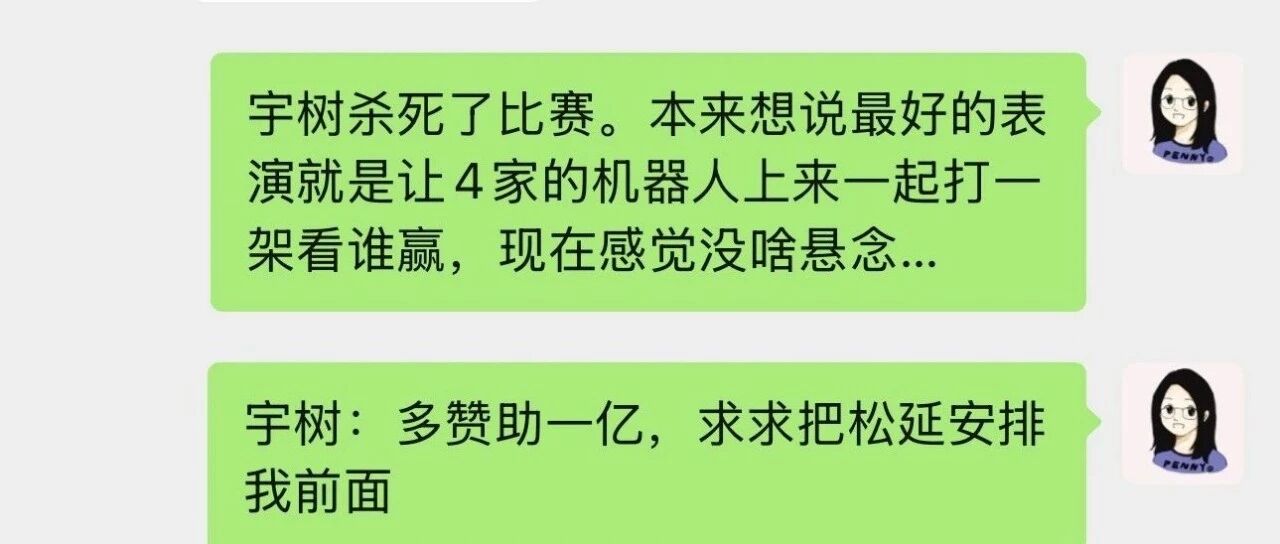
大家好,我是佩妮。 本来想休假纯躺平的,但是看着春晚,实在是忍不住我吐槽的洪荒之力(我知道是老梗),必须爬上来和大家一起唠嗑…… 今年这届春晚,是我 过去几年看得最认真的一届春晚 。无它,过去两年"科技"成为了一二级市场的主旋律,连带这届春晚也成了科技(广 告?)含量最高的一届,也成为了和资本市场关系最紧密的春晚。 这就叫: 过去的我嗤之以鼻,现在的我逐帧学习…… 被玩梗说春晚导演是不是提前上杠杆重仓了,承载了全国股民的希望的一台晚会…… 当然,大 A 很体贴,春节期间赌场不开门,除了一些年前就埋伏了的朋友,就只能看看港股的表现了。 好了,正片开始,主要列一下我感兴趣的点: 1)大家最关注的肯定是这次 春晚 4 家机器人大战 了。 一开始大家都在传,几家机器人公司为了上市重金砸了上亿上春晚,但是咱们仍未知道到底花了多少钱。 说真的,这种编排好的表演有啥意思,都说直接让这4家公司各派一个机器人上去直接格斗得了,更好看。哈哈哈。 结果吧,有目共睹, 宇树杀死了比赛。 就这个武术表演动作控制的 流畅度和稳定度 吧,绝了! 最后超大型人形机器人的出场也非常惊艳,进步太大了,比去年扭秧歌被人拎着后脖颈 下台强太多了。 ...
史上最强机器人阵容登台,2026总台春晚合作盘点:29家品牌覆盖AI到潮玩;豆包暂停视频通话功能;智谱:全网寻找“算力合伙人”丨邦早报
创业邦· 2026-02-17 01:06
Group 1 - The 2026 Spring Festival Gala has announced partnerships with 29 brands, covering various fields including AI technology, robotics, transportation, and consumer goods [3][4] - A record number of six robotics brands, including Magic Atom and Galaxy General, will showcase at the gala, marking the largest robot lineup in the event's history [3][4] - The gala will feature new media collaborations with platforms like Xiaohongshu and Douyin, with Bilibili serving as the exclusive bullet screen video platform [3][4] Group 2 - OpenAI's CEO announced that Peter Steinberger, the creator of OpenClaw, will join OpenAI to advance the development of next-generation personal intelligent agents [5] - Zhipu AI reported a surge in demand for GLM-5, leading to service delays, and has initiated a "computing power partner" recruitment plan to enhance service capacity [6] - Douyin's vice president stated that the 2026 Spring Festival Gala will be the first public project to deeply utilize the domestic AI video generation model Seedance 2.0 [6] Group 3 - The 2026 Spring Festival Gala has seen a significant increase in robot-related searches, with a 300% rise in search volume and a 460% increase in customer inquiries on JD.com [23] - The gala's robot-themed promotions led to a rapid sell-out of various robots, including high-value models like the GALBOT G1, which sold for nearly 630,000 yuan [23]