通威股份

Search documents
努力不如有矿
虎嗅APP· 2026-01-20 00:01
Core Viewpoint - The lithium battery industry is experiencing significant growth, driven by demand from electric vehicles and energy storage, leading to a sharp increase in lithium carbonate prices, which have surpassed 100,000 yuan per ton and are projected to reach 200,000 yuan per ton in 2026 [4][5]. Group 1: Company Performance Comparison - Ganfeng Lithium has diversified its lithium resource sources and expanded downstream into battery production, while Tianqi Lithium primarily benefits from its mining assets [5][10]. - In terms of revenue, Ganfeng Lithium has shown a consistent upward trend, surpassing Tianqi Lithium in 2019 and maintaining a lead in recent years, with a revenue of 146 billion yuan compared to Tianqi's 74 billion yuan in the first three quarters of 2025 [8][10]. - Despite Ganfeng's revenue growth, Tianqi Lithium has outperformed in terms of profitability, particularly due to its mining operations, which yield higher margins compared to Ganfeng's battery business [37][41]. Group 2: Revenue and Profitability Analysis - Ganfeng's revenue from lithium products reached 345.8 billion yuan in 2022, accounting for 83% of total revenue, while its battery segment generated 64.8 billion yuan, reflecting a 220.3% year-on-year growth [13]. - In 2024, Ganfeng's revenue dropped to 45.2% of its 2022 figures, with lithium product revenue at 120.2 billion yuan, a 50.9% decline, while battery revenue decreased by 23.5% to 59 billion yuan [14]. - Tianqi Lithium's mining operations generated significant profits, with a gross profit of 130 billion yuan in 2022 and a gross profit margin of 84%, while Ganfeng's lithium compound gross profit was 215 billion yuan with a margin of 85.9% [34][37]. Group 3: Resource Diversification and Market Dynamics - Ganfeng Lithium has established a diversified resource supply system, achieving over 50% self-sufficiency in lithium resources by 2025, while Tianqi's self-sufficiency exceeds 200% due to its extensive mining operations [25][30]. - The global lithium resource supply is projected to reach approximately 1.438 million tons by 2025, with a notable increase in the production of spodumene (lithium ore) compared to brine lithium [23]. - The volatility in lithium prices has led to fluctuating profit margins for both companies, with Ganfeng's battery business becoming increasingly important for maintaining profitability during periods of low lithium prices [21][22].




白银价格再创新高 光伏行业成本攀升
Xin Lang Cai Jing· 2026-01-19 18:12
Core Viewpoint - The surge in silver prices is significantly impacting the photovoltaic (PV) industry, leading to increased operational pressures and projected losses for major companies in the sector [1][2]. Group 1: Silver Price Impact - International silver prices have recently surpassed $94 per ounce, contributing to heightened costs for PV companies already facing two years of losses [1]. - The cost of silver has increased over threefold in the past year, now accounting for 29% of the total cost of solar panels, compared to 3.4% in 2023 and 14% last year [2]. Group 2: Company Performance Forecasts - Tongwei Co. anticipates a net loss of approximately 9 billion to 10 billion yuan for 2025, citing rising silver prices and declining product prices as key factors [1]. - TCL Zhonghuan, a leading PV silicon wafer manufacturer, expects a net loss between 8.2 billion to 9.6 billion yuan, attributing this to ongoing supply-demand imbalances despite growth in new installations [2]. - Longi Green Energy forecasts a net loss of 6 billion to 6.5 billion yuan for 2025, with significant cost increases in silver paste and silicon materials further straining operations [2]. Group 3: Industry Response - Some component manufacturers have raised prices to reflect the increased costs of silver, while the industry is also exploring technological adjustments to mitigate these pressures [2]. - Longi Green Energy has completed pilot tests for replacing silver paste with cheaper materials and is beginning large-scale production of these alternatives [2].




超300份预告折射产业冷暖,业绩驱动取代概念博弈成市场主线
第一财经· 2026-01-19 12:59
2026.01. 19 本文字数:3133,阅读时长大约5分钟 作者 | 第一财经 魏中原 景气度较差的地产行业,相关上市公司业绩也普遍承压。华夏幸福(600340.SH)预计去年归母净利润亏损160亿元至240亿元;绿地控股 (600606.SH)预亏160亿元至190亿元。就业绩亏损的原因,上述两家企业均表示市场有效需求不足、社会预期偏弱,房地产业的结转规模、基建产 业的营收规模同比均有较大幅度下降。 A股市场已有超过350家公司发布2025年度业绩预告,一幅清晰的产业景气度"分野图"就此展开。 业绩预告数据显示,在全球科技浪潮与商品周期驱动下, 半导体、有色金属 行业业绩耀眼,龙头公司普遍实现高增长;而曾备受瞩目的 光伏 产业则因 产能过剩、价格内卷深陷亏损,多家龙头预亏合计超300亿元。更为引人深思的是, 商业航天、AI应用 等此前遭资金热捧的赛道,多数公司业绩预告 亏损,凸显概念炒作后基本面与估值的严重脱节。 综观已披露的业绩预告,A股市场正在经历一场从"预期叙事"到"报表验证"的切换,市场资金正基于业绩真实成色进行博弈与调仓,业绩确定性已成为 当前市场的核心锚点。 半导体业绩实现高增长,光伏龙头陷 ...

喜娜AI速递:今日财经热点要闻回顾|2026年1月19日
Xin Lang Cai Jing· 2026-01-19 12:00
Group 1 - Trump's threat to impose tariffs on Denmark and other European countries has led to significant market volatility, with European stock markets declining and a surge in demand for safe-haven assets like gold and silver [2][7] - The China Securities Regulatory Commission (CSRC) has outlined key tasks for 2026, focusing on market stability, regulatory enforcement, and promoting the development of listed companies [2][7] - Five leading solar companies, including Tongwei Co. and Longi Green Energy, have announced a combined expected loss exceeding 28.9 billion yuan due to industry challenges such as supply-demand imbalances and rising raw material costs [2][7] Group 2 - Tesla's CEO Elon Musk has announced the restart of the Dojo 3 project, with the new AI5 chip expected to have five times the computing power of the current HW4 chip, impacting the rollout of full self-driving capabilities [3][8] - Rare earth prices have been rising, with a projected supply-demand gap of 140,000 tons by 2030, driven by strong demand from the global electric vehicle sector [3][8] - Several small and medium-sized banks have raised deposit rates as part of a strategy to attract deposits amid low net interest margins, although future rates may stabilize or slightly decrease [3][9] Group 3 - Rongbai Technology is under investigation by the CSRC for misleading statements regarding a significant contract, raising concerns about its ability to fulfill orders due to production capacity issues [4][9] - The minimum margin requirement for financing purchases on the Shanghai and Shenzhen stock exchanges has been increased from 80% to 100% for new contracts, aimed at controlling market leverage risks [4][9] - The 2025 Hurun Report has ranked Cambrian as the top AI company in China, valued at 630 billion yuan, with an increasing number of AI chip companies listed, reflecting a shift towards domestic computing power independence [5][10]


超300份预告折射产业冷暖,业绩驱动取代概念博弈成市场主线
第一财经网· 2026-01-19 10:13
Core Viewpoint - The A-share market is experiencing a clear divergence in industry performance as over 350 companies have released their 2025 earnings forecasts, highlighting strong growth in the semiconductor and non-ferrous metals sectors, while the photovoltaic industry faces significant losses due to overcapacity and price competition [1] Semiconductor Industry - The semiconductor sector is benefiting from the global AI infrastructure wave and rising storage chip prices, with leading companies like 澜起科技 (Lianqi Technology) forecasting a net profit of 2.15 billion to 2.35 billion yuan for 2025, representing a year-on-year growth of 52.29% to 66.46% [2] - 佰维存储 (Baiwei Storage) expects to achieve record revenue of 10 billion to 12 billion yuan, with a net profit forecast of 850 million to 1 billion yuan, reflecting a staggering year-on-year growth of 427.19% to 520.22% [2] Photovoltaic Industry - The photovoltaic sector is struggling with overcapacity, low prices, and rising raw material costs, leading to significant losses among leading companies. 通威股份 (Tongwei Co.) anticipates a net loss of 9 billion to 10 billion yuan, while TCL中环 (TCL Zhonghuan) expects a loss of 8.2 billion to 9.6 billion yuan [3] - The total projected losses for major photovoltaic companies have exceeded 32 billion yuan, with several firms reporting substantial deficits [3] Real Estate Industry - The real estate sector is also under pressure, with companies like 华夏幸福 (China Fortune Land Development) forecasting a net loss of 16 billion to 24 billion yuan, attributed to insufficient market demand and weak social expectations [4] Non-Ferrous Metals Industry - The non-ferrous metals sector has seen significant price increases, benefiting from global monetary easing and fiscal expansion, with companies reporting strong earnings growth. For instance, 紫金矿业 (Zijin Mining) expects a net profit of 51 billion to 52 billion yuan, a year-on-year increase of 59% to 62% [5][6] - The performance of the rare earth sector is also notable, with 北方稀土 (Northern Rare Earth) projecting a net profit of 2.176 billion to 2.356 billion yuan, reflecting a year-on-year growth of 116.67% to 134.60% [7] Concept Stocks and Emerging Industries - Emerging sectors like commercial aerospace and AI applications are facing challenges, with many companies reporting losses despite previous market enthusiasm. For example, 上海瀚讯 (Shanghai Hanxun) and 三维通信 (Sanwei Communication) are expected to incur losses in 2025 [8][9] - 中文在线 (Zhongwen Online) anticipates a net loss of 580 million to 700 million yuan, driven by high promotional costs in its overseas short drama business [9]


供需格局重塑 多晶硅大概率延续区间震荡
Sou Hu Cai Jing· 2026-01-19 07:18
Core Viewpoint - The multi-crystalline silicon market experienced a two-phase price trend in 2025, with initial declines followed by a recovery driven by policy changes and demand surges in the photovoltaic sector [1][2]. Phase One: Price Decline and Stabilization - In the first phase, market sentiment was pessimistic, leading to a decline in both spot and futures prices, approaching the cash cost line of leading companies [1]. - A consensus on production cuts was reached in December 2024, which slowed the price decline and stabilized the market [1]. - Key policies implemented in February 2025, such as the management measures for distributed photovoltaic power generation, triggered a "rush to install" in the first half of 2025, temporarily boosting supply and demand [1]. - By April 2025, as the rush subsided, futures prices stabilized but faced downward pressure due to tariff policies [1]. Phase Two: Price Recovery - The second phase saw a reversal in industry expectations due to a series of "anti-involution" policies, leading to a strong increase in spot prices and an upward trend in futures prices [2]. - By December 2025, the average transaction price for N-type multi-crystalline silicon had reached 53,900 yuan per ton, significantly up from early July [2]. - The cost range for the industry in 2025 was between 40,300 to 42,900 yuan per ton, with current spot prices exceeding this range, indicating a strong support level for prices [2]. 2026 Outlook: Supply and Demand Dynamics - Global photovoltaic installations are expected to grow in 2025, with an estimated total demand for multi-crystalline silicon of approximately 114,350 tons, despite a supply surplus of about 17,650 tons due to a projected production of 132,000 tons [4]. - The domestic photovoltaic demand is anticipated to stabilize, with new installations likely not exceeding the levels of 2024 and 2025, shifting focus towards high-quality development rather than rapid growth [5][6]. - The 2026 demand scenarios suggest a range of 48,750 to 60,940 tons for domestic multi-crystalline silicon, depending on various assumptions about installation levels [6]. Industry Development Trends - The photovoltaic industry is facing significant supply-demand mismatches, with upstream price pressures from multi-crystalline silicon affecting the midstream and downstream segments [7]. - A coordinated reduction in production across the entire supply chain, from silicon materials to components, is necessary to achieve overall market balance [7]. - Current multi-crystalline silicon inventory stands at around 400,000 tons, indicating that the market has not yet reached equilibrium [9]. - The industry is expected to transition towards a healthier and more orderly development phase, focusing on sustainable growth aligned with carbon neutrality goals [9].
国家电网4万亿投资落地,碳中和ETF泰康(560560)盘中涨超1%,新型电力系统建设迎加速期
Xin Lang Cai Jing· 2026-01-19 05:56
截至2026年1月19日 13:35,碳中和ETF泰康(560560)上涨1.04%,跟踪指数中证内地低碳经济主题指数 (000977)上涨0.69%,成分股迈为股份上涨7.57%,福斯特上涨7.01%,特变电工上涨5.91%,金风科技上 涨3.59%,科达利上涨2.97%。 消息面上,根据国家能源局最新数据显示,2025年我国全社会用电量历史性突破10万亿千瓦时,达到 10.4万亿千瓦时,同比增长5%。机构普遍预测,"十五五"期间,我国全社会用电量年均增速在4.2%至 5.6%之间。若GDP年均增长5%,按电力弹性系数测算,全社会用电量增速约为5.5%,到2030年有望突 破13万亿千瓦时。 根据我国新一轮国家自主贡献目标,到2035年,我国非化石能源消费占能源消费总量的比重达到30%以 上,风电和太阳能发电总装机容量达到2020年的6倍以上、力争达到36亿千瓦。为了应对新能源大规模 并网以及数字经济和新型技术发展对电能质量需求的提高,电网投资将大幅加码。近日国家电网宣 布,"十五五"期间固定资产投资预计达4万亿元,较"十四五"时期增长40%,将重点投向科技创新与新 型电力系统建设。 国信证券认为,电网4万 ...
银河期货:多晶硅:区间震荡,关注现货实际成交价格,工业硅:区间上沿逢高沽空
Yin He Qi Huo· 2026-01-19 05:09
Report Industry Investment Ratings - The investment rating for polysilicon is to "observe range-bound fluctuations and focus on actual spot transaction prices." - The investment rating for industrial silicon is to "sell short at the upper end of the range" [1]. Core Views of the Report - For polysilicon, Tongwei Co., Ltd. will halt all production next week, and GCL Technology will significantly reduce production this month. It is expected that polysilicon output in January will drop below 90,000 tons. From April, export tax rebates for photovoltaic products other than photovoltaic cells will be removed, which may lead to a rush to export silicon wafers, cells, and modules from January to March. Polysilicon inventory is expected to decrease in January. The spot market is cautious, and large - scale spot transactions have yet to occur. After the 20th, there may be bulk transactions, and the spot transaction price will be the core guide for the market. The actual transaction price of polysilicon dense material this month is expected to be in the range of 48,000 - 55,000 yuan/ton, and the futures price reference range is (45,000, 55,000). Trading volume is low in the short term, with high volatility, so participation should be cautious [4]. - For industrial silicon, demand is weak due to organic silicon production cuts, seasonal decline in aluminum alloy operating rates, and reduced monthly polysilicon output. There are no short - term production cut plans for industrial silicon manufacturers, resulting in a slight supply - demand surplus. The cost of industrial silicon is basically stable. The commodity market's bullish sentiment is fading, and industrial silicon, with a weak fundamental outlook, may decline in a volatile manner, with a price range reference of (8,000, 8,800) [7]. Summary by Directory Chapter 1: Comprehensive Analysis and Trading Strategies Polysilicon - Supply - demand situation: Production cuts by major companies will reduce output, and potential export rush may lead to inventory reduction. - Trading strategy: Adopt range - bound trading, with low trading volume and cautious participation. There are no current arbitrage or option strategies [4][5]. Industrial Silicon - Supply - demand situation: Weak demand from downstream industries and a slight supply - demand surplus. - Trading strategy: Sell short at the upper end of the range, sell out - of - the - money call options, and there are no current arbitrage strategies [7][8]. Chapter 2: Industrial Silicon Fundamental Data Tracking Market Performance - This week, industrial silicon futures fluctuated narrowly, and spot prices changed little. Manufacturers had low shipment volumes and no large - scale hedging [11]. Downstream Demand - DMC weekly output was 43,600 tons, a 0.91% week - on - week decrease; polysilicon weekly output was 22,000 tons, a 13.27% week - on - week decrease; primary aluminum alloy operating rate was 58.6%, a 0.6 - percentage - point week - on - week increase; and recycled aluminum alloy operating rate was 58.4%, unchanged from the previous week [7][14]. Production - This week, industrial silicon weekly output was 78,400 tons, a 2.82% week - on - week decrease. The total number of open furnaces was 222, a decrease of 6 from the previous week. Tongwei Co., Ltd. will cut production of 8 submerged arc furnaces for its industrial silicon capacity, with 6 already cut this week [24]. Inventory - Industrial silicon social inventory was 555,000 tons, a week - on - week increase of 2,700 tons. The inventory of sample enterprises in Xinjiang, Yunnan, and Sichuan was 210,200 tons, a week - on - week increase of 4,200 tons. Downstream raw material inventory was 233,000 tons, a week - on - week decrease of 2,100 tons [26]. Product Prices - This week, industrial silicon spot prices remained stable, as did DMC and terminal product prices [32][36]. Intermediate and Related Product Data - The operating rate of organic silicon intermediates decreased slightly, while the price and operating rate of aluminum alloy increased slightly [42][46]. Raw Material Prices - This week, industrial silicon raw material prices remained stable [50]. Chapter 3: Polysilicon Fundamental Data Tracking Price Trends - This week, the prices of some polysilicon, cells, and modules increased [55]. Component Data - From April 2026, export tax rebates for photovoltaic components will be removed, which may lead to a rush to export from January to March. It is expected that component production scheduling in January will increase to around 40GW. European component inventory has increased to 31.3GW, and domestic manufacturers' component inventory is 30GW, at a moderately low level [63]. Cell Data - Export tax rebates for photovoltaic cells will be reduced and then removed in 2027. It is expected that cell production scheduling in January will increase to around 48GW [64]. Silicon Wafer Data - Current silicon wafer inventory has decreased to 24.78GW. With the cancellation of export tax rebates in sync with components, there is still demand for silicon wafer exports. Silicon wafer production scheduling in January may increase to 50GW [70]. Polysilicon Data - This week, polysilicon output decreased slightly, and factory inventory increased to 320,000 tons. In January, GCL Technology will lower its operating rate, and Tongwei Co., Ltd. will halt production. Polysilicon output this month will drop below 90,000 tons [75].
超3300只个股上涨
第一财经· 2026-01-19 03:53
Market Overview - The Shanghai Composite Index rose by 0.13% at midday, while the Shenzhen Component Index fell by 0.01%, the ChiNext Index dropped by 0.64%, and the Sci-Tech Innovation Index decreased by 0.19% [3]. - The total trading volume in the Shanghai and Shenzhen markets reached 1.79 trillion yuan, a decrease of 198.5 billion yuan compared to the previous trading day, with over 3,300 stocks rising [6]. Sector Performance - The ultra-high voltage concept stocks surged, with companies like China Xidian hitting the daily limit, and several other stocks in the electric grid equipment sector also saw significant gains [5][6]. - The retail and tourism sectors experienced a rally, with Xinhua Department Store hitting the daily limit and Guangbai Co. rising over 7% [6]. - The AI application sector showed signs of recovery, with Tianqi Co. reaching the daily limit and other companies like Giant Network and Shiji Information also performing well [7]. Notable Stocks - Cambridge Technology hit the daily limit down, despite forecasting a 51%-67% year-on-year increase in net profit for 2025, as Q4 performance fell short of expectations [7]. - Yongjiang Co. reached the daily limit after announcing plans to acquire 98.54% of Yongqiang Technology [11]. - Tongwei Co. opened down over 5%, with an expected net loss of approximately 9 to 10 billion yuan for 2025 [12]. Economic Indicators - The People's Bank of China conducted a 7-day reverse repurchase operation of 158.3 billion yuan at an interest rate of 1.40%, with 86.1 billion yuan of reverse repos maturing today [12].


钧达股份3000万元投资抢滩太空光伏! 特变电工涨超7%,光伏龙头ETF(516290)爆量涨超1%冲击四连阳!2026年最强电新主线确定了?
Xin Lang Cai Jing· 2026-01-19 03:01
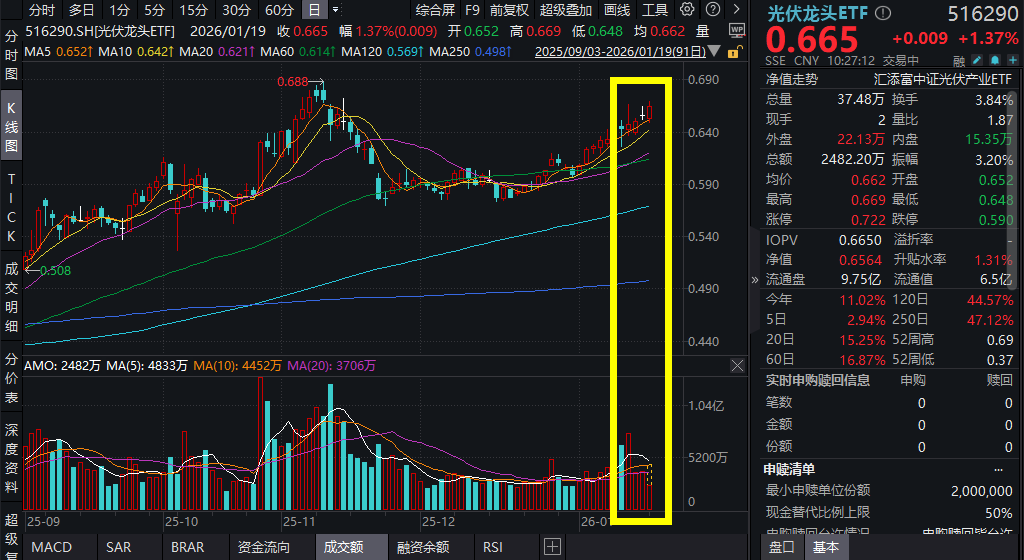
Core Viewpoint - The A-share market experienced fluctuations with the photovoltaic leader ETF (516290) seeing a significant increase of 1.37%, with a trading volume exceeding 30 million yuan, marking a four-day consecutive rise in daily performance [1]. Group 1: Market Performance - The photovoltaic leader ETF (516290) showed mixed performance among its constituent stocks, with TBEA rising over 7%, Maiwei Co. and Chint Electric increasing over 5%, while Longi Green Energy and Jiejia Weichuang experienced pullbacks [3]. - The top ten constituent stocks of the photovoltaic leader ETF include TBEA, which rose by 7.07%, and TCL Technology, which increased by 2.90%, while Longi Green Energy fell by 2.24% [4]. Group 2: Industry Developments - Junda Co. announced a 30 million yuan investment in Shanghai Xingyi Chip Energy Technology Co., aiming to leverage opportunities in the low-orbit satellite networking and space computing industry, enhancing capabilities in photovoltaic industrialization and perovskite technology [5]. - Space photovoltaic energy is highlighted as a strategic solution for commercial space and high-end applications, with the potential to supply energy to satellites and space stations, marking a pivotal moment for the industry [5]. Group 3: Future Outlook - Huaxi Securities emphasizes that photovoltaic technology is the only viable energy solution in space, with advantages over traditional fossil fuels and nuclear energy, making it suitable for extreme environments [5]. - According to CITIC Securities, the space photovoltaic market is expected to reach a trillion yuan scale, with satellite launches projected to increase from 5,000 to 50,000 between 2025 and 2040, driving demand for photovoltaic batteries from 0.024 GW to 1.8 GW [5]. - Guojin Securities expresses strong confidence in "space photovoltaic" becoming a dominant theme in the energy sector through 2026, driven by surging demand and the urgency for resource competition [6].