
国信证券

Search documents
行业研究、行业年度策略:模式换新,乘势而上
Shanxi Securities· 2026-01-15 02:27
Group 1 - The report emphasizes the need for the securities industry to enhance its service quality to better support the real economy, aligning with the "14th Five-Year Plan" which aims to improve the adaptability and inclusiveness of the capital market [13][14] - The report highlights the importance of policy-driven reforms in the capital market, focusing on supporting technological innovation, meeting diverse investor needs, and facilitating high-level institutional openness [16][15] - The securities industry is expected to benefit from ongoing capital market reforms, with a shift from "incremental expansion" to "stock optimization," creating significant opportunities for securities firms [4][3] Group 2 - The report identifies a major shift towards long-term investment systems, with a notable increase in equity investments driven by the transfer of household wealth towards equity assets [24][25] - In 2025, the issuance of public funds reached 1,553, with equity funds seeing explosive growth, indicating a strong demand for equity investment products [25][26] - The report notes that the asset management sector is experiencing a transition towards active management, with a significant increase in the scale of asset management by securities firms [29][30] Group 3 - The report discusses the explosive growth of mergers and acquisitions (M&A) in the capital market, with a notable increase in the number of disclosed M&A transactions in 2025 [37][38] - It highlights the diversification of transaction mechanisms and payment methods in M&A, indicating a more innovative and efficient market environment [38][39] - The report emphasizes that leading securities firms are leveraging their full industry chain capabilities to dominate complex transactions, particularly in high-growth sectors like semiconductors and renewable energy [38][39] Group 4 - The report outlines the acceleration of internationalization in the securities industry, driven by policy support for cross-border business development and the expansion of overseas operations [41][42] - It notes that securities firms are increasingly focusing on serving domestic enterprises' overseas financing needs and facilitating international asset allocation for domestic clients [42][43] - The report indicates that both large and small securities firms are adopting differentiated strategies in their international business development, with a focus on specific regional markets [43][44] Group 5 - The report highlights a trend towards differentiation in business models among securities firms, moving from scale-driven strategies to quality-driven approaches [44][45] - It notes that while larger firms maintain a strong market position, smaller firms exhibit greater elasticity in performance during market fluctuations [44][45] - The report emphasizes the need for securities firms to enhance their operational efficiency and adapt to a low-interest-rate environment by improving their fee structures and service offerings [45][46]


国信证券:GEO加速AI应用破圈及商业化落地 把握AI催化下的板块投资机会
智通财经网· 2026-01-15 01:29
Group 1: Core Insights - GEO is restructuring its traffic and content service ecosystem, with AI applications catalyzing sector performance, particularly in AI marketing and multi-modal applications [1][4] - The media sector underperformed in December 2025, with the media index down 1.60%, lagging behind the CSI 300 index by 3.88 percentage points [1] - The gaming market in China is expected to see significant growth, with 1,772 game licenses issued in 2025, a 25.1% year-on-year increase, and total market revenue projected at 350.79 billion yuan, up 7.7% [2] Group 2: Market Performance - Tencent performed well in the variety show market, with a total box office of 3.712 billion yuan in December 2025, a 58.0% increase year-on-year [3] - The short drama and comic drama segments are gaining popularity, with notable titles leading in viewership [3] - The current valuation of the media index stands at a TTM-PE of 45.8x, which is at the 69.7% percentile over the past five years [1] Group 3: AI Applications and Market Trends - The global GEO market is projected to reach $24 billion by 2026 and $100 billion by 2030, with domestic figures expected to hit 11.1 billion yuan by 2026 [4] - The shift in traffic dynamics from "list links" to "direct answers" is expected to compress intermediary value while amplifying the value of content sources [4] - Investment opportunities are anticipated across the value chain, from upstream content libraries to downstream platform traffic entry points [4]

0费率理财产品涌现,机构盯上万亿存款搬家蛋糕
Xin Lang Cai Jing· 2026-01-14 23:47
2026年伊始,银行理财公司降费潮再度升级,0费率、超低费率产品涌现。国有大行、股份制银行及城 商行系理财公司集体发力,通过阶段性下调固定管理费、销售服务费等方式抢占市场,目标直指持续释 放的存款搬家资金。业内人士认为,价格优惠虽能实现短期冲量,但长期发展终究要靠理财公司的核心 竞争力。机构切忌陷入单纯的价格战,必须从多维度打造差异化优势。 多家券商机构测算,2026年到期的定期存款规模均值为50万亿元。国信证券经济研究所金融团队测算, 2026年到期的全行业长期限定期存款规模为59万亿元至71万亿元。华泰证券固收研究团队测算,2026年 1年期以上定期存款到期规模为50万亿元,集中于2-5年期,国有大行占比较大,规模超30万亿元。业内 人士认为,在理财产品收益率承压背景下,规模竞争迫使机构从费率端发力,而年初"开门红"节点也促 使机构通过阶段性降费冲刺业绩。(中证报) ...
绩优权益基金密集“限流”
券商中国· 2026-01-14 23:18
Core Viewpoint - Recent market recovery has led some high-performing equity funds to implement measures such as suspending or limiting subscriptions to manage scale and ensure stable operations [1][3]. Group 1: Fund Management Actions - Some funds with strong performance and rapid scale expansion have chosen to "close their doors" to control size and ensure operational stability [2][3]. - For instance, China Europe Fund announced the suspension of subscriptions for its small-cap growth fund starting January 13, 2026, due to exceeding its scale control limit of 2 billion yuan [3]. - E Fund has also restricted subscriptions for its high-performing products, including E Fund Kexiang and E Fund Strategy Growth, effective January 13, 2026 [3][4]. Group 2: Performance Metrics - As of September 2025, E Fund Kexiang had a management scale of 4.209 billion yuan and a return of 72.33% for the year, while E Fund Strategy Growth had a management scale of 1.149 billion yuan with an 86.75% return, exceeding its benchmark by 14.00% [4]. - The China Europe small-cap growth fund achieved a return of 64.32% in 2025, outperforming its benchmark by 33.99% [3]. Group 3: Thematic Market Trends - The recent surge in thematic markets, particularly in AI applications and commercial aerospace, has influenced some funds to implement temporary subscription limits to manage the influx of capital [5][6]. - For example, Yongying Information Industry Smart Selection Fund, focused on AI applications, reported a return of 35.00% since the beginning of 2026 and announced a subscription limit starting January 14, 2026 [5]. - Similarly, the Debon Stable Growth Fund achieved a return of 29.48% in the same period and also imposed subscription limits [5]. Group 4: Market Outlook - Analysts suggest that AI applications are at a critical turning point from "valuation-driven" to "performance-driven" growth, with expectations for significant breakthroughs in 2026 [6]. - The commercial aerospace sector is viewed as a core strategic area with substantial long-term growth potential, marking a historical transition from technology validation to large-scale commercial application [6].


0费率理财产品涌现机构盯上万亿存款搬家蛋糕
Zhong Guo Zheng Quan Bao· 2026-01-14 20:51
Core Insights - The banking wealth management sector is experiencing a significant wave of fee reductions, with 0-fee and ultra-low fee products becoming prevalent as banks aim to capture the outflow of deposits [1][2] - While short-term fee reductions can boost sales, long-term success will depend on the core competitiveness of wealth management firms, which should avoid solely engaging in price wars [1][3] Fee Reduction Trends - Major banks, including state-owned and joint-stock banks, have collectively announced fee adjustments, with some products seeing fixed management fees drop from 0.15% to 0.01% [1] - Ningyin Wealth Management has implemented fee reductions across over 100 products, with around 40 products having their sales service fees adjusted to 0 [2] - South Wealth Management has issued 31 announcements regarding fee adjustments, with many products seeing fixed management fees and sales fees reduced to 0.01% [2] Driving Factors Behind Fee Reductions - The current wave of fee reductions is driven by multiple factors, including the need to attract deposit outflows and expand management scale, with an estimated 50 trillion yuan in fixed-term deposits maturing in 2026 [2][3] - The competitive landscape and the "New Year" sales push are prompting institutions to lower fees to enhance performance [3] Implications of Fee Reductions - Fee reductions can enhance perceived returns for investors, especially in a low-interest environment, but they may also compress profit margins for wealth management firms, making it challenging to cover operational costs [3] - The current fee adjustments are viewed as temporary marketing strategies rather than permanent changes, as maintaining low or zero fees could severely impact profitability [3][4] Building Core Competitiveness - Experts suggest that long-term success in the wealth management industry will require firms to develop four core capabilities: strong research and asset allocation, product innovation and differentiation, efficient operations and digital capabilities, and professional customer service [4] - The wealth management sector is expected to see growth in insurance, "fixed income+" products, and private equity funds, with a projected growth rate of 8%-12% for wealth management scale in 2026 [4]

银行“开门红”变奏:揽储氛围有点“冷” 财富业务有些“热”
Shang Hai Zheng Quan Bao· 2026-01-14 17:51
Core Viewpoint - The banking industry is undergoing a significant shift in marketing strategies, moving away from promoting high-interest deposit products towards recommending wealth management and investment products due to ongoing pressure on net interest margins [2][3][5]. Group 1: Changes in Marketing Strategies - Traditionally, the beginning of the year is a peak marketing season for banks, focusing on high-interest deposit products. However, this year has seen a quieter approach, with banks emphasizing wealth management instead [3][4]. - Banks are adjusting their performance evaluation metrics, reducing the weight of deposit-related indicators and focusing more on total assets under management (AUM), which includes wealth management products [3][4]. - Local banks are also shifting strategies, with many previously high-interest deposit banks lowering their deposit rates, indicating a broader industry trend [3][4]. Group 2: Importance of Deposits - Despite the shift in focus, deposits remain crucial for banks, especially in a competitive environment with narrowing interest margins. Stable and low-cost deposits are essential for business development [4]. - The current strategy aims to reduce high-cost deposits while optimizing the liability structure, moving away from the traditional "deposit-first" approach [4][5]. Group 3: Decline of High-Interest Deposits - The banking sector is experiencing a profound adjustment in its liability structure, with high-interest deposit products being phased out due to cost pressures. Many banks have removed long-term deposit options from their offerings [5][6]. - Major state-owned banks have already eliminated five-year large deposits, and some are experiencing an inverted yield curve where short-term deposit rates exceed long-term rates [5][6]. Group 4: Upcoming Maturity of Deposits - A significant portion of term deposits is set to mature, with predictions indicating that by mid-2025, 38% of total deposits will be due, amounting to approximately 57 trillion yuan [7]. - This maturity wave presents both challenges and opportunities for banks, as it may lead to liquidity pressures while also allowing for the replacement of high-interest deposits with lower-cost liabilities [7][8]. Group 5: Investment Trends - The maturing deposits are expected to be redirected towards wealth management products, public funds, and insurance savings, as these offer more attractive relative returns compared to new deposit rates [8][9]. - Banks are encouraged to introduce tiered deposit products and enhance wealth management services to retain clients' comprehensive assets rather than solely focusing on deposit volumes [9].

存款江湖变天遇上开门红:大行拼“资产提升”,小行逆势提利率
Di Yi Cai Jing· 2026-01-14 16:57
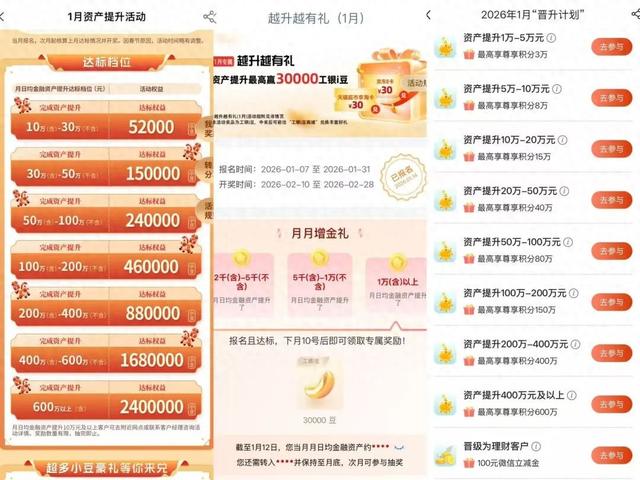
Core Insights - Major banks are launching "opening red" activities to attract depositors, focusing on enhancing various financial asset scales amid declining interest rates and expiring fixed deposits [1][9] - State-owned banks are shifting their strategy from merely attracting deposits to enhancing assets under management (AUM) and strengthening wealth management, with a clear urgency for retail strategy transformation by 2026 [1][10] Group 1: Asset Enhancement Activities - Agricultural Bank of China has initiated a "Unified Asset Enhancement Activity" from January to March 2026, offering rewards based on the increase in monthly average financial assets, with seven tiers of rewards ranging from 52,000 to 2,400,000 small beans [3][4] - Industrial and Commercial Bank of China (ICBC) has a similar program targeting customers with average financial assets below 10,000, offering rewards based on asset increases, with rewards ranging from 5,000 to 30,000 ICBC beans [5] - Other banks like China Construction Bank and Bank of China are also launching asset enhancement activities with various reward structures, indicating a competitive landscape among banks [5] Group 2: Interest Rate Adjustments - Some small and medium-sized banks are raising deposit interest rates to attract customers, with increases of up to 20 basis points, reflecting a strategy to counteract deposit outflows [1][9] - For instance, Hubei Macheng Rural Commercial Bank has raised rates on several deposit products, with the highest rate reaching 1.6% for certain terms [10][11] - Jiangsu Bank has also introduced high-interest fixed deposit products, indicating a trend among smaller banks to offer competitive rates to retain customers [11] Group 3: Customer Engagement Strategies - Social media platforms are buzzing with strategies shared by users on how to maximize benefits from various banks' asset enhancement activities, indicating a growing consumer awareness and engagement [7][8] - Banks are increasingly using these promotional activities not just for attracting deposits but also as tools for maintaining customer relationships, reflecting a shift in traditional banking strategies [10]




60万亿存款年内到期,A股接得住吗
Tai Mei Ti A P P· 2026-01-14 16:28
Core Viewpoint - The article discusses the impending maturity of a significant amount of household savings deposits in China, which could impact market supply and demand dynamics in 2026, amidst a changing macroeconomic environment. Group 1: Deposit Maturity and Scale - The maturity of household savings deposits is expected to reach between 30 trillion to 60 trillion yuan in 2026, with estimates varying among institutions [1][3][5] - The total amount of domestic RMB deposits in financial institutions was approximately 327 trillion yuan as of November 2025, with household time deposits accounting for 121 trillion yuan [3] - A notable decline in the growth of household time deposits was observed, with an increase of only 11.03 trillion yuan in 2025, the lowest since 2022 [3] Group 2: Market Dynamics and Investment Trends - The expectation of a "deposit migration" process has begun, with significant funds potentially flowing into other wealth management assets as deposit rates decline [2][8] - Various brokerages predict a peak in deposit maturities in 2026, particularly for three-year time deposits initiated in 2023, with estimates suggesting a maturity volume of 38 trillion yuan [6][7] - The overall trend indicates that even a small percentage of funds migrating from deposits could represent a substantial amount due to the large base of total deposits [13] Group 3: Alternative Investment Products - Financial products such as wealth management, insurance, and funds are becoming more common alternatives to traditional deposits, with insurance products showing strong appeal due to their higher yields compared to bank deposits [10][11] - The insurance sector is expected to attract significant funds as it offers stable returns and safety, especially as traditional deposit rates decline [10] - Wealth management products are projected to grow significantly, with estimates suggesting an increase of 3.83 trillion yuan under conservative scenarios in 2026 [9] Group 4: Stock Market Implications - The A-share market has shown signs of increased activity, with a record number of new accounts opened in 2025, indicating potential interest in stock investments [12] - Despite skepticism about a direct correlation between deposit maturity and stock market inflows, the sheer volume of deposits suggests that even minor reallocations could lead to significant capital entering the market [13][14] - Some analysts believe that the current environment may lead to a greater willingness among middle-income groups to invest in the stock market, influenced by positive market sentiment [14]

非银金融行业点评报告:两融杠杆上限调降对券商影响有限,看好板块行情
KAIYUAN SECURITIES· 2026-01-14 14:40
Investment Rating - The industry investment rating is "Overweight" (maintained) [2] Core Insights - The report indicates a positive outlook for the non-bank financial sector, highlighting a favorable economic environment and a balanced investment strategy [4][8] - The adjustment of the financing margin ratio by the China Securities Regulatory Commission is expected to have limited impact on existing financing businesses, as the current leverage levels in credit accounts are not at their maximum [5][6] - The report anticipates continued growth in the brokerage sector's return on equity (ROE), driven by factors such as the migration of household deposits and the reconstruction of stock market mechanisms [8] Summary by Sections Industry Overview - The non-bank financial sector is experiencing a recovery, with a projected increase in investment opportunities [4] - The financing scale in the market is currently at 2.67 trillion, representing 2.58% of the market's circulating value, which is below historical highs, indicating room for growth [7] Regulatory Changes - The recent increase in the financing margin ratio to 100% is limited to new financing contracts, with existing contracts remaining unaffected [5] - The regulatory environment is signaling a counter-cyclical adjustment, which is expected to stabilize the financing business [6] Performance Expectations - The brokerage sector's net income from margin trading is estimated to contribute approximately 10% to overall brokerage revenue in 2025 [7] - There is a notable expectation gap regarding the sustainability of brokerage performance and the impact of funding pressures, suggesting potential for growth in the sector [8]
12月进出口数据点评:外贸力撑“三驾马车”
Guoxin Securities· 2026-01-14 14:04
Trade Performance - December exports increased by 6.6% year-on-year, while imports grew by 5.7%, resulting in a trade surplus of $114.14 billion[2] - For the entire year, exports rose by 5.5%, and imports recorded no growth, leading to a total trade surplus of $1,189.99 billion, marking a historic high[4] Structural Changes - High-end manufacturing and key resource products drove export growth, with significant increases in automotive exports (up 71.7%), integrated circuits (up 47.7%), and rare earths (up 53.3%)[13] - Exports to emerging markets, particularly countries along the Belt and Road Initiative, accounted for 53% of total exports in December, mitigating weak demand from traditional markets like the U.S.[6] Import Dynamics - December imports reached $223.69 billion, reflecting a 5.7% year-on-year increase, driven by seasonal procurement of energy and raw materials[15] - Resource-based imports, including rare earths (up 102.0%) and copper ore (up 33.2%), indicated robust industrial production demand[16] Future Outlook - The external trade environment is expected to remain resilient, with geopolitical factors continuing to reshape trade structures and a focus on bilateral and regional cooperation[5] - Service exports and new trade forms are anticipated to become significant growth drivers in the future[20]