盐津铺子

Search documents
盐津铺子(002847):2026年度投资峰会速递:品类品牌战略驱动价值增长
HTSC· 2025-11-07 11:35
Investment Rating - The investment rating for the company is maintained as "Buy" with a target price of RMB 89.52 [1][4]. Core Insights - The company is focusing on a category brand strategy to drive value growth, with a positive outlook for revenue and profit margin improvement through product innovation and channel expansion [1][2][3]. Product Strategy - The company has restructured its organization to manage products based on trends and growth potential, dividing into three main divisions: Spicy (mainly konjac and dried tofu), Health (deep-sea snacks, quail eggs), and Sweet (jelly, baked goods). The konjac division is expected to benefit from innovative flavors and controlled price competition [2][3]. Channel Strategy - The company is enhancing its high-value channel layout by focusing on e-commerce and quantitative distribution channels. E-commerce is expected to improve profitability despite initial revenue adjustments, while quantitative channels are projected to maintain high growth driven by konjac products [3]. Profitability Outlook - The company's profit margin improved year-on-year in Q3 2025 due to a focus on key products and the elimination of inefficient products and channels. The outlook suggests further cost improvements and brand building investments for major products [3][4]. Financial Projections - The company maintains its earnings forecast, expecting EPS of RMB 3.09, 3.73, and 4.34 for 2025, 2026, and 2027 respectively. The target PE for 2026 is set at 24x, aligning with comparable companies [4][9].

食品饮料行业10月月报:个股表现好于板块整体,关注新消费-20251107
Zhongyuan Securities· 2025-11-07 09:00
Investment Rating - The industry investment rating is "In line with the market," indicating that the industry index is expected to fluctuate between -10% to 10% relative to the CSI 300 over the next six months [58]. Core Insights - The food and beverage sector recorded a decline in October 2025, with a component index drop of -0.58%. The performance of the liquor segment significantly dragged down the overall results, while sectors like prepared foods, health products, and baking showed positive growth [6][7]. - From January to October 2025, the food and beverage sector's cumulative performance was -0.97%, underperforming the market benchmark index, with significant contributions from the weak performance of major segments like liquor and beer [11][14]. - The valuation of the food and beverage sector is at a relative low point historically, with a current valuation of 20.06 times earnings, down 6.27% from the previous month. This is the lowest in ten years, with liquor valuations also below the sector average [17]. - In October 2025, 60.16% of individual stocks in the sector saw price increases, indicating that individual stock performance was better than the overall sector [23][29]. Summary by Sections 1. Market Performance of the Food and Beverage Sector - The food and beverage sector experienced a decline in October 2025, with a component index drop of -0.58%. The total trading volume for the sector was 20.352 billion shares, a significant decrease from September [6][7]. - The cumulative performance from January to October 2025 was -0.97%, with the sector ranking last among 31 primary industries [11][14]. 2. Valuation of the Food and Beverage Sector - As of October 31, 2025, the sector's valuation stood at 20.06 times earnings, marking a 6.27% decrease from the previous month. This valuation is lower than 20 other industries, placing it in the lower tier of industry valuations [17]. 3. Individual Stock Performance - In October 2025, 60.16% of individual stocks in the food and beverage sector increased in value, with notable performances from composite seasoning, dairy, health products, and prepared foods [23][29]. - Specific stocks that performed well included Hai Xin Foods (+12.65%), Tang Chen Bei Jian (+8.85%), and others across various sub-sectors [24][25]. 4. Industry Output and Price Factors - The food and beverage manufacturing sector saw a fixed asset investment increase of 22.9% year-on-year in 2024, with a continued high growth level into 2025 [31]. - Production trends showed a decline in liquor and wine output, while fresh meat and edible oil production maintained growth [35][37]. 5. Investment Strategy - The report recommends focusing on investment opportunities in soft drinks, health products, baking, yeast, composite seasoning, and snacks for November 2025 [54][55]. - The suggested stock portfolio includes companies like Bao Li Foods, Li Gao Foods, and Xian Le Health, all rated for potential growth [56].
休闲食品板块11月7日涨0.1%,好想你领涨,主力资金净流出2563.74万元
Zheng Xing Xing Ye Ri Bao· 2025-11-07 08:41
Market Overview - The leisure food sector increased by 0.1% on November 7, with "Hao Xiang Ni" leading the gains [1] - The Shanghai Composite Index closed at 3997.56, down 0.25%, while the Shenzhen Component Index closed at 13404.06, down 0.36% [1] Top Performers - "Hao Xiang Ni" (002582) closed at 10.17, up 2.01% with a trading volume of 136,900 shares and a turnover of 139 million yuan [1] - "Gui Fa Xiang" (002820) closed at 13.65, up 1.41% with a trading volume of 226,700 shares and a turnover of 310 million yuan [1] - "Mai Qu Er" (002719) closed at 696, up 1.04% with a trading volume of 58,400 shares and a turnover of approximately 56.37 million yuan [1] Underperformers - "Li Gao Food" (300973) closed at 40.34, down 1.22% with a trading volume of 16,100 shares and a turnover of approximately 65.46 million yuan [2] - "Xi Mai Food" (002956) closed at 22.24, down 1.20% with a trading volume of 22,600 shares and a turnover of approximately 50.49 million yuan [2] - "ST Jue Wei" (603517) closed at 13.52, down 0.88% with a trading volume of 67,400 shares and a turnover of approximately 91.68 million yuan [2] Capital Flow - The leisure food sector experienced a net outflow of 25.64 million yuan from institutional investors, while retail investors saw a net inflow of 21.83 million yuan [2] - The overall capital flow indicates a mixed sentiment within the sector, with institutional investors pulling back while retail investors are more active [2] Individual Stock Capital Flow - "Hao Xiang Ni" saw a net inflow of 15.22 million yuan from institutional investors, but a net outflow of 10.14 million yuan from retail investors [3] - "Yan Jin Pu Zi" (002847) had a net inflow of 8.44 million yuan from institutional investors, with retail investors also showing a net outflow [3] - "Mai Qu Er" experienced a slight net outflow from institutional investors, while retail investors contributed positively with a net inflow of 2.12 million yuan [3]



食品饮料行业2026年策略:从胜率和赔率角度看食品饮料行业投资机会
Dongxing Securities· 2025-11-07 08:26
Core Insights - The report emphasizes the investment opportunities in the food and beverage industry from the perspectives of win rate and odds, suggesting a transition from low win rates to high win rates driven by macroeconomic changes [4][13][22]. Investment Summary - The theoretical expected return formula is defined as expected investment = win rate × odds - (1 - win rate), where odds reflect valuation and potential upside versus downside risk, while win rate indicates the probability of successful investment based on fundamental momentum [4][13]. - The food and beverage sector is currently in a phase of high odds and low win rates, with the potential for improvement in win rates depending on macroeconomic conditions and overall demand changes [4][13][14]. - The report predicts that the food and beverage sector could achieve dual growth in fundamentals and valuations in 2026, contingent on macroeconomic recovery [4][14]. Investment Strategy - High win rate opportunities are primarily found in the mass consumer goods sector, particularly companies benefiting from new channels and product categories, such as leading snack food companies [5][14]. - The liquor sector is in a bottoming phase, with win rates expected to improve as fundamentals recover, representing an "odds-first" investment choice [5][14]. Valuation Perspective - The food and beverage sector's overall valuation is currently low, with the Shenwan Food and Beverage Index's price-to-earnings (PE) ratio at 21.29, which is in the 11.85th percentile historically, indicating limited downside potential and significant upside potential if fundamentals improve [15][16]. - The calculated odds for the food and beverage industry stand at 4.57, indicating a favorable risk-reward ratio [16]. Win Rate Analysis - The win rate is assessed through various dimensions, including profitability momentum, funding conditions, and macroeconomic policy environments, with a focus on how these factors influence the food and beverage sector [22][23]. - The report highlights a strong correlation between macroeconomic indicators and the revenue and net profit of the food and beverage sector, suggesting that macroeconomic changes will significantly impact industry performance [24][26]. Macroeconomic and Policy Impact - Recent macroeconomic policies aimed at boosting consumption and expanding domestic demand are expected to create a favorable environment for the recovery of the food and beverage sector [27][29]. - The report notes that as macroeconomic totals increase, food and beverage consumption is likely to follow suit, enhancing the certainty of growth in the sector [27][29]. Interest Rate Influence - The report discusses the negative correlation between interest rates and asset pricing in the food and beverage sector, indicating that a decrease in U.S. interest rates could positively impact domestic valuations [30][31]. Growth Momentum - The report identifies three underlying forces affecting the profitability momentum in the food and beverage sector: demand-side changes, cost-side pressures, and corporate governance [35]. - It emphasizes that the recovery of the macroeconomic environment will lead to improved demand, thereby enhancing the overall win rate for the food and beverage sector [35]. Conclusion on Investment Opportunities - The food and beverage sector is positioned for a transition from low to high win rates, with significant investment potential as macroeconomic conditions improve [36][40]. - Recommended companies include leading snack food firms such as Salted Fish and Sweet Potato, as well as liquor giants like Kweichow Moutai and Wuliangye [40].



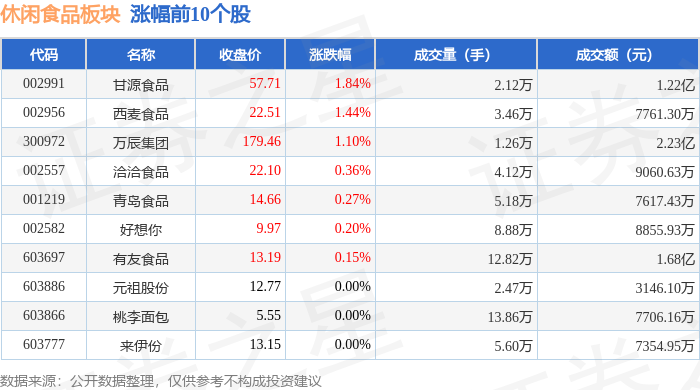
休闲食品板块11月6日跌0.13%,ST绝味领跌,主力资金净流出1.26亿元
Zheng Xing Xing Ye Ri Bao· 2025-11-06 08:51
Market Overview - The leisure food sector experienced a slight decline of 0.13% on November 6, with ST Juewei leading the drop [1] - The Shanghai Composite Index closed at 4007.76, up 0.97%, while the Shenzhen Component Index closed at 13452.42, up 1.73% [1] Individual Stock Performance - Notable gainers in the leisure food sector included: - Ganyuan Food (002991) with a closing price of 57.71, up 1.84% and a trading volume of 21,200 lots [1] - Ximai Food (002956) closed at 22.51, up 1.44% with a trading volume of 34,600 lots [1] - Wancheng Group (300972) closed at 179.46, up 1.10% with a trading volume of 12,600 lots [1] - Conversely, ST Juewei (603517) saw a decline of 1.52%, closing at 13.64 with a trading volume of 91,600 lots [2] - Other notable decliners included: - Yanjinpuzi (002847) down 1.38% to 71.33 [2] - Three Squirrels (300783) down 1.02% to 23.32 [2] Capital Flow Analysis - The leisure food sector saw a net outflow of 126 million yuan from institutional investors, while retail investors contributed a net inflow of 100 million yuan [2] - The overall capital flow for individual stocks showed mixed results, with Ganyuan Food experiencing a net inflow of over 3.89 million yuan from institutional investors [3] - Other stocks like Ziyan Food (603057) had a net inflow of 1.55 million yuan from institutional investors, while stocks like ST Juewei and Lihai Food (300973) faced significant net outflows [3]




食品饮料2025年三季报总结:白酒主动释放压力,速冻迎来行业拐点,软饮、零食量贩高景气维持
China Post Securities· 2025-11-06 05:06
Industry Investment Rating - The investment rating for the food and beverage industry is "Outperform" [1] Core Insights - The report highlights that the liquor sector is actively releasing pressure on financial statements, with the industry gradually bottoming out. The frozen food sector is witnessing a turning point, while the soft drink and snack sectors maintain high levels of prosperity [3][4][30] Summary by Sections 1. Liquor - The liquor sector's total revenue for the first three quarters of 2025 was CNY 319.23 billion, a year-on-year decrease of 5.76%, with net profit down 6.85% to CNY 122.67 billion. In Q3 alone, revenue fell 18.38% to CNY 78.48 billion, and net profit dropped 22.00% to CNY 28.09 billion [14][28] - High-end liquor brands like Moutai showed stable growth, while others like Wuliangye and Luzhou Laojiao faced significant declines. Moutai's revenue grew by 9.28% year-on-year, while Wuliangye's fell by 10.26% [17][19] - The second-tier liquor brands, such as Fenjiu, showed resilience with a revenue increase of 5.00%, while others like Shui Jing Fang and Shede experienced declines [26][22] 2. Soft Drinks - The soft drink sector saw significant growth, with companies like Dongpeng Beverage reporting a 34.13% increase in revenue year-on-year. The energy drink segment, particularly, showed robust growth [30][31] - The introduction of new flavors and products, such as Dongpeng's summer limited edition, contributed to the sustained high growth rates in this sector [30] 3. Dairy Products - The dairy sector, led by Yili, maintained stable performance despite high base effects, with significant growth in milk powder and cold drink products. New Dairy's low-temperature products continued to show double-digit growth [4][31] 4. Frozen Foods - The frozen food industry is experiencing a turning point, with companies noting that the price war has peaked. The focus is shifting towards rational competition and value [7][30] 5. Snacks - The snack sector is undergoing strategic adjustments, with member stores and instant retail becoming key growth channels. The overall consumption environment remains weak, but the snack sector is adapting with targeted strategies [7][30]


食品饮料周报(25年第40周):酒类渠道包袱加速去化,大众品品类表现分化-20251105
Guoxin Securities· 2025-11-05 11:16
Investment Rating - The report maintains an "Outperform the Market" rating for the food and beverage sector [4][5][11]. Core Views - The food and beverage sector is currently characterized by "low base, low holdings, and low expectations," indicating potential for stock price increases with any changes in supply and demand dynamics [3][11]. - The report highlights a divergence in performance across categories, with beverages outperforming food and alcoholic beverages [2][11]. - The report suggests that the liquor segment is entering a left-side layout phase, with quality companies expected to gain greater growth opportunities [2][11]. Summary by Relevant Sections Liquor - The liquor sector is experiencing an expanded decline in performance, with Q3 revenue down 18.4% year-on-year and net profit down 22.2% [2][11]. - Recommended companies include Luzhou Laojiao, Shanxi Fenjiu, and Guizhou Moutai, which are expected to benefit from national expansion and pricing power [2][11]. - The report notes that the current inventory clearance pace is similar to the 2013-2014 period, suggesting a potential recovery in the future [11]. Beer - The beer industry is in a healthy inventory position, awaiting demand recovery, with recommendations for Yanjing Beer and China Resources Beer [12][11]. - The report anticipates that the relaxation of consumption regulations will positively impact beer sales [12]. Dairy Products - The dairy sector is seeing a steady recovery in demand, with a recommendation for Yili as a leading company with valuation safety margins [14][11]. - The report indicates that the supply side is gradually clearing, which may lead to improved supply-demand dynamics by 2025 [14]. Snacks - The report emphasizes the importance of strong alpha stocks in the snack sector, particularly focusing on the growth potential of konjac snacks [12][11]. - Leading companies in this category, such as Weidong and Yanjin Pouch, are highlighted for their competitive advantages and strong growth prospects [12]. Food Supply Chain - The food supply chain sector is showing signs of stabilization, with recommendations for leading companies like Yihai International and Haitian Flavoring [13][11]. - The report notes that the overall profitability of the industry is expected to gradually stabilize as companies optimize their expense management [13]. Beverages - The beverage sector continues to show strong performance, with recommendations for Nongfu Spring and Dongpeng Beverage, which are expected to benefit from accelerated operations and national expansion [14][11]. - The report highlights the ongoing growth in the no-sugar tea and energy drink segments, indicating a favorable outlook for leading companies [14].


“史上最长”春节假期来了!这些板块或可关注
天天基金网· 2025-11-05 09:10
Core Viewpoint - The announcement of the longest Spring Festival holiday in history, lasting 9 days in 2026, is expected to significantly benefit various sectors including tourism, hospitality, retail, and transportation [2][5]. Tourism and Travel - The extended holiday is anticipated to boost travel demand, with a reported 63% increase in flight bookings for the 2026 Spring Festival compared to 2025 [6]. - Data from Qunar indicates a threefold increase in searches for flights during the Spring Festival shortly after the announcement, highlighting a surge in travel interest [5]. - Spring and summer travel to popular European destinations has seen a 200% increase in inquiries, indicating a strong demand for international travel during the holiday [5]. Hospitality and Dining - The longer holiday is expected to enhance overnight stays and dining out, benefiting hotels, restaurants, and related services [6]. - The hospitality sector, including hotels and restaurants, is likely to experience increased patronage due to the extended holiday period [6]. Retail and Consumer Spending - The holiday is projected to stimulate consumer spending in retail, particularly in sectors like duty-free shopping and commercial retail [2]. - Increased travel and dining out during the holiday are expected to drive sales in the retail sector, particularly in urban areas [6]. Industry Implications - The extended holiday will likely lead to a more balanced daily flow of tourists, reducing congestion and enhancing the overall travel experience [6]. - Analysts suggest that the 9-day holiday will not only encourage long-distance and interprovincial travel but also increase the duration of stays, positively impacting various industries [6].

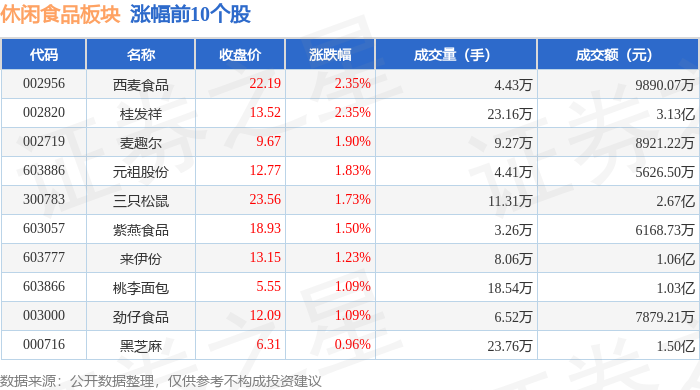
休闲食品板块11月5日涨0.08%,西麦食品领涨,主力资金净流出367.26万元
Zheng Xing Xing Ye Ri Bao· 2025-11-05 08:42
Market Overview - The leisure food sector increased by 0.08% on November 5, with Ximai Food leading the gains [1] - The Shanghai Composite Index closed at 3969.25, up 0.23%, while the Shenzhen Component Index closed at 13223.56, up 0.37% [1] Stock Performance - Ximai Food (002956) closed at 22.19, up 2.35% with a trading volume of 44,300 shares and a transaction value of 98.90 million [1] - Guifaxiang (002820) also rose by 2.35% to 13.52, with a trading volume of 231,600 shares and a transaction value of 313 million [1] - Other notable performers include Maiqu'er (002719) up 1.90% to 9.67, and Sanzhi Songshu (300783) up 1.73% to 23.56 [1] Capital Flow - The leisure food sector experienced a net outflow of 3.67 million from institutional investors, while retail investors saw a net outflow of 43.58 million [2] - Conversely, speculative funds recorded a net inflow of 47.25 million [2] Individual Stock Capital Flow - Sanzhi Songshu (300783) had a net inflow of 20.74 million from institutional investors, but a net outflow of 30.54 million from retail investors [3] - Guifaxiang (002820) saw a net inflow of 9.29 million from institutional investors, with a net outflow of 13.02 million from retail investors [3] - Other stocks like Jinzai Food (003000) and Yuanzi Food (603886) also showed mixed capital flows, with significant retail outflows [3]


“史上最长”春节假期来了!这些板块或可关注
天天基金网· 2025-11-05 08:16
Group 1 - The 2026 Spring Festival holiday will last for 9 days, marking the longest Spring Festival holiday in history, benefiting various sectors such as tourism, hotel and catering, retail, and transportation [2][5]. - Following the announcement of the holiday, there was a significant increase in travel-related searches, with flight searches for the Spring Festival period tripling, indicating a strong demand for travel [5][6]. - The extended holiday is expected to boost long-distance and inter-provincial travel, leading to increased overnight stays and dining out, which will positively impact industries like hotels, scenic spots, and transportation [6][5]. Group 2 - Data from Qunar shows that the number of booked flights for the 2026 Spring Festival is projected to increase by 63% compared to 2025, reflecting heightened travel interest [6]. - The announcement has led to a 200% increase in inquiries for European travel, with popular destinations seeing a doubling in search volume, suggesting a potential surge in travel orders for the Spring Festival [5][6]. - The longer holiday is anticipated to create a more balanced daily flow of tourists, enhancing the overall travel experience during the Spring Festival [6].