
高盛

Search documents
金价,爆了!最新预测:或将触及这个价格→
Sou Hu Cai Jing· 2025-11-11 14:55
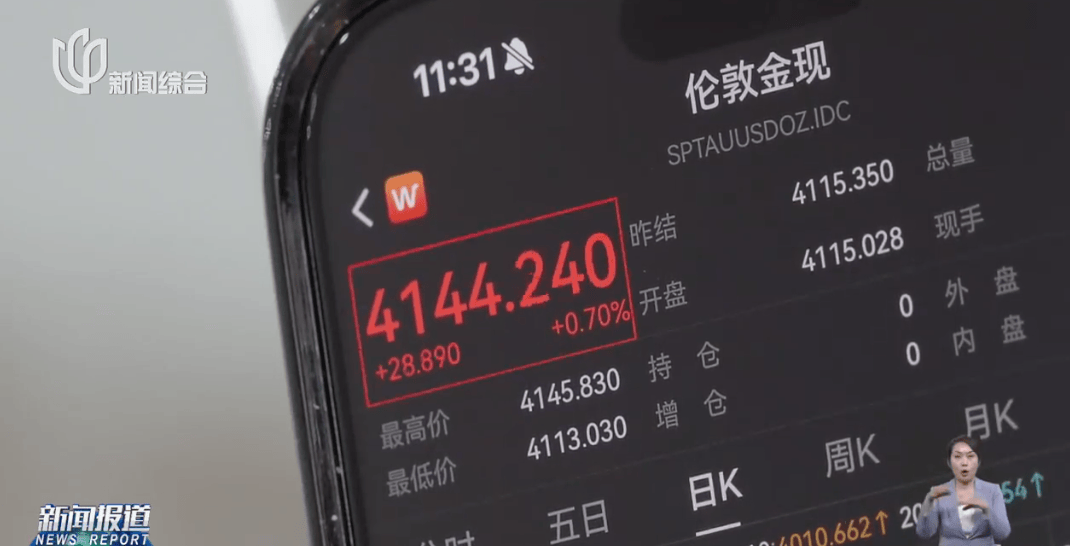
Core Viewpoint - International gold prices continue to rise, with spot gold surpassing $4,140 per ounce, marking an increase of over 3% this week [1][3]. Price Movements - Domestic gold jewelry prices have significantly increased by nearly 30 CNY per gram compared to yesterday, with some prices exceeding 1,300 CNY per gram, reaching new highs [3][5]. - Specific prices for gold jewelry include: Chow Tai Fook, Chow Sang Sang, and Chow Tai Sheng at 1,308 CNY per gram, while Lao Feng Xiang and Lao Miao gold jewelry are priced at 1,310 CNY per gram [5]. Market Dynamics - The high gold prices, combined with tax impacts, are expected to negatively affect gold sales. However, the demand for gold buying and exchanging services is anticipated to increase [9]. - A local gold shop owner noted a rise in customers exchanging old jewelry for new pieces, indicating a shift in consumer behavior due to high gold prices [11][12]. Future Outlook - Since reaching a historical high of $4,380 per ounce in mid-October, gold has decreased by approximately 6%, but it has still risen over 56% this year. Factors driving the recent price increase include a weaker dollar and geopolitical tensions [14]. - Analysts from China International Capital Corporation (CICC) predict that gold prices may continue to rise next year, supported by central bank purchases in emerging markets and potential economic pressures in the U.S. [14]. - Alex Wolf from JPMorgan forecasts that gold prices could reach $5,200 to $5,300 by the end of 2026, driven by central bank demand, particularly from countries like China, Poland, Turkey, and Kazakhstan [16]. - The People's Bank of China reported an increase in gold reserves to 74.09 million ounces as of the end of October, marking the 12th consecutive month of gold accumulation [18]. - The World Gold Council's report indicates that global central banks accelerated gold purchases in Q3, with a net purchase of 220 tons, a 28% increase from Q2 and a 10% year-on-year rise [18].

AI泡沫论甚嚣尘上之际 微软(MSFT.US)真金白银驳斥:百亿美元投向葡萄牙海岸数据中心
智通财经网· 2025-11-11 13:12
Core Insights - Microsoft announced a significant investment of up to $10 billion to build a large AI data center in Sines, Portugal, marking it as one of the largest investment projects in Europe for the year [1][4] - This investment counters the prevailing "AI bubble" narrative, reinforcing the ongoing "AI super investment cycle" [1][3] - The data center will be developed in collaboration with local developer Start Campus and UK startup Nscale, with the first building already opened in March [1][2] Investment and Infrastructure - Microsoft has signed a long-term capacity leasing agreement for AI computing infrastructure in Sines, as part of its expansion to meet the growing AI computing demands of its Azure cloud platform [2] - The company is also entering into long-term partnerships with several "neocloud" service providers to secure AI computing resources, including CoreWeave Inc. and Nebius Group NV [2] - Sines is becoming a key investment hub due to its geographical advantages, including large-scale submarine cables connecting Europe with Brazil and Africa [2] Market Sentiment and Future Outlook - The substantial investment by Microsoft serves as a strong rebuttal to concerns about an AI investment bubble, especially as major tech companies continue to expand their AI data center capabilities [3][4] - Analysts predict that overall capital expenditures for large tech companies could rise significantly from approximately $380 billion this year to nearly $550 billion or $600 billion by 2026, driven by the next wave of AI spending [4] - Major financial institutions believe that the global AI infrastructure investment wave is just beginning, with potential investments reaching $3 trillion to $4 trillion by 2030 [5]

高盛调研发现A股机器人“订单荒”?产业链上市公司:静待订单落地
第一财经· 2025-11-11 10:11
Core Viewpoint - The article discusses the contrasting expectations and realities in the humanoid robot sector, highlighting a recent Goldman Sachs report that indicates a lack of confirmed large orders despite optimistic production capacity plans from several companies [4][12]. Group 1: Market Sentiment and Capacity Planning - Goldman Sachs conducted a survey of nine Chinese robot supply chain companies, revealing that while they are planning annual production capacities ranging from 100,000 to 1 million units, none have confirmed large orders or clear timelines for mass production [4][6]. - Companies like Top Group and Sanhua Intelligent Control are actively planning production facilities in Thailand and Mexico, with Top Group's Thai factory projected to have an annual capacity of 1 million units and an investment of 7-8 billion yuan [7][8]. - Despite the current lack of orders, industry insiders suggest that the proactive capacity planning is typical for emerging industries and does not necessarily indicate an impending oversupply [5][12]. Group 2: Company Responses and Market Dynamics - Several companies, including Sanhua Intelligent Control and Top Group, have acknowledged the absence of confirmed orders but emphasize that their capacity planning is based on guidance from major clients [10][11]. - The article notes that the current "order vacuum" should not be hastily interpreted as a sign of oversupply, as the industry is still in its early development stages, and the demand-supply mismatch is common in new sectors [13]. - Companies like Minth Group and Double Ring Transmission are expanding their production capabilities in anticipation of future demand, with Minth expecting humanoid robot-related revenue to reach 5 billion yuan by 2030 [8][12]. Group 3: Long-term Industry Outlook - The report suggests that the current lack of orders does not negate the long-term growth potential of humanoid robots, as the industry is still exploring specific applications and technological paths [13]. - Goldman Sachs maintains a positive outlook on the long-term trends in humanoid robot technology, although it emphasizes the need to monitor key product performance and specific end-use applications to assess potential technological breakthroughs [12][13].


高盛调研发现A股机器人订单荒?产业链公司回应
Di Yi Cai Jing· 2025-11-11 09:17
Core Viewpoint - The human-shaped robot sector is experiencing a clash between optimistic expectations and the current reality, as highlighted by a Goldman Sachs report indicating that nine surveyed supply chain companies have not confirmed any significant mass production timelines or large orders [2][3]. Group 1: Survey Findings - Goldman Sachs conducted a survey from November 3 to 6, covering nine companies in the Chinese robot supply chain, including prominent firms like Sanhua Intelligent Control and Top Group [2][3]. - The surveyed companies are planning annual production capacities ranging from 100,000 to 1,000,000 robot equivalents, reflecting a positive outlook on industry growth despite the absence of confirmed large orders [3][4]. - Companies like Top Group and Sanhua Intelligent Control are actively establishing production lines in Thailand and Mexico, with Top Group's Thai factory projected to have an annual capacity of 1,000,000 units and an investment of approximately 7 to 8 billion yuan [4]. Group 2: Production Capacity and Market Response - Despite the ambitious production plans, none of the surveyed companies have confirmed receiving substantial orders, leading to concerns about potential overcapacity in the robot supply chain [3][6]. - Companies are preparing for future demand based on guidance from major clients, even though they currently lack confirmed orders [6][7]. - Analysts suggest that the current lack of orders should not be interpreted as a sign of overcapacity, as proactive capacity planning is typical in emerging industries [8]. Group 3: Industry Outlook - The optimism surrounding production capacity expansion is driven by the belief in the long-term potential of the human-shaped robot market, with companies like Minth Group projecting revenues of 5 billion yuan from related businesses by 2030 [5][8]. - The current phase of order scarcity is viewed as a natural part of the industry's early development, with significant uncertainties regarding future demand and technological evolution [8]. - Goldman Sachs maintains a positive long-term outlook on human-shaped robot technology, emphasizing the need to monitor key product performance and applications to assess potential technological breakthroughs [8].

昨夜,芯片股大涨!
Zheng Quan Shi Bao· 2025-11-10 23:55
Market Overview - On November 10, US stock indices collectively rose, with the Dow Jones up 0.81%, S&P 500 up 1.54%, and Nasdaq up 2.27% [1][2] - The S&P 500 saw eight sectors rise and three decline, with the technology and communication services sectors leading the gains at 2.68% and 2.53% respectively [2] Semiconductor Sector - The Philadelphia Semiconductor Index increased by 3.02%, with notable gains in Micron Technology (over 6%), Nvidia (over 5%), and AMD (over 4%) [2] - Industry reports indicate a global AI wave is driving demand, leading to a shortage of storage chips and prompting a production expansion [2] - Major companies like Samsung, SK Hynix, and Micron are shifting capital expenditures towards high-bandwidth memory (HBM) products, suggesting a supply-demand gap in traditional storage will persist at least until next year [2] Notable Stocks - SanDisk shares rose by 11.89%, reaching a historical high, with a year-to-date increase of over 400% [2] - SanDisk has reportedly raised contract prices for its November NAND flash memory chips by 50%, driven by AI-related demand growth [2] Banking Sector - Bank stocks saw a general increase, with Morgan Stanley, Goldman Sachs, and US Bancorp rising over 1% [3] Energy Sector - Energy stocks also experienced gains, with US energy up nearly 2% and companies like ConocoPhillips and BP rising over 1% [3] Chinese Stocks - The Nasdaq Golden Dragon China Index rose by 2.25%, with significant increases in stocks like XPeng (over 16%) and Canadian Solar (nearly 14%) [3]
每日投行/机构观点梳理(2025-11-10)
Jin Shi Shu Ju· 2025-11-10 10:46
国外 1. 三菱日联:美国政府结束停摆将降低数据不确定性和提振投资者情绪 金十数据11月10日讯,三菱日联新加坡分行高级货币分析师Lloyd Chan表示,结束政府停摆的协议可能 会引发显著的市场反应,主要体现在降低数据不确定性和提振投资者情绪。近期美国股市的反弹似乎是 由技术性复苏和市场对政府停摆即将结束的乐观情绪共同推动的。 2. 花旗:日本30年期国债收益率料将维持区间波动 花旗投资研究的Tomohisa Fujiki在一份报告中称,未来一段时间30年期日本国债的复合收益率可能会保 持在3%至3.2%的区间内。该策略师表示:"我们认为,无论预算规模如何,发行规模的缩减都将为超长 期债券提供支撑。"花旗预计,20年期和30年期日本国债每次标售的规模将减少1,000亿日元,并预计明 年40年期日本国债的发行速度将放缓。他说,市场可能会继续受美国动态的影响,但随着7-9月GDP萎 缩得到证实,市场对日本央行12月加息的定价应该会减弱。据Tradeweb的数据,30年期日本国债收益率 上升0.3个基点,至3.136%。 3. 高盛:美资大举流入日本股市,参与度达三年来最高水平 高盛表示,越来越多的美国投资者正买 ...
内存需求火爆!DRAM价格预期再度上调,AI巨头甚至疯抢2027年产能
Hua Er Jie Jian Wen· 2025-11-10 07:40
在人工智能的强劲需求驱动下,全球内存芯片市场正迎来一轮超预期的涨价潮。 据追风交易台消息,据高盛10日发布的一份研究报告,市场情报公司集邦科技(TrendForce)已再度大 幅上调其对2025年第四季度DRAM价格的增长预期。此次调整覆盖了服务器、个人电脑(PC)和智能 手机等所有主要应用,最新的预测数值现已超过了高盛此前的乐观估计。 服务器需求一骑绝尘,AI客户锁定远期产能 集邦科技最新预测显示,2025年第四季度服务器DRAM的价格环比涨幅预计将达到28-33%,远高于此 前15-20%的预期。 强劲的需求主要源于AI服务器的建设热潮。高盛报告援引集邦科技的评论称,美国云巨头与内存供应 商的谈判已进入到2027年的供应量,这为内存厂商提供了罕见的长期业务可见性。10月份的数据已经反 映了这一趋势,DDR4 64GB服务器内存模组价格单月上涨28%至300美元,DDR5 64GB模组价格也上涨 24%至338美元。 由于内存供应商优先将产能分配给利润更高的服务器客户,PC和手机制造商正面临供应紧张的局面。 集邦科技因此将第四季度PC DRAM的价格增长预期从18-23%上调至25-30%。报告提到,尽管P ...
机器人概念股走低 德昌电机控股跌超6% 三花智控跌超3%
Zhi Tong Cai Jing· 2025-11-10 02:33
Core Viewpoint - The report indicates a significant decline in robotics concept stocks, with notable drops in companies like 德昌电机控股 and 三花智控, amidst optimistic capacity planning for humanoid robot production by Chinese suppliers [1] Group 1: Stock Performance - 德昌电机控股 (00179) decreased by 6.06%, trading at 33.16 HKD [1] - 三花智控 (002050) fell by 3.56%, trading at 36.34 HKD [1] Group 2: Industry Insights - Goldman Sachs conducted a survey from November 3 to 6, 2025, involving nine Chinese supply chain companies, including 三花, 拓普, 荣泰, and 双环 [1] - The key finding is that most suppliers are actively planning production capacity in China and overseas (primarily Thailand, followed by Mexico) to support potential large-scale production of humanoid robots [1] - Planned annual production capacity ranges from 100,000 to 1,000,000 robots, indicating an aggressive outlook as Goldman Sachs forecasts only 1.38 million humanoid robots to be shipped globally by 2035 [1] Group 3: Production Strategy - No company has confirmed large-scale orders or a clear production timeline, with suppliers generally adopting a "gradual ramp-up" strategy based on actual order fulfillment [1] - This strategy helps mitigate the immediate risk of overcapacity but represents a gamble based on expectations [1]
多只持仓股大涨外资机构积极布局A股
Shang Hai Zheng Quan Bao· 2025-11-09 15:26
Group 1 - Foreign institutional investors are actively exploring structural opportunities in the A-share market, particularly in manufacturing and technology sectors [2][5] - Several QFI institutions have increased their holdings in stocks like RuiNeng Technology and YuanDa Intelligent, leading to significant price increases for these stocks [3][4] - As of November 6, foreign institutions have conducted nearly a thousand investigations into A-share listed companies, with notable interest in companies like United Imaging Healthcare and Zhaoyi Innovation [5][6] Group 2 - The recent performance of stocks such as Guoguang Chain, RuiNeng Technology, YuanDa Intelligent, and Lixing Co. has been strong, with Guoguang Chain rising by 43.67% since October [4] - Analysts from UBS and Morgan Stanley express optimism about the mid-term outlook for the A-share market, citing factors such as gradual profit recovery and continued net inflows of capital [5][6] - Six out of ten industries reported year-on-year profit growth in Q3, with sectors like non-ferrous metals, non-bank financials, and electronics achieving over 30% growth [5]



被大空头狙击的明星AI股Palantir,华尔街怎么看
Di Yi Cai Jing Zi Xun· 2025-11-09 12:38
Core Viewpoint - The recent surge in skepticism regarding artificial intelligence (AI) has led to a decline in major stock indices, with the S&P 500 down 1.6% and the Nasdaq down 3%, marking the worst weekly performance since April [1] Group 1: Market Performance and Reactions - The stock prices of AI-focused companies Palantir and Nvidia have faced significant short-selling pressure, with Palantir experiencing a maximum drawdown of approximately 18% and Nvidia 16% from their highs, contributing to the overall poor performance of tech stocks [1] - Despite Palantir's stock price increasing nearly 200% over the past year, its static price-to-earnings (P/E) ratio reached as high as 1000 times, raising concerns about its valuation amidst strong growth in AI and data analytics [2] - Following a strong third-quarter earnings report, Palantir's stock saw a decline of nearly 9% as investors took profits, despite the company reporting revenue of $1.181 billion, a 63% year-over-year increase, and adjusted net income of $477 million, up 220% [2] Group 2: Valuation Concerns - Analysts have raised concerns about Palantir's valuation, with reports indicating that its valuation is over 200 times expected earnings for 2025 and sales multiples exceeding 80 times [2] - The company has adjusted its revenue expectations for 2025 from approximately $4.14–4.15 billion to about $4.4 billion, projecting an average annual revenue growth of around 25% and an earnings per share (EPS) growth of approximately 26%–30% [4] - Despite the strong growth projections, the high valuation poses challenges for Palantir to reduce its P/E ratio from 80 times to a more typical range of 30-40 times, which could take around three years [5] Group 3: Institutional Perspectives - Amidst market pessimism, some investment banks have raised their target prices for Palantir, with Bank of America increasing its target from $215 to $255, citing Palantir's unique AI solutions and strong growth in both government and commercial sectors [4] - In contrast, Citigroup maintains a neutral stance with a target price of $190, acknowledging the strong quarterly performance but highlighting the high expectations and extreme valuation reflected in the post-earnings stock price movement [4] - Overall, institutional sentiment remains cautiously optimistic about tech stocks, with expectations for a year-end "Santa Rally" despite recent volatility [6][7]