奈雪的茶

Search documents
5家头部茶饮品牌上半年关店超1500家,行业打响“单店保卫战”
东京烘焙职业人· 2025-09-05 08:33
Core Viewpoint - The tea beverage industry is transitioning from rapid growth to a more stable and health-focused competition, with an emphasis on profitability and growth quality rather than just expansion speed [5][6][21]. Group 1: Financial Performance of Leading Brands - Gu Ming emerged as the biggest winner in the recent financial report season, achieving a revenue growth of 41.2% and an adjusted profit growth of 42.4%, outpacing its revenue growth [11]. - Ba Wang Cha Ji, despite maintaining the top position with revenue of 6.725 billion and profit of 1.307 billion, showed a concerning trend with a revenue growth of only 21.6% and an adjusted profit growth of just 6.8% [11]. - Hu Shang A Yi reported a profit growth of 14.0% but a revenue growth of only 9.7%, indicating potential fatigue in growth [11]. - Cha Bai Dao faced a challenging situation with a mere 4.3% revenue growth and a 13.8% decline in adjusted net profit [11][12]. Group 2: Store Opening and Closing Trends - Over 1,500 stores were closed among five leading tea brands in the first half of the year, indicating a significant shift in operational strategies [14]. - Gu Ming led in net store openings with an increase of 1,265 stores, while Hu Shang A Yi and Cha Bai Dao exhibited a high frequency of opening and closing stores [16]. - The aggressive expansion without proper management of single-store profitability has led to many franchisees facing difficulties, resulting in store closures [16][18]. Group 3: Market Strategy and Positioning - The tea beverage industry is entering a new cycle characterized by structural adjustments, where brands are shifting focus from rapid expansion to sustainable profitability [21]. - Ba Wang Cha Ji and Cha Bai Dao are focusing on high-tier cities, while Gu Ming and Hu Shang A Yi are targeting lower-tier markets for growth [23]. - The competition in lower-tier markets is becoming increasingly intense, with a shift from price wars to deeper operational capabilities, particularly in supply chain management [24]. Group 4: Online and Offline Channel Strategies - The reliance on online platforms for sales is growing, with Cha Bai Dao and Nai Xue's Tea investing heavily in online channels, while Gu Ming adopts a more cautious approach [25][26]. - The external pressures from online platforms create a dual-edged sword for brands, providing significant order volume but also leading to high commission and marketing costs [26]. - The new cycle in the tea beverage industry emphasizes the need for brands to establish a stable and reliable single-store profitability model [26].


Z世代,正在用情绪消费重塑市场
3 6 Ke· 2025-09-05 00:06
Group 1: Trend in Toy Industry - The toy industry is experiencing phenomenal growth in 2025, with Pop Mart achieving a revenue of 138.76 billion RMB, a year-on-year increase of 204.4%, and a pre-tax profit of 61.57 billion RMB, up 401.2% [2] - Pop Mart has evolved from a single blind box manufacturer to an "IP full industry chain operator," with 13 artist IPs generating over 100 million RMB in revenue in the first half of 2025 [2] - The card game sector, represented by Ka You, is also seeing significant growth, with a projected revenue of 100.57 billion RMB in 2024, a year-on-year increase of 278% [2] Group 2: Market Dynamics and Consumer Behavior - The rise of emotional consumption and the "Z generation" is driving the toy market, with over 500 million people in this demographic expected by 2024, leading to a market size of approximately 600 billion RMB [3] - The toy market is shifting towards mid-to-high-end products, with blind boxes, building toys, and card games leading the growth [4] - The overseas expansion of Chinese toy brands, particularly Pop Mart, is becoming a new trend, with significant revenue growth in international markets [4] Group 3: New Tea Beverage Industry Transformation - The new tea beverage industry is undergoing a transformation, focusing on "quality-price ratio" and large-scale operations, with major brands like Mixue Ice City and Gu Ming achieving impressive market valuations [7] - Mixue Ice City reported a revenue of 148.7 billion RMB in the first half of 2025, a year-on-year increase of 39.3%, with a global store count of 53,014 [8] - Gu Ming's revenue reached approximately 56.63 billion RMB in the first half of 2025, a year-on-year increase of 41.2%, indicating a strong performance in the mid-tier market [8] Group 4: Competitive Strategies and Market Outlook - The franchise model is becoming mainstream in the new tea beverage sector, allowing brands to expand rapidly with lower capital investment [9] - Supply chain management is emerging as a critical competitive advantage, with leading companies focusing on direct sourcing and optimizing logistics to enhance product quality and profitability [9] - The Z generation's increasing demand for health-conscious options is expected to drive the tea beverage industry towards more refined and stable offerings [9]
古茗收入增速最快,蜜雪冰城开店最多
Nan Fang Du Shi Bao· 2025-09-04 23:07
Core Insights - The tea beverage industry is experiencing significant changes in revenue and store expansion, with brands like Mixue Ice City leading in revenue growth while Nayuki is facing declines in both revenue and store count [3][12][14]. Revenue Performance - Mixue Ice City reported the highest revenue at 14.875 billion yuan, with a year-on-year growth of 39.3% [12]. - The fastest revenue growth was seen in Gu Ming, which achieved a 41.2% increase, reaching 5.663 billion yuan [12]. - Nayuki is the only brand with a revenue decline, reporting 2.178 billion yuan, down 14.4% year-on-year [12]. Profitability - Mixue Ice City also leads in net profit, achieving 2.693 billion yuan, a 42.9% increase [13]. - Gu Ming's net profit grew by 121.5% to 1.625 billion yuan, while Nayuki reported a net loss of 118 million yuan, although this was a 73.1% improvement from the previous year [6][13]. Store Expansion - Mixue Ice City added 6,534 stores, bringing its total to 53,014, while Gu Ming increased its store count by 1,265 to 11,179 [14][15]. - Nayuki, however, closed 160 stores, resulting in a total of 1,638 stores [15]. Store Closure Rates - The highest closure rate was observed in Hu Shang A Yi at 7.05%, while Mixue Ice City had the lowest at 2.55% [16]. Average Store Revenue - Nayuki reported the highest average monthly revenue per store at 22.98 million yuan, while Hu Shang A Yi had the lowest at 3.26 million yuan [9][18]. - Gu Ming's average monthly revenue per store increased by 23.96% to 8.95 million yuan [17]. New Product Launches - Hu Shang A Yi launched 136 new products in the first half of the year, while Gu Ming introduced 52 new products [19][20]. - Mixue Ice City also released several new products, although its top-selling items were existing products [20]. Impact of Delivery Wars - The ongoing delivery wars have positively impacted revenue for several brands, with Nayuki seeing a 7.6% increase in delivery revenue [21]. - However, the delivery wars have also created operational challenges, increasing workload and affecting service quality [21][22]. Strategic Responses - Brands like Ba Wang Cha Ji are focusing on maintaining quality and avoiding price wars, emphasizing long-term brand loyalty over short-term discounts [23][24].

“秋天的第一杯奶茶”,流行到海外了
创业邦· 2025-09-04 10:43
Core Viewpoint - The article discusses the globalization of new tea beverage brands, highlighting their strategies to adapt to local markets while maintaining their unique identity. The success of these brands is attributed to innovative product offerings, effective supply chain management, and cultural integration with local preferences [5][27][35]. Group 1: Product Innovation and Market Adaptation - The introduction of unique products like "抹云椰蓝" and "三倍厚抹" demonstrates how brands are leveraging local ingredients and preferences to create appealing offerings in international markets [5][7][14]. - New tea beverage brands are not merely replicating their domestic menus abroad but are instead creating localized versions that resonate with local tastes, such as using local fruits and flavors [9][10][12]. - The success of limited-time offerings and seasonal flavors has been noted, with brands like 喜茶 and 蜜雪冰城 effectively utilizing these strategies to attract consumers [9][10][22]. Group 2: Supply Chain and Operational Efficiency - The article emphasizes the challenges of establishing a supply chain in unfamiliar markets, including compliance with local regulations and sourcing quality ingredients [19][21]. - Companies are increasingly adopting digital tools and refined processes to enhance their product development and supply chain efficiency, significantly reducing the time required to launch new products [21][22]. - The establishment of local warehouses and logistics centers by brands like 喜茶 ensures consistent product quality across different regions [22][24]. Group 3: Cultural Integration and Marketing Strategies - The integration of local culture into product offerings and marketing strategies is crucial for success in international markets, as seen with 喜茶's culturally inspired products [27][29][33]. - Collaborations with local influencers and cultural figures help brands build a connection with consumers, enhancing their market presence [33][34]. - The article highlights the importance of visual appeal and social media engagement in attracting younger consumers, particularly the Z generation, who value aesthetic and shareable experiences [17][35]. Group 4: Market Growth and Future Prospects - The global ready-to-drink beverage market is experiencing significant growth, with projections indicating a compound annual growth rate of 7.2% from 2023 to 2028 [28]. - The article notes the regional differentiation in market opportunities, with Southeast Asia presenting unique challenges and opportunities due to its demographic and climatic characteristics [28][29]. - The ongoing cultural exchange facilitated by these brands is reshaping consumer habits and preferences, indicating a shift towards a more integrated global beverage culture [35].

三棵树(603737):社区店vs茶饮店,如何理解涂料新消费
SINOLINK SECURITIES· 2025-09-04 09:49
Investment Rating - The report maintains a "Buy" rating for the company, indicating a positive outlook for future performance [4][22]. Core Insights - The company is positioned in a growth phase with improved profitability and high growth potential in new business models. The net profit forecasts for 2025 and 2026 have been raised to 1.0 billion and 1.4 billion RMB, respectively, reflecting optimism about the company's expansion and profit recovery [4][22]. - The "马上住" community store model is compared to the tea beverage industry, highlighting similarities in brand standardization and service enhancement to address consumer trust issues. The tea beverage sector has reached a mature stage, while "马上住" is still in the growth phase, indicating significant market potential [2][10][21]. Summary by Sections Company Overview - The company has launched the "马上住" one-stop service system since 2016, with strategic upgrades leading to a comprehensive service ecosystem. The goal is to provide a seamless home renovation experience, with plans to expand the number of community stores significantly by 2026 [9][21]. Financial Projections - Revenue projections for the company are as follows: 12,476 million RMB in 2023, with a growth rate of 10.03%, and expected to reach 16,212 million RMB by 2027. The net profit is projected to grow from 174 million RMB in 2023 to 1,759 million RMB by 2027, indicating a robust growth trajectory [8][22]. Market Comparison - The initial investment for a "马上住" store is approximately 100,000 RMB, significantly lower than the average costs for tea beverage stores, which range from 170,000 to 800,000 RMB. The average payback period for "马上住" stores is around 6 months, suggesting a favorable investment environment [3][16]. Competitive Landscape - The report emphasizes the importance of establishing a strong supply chain and human resource management to support rapid expansion. The company aims to leverage its existing brand recognition and operational standards to create a competitive edge in the home renovation market [21][22].

新茶饮半年报:行业分化态势加剧 外卖业务将回归常态
Zheng Quan Shi Bao Wang· 2025-09-04 08:19
Core Insights - The new tea beverage industry is experiencing significant differentiation, with leading companies leveraging scale and supply chain advantages to maintain market leadership, while other brands face increasing competition [1] - Overseas expansion has become a crucial strategy for major brands amid intensified domestic competition [4] - The impact of the recent delivery service subsidy wars has been limited on overall performance, with expectations for the delivery business to normalize [5][6] Revenue Summary - Mixue Group reported revenue of 14.875 billion yuan, a year-on-year increase of 39.3%, leading the industry [1] - Bawang Chaji achieved revenue of 6.725 billion yuan, ranking second, while Guming reported 5.663 billion yuan, with a growth rate of 41.2% [1] - Other brands like Cha Baidao and Hushang Ayi reported revenues of 2.5 billion yuan and 1.818 billion yuan, respectively, while Nayuki's Tea saw a decline in revenue to 2.178 billion yuan, down 14.4% [1] Profitability Overview - Mixue Group's profit increased by 44.1% to 2.718 billion yuan, maintaining its leading position [2] - Guming's profit surged by 121.5% to 1.625 billion yuan, driven by refined operations and supply chain optimization [2] - Other brands reported varying profit growth, with Cha Baidao at 333 million yuan (up 39.5%) and Hushang Ayi at 203 million yuan (up 20.9%), while Nayuki's Tea reduced its adjusted net loss to 117 million yuan, a 73.1% improvement [2] Store Expansion Insights - Mixue Group expanded its global store count to 53,014, with 9,796 new stores added in the first half of the year, 57.6% of which are in third-tier cities and below [2] - Guming became the second brand to exceed 10,000 stores, reaching 11,179 locations, with 1,570 new openings [2] - Nayuki's Tea reduced its store count to 1,638, closing 160 stores as part of its optimization strategy [2] Supply Chain Developments - Mixue Group has achieved 100% self-production of core beverage ingredients, establishing five production bases and over 70 smart production lines [3] - Guming has 98% of its stores implementing a "two-day delivery" cold chain, with an 85% direct sourcing rate [3] - Cha Baidao has increased its distribution centers to 26, ensuring next-day delivery for approximately 93.8% of its stores [3] Overseas Expansion Strategy - As of mid-year, Mixue Group has 4,733 stores outside mainland China, with a net increase of 128 stores, covering 12 overseas countries [4] - Bawang Chaji expanded its overseas store count to 208, with a GMV of 235.2 million yuan in Q2, a 77.4% year-on-year increase [4] Delivery Business Trends - The recent delivery service subsidy wars have had a limited impact on the new tea beverage industry, with brands like Mixue Group and Cha Baidao seeing increased order volumes [4] - Nayuki's Tea reported a 7.5 percentage point increase in revenue from delivery orders, indicating a growing reliance on this channel [4]
金十数据全球财经早餐 | 2025年9月4日
Jin Shi Shu Ju· 2025-09-03 23:09
Group 1: Economic Indicators - The Federal Reserve officials are paving the way for interest rate cuts, with the Beige Book indicating that economic activity is largely flat [3][10] - The number of job openings in the U.S. unexpectedly fell to its lowest level in nearly a year, dropping to 7.18 million from a revised 7.36 million in June [10] - The U.S. Treasury yields fell across the board, with the 10-year Treasury yield closing at 4.221% and the 2-year yield at 3.625% [3] Group 2: Commodity Markets - Spot gold prices rose for seven consecutive days, reaching a record high of $3,580 per ounce before closing at $3,559.13, up 0.73% [3][7] - Spot silver prices surpassed $41 per ounce, marking a new high since 2011, closing at $41.22, up 0.81% [3][7] - International crude oil prices fell sharply, with WTI crude dropping 2.78% to $63.55 per barrel and Brent crude down 2.49% to $67.28 per barrel [3][7] Group 3: Stock Market Performance - U.S. stock indices showed mixed results, with the Dow Jones down 0.05%, S&P 500 down 0.5%, and Nasdaq up 1% [4] - The Hang Seng Index in Hong Kong fell 0.6% to 25,343.43 points, with significant declines in technology and military stocks [5] - A-share indices also displayed divergence, with the Shanghai Composite Index down 1.16% and the ChiNext Index up 0.95% [6] Group 4: Corporate Developments - The FTSE China A50 Index will include four new stocks: BeiGene, WuXi AppTec, NewEase Technology, and Zhongji Xuchuang [10][15] - American Bitcoin, a cryptocurrency mining company linked to the Trump family, saw its stock rise by 16% after listing on Nasdaq [10]

半年报看板丨原料涨价、外卖补贴,新茶饮品牌上半年业绩分化背后
Xin Hua Cai Jing· 2025-09-03 12:47
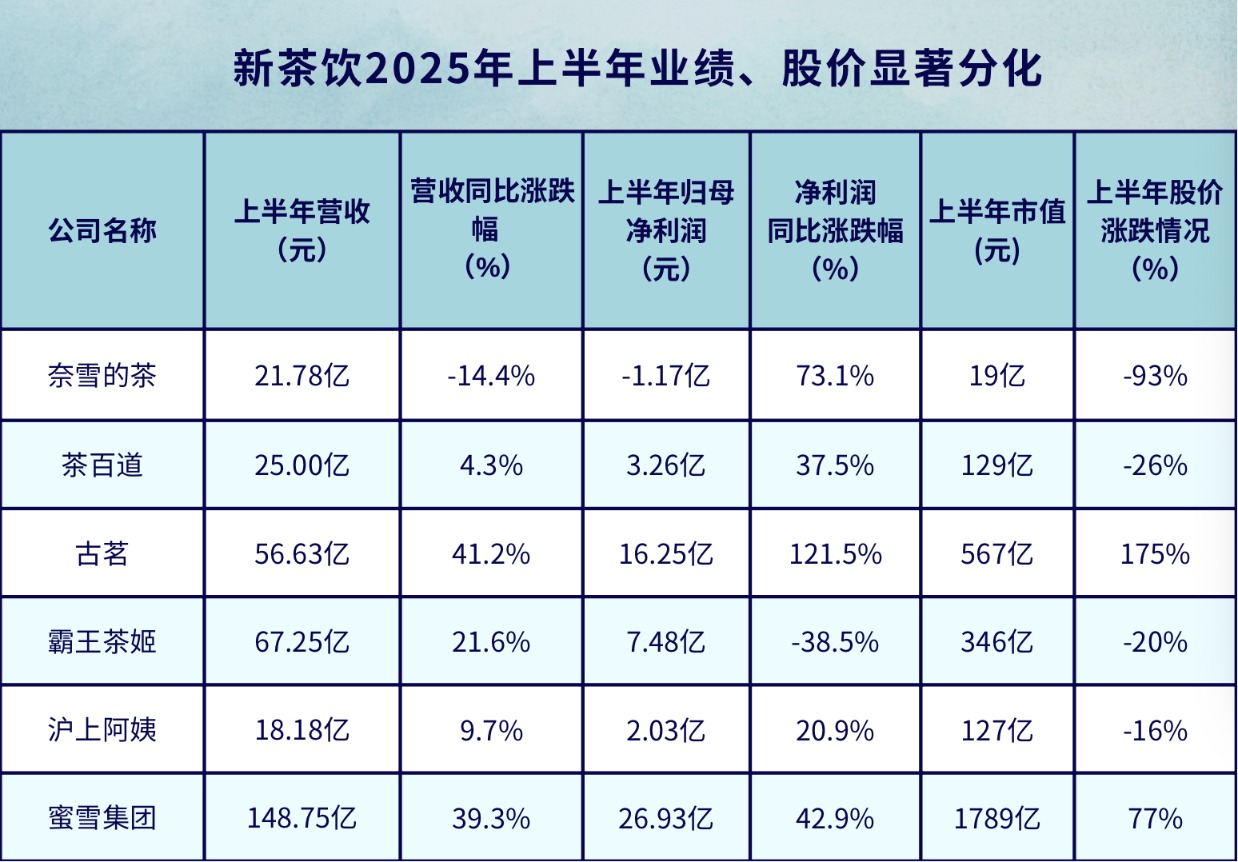
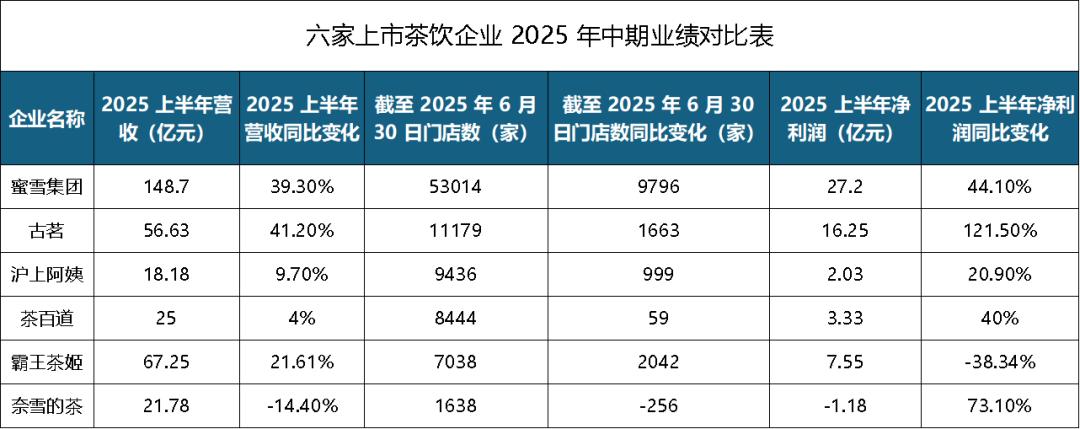
Core Insights - The new tea beverage industry is experiencing unprecedented differentiation due to the "takeaway war," with brands leveraging scale and supply chain advantages for expansion while some face growth bottlenecks [1][2] - The competition has shifted from "wild growth" to "refined management," emphasizing the importance of balancing scale and innovation, brand image, and supply chain barriers for future competition [1] Company Performance - Six listed new tea beverage companies have released their mid-year financial reports, with Mixue Group leading the industry with a revenue of 14.875 billion yuan, while Gu Ming achieved the fastest revenue growth at 41.2% [2][3] - Mixue Group's revenue growth of 39.3% and net profit of 2.693 billion yuan (up 42.9%) is attributed to its strong scale effect and expansion of product offerings [4] - Gu Ming's revenue reached 5.663 billion yuan with a net profit of approximately 1.625 billion yuan, marking a significant increase of 121.5% [4] - Other companies like Hu Shang Ayi and Cha Bai Dao showed steady revenue growth, while Ba Wang Cha Ji faced profit decline despite a revenue increase of 21.6% [5][6] Supply Chain and Market Dynamics - The takeaway war has positioned new tea beverages as major beneficiaries of ongoing subsidies, with companies like Mixue and Gu Ming seeing increased sales due to these incentives [7][8] - Mixue's supply chain efficiency, including direct procurement and vertical integration, has allowed it to maintain lower costs and higher profit margins [8][9] - Gu Ming's long-term investment in supply chain optimization has also contributed to its significant revenue growth [9][10] Product Innovation and Market Expansion - Companies are diversifying their product offerings to avoid over-reliance on single categories, which can lead to decreased customer loyalty [11] - Gu Ming has introduced 52 new products, including coffee, which has enhanced customer engagement and sales volume [11][12] - Mixue's "Lucky Coffee" brand is emerging as a significant growth driver, leveraging direct procurement advantages [12][13] Future Outlook - The industry is at a critical juncture, requiring brands to redefine their positioning and avoid homogenization while balancing capital and supply chain management [13]
外卖大战时代的新茶饮,原来是生死内功局
3 6 Ke· 2025-09-03 07:20
Core Viewpoint - The recent delivery subsidy war has led to a temporary boost in sales for tea beverage stocks, particularly milk tea, but raises questions about the sustainability of this growth once subsidies are withdrawn [1][5][11]. Group 1: Financial Performance of Listed Tea Beverage Companies - Six listed tea beverage companies have shown a divergence in their financial performance for the first half of 2025, with significant differences in revenue growth and profitability [2]. - Mixue Group reported a revenue of 14.87 billion yuan, a year-on-year increase of 39.3%, and a net profit of 2.72 billion yuan, up 44.1% [2]. - Gu Ming achieved a net profit of approximately 1.625 billion yuan, a staggering increase of 121.5%, with revenue of 5.663 billion yuan, up 41.2% [3]. - Other companies like Hu Shang A Yi and Cha Bai Dao showed modest growth, while Ba Wang Cha Ji experienced a decline in net profit despite revenue growth [4]. - Nai Xue's Tea reported a revenue of 2.178 billion yuan, a decline of 14.4%, and a net loss of 118 million yuan, indicating significant challenges in maintaining market position [4]. Group 2: Impact of Delivery Subsidy War - The delivery subsidy war has unexpectedly disrupted the tea beverage industry, with analysts suggesting that subsidy resources will increasingly concentrate on leading brands [5][7]. - High order volumes are primarily manageable by top tea beverage brands, which possess the necessary supply chain capabilities to meet increased demand [5][8]. - The competition has led to a "Matthew Effect," where companies with strong supply chains benefit the most, while smaller brands struggle to survive [8][11]. - Gu Ming reported a peak weekly delivery order volume of over 8 million, a threefold increase compared to normal levels, highlighting the impact of the subsidy war on operational capacity [8]. Group 3: Future Industry Trends - As subsidies are expected to diminish, the demand stimulated by these incentives may also decline, leading to a potential market shakeout [11][12]. - Companies are encouraged to focus on strengthening their supply chains and diversifying product offerings to remain competitive in a challenging market environment [12][13]. - The introduction of coffee products by brands like Gu Ming and Mixue indicates a strategic shift towards cross-category competition, which may become a key growth area [9][12].
2025年中国消费市场趋势洞察报告v1.0
Sou Hu Cai Jing· 2025-09-03 05:10
Group 1 - The core of new consumption is not about "new brands" but the ability to "solve user tasks," emphasizing the importance of understanding consumers' real needs in specific scenarios [2][3] - The rise of new consumption represents a "user task revolution," where consumers actively choose products that meet their life, emotional, and social needs, moving towards a more equal and human-centered market [1][11] - The traditional business logic is being disrupted by a "task-oriented" approach, with significant growth in both the affluent Z generation and the rational, potential-rich lower-tier markets [3][4] Group 2 - The "value-for-money revolution" is shifting from low-price competition to a consensus on quality-price balance, with brands like 瑞幸 and 名创优品 providing high-quality products at reasonable prices [4][5] - The rise of "self-care consumption" is notable, with 73% of urban white-collar workers willing to spend on long-term psychological satisfaction rather than short-term material possession [5][6] - The integration of domestic products with cultural elements is becoming a significant trend, as brands convey cultural identity through their offerings, enhancing consumer engagement [6][12] Group 3 - The report highlights the structural imbalance in resource allocation, with traditional brands focusing on high-end urban markets while neglecting the potential of lower-tier markets, which now account for 59% of total consumption [24][25] - Traditional businesses face challenges due to a product-centric approach that fails to address the complex task needs of consumers, leading to the rise of new brands that offer comprehensive solutions [25][28] - The shift towards digital channels is evident, with online shopping growing at 10.8% while traditional retail experiences a decline, indicating a need for businesses to adapt to immediate consumer demands [28][29]