
通富微电

Search documents
行业投资策略:AI算力自主可控的全景蓝图与投资机遇
KAIYUAN SECURITIES· 2026-01-08 14:22
Group 1 - The semiconductor industry is expected to experience significant growth, with the domestic semiconductor index outperforming the CSI 300 index, showing a cumulative increase of 54.51% as of October 28, 2025, driven by factors such as national subsidies, AI computing demand, and domestic substitution [16][21]. - The AI chip market in China is projected to grow from 142.54 billion yuan in 2024 to 1,336.79 billion yuan by 2029, with a compound annual growth rate (CAGR) of 53.7% from 2025 to 2029, indicating a critical development opportunity for domestic AI chip manufacturers [42][44]. - The global GPU market is expected to grow from $77.39 billion in 2024 to $472.45 billion by 2030, with a CAGR of 35.19%, reflecting strong demand for AI computing [37][40]. Group 2 - The domestic AI chip industry is categorized into three stages: the first stage focuses on the self-sufficiency of computing, storage, and power chips; the second stage emphasizes the self-sufficiency of chip manufacturing processes; and the third stage targets the self-sufficiency of foundational hard technologies such as equipment materials and EDA [5][6]. - The demand for AI computing chips is driven by the rapid growth of generative AI applications, with NVIDIA's data center revenue increasing by 69% year-on-year to $44.1 billion in the first quarter of fiscal 2026, highlighting the accelerating demand for AI computing power [37][44]. - The semiconductor equipment sector is experiencing a significant increase in domestic production capacity, with the domestic semiconductor equipment localization rate expected to rise rapidly, particularly in dry etching and thin film deposition processes [6][15]. Group 3 - The report indicates that the advanced packaging technology, such as CoWoS, is expected to play a crucial role in the evolution of AI computing power, with domestic companies making significant advancements in this area [7][11]. - The semiconductor industry is witnessing a recovery in profitability, with the average gross margin and net profit margin for the semiconductor sector showing improvements in the first half of 2025 [36][34]. - The report highlights the importance of advanced wafer manufacturing as the physical foundation for AI chips, with a long-term demand for advanced foundry services expected to drive growth in this segment [7][11].


并购 | 从上市公司收购中多元化支付工具的运用看并购对价的博弈
Sou Hu Cai Jing· 2026-01-07 07:56
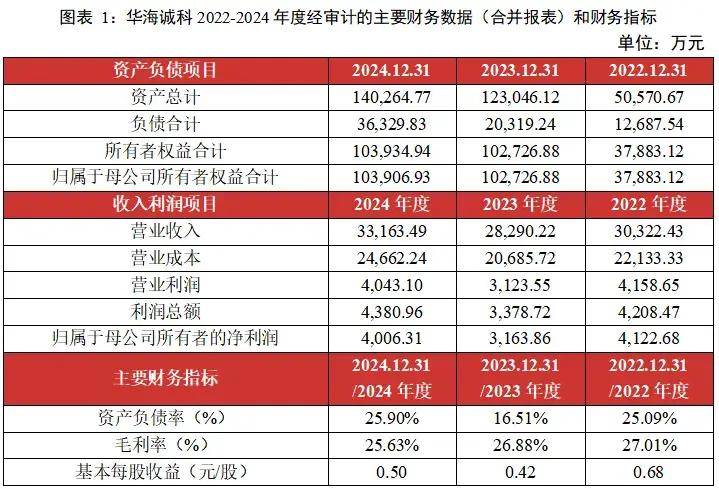
Core Viewpoint - The acquisition of 70% stake in Hengsuo Huawai by Huahai Chengke marks a significant step in enhancing the domestic semiconductor packaging materials industry, aiming to improve international competitiveness and technological capabilities in the sector [1][5]. Company Overview - Huahai Chengke, established in December 2010, is a national-level specialized and innovative "little giant" enterprise focused on the R&D and industrialization of semiconductor chip packaging materials, with a complete R&D and production system and independent intellectual property rights [1]. - Hengsuo Huawai is recognized as a national-level specialized and innovative "little giant" enterprise, with a strong global sales network and a product range that includes over a hundred models under the Hysol brand [2]. Financial Performance - As of December 31, 2024, Huahai Chengke reported total assets of 53.53 billion, total liabilities of 13.21 billion, and total equity of 40.33 billion, indicating growth from the previous year [4]. - The company's revenue for 2024 was 46.78 billion, with a net profit of 4.57 billion, reflecting an increase from 2023 [4]. Market Context - The semiconductor packaging materials market is projected to grow significantly, with epoxy molding compounds being critical for the semiconductor industry, as over 90% of semiconductor chips utilize these materials [4][5]. - The domestic demand for semiconductor supply chain security is urgent, given the low localization rate of high-performance packaging materials in China, which is only 10%-20% [4]. Acquisition Details - The acquisition of Hengsuo Huawai was valued at 1.12 billion, with payment structured through cash, shares, and convertible bonds, allowing for a balanced approach to meet various shareholder needs [6][7]. - The cash payment of 320 million was aimed at addressing short-term liquidity needs of certain shareholders, while share issuance and convertible bonds were designed to bind long-term value supporters [7][9][10]. Strategic Implications - The acquisition is expected to extend Huahai Chengke's production and sales base to international markets such as South Korea and Malaysia, enhancing its global market share and competitiveness [5]. - The multi-faceted payment structure of cash, shares, and convertible bonds is seen as a strategic move to mitigate risks associated with valuation discrepancies and to ensure a smooth integration post-acquisition [10][12]. Industry Outlook - The global semiconductor materials market is anticipated to grow by 3.8% in 2024, reaching approximately 67.5 billion, with packaging materials revenue expected to increase by 4.7% to 24.6 billion [5]. - The Chinese packaging materials market is projected to reach 7.86 billion by 2025, growing at a rate of 7.23% [5].


东方证券:英伟达推出推理上下文内存存储平台 AI存储需求持续扩张
智通财经网· 2026-01-07 07:38
Core Viewpoint - NVIDIA has launched a context memory storage platform at CES 2026, aimed at creating a new memory layer optimized for AI inference, bridging GPU memory and traditional storage [1][2]. Group 1: NVIDIA's New Platform - The context memory storage platform is a POD-level AI-native storage infrastructure designed to support long-term AI operations by optimizing data management and access [2]. - The platform includes hardware and software components such as BlueField-4 for data management, Spectrum-X Ethernet for high-performance networking, and various software tools to enhance system efficiency [2]. Group 2: Shift in AI Inference Bottlenecks - The bottleneck in AI inference is shifting from computation to context storage, necessitating a restructured AI storage architecture to handle increased context data from complex tasks [3]. - There is an anticipated significant growth in demand for storage chips as AI evolves from simple chatbots to intelligent collaborative agents requiring extensive context capacity [3]. Group 3: Domestic Storage Industry Opportunities - The ongoing shortage of storage capacity presents a historic opportunity for domestic storage manufacturers, especially as international competitors may face limitations in expanding production [4]. - Companies like Changxin Technology and Yangtze Memory Technologies are making strides in DRAM and NAND technologies, respectively, which could lead to substantial production increases following their IPOs [4]. Group 4: Related Companies - Key semiconductor equipment companies include Zhongwei Company, Jingzhida, and Beifang Huachuang, while notable packaging and testing firms are Deep Technology and Huicheng Shares [5][6]. - Companies involved in AI storage solutions and benefiting from storage technology iterations include Zhaoyi Innovation and Jiangbolong [6].

东方证券:英伟达(NVDA.US)推出推理上下文内存存储平台 AI存储需求持续扩张
智通财经网· 2026-01-07 07:37
Core Viewpoint - NVIDIA has introduced a context memory storage platform at CES 2026, aimed at creating a new memory layer optimized for AI inference, bridging GPU memory and traditional storage [1][2]. Group 1: NVIDIA's New Platform - The context memory storage platform is a POD-level AI-native storage infrastructure designed to support long-term AI operations by optimizing data access and management [2]. - The platform includes hardware and software components such as BlueField-4 for data management, Spectrum-X Ethernet for high-performance networking, and various software tools to enhance system efficiency [2]. Group 2: Shift in AI Inference Bottlenecks - The bottleneck in AI inference is shifting from computation to context storage, necessitating a restructured AI storage architecture to handle increased context data from complex tasks [3]. - There is an expectation that the demand for storage chips will grow significantly as AI evolves from simple chatbots to more complex collaborative entities requiring extensive context capacity [3]. Group 3: Domestic Storage Industry Opportunities - The ongoing supply-demand imbalance in storage, coupled with limited expansion from overseas storage giants, presents a historic opportunity for domestic storage manufacturers to increase their market share [4]. - Companies like Changxin Technology and Yangtze Memory Technologies are making significant advancements in DRAM and NAND technologies, respectively, which could lead to substantial production capacity increases post-IPO [4]. Group 4: Related Companies - Key domestic semiconductor equipment companies include Zhongwei Company, Jingzhida, and Beifang Huachuang, among others [5]. - Companies involved in packaging and testing include Deep Technology and Huicheng Shares [6]. - Firms focusing on AI storage solutions and benefiting from storage technology iterations include Zhaoyi Innovation and Lianyun Technology [6].
2025年中国集成电路行业技术发展分析 高端国产化率仍然较低【组图】
Qian Zhan Wang· 2026-01-07 06:11
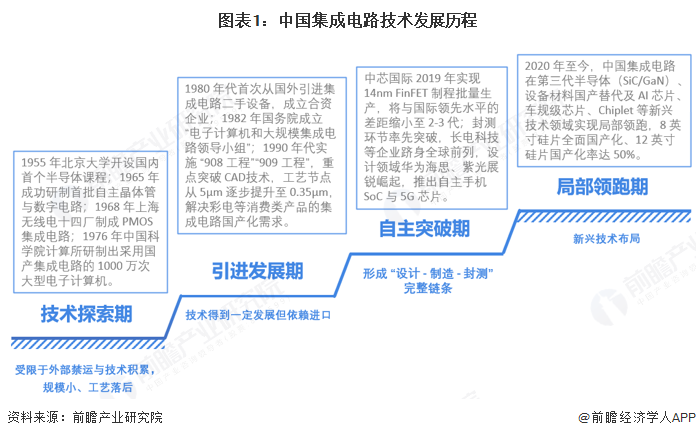
Core Insights - The Chinese integrated circuit industry has evolved from a technology exploration phase to a stage of partial leadership in emerging fields such as third-generation semiconductors and AI chips [1] Group 1: Industry Overview - Major listed companies in the Chinese integrated circuit industry include companies like Chipone (688521.SH), Cambricon (688256.SH), and SMIC (688981.SH/00981.HK) [1] - The development of integrated circuit technology in China has gone through three main phases: foundational exploration (1950s-1978), technology introduction (1978-2000), and independent breakthroughs (2000-2020) [1] Group 2: Core Production Technologies - The integrated circuit technology system focuses on three core areas: design, manufacturing, and packaging/testing [4] - Key design aspects include EDA tools, chip architecture (RISC-V/ARM), and semiconductor IP [4] - Manufacturing focuses on wafer processes (including EUV lithography) and advanced process nodes (such as 7nm and 5nm) [4] - Packaging/testing emphasizes advanced techniques like Chiplet and 3D stacking [4] Group 3: Current Production Status - Chinese companies lead in production volume but lack sufficient autonomy in technology [7] - The design sector has achieved some autonomy in mature process tools and IP, but high-end EDA and core IP still rely on imports [7] - Manufacturing has sufficient capacity for mature processes but faces limitations in advanced processes due to equipment restrictions [7] - The packaging/testing sector is a strength, with leading companies holding significant global market shares [7] Group 4: Market Segmentation - The low-end market (45nm and above) has a self-sufficiency rate exceeding 75%, with companies like Hua Hong Semiconductor leading [10] - The mid-range market (14-28nm) has a domestic production rate of about 35%, with breakthroughs in memory chips [10] - The high-end market (7nm and below) has a self-sufficiency rate of less than 20%, heavily relying on overseas foundries [10] Group 5: Challenges and Future Outlook - The Chinese integrated circuit industry faces challenges such as low domestic production of high-end technologies, risks to industrial security, and the need for improved product quality [13] - Future strategies include focusing on technological breakthroughs, collaborative ecosystem development, and enhancing talent cultivation to support high-quality industry growth [13]



AI 算力破局关键!52 页先进封装报告逐页拆解(含隐藏机遇)
材料汇· 2026-01-06 16:00
Core Insights - The article discusses the rising costs associated with advanced semiconductor processes, highlighting that the transition from planar FET to FinFET and Nanosheet technologies has led to exponential increases in design and manufacturing costs, making it difficult for small and medium enterprises to invest in advanced processes [8][9]. - The industry is shifting towards higher concentration among leading foundries, while advanced packaging technologies allow smaller companies to participate in high-end chip design without relying on advanced processes [9][11]. - The article emphasizes the importance of heterogeneous integration and the need for tailored architectures based on application scenarios, indicating a trend towards dynamic adjustments in advanced packaging strategies [25][56]. Cost Trends - Design costs have surged from $28 million for 65nm processes to $725 million for 2nm processes, with manufacturing investments also increasing significantly [9]. - The investment required for a 5nm factory is five times that of a 20nm factory, indicating a substantial financial barrier for smaller players in the industry [8]. Architectural Comparisons - The article compares four architectures, noting that smaller systems (like mobile chips) benefit from a "large chip + 3D stacking" approach, while larger systems (like AI servers) favor a "chiplet + 3D stacking" strategy to balance performance and cost [16][24]. - As system complexity increases, the advantages of chiplet-based designs become more pronounced, particularly in terms of cost efficiency [17][23]. Advanced Packaging Technologies - Advanced packaging is evolving to meet the demands of AI and high-performance computing, with technologies like 2.5D and 3D packaging becoming standard for high-end chips [36][72]. - The integration of HBM (High Bandwidth Memory) with 2.5D packaging has become a standard, driven by the need for high memory bandwidth in AI applications [29][36]. Interconnect Technologies - The article highlights the critical role of interconnect technologies in enhancing I/O density, with projections showing a significant increase in interconnect density from 1960s levels of 2/mm² to future levels of 131072/mm² [38]. - Advanced packaging is shifting from being a secondary process to a core component of performance enhancement, with interconnect-related technologies expected to yield higher profit margins than traditional packaging [39][42]. Market Dynamics - The article notes that the demand for advanced packaging is driven by the need for high bandwidth, miniaturization, and low power consumption, particularly in edge AI applications [49][50]. - The automotive sector's transition from distributed ECUs to centralized computing is pushing for higher integration levels, which in turn drives advancements in packaging technologies [53][56]. Technology Evolution - The evolution of packaging technologies is characterized by a shift from single technology optimization to system-level engineering design, necessitating cross-domain integration capabilities [68][70]. - The article outlines a clear roadmap for the evolution of interconnect technologies, indicating that the industry is entering a phase of rapid technological iteration driven by market demands [154][165]. Cost Structure - The cost structure for 2.5D packaging is primarily driven by the interposer (Si/mold/silicon bridge) and packaging substrate, while for 3D packaging, the key cost factor is the bonding process [168][169]. - The differences in cost structures dictate the profitability models for companies, with 2.5D packaging firms needing to manage interposer and substrate costs, while 3D packaging firms focus on optimizing bonding yields and efficiency [169].




英伟达推出推理上下文内存存储平台,AI存储需求持续扩张
Orient Securities· 2026-01-06 14:13
Investment Rating - The report maintains a "Positive" investment rating for the electronic industry in China [5]. Core Insights - NVIDIA has launched a context memory storage platform for inference, indicating a continuous expansion in AI storage demand. This platform aims to create a new memory layer optimized for inference between GPU memory and traditional storage, supporting long-term AI operations [3][6]. - The bottleneck in AI inference is shifting from computation to context storage, leading to a significant growth in demand for storage chips. As AI models become more complex, the need for high-frequency data access will drive changes in storage architecture [6][7]. - The ongoing shortage of storage capacity presents historic opportunities for domestic storage manufacturers, especially as international competitors may have limited expansion capabilities. Domestic companies like Changxin Technology and Yangtze Memory Technologies are positioned to benefit from this trend [6][7]. Summary by Sections Investment Recommendations and Targets - The report highlights several investment targets in the semiconductor and storage sectors, including: - Semiconductor equipment companies: Zhongwei Company, Jingzhida, Jingyi Equipment, Weidao Nano, Tuojing Technology, and Northern Huachuang [3][7]. - Domestic packaging and testing companies: Deep Technology, Huicheng Co., and Tongfu Microelectronics [3][7]. - Logic chip manufacturers: Jinghe Integration [3][7]. - Companies focusing on edge AI storage solutions: Zhaoyi Innovation and Beijing Junzheng [3][7]. - Companies benefiting from storage technology iterations: Lianqi Technology and others [3][7]. - Domestic storage solution providers: Jiangbolong, Demingli, Baiwei Storage, and Lenovo Group [3][7].
中证500ETF东财(159337)涨1.52%,半日成交额689.83万元
Xin Lang Cai Jing· 2026-01-06 06:49
Core Viewpoint - The performance of the Zhongzheng 500 ETF Dongcai (159337) shows a positive trend with a 1.52% increase in value, indicating strong market interest and potential investment opportunities [1] Group 1: ETF Performance - As of the midday close, Zhongzheng 500 ETF Dongcai (159337) reported a price of 1.737 yuan with a trading volume of 6.8983 million yuan [1] - The fund's performance benchmark is the Zhongzheng 500 Index return, managed by Dongcai Fund Management Co., with a return of 71.38% since its establishment on September 2, 2024, and an 8.11% return over the past month [1] Group 2: Major Holdings Performance - Key stocks within the Zhongzheng 500 ETF Dongcai include: - Shenghong Technology increased by 1.57% - Huagong Technology decreased by 2.45% - XianDao Intelligent rose by 2.58% - Chip Origin shares increased by 3.61% - Giant Network grew by 1.59% - Guiding Compass surged by 7.55% - Wolong Electric Drive increased by 0.46% - Xinwangda rose by 0.93% - Chifeng Gold increased by 0.28% - Tongfu Microelectronics rose by 1.64% [1]
通富微电涨2.30%,成交额21.06亿元,主力资金净流入7345.31万元
Xin Lang Zheng Quan· 2026-01-06 05:08
1月6日,通富微电盘中上涨2.30%,截至13:00,报40.45元/股,成交21.06亿元,换手率3.48%,总市值 613.87亿元。 截至9月30日,通富微电股东户数35.07万,较上期增加27.05%;人均流通股4327股,较上期减少 21.29%。2025年1月-9月,通富微电实现营业收入201.16亿元,同比增长17.77%;归母净利润8.60亿元, 同比增长55.74%。 通富微电今年以来股价涨7.29%,近5个交易日涨7.84%,近20日涨10.55%,近60日跌11.29%。 资料显示,通富微电子股份有限公司位于江苏省南通市崇川开发区崇川路288号,成立日期1994年2月4 日,上市日期2007年8月16日,公司主营业务涉及集成电路的封装和测试。主营业务收入构成为:集成 电路封装测试96.98%,模具及材料销售等3.02%。 通富微电所属申万行业为:电子-半导体-集成电路封测。所属概念板块包括:AIPC概念、封测概念、存 储概念、华为海思、汽车芯片等。 分红方面,通富微电A股上市后累计派现4.54亿元。近三年,累计派现2.33亿元。 机构持仓方面,截止2025年9月30日,通富微电十大流通股 ...
苏州集成电路产业注入新动能 京隆科技高阶半导体测试项目新厂投用
Su Zhou Ri Bao· 2026-01-06 00:21
吴庆文在致辞时表示,近年来,苏州大力培育集成电路领域新质生产力,已集聚集成电路产业链重 点企业超380家,形成了从设计、制造、封测到设备材料的完整产业布局。通富微电是苏州并肩前行的 好伙伴,此次投资建设京隆科技高阶半导体新项目,必将为苏州集成电路产业发展跃升注入新的强劲动 能。期待企业家朋友把更多先进技术、高端项目、优质资源带到苏州。苏州将坚持长期主义,一如既往 提供细致周到服务,持续营造市场化、法治化、国际化一流营商环境,陪伴企业成长,共享发展机遇、 共创美好未来。 通富微电董事长兼京隆科技副董事长石磊;市委常委、苏州工业园区党工委书记沈觅,市政府秘书 长徐本,市有关部门主要负责同志参加。 京隆科技(苏州)有限公司扎根苏州工业园区20余年,已发展成为国内最大的高阶芯片专业测试厂 商,构建了全流程芯片封测服务体系。2025年,园区产业基金联合全球封测龙头企业通富微电,完成京 隆科技股权重组。此次投用的新工厂位于独墅湖科教创新区(东区),总投资40亿元,占地68亩,其搭 载的智能产线涵盖人工智能、车规级、工业级等高阶芯片测试领域。预计达产后,将进一步扩大企业产 能规模,提升核心竞争力,为产业链上下游提供更高效、 ...