海螺水泥

Search documents
研报掘金丨长江证券:予海螺水泥“买入”评级 判断公司2025年销量表现有望优于同行业
Ge Long Hui A P P· 2025-11-14 08:50
Core Viewpoint - The report from Changjiang Securities indicates that both the real estate and infrastructure sectors are under pressure, leading to a continuous decline in national cement production [1] Industry Summary - National fixed asset investment (excluding rural households) reached 37.15 trillion yuan in the first three quarters of 2025, a year-on-year decrease of 0.5% [1] - Infrastructure investment increased by 1.1% year-on-year, while manufacturing investment grew by 4.0% [1] - Real estate development investment saw a significant decline of 13.9% [1] - National cement production for the first three quarters of 2025 was 1.259 billion tons, down 5.2% year-on-year [1] - In September alone, national cement production was 154 million tons, reflecting an 8.6% year-on-year decrease [1] Company Summary - Considering Conch Cement's comprehensive competitiveness and regional advantages, the company is expected to outperform its peers in terms of sales in 2025 [1] - The demand for cement has historically been driven by real estate and infrastructure; however, under the current steady growth context, infrastructure is expected to provide marginal support [1] - Certain regions may stabilize first due to accelerated construction of key projects [1] - The share of real estate in cement demand has significantly decreased due to the decline in real estate central area [1] - The company's projected performance for 2025 and 2026 is 83 billion yuan and 100 billion yuan, respectively, with corresponding P/E ratios of 15 and 12 times, leading to a "buy" rating [1]
房地产及建材行业双周报(2025、10、31-2025、11、13):房地产基本面仍处于“磨底”阶段-20251114
Dongguan Securities· 2025-11-14 08:43
Investment Rating - The report maintains a "Neutral" rating for both the real estate and building materials sectors [2][4]. Core Views - The real estate sector is currently in a "bottoming" phase, with new home and second-hand home transaction areas still showing negative year-on-year growth, although the decline is narrowing compared to 2024. New construction starts and development investments continue to decline, and funding is tight, indicating an ongoing deleveraging cycle. The overall loss level of the industry has further expanded compared to the second quarter, suggesting that the fundamentals remain weak. Future policy support and stabilization of the industry are expected to drive market trends [4][28]. - The building materials sector, particularly cement, is benefiting from a dual advantage of cost and policy due to the elimination of high-energy, low-efficiency capacities. The sector is expected to see stable support from urban village renovations and the acceleration of affordable housing construction. Current valuations are at historical lows, making certain stocks attractive for defensive and long-term investment [4][50]. Summary by Sections Real Estate Sector - As of November 13, 2025, the Shenwan Real Estate Index has increased by 2.07% over the past two weeks, outperforming the CSI 300 Index by 1.32 percentage points, ranking 20th among 31 sectors. Year-to-date, the index has risen by 11.37% [13][17]. - The report highlights that the industry is transitioning from a high-leverage, high-turnover model to one focused on quality, service, and sustainability, with urban renewal expected to unlock potential in existing stock [4][28]. Building Materials Sector - The Shenwan Building Materials Index has risen by 2.63% over the past two weeks, outperforming the CSI 300 Index by 1.3 percentage points, ranking 17th among 31 sectors. Year-to-date, the index has increased by 23.38% [29][32]. - The cement industry is expected to see a significant increase in profitability due to the implementation of carbon trading regulations and the elimination of inefficient capacities. The sector is supported by ongoing construction projects and a favorable valuation environment [4][50]. Recommendations - The report recommends focusing on leading companies with strong fundamentals and high dividend yields, such as Poly Developments (600048), China Merchants Shekou (001979), and Binhai Group (002244) in the real estate sector, and Conch Cement (600585) and Huaxin Cement (600801) in the building materials sector [4][53].
建信期货焦炭焦煤日评-20251114
Jian Xin Qi Huo· 2025-11-14 07:11
Report Summary 1. Industry Investment Rating No industry investment rating is provided in the report. 2. Core Viewpoints - On November 13, the main contracts 2601 of coke and coking coal futures declined slightly compared to the previous day's closing prices, hitting new lows since October 23 during intraday trading. The futures of coke and coking coal dropped significantly due to coal supply - guarantee policies. Although the spot market still has support, considering the large increase in Mongolian coal customs clearance and the significant growth in coking coal inventories of independent coking plants and ports, there may be downward pressure on prices due to oversupply. It is expected that the futures of coke and coking coal still need to digest the strong negative factors from the news, and it is advisable to try high - selling hedging or investment strategies. Attention should be paid to the implementation of supply - guarantee policies and the rhythm of spot price declines [5][11]. 3. Summary by Relevant Catalogs 3.1 Market Review - **Futures Market**: On November 13, the main contracts 2601 of coke and coking coal futures, J2601 and JM2601, first declined and then rebounded. J2601 closed at 1686 yuan/ton, down 0.30% from the previous day, with a trading volume of 13,768 lots and an open interest of 37,775 lots, a decrease of 164 lots. JM2601 closed at 1214 yuan/ton, down 0.29%, with a trading volume of 572,483 lots and an open interest of 592,106 lots, a decrease of 991 lots. In the black - series futures, the long - short positions of the top 20 in RB2601, HC2601, SS2601, J2601, JM2601, and I2601 contracts also changed [5][6]. - **Spot Market**: On November 13, the ex - warehouse price index of quasi - first - grade metallurgical coke at Rizhao Port, Qingdao Port, and Tianjin Port remained unchanged at 1620 yuan/ton. The aggregated price of low - sulfur main coking coal in some regions was stable, with a 40 - yuan increase in Linfen [8]. 3.2 Outlook for the Future - **Policy**: The National Development and Reform Commission organized a video conference on energy supply guarantee for the 2025 - 2026 heating season, requiring all regions and relevant enterprises to ensure stable energy production and supply, improve the performance of medium - and long - term coal contracts, and focus on ensuring coal demand in northern heating areas [10]. - **Supply and Demand**: Due to continuous losses for four weeks, the coke output of independent coking enterprises dropped to a new low since late March. Although coking plants and steel mills continued to reduce coke inventories, port coke inventories have increased in the past five weeks. Since October 25, the customs clearance volume of Mongolian coal has increased significantly, and the coking coal inventories of 230 independent coking plants and ports have also increased [10]. 3.3 Industry News - **Water Conservancy Construction**: From January to October this year, China completed 1.00947 trillion yuan in water conservancy construction investment, implemented 46,000 water conservancy projects, and started 28,000 new projects, creating 2.484 million jobs and paying 47.06 billion yuan in wages [12]. - **Energy in Yunnan**: From January to September, Yunnan's energy department promoted the integrated development of "source - network - load - storage", driving a 11.3% increase in coal production, a 7.4% increase in crude oil processing volume, a 6.2% increase in refined oil production, and a 17% increase in natural gas consumption [12]. - **Anhui Kuangneng**: From November 10 - 12, Anhui Kuangneng held a production and operation work symposium for the coal sector, summarizing this year's work and planning next year's key tasks [12][13]. - **Concrete Industry**: Affected by the real - estate market adjustment and infrastructure investment slowdown, the demand in the cement industry is weak, and prices are low. However, prices are expected to recover to some extent under the anti - involution trend [13]. - **Shanxi Coking Coal**: The company's main products are high - quality coking coals, and it has established long - term strategic partnerships with many large steel enterprises. It also has a power generation business with a power - generation capacity of 4.32 million kilowatts per year [13]. - **Other News**: There were coal mine accidents in Henan; Lu'an Huaneng announced its coal production and sales in October; Fangda Special Steel is cooperating with CATL; Handan launched a level - II emergency response for heavy pollution; Shaanxi's industrial production and consumption of coal, natural gas, and oil showed different trends; Inner Mongolia's coal production was stable, and its new - energy installed capacity increased; Newcastle Port and Indian coal production and exports had certain changes; OPEC predicted an oversupply in the oil market in 2026; India imposed anti - dumping duties on Vietnamese steel [11][12][13][14][15]. 3.4 Data Overview The report provides various data charts, including the spot price index of metallurgical coke, the aggregated price of main coking coal, the production and capacity utilization of coking plants and steel mills, iron - water production, coke and coking coal inventories, and the basis of futures contracts [18][20][25][27][28][29].
事关“场景”:如何补短板?怎么挖潜力?怎样建生态?
Jing Ji Ri Bao· 2025-11-14 01:06
Core Viewpoint - The State Council has issued an implementation opinion to accelerate the cultivation and large-scale application of new scenarios, emphasizing the importance of "scenarios" in driving technological and industrial innovation [3][4][9]. Group 1: Definition and Importance of Scenarios - The term "scenario" is defined as a specific context for systematically verifying the industrial application of new technologies, products, and business models, serving as a bridge between technology and industry [4][5]. - Scenarios are crucial for enabling the development of new productive forces, acting as a "test stone" for the feasibility of technologies in real market environments [5][9]. - The implementation opinion emphasizes a scenario-driven innovation paradigm, promoting a virtuous cycle where demand drives innovation and innovation meets demand [5][9]. Group 2: Challenges in Scenario Supply - Insufficient effective scenario supply is a major obstacle to the transformation of new industries and models, with many technological breakthroughs lacking appropriate application contexts [3][6]. - Three main reasons for the supply shortage include unclear profit distribution mechanisms, local protectionism, and the need for policy coordination among departments [7][8][9]. - The opinion aims to address these challenges through systematic top-level design and policy support [8][9]. Group 3: Strategies for Scenario Cultivation and Application - The opinion proposes expanding the supply of production, work, and life scenarios, promoting fair and efficient allocation of scenario resources [9][10]. - It highlights the need for both hard infrastructure and soft innovations in regulations and policies to facilitate scenario cultivation and application [9][26]. - Specific paths include prioritizing new fields and high-value scenarios, leveraging China's large market advantages to enhance scenario supply [9][10]. Group 4: Case Studies and Practical Applications - The collaboration between Anhui Conch Group and Huawei in developing an AI-driven cement production model exemplifies successful scenario application, achieving significant efficiency and sustainability improvements [12][14]. - The gaming industry, particularly the success of "Black Myth: Wukong," showcases how small-cut scenarios can lead to high-value creative outputs through advanced technologies [16][17]. - The establishment of a comprehensive unmanned system in Hefei illustrates the potential of scenario innovation to drive urban development and industry clustering [18][19]. Group 5: Future Directions and Ecosystem Building - The development of a scenario innovation ecosystem requires collaboration among various stakeholders, including industry players, technology providers, and government entities [18][19]. - The focus should be on creating a multi-faceted innovation environment that encourages the free flow of resources and ideas across regions and sectors [22][23]. - Continuous efforts to refine the regulatory framework and enhance the safety and risk management of scenario applications are essential for sustainable growth [19][26].
申万宏源证券晨会报告-20251114
Shenwan Hongyuan Securities· 2025-11-14 00:47
Core Insights - The construction materials industry has shown signs of improvement in revenue and profit during the first three quarters of 2025, with a total revenue of 432.25 billion yuan, a year-on-year decline of 3.1%, which is a narrowing of the decline compared to the 2024 full year by 11.7 percentage points. The net profit attributable to shareholders reached 24.44 billion yuan, a year-on-year increase of 27.8%, reversing the 49.1% decline seen in 2024 [2][13] - The cement industry has demonstrated significant profit recovery, with a total revenue of 181.23 billion yuan, a year-on-year decline of 8.4%, while net profit attributable to shareholders surged by 148.8% to 9.13 billion yuan. Notably, Huaxin Cement and Conch Cement have shown strong performance, contributing significantly to the industry's profit [2][13] - The fiberglass sector has also reported growth, with eight sample companies achieving a total revenue of 49.21 billion yuan, a year-on-year increase of 23.5%, and a net profit of 4.87 billion yuan, up 121.4%. The recovery in pricing has started to reflect positively on profits [3][13] - The consumer building materials segment remains under pressure, with a total revenue of 110.75 billion yuan, a slight decline of 0.9%, and a net profit of 8.21 billion yuan, down 6.9%. However, companies like Keda Manufacturing and Sankeshu are showing promising growth due to their unique market strategies [3][13] Industry Summaries Cement Industry - The cement industry has seen a gradual release of profit elasticity, with significant improvements in profitability. The overall revenue for the sector was 181.23 billion yuan, with a notable profit increase driven by companies like Huaxin Cement and Conch Cement, which leverage cost and scale advantages [2][13] Fiberglass Industry - The fiberglass industry has experienced revenue and profit growth across most companies, with a total revenue of 49.21 billion yuan and a net profit of 4.87 billion yuan. The pricing recovery initiated by leading firms has started to yield positive results [3][13] Consumer Building Materials - The consumer building materials sector is facing challenges, with a revenue of 110.75 billion yuan and a net profit of 8.21 billion yuan. However, certain companies are thriving due to strategic positioning and market demand [3][13] Investment Recommendations - Investment opportunities are suggested in the fiberglass and cement sectors, focusing on leading companies such as Huaxin Cement, Conch Cement, and China Jushi. Additionally, companies with alpha attributes in consumer building materials like Keda Manufacturing and Sankeshu are recommended for consideration [4][13]
新兴产业领跑、传统产业焕新 上市公司结构向好创新向优
Jing Ji Ri Bao· 2025-11-14 00:27
Core Insights - The A-share market is experiencing a dual growth trend with emerging industries and traditional sectors both showing positive performance amid favorable macro policies and challenges such as weak global economic growth and insufficient domestic demand [1][2][5] Emerging Industries - New generation information technology, new energy, and new materials are leading the A-share market, with companies in these sectors showing strong performance [2] - In the first three quarters, 588 companies on the Sci-Tech Innovation Board achieved a total revenue of 1.01 trillion yuan, a year-on-year increase of 6.6% [2] - Key technological breakthroughs are driving the performance of technology companies, with significant advancements in biomedicine, high-end equipment, and communication sectors [2][3] Traditional Industries - Traditional industries are also innovating and improving efficiency, with companies like Midea Group and BYD showing growth in smart home and electric vehicle sales, respectively [5][6] - The steel and cement industries are optimizing supply-demand balances, with companies like Nanjing Steel and Anhui Conch Cement reporting significant profit increases due to improved pricing and cost management [7] R&D Investment - Increased R&D investment is providing strong internal momentum for technology companies, with the R&D intensity for the ChiNext, Sci-Tech Innovation Board, and Beijing Stock Exchange reaching 4.54%, 11.22%, and 4.42% respectively [4] - Companies like Zhongrun Optical are focusing R&D efforts on new product innovation, leading to substantial growth in core technology competitiveness [4] Investor Return Awareness - Companies are enhancing their awareness of investor returns, with an increase in cash dividend announcements and share buybacks, reflecting a commitment to shareholder value [8][9] - As of October 31, 2023, 1,033 companies announced cash dividend plans totaling 734.9 billion yuan, with 89 companies planning dividends exceeding 1 billion yuan [8] Future Outlook - Despite external uncertainties, many companies maintain an optimistic outlook for future growth, supported by proactive strategies and scientific planning [10]
上市公司结构向好创新向优
Jing Ji Ri Bao· 2025-11-13 22:10
Core Viewpoint - The A-share market is experiencing a dual growth trend in both emerging and traditional industries, driven by favorable macro policies and technological innovation, despite facing challenges such as weak global economic growth and insufficient domestic demand [1] Emerging Industries - Emerging industries, particularly in hard technology sectors like new generation information technology, new energy, and new materials, are showing strong performance, with 588 companies on the Sci-Tech Innovation Board achieving a total revenue of 1.01 trillion yuan, a year-on-year increase of 6.6% [2] - Key technological breakthroughs are driving the performance of technology companies, with 26 new Class 1 drugs approved in the biopharmaceutical sector and significant advancements in high-end equipment and communication technologies [2] - Companies like Mingzhi Electric and Obit Zhongguang are capitalizing on opportunities in AI and robotics, with revenue growth of 11.66% and 103.5% respectively in the first three quarters [3] R&D Investment - Increased R&D investment is providing strong internal momentum for technology companies, with R&D intensity reaching 4.54% for the ChiNext, 11.22% for the Sci-Tech Innovation Board, and 4.42% for the Beijing Stock Exchange [4] - Companies are focusing on innovation and technology breakthroughs to enhance their competitive edge, as seen with Zhongrun Optical's 50.47% increase in R&D spending [4] Traditional Industries - Traditional industries are also evolving, with companies like Midea Group and Seres adapting to new technologies and applications, resulting in a 13% increase in smart home revenue and significant sales in the electric vehicle sector [5][6] - The steel and cement industries are optimizing supply-demand balances, with companies like Nanjing Steel and Anhui Conch Cement reporting improved profit margins and net profit growth due to strategic adjustments [7] Investor Return Awareness - There is a growing awareness among companies regarding investor returns, with an increase in cash dividend announcements and share buybacks, totaling 734.9 billion yuan in cash dividends announced by 1,033 companies [8] - Companies like Yili Group are actively engaging in share buybacks and dividend distributions to enhance shareholder value [8][9] Future Outlook - Despite external uncertainties, many companies maintain an optimistic outlook for future growth, supported by proactive strategies in R&D, market expansion, and operational efficiency [10]
看安徽制造的破局之道(连线评论员)
Ren Min Ri Bao· 2025-11-13 22:10
Core Insights - Anhui's manufacturing sector has shown remarkable performance in 2023, with significant growth in various industries and a strong focus on innovation and collaboration [1][2][3] Group 1: Manufacturing Performance - In the first three quarters of 2023, Anhui ranked first in the country for automobile production, and the export value of "new three items" increased by 71.9% [1] - The number of large-scale industrial enterprises in Anhui grew by nearly 40% during the 14th Five-Year Plan period, with national high-tech enterprises and provincial specialized enterprises both increasing by about 200% [1] - The number of enterprises with over 10 billion yuan in revenue rose from 36 to 61 [1] Group 2: Strategic Initiatives - The government has implemented a "systematic methodology" to support manufacturing, focusing on deepening the integration of government, industry, academia, research, finance, and services [1] - Anhui's strategic emerging industries contribute over 60% to the province's industrial economic growth [2] - The province has established a service network for enterprises, fostering an ecosystem that supports innovation and development [1][2] Group 3: Regional Collaboration - Anhui's collaboration with the Yangtze River Delta region has led to significant advancements, such as the development of high-temperature alloy blades for aircraft, breaking foreign monopolies [2] - The region has created a "4-hour industrial circle" for electric vehicles and established 12 innovation consortia, emphasizing complementary advantages rather than zero-sum competition [2] Group 4: International Influence - The World Manufacturing Conference has permanently settled in Hefei, with participation from 53 countries and regions in 2025, showcasing Anhui's transformation and enhancing its international influence [3] - Recent diplomatic efforts included a visit to Morocco, where Anhui's automotive industry was highlighted as a key link in international cooperation [3] Group 5: Future Outlook - The emphasis on high-quality development in manufacturing aligns with the need to adapt to new technologies, particularly artificial intelligence, which is reshaping the industry [3][4] - Anhui's experience in leveraging national strategies and regional collaboration serves as a model for other regions to transform comparative advantages into developmental strengths [4]
基建地产链2025年三季报综述:盈利仍然承压,经营性现金流表现改善
Soochow Securities· 2025-11-13 12:02
Investment Rating - The report maintains an "Accumulate" rating for the construction materials industry [1] Core Insights - The construction materials industry continues to face pressure on profitability, with operating cash flow showing improvement [1] - The overall revenue of the sample companies in the infrastructure real estate chain decreased by 4.5% year-on-year in Q3 2025, but the decline has narrowed compared to previous quarters [27] - The report highlights that leading companies are seeking external growth and enhancing market share despite the challenging environment [24] Summary by Sections Profit and Loss Analysis - The revenue decline for the construction materials sector has slowed, with Q3 2025 revenues for construction and materials down 4.6% and 3.4% year-on-year, respectively [27] - The revenue growth rates for various sub-sectors in Q3 2025 show significant variation, with design consulting at 38.4% and cement at 53.8% [1][15] - The overall return on equity (ROE) for the sample companies was 6.5%, with the construction and materials sectors at 7.2% and 3.8%, respectively [2][19] - The sales net profit margin for the construction materials sector was 5.5%, reflecting a year-on-year decrease of 0.3 percentage points [3][22] Cash Flow and Balance Sheet - The net cash flow from operating activities for the sample companies reached 926.9 billion, with the construction sector generating 754.8 billion and the materials sector 172.1 billion [8][5] - The overall asset-liability ratio for the sample companies was 75.2%, with the construction and materials sectors at 77.4% and 48.2%, respectively [8][5] Key Sub-sector Performance - In Q3 2025, the construction materials sector's net profit decreased by 14.4% year-on-year, while the materials sector saw a 10.9% increase [4][31] - The highest net profit growth rates were observed in the decoration and renovation sector at 289.0% and glass fiber at 84.7% [31][4] - The report indicates that the cash flow management has improved, particularly in the infrastructure and international engineering sub-sectors [8][5]
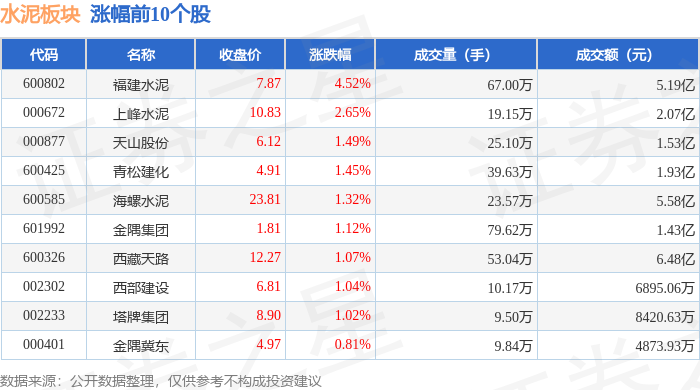
水泥板块11月13日涨1.04%,福建水泥领涨,主力资金净流出1.34亿元
Zheng Xing Xing Ye Ri Bao· 2025-11-13 08:45
Group 1 - The cement sector experienced a rise of 1.04% on November 13, with Fujian Cement leading the gains [1] - The Shanghai Composite Index closed at 4029.5, up 0.73%, while the Shenzhen Component Index closed at 13476.52, up 1.78% [1] - Fujian Cement's stock price increased by 4.52%, closing at 7.87, with a trading volume of 670,000 shares and a transaction value of 519 million yuan [1] Group 2 - The cement sector saw a net outflow of 134 million yuan from institutional investors and 121 million yuan from speculative funds, while retail investors had a net inflow of 255 million yuan [2] - The trading data for various cement stocks indicates mixed performance, with some stocks experiencing declines, such as Sichuan Jinding, which fell by 3.87% [2][3] - The net inflow and outflow of funds varied significantly among different stocks, with Fujian Cement showing a net inflow of 22.72 million yuan from institutional investors [3]