
平煤股份

Search documents
非电煤和电煤接力换棒,秋季煤炭布局稳扎稳打行业周报 | 投研报告
Zhong Guo Neng Yuan Wang· 2025-09-08 01:55
Core Viewpoint - The coal market is experiencing a slight price decline, but there are positive factors that may support a rebound in coal prices, particularly in the non-electric coal sector during the upcoming demand season [1][2]. Group 1: Coal Price Trends - As of September 5, the Qinhuangdao Q5500 thermal coal price is 679 RMB/ton, down 11 RMB/ton or 1.59% from the previous period [2]. - The current price is below 700 RMB/ton, following a rebound above this level [2]. - The market is transitioning from summer to autumn, with expectations for increased non-electric coal demand in September and October [1][2]. Group 2: Supply and Demand Factors - The operating rate of coal mines in Shanxi, Shaanxi, and Inner Mongolia is at a low level of 79.5%, down 0.4 percentage points as of August 31 [2]. - Port inventories are decreasing, with the inventory in the Bohai Rim at 22.66 million tons, down 1.48% as of September 5, and Guangzhou Port inventory declining by over 7% [2]. - Non-electric coal demand, particularly from the coal chemical sector, is expected to increase, with methanol operating rates at 83.72%, up 1.41 percentage points [2]. Group 3: Coking Coal Market - As of September 5, the price of coking coal at Jingtang Port is 1540 RMB/ton, rebounding from a low of 1230 RMB/ton in early July [2]. - Coking coal futures have seen a significant increase, rising from 719 RMB in early June to 1159 RMB, a cumulative increase of 61.2% [2]. - The coking coal market is characterized by strong expectations but weak realities, with supply tightening due to regulatory measures [2]. Group 4: Investment Logic - The price of thermal coal is expected to rebound to long-term contract prices, currently above 700 RMB, with a target of around 750 RMB by 2025 [3]. - The breakeven point for power plants is estimated at around 860 RMB, which could serve as a price ceiling [3]. - The price ratio of coking coal to thermal coal is 2.4, with target prices for coking coal set at 1608 RMB, 1680 RMB, 1800 RMB, and 2064 RMB corresponding to thermal coal price targets [4]. Group 5: Investment Recommendations - The coal sector is seen as having both cyclical and dividend attributes, making it a favorable time for investment [5]. - Four main investment lines are identified: - Cyclical logic: Jin控煤业, 兖矿能源 - Metallurgical coal: 平煤股份, 淮北矿业, 潞安环能 - Dividend potential: 中国神华, 中煤能源, 陕西煤业 - Diversified growth: 神火股份, 电投能源, 新集能源, 广汇能源 [5].
非电煤和电煤接力换棒,秋季煤炭布局稳扎稳打
KAIYUAN SECURITIES· 2025-09-07 13:50
Investment Rating - The investment rating for the coal industry is "Positive" (maintained) [1] Core Viewpoints - The transition from thermal coal to non-thermal coal is expected to support coal prices, with a stable layout in the coal sector [12] - The current dynamics in the coal market indicate that both thermal coal and coking coal prices have reached a turning point, suggesting potential price recovery [12] - The report highlights that the demand for non-thermal coal, particularly from the coal chemical sector, is anticipated to be a key driver for future price increases [4][12] Summary by Sections Investment Logic - Thermal coal prices are expected to rebound to long-term contract prices, currently above the second target price of around 700 CNY per ton [4][12] - The forecast for thermal coal prices suggests a potential rise to 750 CNY per ton, which is seen as a profit-sharing point for coal and power generation companies [4][12] - Coking coal prices are more influenced by supply and demand fundamentals, with target prices set at 1608 CNY, 1680 CNY, 1800 CNY, and 2064 CNY corresponding to thermal coal price targets [4][12] Investment Recommendations - The report identifies four main investment lines in the coal sector: 1. Cycle logic: Companies like Jinko Coal and Yanzhou Coal Mining 2. Dividend logic: China Shenhua and China Coal Energy 3. Diversified aluminum elasticity: Shenhua Holdings and Electric Power Investment 4. Growth logic: New Energy and Guanghui Energy [5][13] Key Market Indicators - The coal index increased by 0.31%, outperforming the CSI 300 index by 1.12 percentage points [7][9] - The average PE ratio for the coal sector is 13.2, and the PB ratio is 1.23, ranking low among all A-share industries [27][32] - As of September 5, 2025, the price of Qinhuangdao Q5500 thermal coal is 679 CNY per ton, reflecting a slight decrease of 1.59% [19][31] Coking Coal Market - The price of main coking coal at Jingtang Port is currently 1540 CNY per ton, down from 1610 CNY [20][22] - The report notes a significant rebound in coking coal futures prices, which have increased by 61.2% since June [4][12] Non-Thermal Coal Sector - The methanol operating rate is currently at 83.72%, indicating a slight increase, while the urea operating rate has decreased significantly [11][19] - The report emphasizes the importance of non-thermal coal demand, particularly from the coal chemical industry, as a stabilizing factor for coal prices [4][12]
煤炭与消费用燃料行业周报:焦煤期货大涨后,后续如何看?-20250907
Changjiang Securities· 2025-09-07 09:15
Investment Rating - The industry investment rating is "Positive" and maintained [10] Core Viewpoints - The report indicates that after a significant rise in coking coal futures by 6%, the price support for coking coal remains strong due to tight supply and replenishment effects. In the medium to long term, the focus will be on "anti-involution" and price stability, with potential for a demand recovery driven by economic stimulus, which could lead to a "Davis Double" for coking coal [2][7] - The coal index (Yangtze) increased by 0.34%, outperforming the CSI 300 index by 1.15 percentage points, ranking 9th out of 32 industries [6][15] - The report emphasizes the importance of price stability as indicated by recent policies from Shanxi and Shaanxi provinces, which aim to promote stable coal market operations [6][7] Summary by Sections Coking Coal Market - As of September 5, the price of main coking coal at Jingtang Port was 1540 RMB/ton, a decrease of 70 RMB/ton week-on-week. The report suggests that while short-term fluctuations may increase due to a slowdown in downstream purchasing demand, the medium to long-term outlook remains positive with potential for price support [6][7][17] Thermal Coal Market - The market price for thermal coal at Qinhuangdao Port was 679 RMB/ton as of September 5, down 11 RMB/ton week-on-week. Despite a seasonal transition from peak to off-peak demand, the report anticipates limited downside for coal prices due to ongoing supply constraints and replenishment needs [6][16] Investment Recommendations - The report recommends a focus on companies with improving fundamentals under the "anti-involution" theme, suggesting a mix of elastic stocks and stable profit leaders. Specific companies highlighted include Yanzhou Coal Mining Company, China Shenhua Energy, and others [8][29]
旺季尾声日耗见顶,供给收缩托底煤价
Huafu Securities· 2025-09-07 07:58
Investment Rating - The coal industry is rated as "stronger than the market" [6] Core Viewpoints - The report emphasizes that the fundamental goal is to reverse the Producer Price Index (PPI), which has been declining, with July's PPI showing a year-on-year decrease of 3.6%. The stability of coal prices is closely linked to PPI, and the lowest coal prices in 2025 may represent a policy bottom, with expectations for more supply-side policies to be introduced [5][6] - The coal industry is currently undergoing a significant transformation, with strict capacity controls and increasing operational difficulties leading to a tighter supply. The report suggests that coal will remain a key energy source in the short term, despite macroeconomic weaknesses affecting demand [5][6] - The report identifies several investment opportunities in the coal sector, focusing on companies with strong resource endowments, stable operating performance, and high or potentially increasing dividend ratios [6] Summary by Sections 1. Market Overview - The coal index increased by 0.31% this week, outperforming the Shanghai and Shenzhen 300 index, which decreased by 0.81%. Year-to-date, the coal index has dropped by 9.32%, while the Shanghai and Shenzhen 300 index has risen by 13.35% [11][12] 2. Thermal Coal 2.1 Key Indicators - As of September 5, 2025, the Qinhuangdao 5500K thermal coal price was 679 CNY/ton, down 1.6% week-on-week. The average daily production from 462 sample mines was 5.379 million tons, a year-on-year decrease of 6.5% [3][21] 2.2 Annual Long-term Contract Price - The long-term contract price for Qinhuangdao thermal coal (Q5500) was 674 CNY/ton, with a month-on-month increase of 0.9% and a year-on-year decrease of 3.3% [23] 2.3 Spot Prices - The report details various spot prices for thermal coal across different regions, indicating slight fluctuations in prices [27][28] 2.4 Supply and Demand - The report notes a slight decrease in daily consumption by major power plants, with a total inventory of 13.388 million tons, reflecting a minor decline [37][48] 3. Coking Coal 3.1 Key Indicators - The report highlights the price changes for coking coal, with the main coking coal price at Jing Tang Port dropping to 1540 CNY/ton, a decrease of 4.3% week-on-week [62][63] 3.2 Spot Prices - Various spot prices for coking coal are provided, showing both increases and decreases across different regions [66][68]
煤炭行业周报(9月第1周):9月长协价格上调,板块左侧布局-20250907
ZHESHANG SECURITIES· 2025-09-07 06:19
Investment Rating - The industry investment rating is "Positive" [1] Core Viewpoints - The coal sector has shown resilience, with a slight increase in prices and a positive outlook for the second half of the year, suggesting a potential balance between supply and demand [6][23] - The report highlights the importance of positioning in high-dividend coal companies and those undergoing turnaround in coking coal and coke sectors [6][23] Summary by Sections Market Performance - As of September 5, 2025, the CITIC coal industry index rose by 0.1%, outperforming the CSI 300 index, which fell by 0.81%, resulting in a 0.91 percentage point advantage [2] - The highest weekly stock price increase was seen in Yunmei Energy, with a rise of 4.03% [2] Supply and Demand Data - Average daily coal sales for monitored enterprises were 6.67 million tons, a week-on-week increase of 0.9% but a year-on-year decrease of 1.9% [2] - The average daily coal production was 6.64 million tons, showing a week-on-week decrease of 0.1% and a year-on-year decrease of 1.7% [2] - Total coal inventory (including port storage) was 25.85 million tons, down 0.7% week-on-week and down 9.1% year-on-year [2] Price Trends - The price index for thermal coal (Q5500K) was 676 CNY/ton, reflecting a week-on-week increase of 0.75% [3] - The average price for coking coal at Jing Tang Port was 1550 CNY/ton, down 4.9% week-on-week [4] - The report notes fluctuations in prices across various coal types, with some showing declines while others have remained stable [4][5] Investment Recommendations - The report suggests that coal prices are expected to rebound in September, with long-term contract prices for different grades of coal being 674, 613, and 551 CNY/ton respectively [6][23] - Recommended companies for investment include major thermal coal firms such as China Shenhua, Shaanxi Coal, and others, as well as coking coal companies like Huabei Mining and Shanxi Coking Coal [6][23]



2025年1-7月中国原煤产量为27.8亿吨 累计增长3.8%
Chan Ye Xin Xi Wang· 2025-09-07 00:33
Group 1 - The core viewpoint of the article highlights the trends in China's coal mining industry, particularly focusing on production statistics and future projections [1] - According to the National Bureau of Statistics, China's raw coal production in July 2025 was 380 million tons, representing a year-on-year decrease of 3.8% [1] - From January to July 2025, the cumulative raw coal production in China reached 2.78 billion tons, showing a cumulative growth of 3.8% [1] Group 2 - The article mentions key listed companies in the coal sector, including China Shenhua (601088), Zhongmei Energy (601898), Shanxi Coking Coal (000983), and others [1] - It references a report by Zhiyan Consulting titled "Analysis of Supply and Demand Trends in China's Coal Mining Industry from 2025 to 2031" [1] - Zhiyan Consulting is described as a leading industry consulting firm in China, providing comprehensive industry research reports and customized services [1]


兴业证券:险资入市全拆解
智通财经网· 2025-09-06 07:43
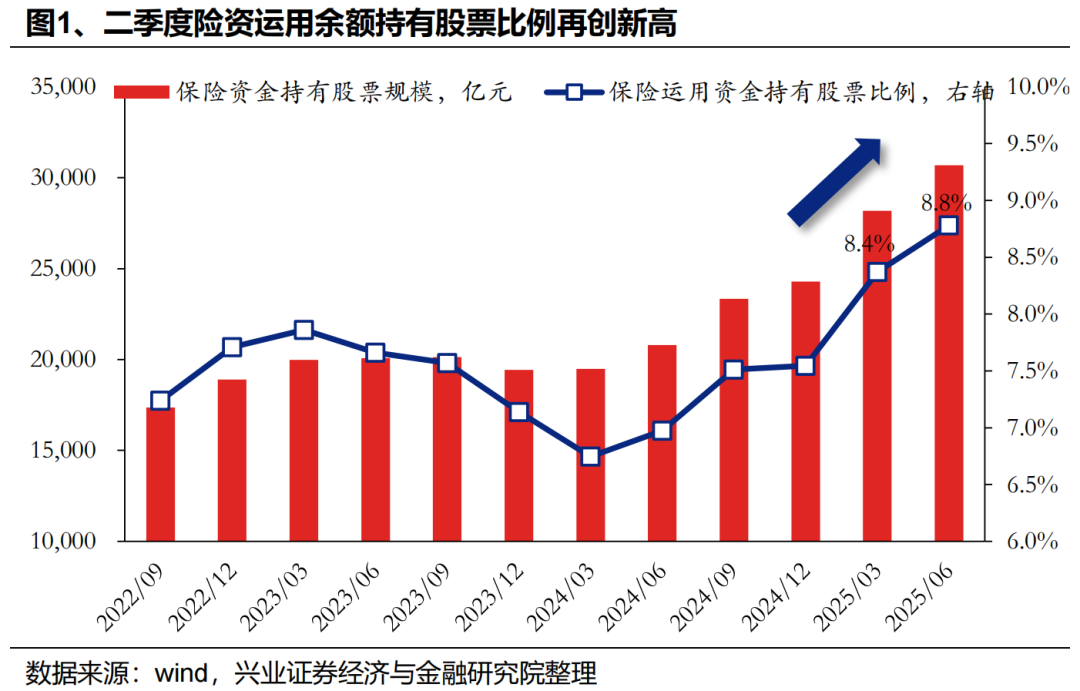
Group 1 - The core viewpoint of the articles indicates that state-owned insurance companies are increasingly optimizing their performance evaluation methods and enhancing their investment in equity assets, leading to a significant increase in stock holdings and a shift towards direct investment strategies [1][2][3]. Group 2 - Insurance funds have accelerated their entry into the market, with a net inflow of approximately 200 billion yuan into stocks in the second quarter, raising the proportion of stocks held to 8.8% [2]. - It is estimated that insurance funds will continue to increase their allocation to A+H stocks by 300 to 400 billion yuan in the second half of the year, driven by a policy encouraging large state-owned insurance companies to invest 30% of new premiums in the stock market [2]. - The shift in investment strategy is evident as insurance funds are moving from external management to direct investment, with a notable increase in stock holdings and a decrease in fund holdings since the fourth quarter of 2024 [2]. Group 3 - In the second quarter, insurance funds increased their allocation to high-dividend stocks while reducing their holdings in energy sectors, with a focus on technology and high-end manufacturing [3]. - The average dividend yield of the top 20 stocks increased to 3.80%, reflecting a preference for high-dividend assets, while the reduction in holdings of cyclical resource stocks indicates a strategic shift in asset allocation [3]. Group 4 - Insurance funds have significantly increased their stake in Hong Kong-listed companies, with 28 instances of shareholding increases this year, 23 of which were in Hong Kong stocks, marking a substantial rise compared to previous years [4]. - The influx of insurance funds into Hong Kong stocks has been a key driver of the rise in dividend assets in the region, particularly after a temporary slowdown due to tariff impacts [4]. Group 5 - In the first half of 2025, insurance funds reduced their allocation to ETFs focused on broad indices while increasing their investment in industry-specific ETFs, particularly in TMT, manufacturing, and financial real estate sectors [5][7]. - The net inflow into industry-themed ETFs reached 609 billion yuan, with insurance funds contributing significantly to this growth [7]. Group 6 - The top insurance companies in the A-share market have accelerated their stock allocations, with a total increase in stock market value of 411.9 billion yuan in the first half of 2025, reflecting a 28.7% increase [8]. - The proportion of FVOCI stocks held by these companies has risen significantly, indicating a strategic focus on long-term investments in dividend assets [8].

险资入市全拆解:连续五个季度大幅增配股票,二季度整体增配红利,整体仍增配科技
Xin Lang Cai Jing· 2025-09-06 07:29
Group 1 - The performance evaluation methods for state-owned insurance companies have been continuously optimized since the beginning of the year, leading to an improved policy environment for insurance fund equity investments, which has accelerated the entry of insurance capital into the market [1] - In the second quarter, insurance companies further increased their stock allocations by approximately 200 billion yuan, with the proportion of stocks held rising by 0.4 percentage points to 8.8% compared to Q1 [1] - It is estimated that insurance capital will continue to increase allocations to A+H stocks by 300 to 400 billion yuan in the second half of the year, based on a 30% investment of new premium income [5] Group 2 - Insurance capital's participation in equity assets is gradually shifting from external management to direct investment, with a notable increase in stock holdings since Q4 2024, while fund holdings have decreased [8] - In the second quarter, insurance capital increased allocations to dividend-paying stocks while reducing holdings in energy sectors, with a focus on technology and high-end manufacturing [11] - The average dividend yield of the top 20 stocks increased to 3.80%, indicating a preference for high-dividend assets [13] Group 3 - Insurance capital has accelerated its stake acquisitions in listed companies, particularly in Hong Kong stocks, with 28 stake acquisitions recorded by August 31, surpassing the total for the previous year [16] - The preference for Hong Kong assets has made insurance capital a core driver of the rise in Hong Kong dividend assets [19] Group 4 - In the first half of 2025, insurance capital's holdings in ETFs saw a slowdown, with a total of 214.9 billion yuan held, reflecting a shift towards direct investments [23] - Despite the slowdown in total ETF allocations, there has been a significant internal structural adjustment, with increased allocations to TMT, manufacturing, and financial real estate sector ETFs [29] Group 5 - The five listed insurance companies in A-shares increased their stock holdings by 411.9 billion yuan in the first half of the year, representing a 28.7% increase [33] - The proportion of FVOCI stocks held by listed insurance companies has significantly increased, with a 62.2% rise in holdings [36]



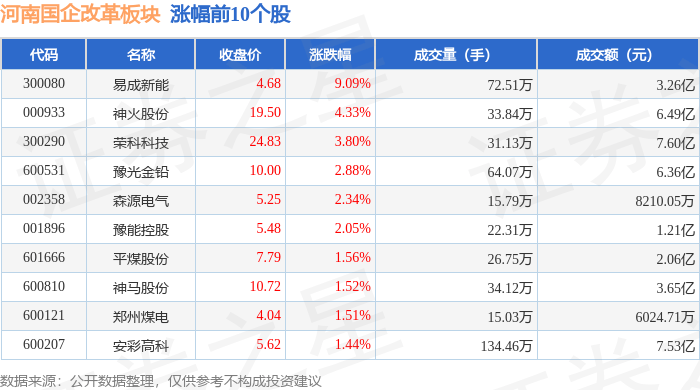
河南国企改革板块9月5日涨2.2%,易成新能领涨,主力资金净流入9247.48万元


Sou Hu Cai Jing· 2025-09-05 09:28
Market Performance - On September 5, the Henan state-owned enterprise reform sector rose by 2.2%, with Yicheng New Energy leading the gains [1] - The Shanghai Composite Index closed at 3812.51, up 1.24%, while the Shenzhen Component Index closed at 12590.56, up 3.89% [1] Individual Stock Performance - Yicheng New Energy (300080) closed at 4.68, up 9.09%, with a trading volume of 725,100 shares and a transaction value of 326 million yuan [1] - Shenhuo Co. (000933) closed at 19.50, up 4.33%, with a trading volume of 338,400 shares and a transaction value of 649 million yuan [1] - Rongke Technology (300290) closed at 24.83, up 3.80%, with a trading volume of 311,300 shares and a transaction value of 760 million yuan [1] - Other notable stocks include Yuguang Jinchang (600531) and Senyuan Electric (002358), which also saw positive gains [1] Capital Flow Analysis - The Henan state-owned enterprise reform sector experienced a net inflow of 92.47 million yuan from institutional investors, while retail investors saw a net outflow of 111 million yuan [2][3] - Notable net inflows from institutional investors include Shenhuo Co. (434.19 million yuan) and Rongke Technology (404.44 million yuan) [3] - Retail investors showed significant outflows in stocks like An Cai High-Tech (600207) and Yicheng New Energy (300080) [3]
国泰海通晨报-20250905
Haitong Securities· 2025-09-05 02:52
Coal Mining Industry Research - The coal industry is experiencing a decline in profitability due to falling coal prices, with the second quarter of 2025 marking a significant pressure point for the sector, although leading companies have exceeded performance expectations, indicating that downside risks have been identified [1][3] - In the first half of 2025, the coal industry saw a total revenue of 578.1 billion yuan, a year-on-year decline of 18.6%, and a net profit of 54.2 billion yuan, down 31.3% year-on-year [3] - The average price of thermal coal at Huanghua Port (Q5500) in the first half of 2025 was 685.9 yuan per ton, a decrease of 22.4% year-on-year, while the average price of coking coal at Jingtang Port was 1377.7 yuan per ton, down 38.5% year-on-year [2][3] - The coal production in the first half of 2025 reached 2.4 billion tons, a year-on-year increase of 5.4%, but a decrease of 8 million tons compared to the second half of 2024, indicating a self-imposed reduction in production within the industry [2] - The leading companies in the coal sector, such as China Shenhua, Shaanxi Coal, and China Coal Energy, have shown resilience and performed better than the industry average despite the overall decline in profits [3][4] Investment Recommendations - The report continues to recommend leading companies in the coal sector, including China Shenhua, Shaanxi Coal, and China Coal Energy, as well as Yanzhou Coal and Jinkong Coal [1]