通威股份

Search documents
出口退税取消叠加自律机制调整 市场化下光伏产业链面临价值重估
Di Yi Cai Jing· 2026-01-11 21:11
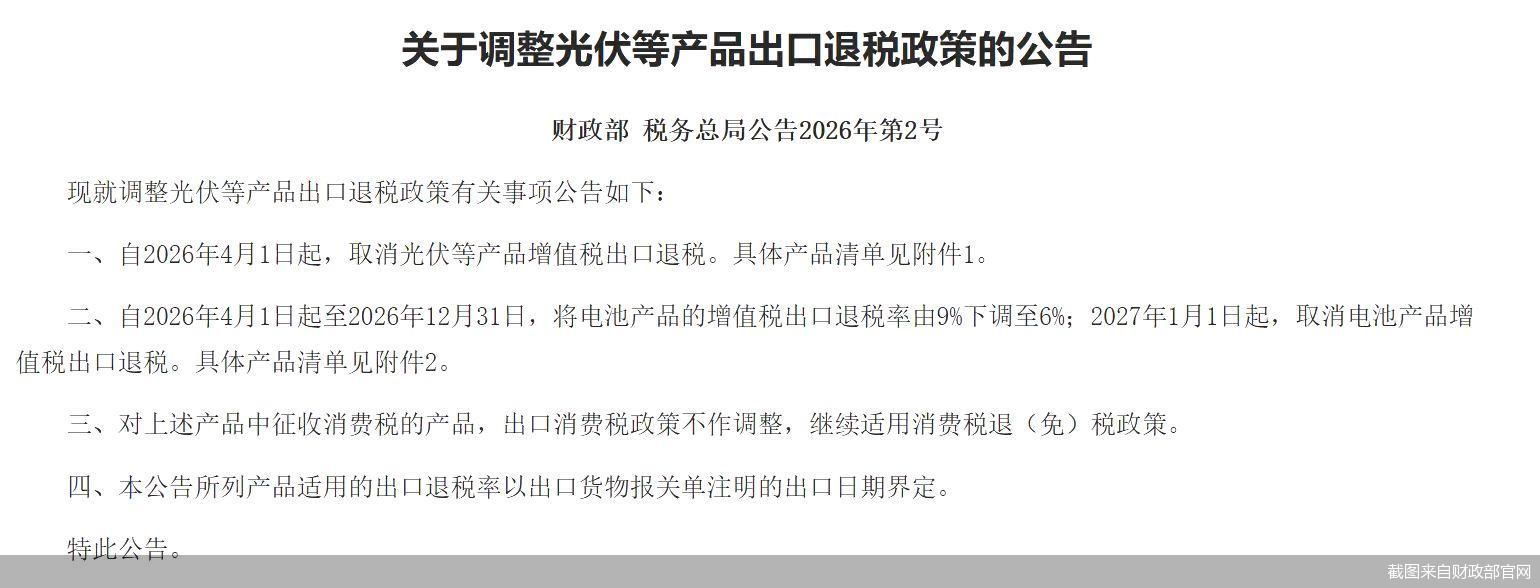
Core Viewpoint - The photovoltaic industry is facing a significant policy shift as the export tax rebate for photovoltaic products is fully canceled, marking the end of a supportive policy environment and leading to a historical turning point for the industry [1][2]. Policy Changes - The Ministry of Finance and the State Taxation Administration announced the cancellation of the export tax rebate for photovoltaic products starting April 1, 2026, transitioning the industry into a "no rebate subsidy" phase [2]. - The export tax rebate policy, which began in October 2013, has seen a gradual decline in rebate rates, dropping from 13% to 9% for photovoltaic silicon wafers, batteries, and modules as of December 1, 2024 [2]. Market Reaction - The market reacted sharply to these policy changes, with the sentiment in the polysilicon market plummeting, leading to significant declines in polysilicon futures and related stocks such as Daqo New Energy and Tongwei Co., Ltd. [1][3]. - On January 8, polysilicon futures dropped by 9%, followed by an 8% decline on January 9, reaching a low of 50,080 yuan/ton [3]. Industry Self-Regulation - The industry self-regulation phase has entered a new stage, with the State Administration for Market Regulation holding discussions with major companies regarding monopoly risks and requiring them to avoid agreements on production capacity, sales prices, and market division [3][4]. - The self-regulation efforts that began in 2025 had initially helped stabilize prices, but the recent regulatory changes indicate a shift away from relying on such practices [4]. Price Dynamics - Despite rising prices for upstream polysilicon and silicon wafers, downstream module prices have not followed suit, leading to squeezed profit margins for developers [5][6]. - The average transaction price for N-type polysilicon was reported at 59,200 yuan/ton, reflecting a week-on-week increase of 9.83%, while N-type G10L monocrystalline silicon wafers saw a price increase of 9.17% [5]. Demand Outlook - The first quarter is traditionally a weak demand season for the photovoltaic industry, with both domestic and overseas markets showing signs of slowing order execution and limited visibility for new orders [7]. - The overall market demand has been declining, and the anticipated price increases for components face significant resistance due to low demand [6][7]. Market Valuation - The shift in policy is prompting a "value reassessment" in the capital market for the photovoltaic sector, with significant sell-offs observed in the stock market [8]. - From January 8 to 9, the photovoltaic sector experienced a notable decline, with polysilicon futures dropping by 10.2% and major companies like Tongwei Co., Ltd. and GCL-Poly Energy Corp. seeing substantial stock price decreases [8]. Investment Opportunities - Despite the challenges, the photovoltaic industry's overall valuation is at historical lows, which may present attractive investment opportunities compared to other sectors [8]. - Companies with advantages in technology iteration, cost control, and global channel layout are expected to be identified as potential investment opportunities amidst the changing landscape [8].



工业硅、多晶硅周报:将取消光伏等产品增值税,出口退税-20260111
Hua Lian Qi Huo· 2026-01-11 15:19
期货交易咨询业务资格:证监许可【2011】1285号 请务必阅读正文后的免责声明。本报告的信息均来自己公开信息,关于信息的准确性与完整性,建议投资者谨慎判断,据此入市,风险自担。 华联期货工业硅、多晶硅周报 将取消光伏等产品增值税出口退税 20260111 作者:陈小国 0769-22116880 从业资格号:F03100622 交易咨询号:Z0021111 审核:萧勇辉,从业资格号:F03091536,交易咨询号:Z0019917 2 行业格局 3 期现市场 4 库存 1 周度观点及热点资讯 8 进出口 5 成本利润 6 供给 7 需求 请务必阅读正文后的免责声明。本报告的信息均来自己公开信息,关于信息的准确性与完整性,建议投资者谨慎判断,据此入市,风险自担。 请务必阅读正文后的免责声明。本报告的信息均来自己公开信息,关于信息的准确性与完整性,建议投资者谨慎判断,据此入市,风险自担。 周度观点及热点资讯 热点资讯 请务必阅读正文后的免责声明。本报告的信息均来自己公开信息,关于信息的准确性与完整性,建议投资者谨慎判断,据此入市,风险自担。 u 自2026年4月1日起,取消光伏等产品增值税出口退税。自2026年 ...
电力设备产业周跟踪:光伏锂电取消出口退税利好短期抢装和长期发展,继续重视商业航天太空光伏赛道
Huafu Securities· 2026-01-11 15:01
Investment Rating - The report maintains an "Outperform" rating for the industry [5] Core Insights - The cancellation of export tax rebates for lithium batteries and photovoltaic products is expected to accelerate the clearing of outdated production capacity and promote global expansion [2][19] - The energy storage sector is experiencing rising prices for systems and EPC contracts, driven by strong demand [50][51] - The wind power sector is advancing with multiple offshore wind projects receiving approval, indicating ongoing growth in domestic offshore wind energy [34][35] Summary by Sections Lithium Battery Sector - A meeting was held by four departments to regulate the competitive order in the lithium battery industry, proposing the cancellation of export tax rebates for lithium batteries [9][10] - The Chinese government plans to cancel or reduce export tax rebates for battery-related products starting April 1, 2026 [10] Photovoltaic Sector - The official cancellation of export tax rebates for photovoltaic products is set for April 1, 2026, marking the end of the "rebate dividend" era [19][20] - This policy is expected to lead to a surge in orders and installations before the policy takes effect, while long-term effects include the elimination of low-cost competition and a shift towards technological innovation and brand building [19][20] Wind Power Sector - Several offshore wind projects in Jiangsu have been approved, with ongoing progress in deep-sea offshore wind projects [34][35] - The approval of a 1GW offshore wind project in Guangdong and a 0.8GW project in Jiangsu highlights the sector's growth [34] Energy Storage Sector - In December, the average prices for energy storage systems and EPC contracts increased, with strong demand noted in regions like Xinjiang and Shanxi [50][51] - The adjustment of export tax policies for batteries is expected to increase export costs, potentially leading to a surge in exports before the policy takes effect [52] Power Equipment Sector - The CES2026 event showcased the successful launch of the Rubin platform, which is expected to enhance AI computing capabilities [60][61] - The Qinggui DC project has entered the feasibility study phase, marking significant progress in high-voltage direct current transmission projects [62] Hydrogen Energy Sector - The National Energy Group has undergone structural adjustments, establishing a new hydrogen energy division, emphasizing hydrogen as a key growth point in the economy [74][77] - The procurement of a hundred-ton SAF unit indicates ongoing investment in hydrogen technology [78]
每周经济观察:华创宏观WEI指数回升-20260111
Huachuang Securities· 2026-01-11 14:43
Economic Indicators - The Huachuang Macro WEI index rose to 6.05% as of January 4, 2026, an increase of 0.46 percentage points from the previous week[2] - Subway passenger volume in 26 cities increased by 6% year-on-year in the first week of January, while domestic flight operations averaged 12,400 flights per day, down 0.6% year-on-year[2] - Container throughput at Chinese ports rebounded slightly, with a week-on-week increase of 6.3% as of January 5, 2026, and a year-on-year increase of 7.7% over the past four weeks[2] Real Estate and Construction - Residential property sales in 67 cities saw a year-on-year decline of 43% in the first ten days of January, compared to a 24% decline in December 2025[3] - The average land premium rate in 100 cities fell to 0.45% as of January 4, 2026, down from 1.64% in December 2025[3] - Cement shipment rates dropped to 29% as of January 2, 2026, a decrease of 2.4 percentage points from the previous week[3] Commodity Prices - Gold prices rose to $4,473 per ounce, an increase of 3.6%, while copper prices reached $12,990 per ton, up 3.8%[2] - Crude oil prices increased, with WTI at $59.1 per barrel (up 3.1%) and Brent at $63.3 per barrel (up 4.3%)[2] - Lithium carbonate prices surged by 15.6% in the latest trading session[2] Financial Markets - The stock-bond Sharpe ratio difference stood at 4.25, indicating a high relative value for equities compared to bonds[9] - New special bond issuance in early January totaled 874 billion yuan, significantly higher than zero in the same period last year[4] - Interest rates fell post-year-end, with DR001 at 1.2727% and DR007 at 1.4727%, reflecting decreases of 5.98 and 50.94 basis points respectively since December 31, 2025[4]
4月1日起执行!光伏出口退税全面取消,行业影响几何
Bei Jing Shang Bao· 2026-01-11 13:01
Core Viewpoint - The cancellation of the export VAT rebate for photovoltaic products marks the end of the "rebate subsidy era," significantly impacting component manufacturers and potentially leading to a surge in exports before the policy takes effect [1][3][5]. Policy Changes - The Ministry of Finance and the State Taxation Administration announced the cancellation of the export VAT rebate for photovoltaic products effective April 1, 2026, with a reduction in the rebate rate for battery products from 9% to 6% until the end of 2026 [3][4]. - The announcement includes a list of 249 products related to photovoltaic and 22 battery products affected by the policy change [4]. Industry Impact - The cancellation of the export VAT rebate is expected to have a significant impact on component manufacturers, with predictions of a "rush to export" before the policy takes effect [5][6]. - Major manufacturers such as JinkoSolar, Trina Solar, JA Solar, and LONGi Green Energy reported substantial losses in the first three quarters of 2025, with JinkoSolar's overseas revenue exceeding 60% of its total revenue [5][6]. Market Dynamics - The Chinese Photovoltaic Industry Association indicated that the adjustment of export VAT rebates could help stabilize overseas market prices, which have been declining due to fierce competition [4][10]. - The industry is experiencing a shift from "price competition" to "value competition," as companies will need to focus on technological upgrades and high-value segments to maintain competitiveness [10][11]. Regulatory Environment - Recent meetings involving the China Photovoltaic Industry Association and leading polysilicon companies addressed concerns about monopolistic practices and market regulation, indicating a tightening regulatory environment [8][9]. - The cancellation of export rebates and potential changes in the polysilicon storage plan are seen as part of a broader effort to combat "internal competition" within the industry [10].





市场化下光伏产业链面临价值重估
Di Yi Cai Jing Zi Xun· 2026-01-11 11:37
Group 1 - The core viewpoint of the article highlights a significant policy shift in the photovoltaic (PV) industry, marked by the cancellation of export VAT rebates and the cessation of industry self-regulation, indicating a historical turning point for the sector [2][3]. - The Ministry of Finance and the State Taxation Administration announced the cancellation of export VAT rebates for PV products starting April 1, 2026, transitioning the industry into a "no rebate subsidy" phase [3]. - The cancellation of the export VAT rebate follows a period of declining export prices and increased competition in overseas markets, leading to substantial losses across the industry [3][4]. Group 2 - The market reacted sharply to these changes, with significant declines in the prices of polysilicon futures and related stocks, indicating a loss of investor confidence [4][8]. - The recent discussions between the State Administration for Market Regulation and leading companies in the PV sector, including Tongwei Co. and Daqo New Energy, focused on addressing monopoly risks and enforcing compliance with new regulations [4][5]. - Despite rising prices for upstream materials like polysilicon and silicon wafers, downstream component prices have not followed suit, leading to squeezed margins for developers [5][6]. Group 3 - The first quarter is traditionally a slow season for the PV industry, and the anticipated price increases for components face resistance due to weak demand [6][7]. - The shift in policy is prompting a reevaluation of the PV sector's value in the capital markets, with significant sell-offs observed in the stock prices of major companies [7][8]. - Analysts suggest that while the overall valuation of the PV industry is at historical lows, the uncertainty surrounding future profitability and market dynamics poses challenges for attracting investment [8].
市场化下光伏产业链面临价值重估
第一财经· 2026-01-11 11:28
Core Viewpoint - The photovoltaic industry in China is facing a significant policy shift with the complete cancellation of export VAT rebates and the halting of industry self-regulation, marking a historical turning point for the sector [3][4]. Policy Changes - Starting April 1, 2026, the export VAT rebate for photovoltaic products will be fully canceled, transitioning the industry into a "no rebate subsidy" phase [4]. - The export VAT rebate policy, initiated in October 2013, has seen a gradual decline in rebate rates, dropping from 13% to 9% as of December 1, 2024, indicating a move towards the cancellation of rebates [4]. Market Reactions - The market reacted sharply to these policy changes, with the price of multicrystalline silicon contracts dropping significantly, and major companies like Daqo New Energy and Tongwei Co. experiencing substantial stock declines [3][5]. - On January 8 and 9, 2026, the main contract for multicrystalline silicon futures fell by 9% and 8% respectively, reaching a low of 50,080 yuan/ton [5][11]. Industry Self-Regulation - The recent discussions between the State Administration for Market Regulation and leading companies in the silicon material sector indicate a shift away from previous self-regulatory practices, which had aimed to stabilize prices through coordinated production and sales strategies [5][6]. - The new regulatory environment prohibits companies from coordinating on production capacity, sales volumes, and pricing, which could lead to increased market volatility [5][6]. Price Dynamics - Despite rising prices for upstream materials like silicon and silicon wafers, the prices for downstream components have not followed suit, squeezing profit margins for developers [9]. - The average transaction price for N-type multicrystalline silicon was reported at 59,200 yuan/ton, reflecting a week-on-week increase of 9.83%, while N-type G10L monocrystalline silicon wafers saw a price increase of 9.17% [9]. Demand and Market Outlook - The first quarter is traditionally a low-demand season for the photovoltaic industry, complicating the acceptance of price increases by end-users [10]. - The overall market demand has been weakening, with a decline in order visibility for both domestic and overseas markets as the year-end approaches [10]. Capital Market Impact - The shift in policy is prompting a "value reassessment" in the capital markets for the photovoltaic sector, leading to significant sell-offs and pressure on valuations [11]. - From January 8 to 9, 2026, the photovoltaic sector experienced a notable sell-off, with major companies like Tongwei Co. and GCL-Poly Energy facing significant stock price declines [11].
出口退税取消叠加自律机制调整,市场化下光伏产业链面临价值重估
Di Yi Cai Jing· 2026-01-11 11:11
Core Viewpoint - The photovoltaic industry is undergoing significant changes in 2026 due to the cancellation of export VAT rebates and the halting of industry self-regulation, leading to a historical turning point for the sector [1][2]. Policy Changes - The Ministry of Finance and the State Taxation Administration announced the cancellation of export VAT rebates for photovoltaic products starting April 1, 2026, marking the transition to a "no rebate subsidy" phase [2]. - The export VAT rebate policy for the photovoltaic industry began in October 2013, with rates gradually decreasing over the past two years, culminating in a drop from 13% to 9% in December 2024 [2]. Market Reactions - The market reacted sharply to these policy changes, with the price of polysilicon futures dropping significantly, indicating a loss of confidence among investors [3][8]. - On January 8 and 9, polysilicon futures contracts fell by 9% and 8%, respectively, with related stocks also experiencing substantial declines [3][8]. Industry Self-Regulation - The recent discussions between the State Administration for Market Regulation and major companies in the photovoltaic sector signal a shift away from previous self-regulatory practices, which had aimed to stabilize prices [3][4]. - Companies are now prohibited from coordinating on production capacity, sales prices, and other market behaviors, which could lead to increased volatility in pricing [3][4]. Price Dynamics - Despite rising prices for upstream materials like polysilicon and silicon wafers, downstream component prices have not followed suit, leading to squeezed margins for developers [5][6]. - The average transaction price for n-type polysilicon rose to 59,200 yuan/ton, a 9.83% increase week-on-week, while the average price for N-type G10L monocrystalline silicon wafers increased by 9.17% [5]. Demand Outlook - The first quarter is traditionally a slow season for the photovoltaic industry, with both domestic and international demand showing signs of weakness [7]. - The overall market demand has been declining, with new orders becoming less visible, further complicating the pricing landscape [7]. Market Valuation - The shift in policy is prompting a reevaluation of the photovoltaic sector's value in the capital markets, with significant sell-offs observed in early January [8]. - From January 8 to 9, the photovoltaic sector saw a drop of 10.2% in polysilicon futures, with major companies like Tongwei Co. and Daqo New Energy experiencing notable declines in stock prices [8].
兴业证券:如何看待A股本轮开门红的结构与延续性?
智通财经网· 2026-01-11 10:36
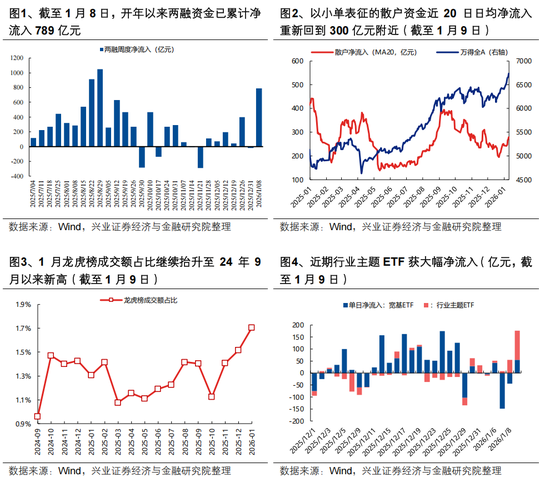
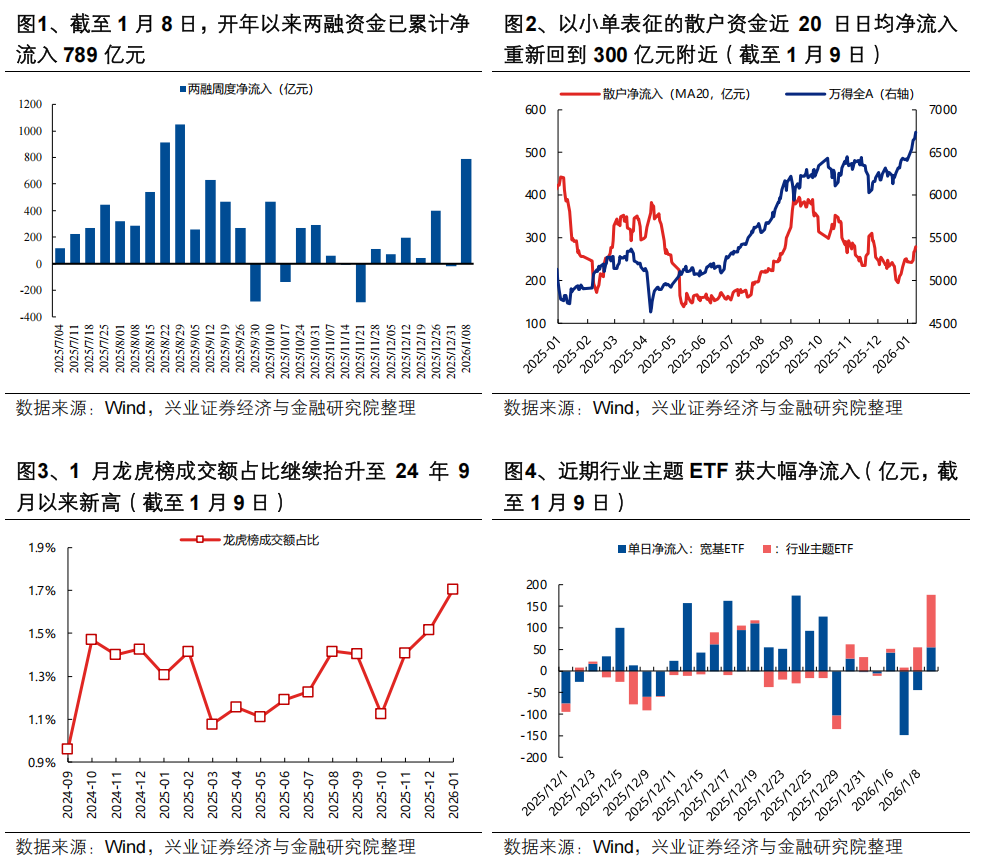
Core Viewpoint - The recent "opening red" in the A-share market reflects a favorable macroeconomic environment and abundant liquidity, which supports market risk appetite and attracts incremental capital inflow, creating a positive feedback loop between capital inflow and market rise [2][18]. Group 1: Market Dynamics - The A-share market has experienced a strong start with the Shanghai Composite Index breaking key levels and achieving a "sixteen consecutive days" rise, exceeding many investors' expectations [1][19]. - Historical data indicates that after a single-day trading volume exceeds 3 trillion yuan, there is typically at least a monthly-level market rally [19]. - Various types of trading funds have shown signs of accelerated entry, including a net inflow of 78.9 billion yuan in margin financing since the beginning of the year and a return of retail investor net inflow to around 30 billion yuan daily [2][5]. Group 2: Structural Characteristics - The inflow structure of different funds shows a strong consensus on key themes, primarily focusing on TMT (storage, AI applications), military industry (commercial aerospace), non-ferrous metals, new energy (controlled nuclear fusion), machinery (robots), and pharmaceuticals (innovative drugs, brain-machine interfaces) [5][36]. - The global stock market has also seen a strong start in 2026, driven by macroeconomic and industrial narratives, with A-shares reflecting similar trends [13][18]. Group 3: Future Directions - As companies begin to disclose annual reports, earnings will become a key factor driving market dynamics, leading to a structural adjustment where previously hot sectors face performance validation, while some low-performing sectors may attract new capital inflows [36]. - Industries with significant upward revisions in profit forecasts since November include technology (consumer electronics, computing), advanced manufacturing (new energy, military), cyclical sectors (building materials, non-ferrous metals), and consumer sectors (food processing, retail) [37][38].

兴证策略:如何看待本轮开门红的结构与延续性?
Xin Lang Cai Jing· 2026-01-11 10:28
Group 1 - The current market rally, referred to as "开门红," is supported by improving macroeconomic data and ample liquidity, which enhances market risk appetite and attracts new capital inflows [1][9][40] - Various types of trading funds have shown accelerated entry into the market, including a net inflow of 78.9 billion yuan in margin financing since the beginning of the year and an average daily net inflow of retail funds returning to around 30 billion yuan [1][9][40] - The structural consensus among different types of funds is strong, focusing on sectors such as TMT (storage, AI applications), military (commercial aerospace), non-ferrous metals, new energy (controlled nuclear fusion), machinery (robots), and pharmaceuticals (innovative drugs, brain-machine interfaces) [2][35][38] Group 2 - The global stock market is experiencing a strong start in 2026, driven by expectations of loose liquidity, geopolitical changes, and emerging industrial trends, with A-shares reflecting this global narrative [5][38] - Key events such as the International Consumer Electronics Show (CES) and geopolitical developments are catalyzing themes in the market, enhancing the strategic value of resource products and driving structural similarities across global markets [5][38] - The market is currently in a favorable position with limited downside risk and significant potential for upward movement, supported by improved PMI and price data, as well as a high percentage of stocks still below their previous highs [11][44] Group 3 - The recent surge in the commercial aerospace sector has raised concerns about its current crowding and sustainability, with trading volume indicating a potential for further upward movement [16][51] - As the earnings forecast disclosure period approaches, the correlation between stock prices and earnings will increase, necessitating a focus on structural adjustments based on performance [21][57] - Industries with significant upward revisions in profit forecasts since November include technology (consumer electronics, computing), advanced manufacturing (new energy, military), and cyclical sectors (building materials, non-ferrous metals) [26][58]