
雀巢

Search documents
宠物食品行业专题报告十五:如何看待亚宠展新品情况?
Changjiang Securities· 2025-09-12 15:21
Investment Rating - The investment rating for the pet food industry is "Positive" and maintained [10] Core Insights - The 2025 Asia Pet Expo highlights innovation in production processes, with a continued interest in baked food from 2024, and the introduction of fresh steamed, enzymatic, and freeze-dried products [2][6] - Overseas brands like Royal Canin and Pro Plan are focusing on localized products to meet specific consumer needs, while domestic leaders such as Guobao and Zhongchong are innovating based on pet health requirements [2][6] - Future competition in the industry will hinge on production processes and R&D capabilities, with companies deeply engaged in canine and feline research likely to build strong product barriers [2][6] Summary by Sections Competitive Trends - The market is becoming increasingly concentrated among leading brands, with the CR10 of the pet food industry rising from 28.3% in 2019 to 32.7% in 2024, indicating a trend towards consolidation [7][17] - Intense competition exists among mid-tier brands, with many small enterprises facing significant pressure due to product homogeneity and online sales channels, leading to a wave of industry restructuring [7][17] - The number of bankruptcy and restructuring cases in the pet industry has surged, with 151 cases reported in 2024, primarily involving small to medium-sized enterprises [17][19] Overseas Brands - Overseas brands are developing comprehensive nutritional solutions for pets throughout their life cycles, maintaining high market shares in China [25][26] - Royal Canin launched breed-specific products tailored to local preferences, such as a specialized formula for Corgis, emphasizing scientific nutritional approaches [25][26] - Pro Plan has established a platform for professional veterinary consultations and educational sessions at the Asia Pet Expo, enhancing its brand authority in pet nutrition [28][29] Domestic Brands - Domestic brands are focusing on continuous innovation in production processes, with significant advancements in enzymatic, freeze-dried, and fresh steamed products [8][33] - Leading domestic brands are enhancing their core competitiveness through innovative ingredient formulations and targeted nutritional solutions for pets at different life stages [8][33] - The trend of using fresh meat as a core selling point is evolving, with brands exploring diverse protein sources and innovative feeding experiences [8][33]
星巴克,或许将出售中国业务控制权
2 1 Shi Ji Jing Ji Bao Dao· 2025-09-12 02:30
Group 1: Starbucks China Sale - Starbucks is preparing to sell its controlling stake in its China business, with final bids expected by early October from firms including Carlyle, Hillhouse, Sequoia China, and Boyu Capital [1] - The deal structure remains negotiable, but Starbucks aims to retain control over its coffee roasting facilities in China to maintain quality [1] - CEO Brian Niccol expressed confidence in the Chinese market and indicated that Starbucks is evaluating over 20 interested institutions for potential partnerships to expand its store count significantly [1] Group 2: Competitive Landscape - Luckin Coffee reported a 47.1% year-on-year revenue growth in Q2, reaching 12.36 billion yuan, significantly outpacing Starbucks, which saw an 8% revenue increase to 7.9 billion USD (approximately 56.25 billion yuan) [2] - Luckin's same-store sales grew by 13.4% in Q2, driven primarily by an increase in cup volume, while Starbucks experienced a 2% increase in same-store sales with a 4% decline in average transaction value [2] - The competitive dynamics in the Chinese coffee market are shifting, prompting local capital to pursue Starbucks due to its potential for localized growth [2]

“中国线上消费品牌指数”亮相服贸会,淘宝天猫助力“品质消费”研究
Huan Qiu Wang Zi Xun· 2025-09-11 09:07
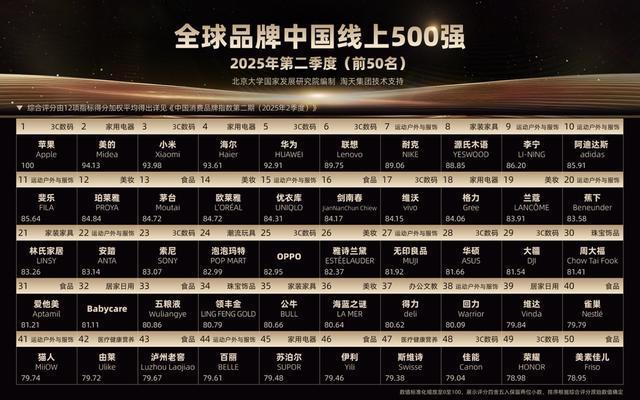
Core Insights - The "China Online Consumption Brand Index" (CBI) was prominently featured at the 2025 China International Service Trade Fair, showcasing its significance in measuring online consumer quality [1][3] - The CBI index reflects a shift towards higher quality consumption in China, with the average score increasing from 59.42 in Q1 2023 to 65.21 in Q2 2025, indicating a notable improvement in consumer brand quality [5][6] Group 1: CBI Index Overview - The CBI index is the first of its kind to utilize real consumer data to focus on high-quality development in online consumption, filling a gap in macroeconomic statistics regarding consumption quality [2][3] - The index includes various sub-indices such as the China Online Brand Purchasing Power Index and the Global Brand China Online 500 Strong list, providing insights at both national and regional levels [3] Group 2: Industry Insights - The highest CBI scores are found in the 3C and home appliance sectors, indicating a consumer preference for high-scoring brands in these categories [5] - Emerging sectors like pet products and jewelry are experiencing the fastest growth in CBI scores, reflecting an increasing consumer focus on quality and brand [5] Group 3: Regional Characteristics - New first-tier and second-tier cities exhibit stronger CBI scores, suggesting higher average consumption quality in these areas, while first-tier cities dominate in total purchasing power [5] - Regions with a high proportion of mobile populations show a balanced consumption quality and strong purchasing power [5] Group 4: Consumer Demographics - The middle-income group in China exceeds 400 million, providing a solid foundation for quality consumption growth, despite perceptions of a "white label era" [6] - The research indicates that new brands on the list share characteristics such as strong originality and a focus on product innovation in niche consumption scenarios [5]

办公室恋情可能带来什么后果?看看雀巢CEO
财富FORTUNE· 2025-09-10 13:09
Core Insights - Nestlé's CEO Laurent Freixe was dismissed for violating company conduct guidelines, specifically for an inappropriate relationship with a subordinate, highlighting a shift in corporate tolerance towards such behavior [2][3][4] - The new CEO, Philipp Navratil, was promoted internally, indicating a preference for stability and internal leadership amidst ongoing scrutiny of executive conduct [2][4] Group 1: Corporate Governance and Conduct - There is a decreasing tolerance for inappropriate behavior among CEOs, with boards acting swiftly to replace controversial leaders, contrasting with the past where performance issues were often overlooked [3][4] - Freixe did not receive any severance pay upon his departure, reflecting a stricter enforcement of corporate discipline compared to the past, where underperforming executives might receive "golden parachutes" [4] - The details of the misconduct, including Freixe's failure to disclose the relationship, played a crucial role in the decision to terminate him, as many companies maintain a zero-tolerance policy for CEO-employee relationships due to power imbalances [4][5] Group 2: Implications for Leadership - While inappropriate relationships can lead to dismissal, there are instances where high-performing executives' misconduct is overlooked, suggesting a double standard in corporate governance [6][7] - The initial hiring of Freixe by the board, despite knowledge of his personal history, raises questions about the consistency of corporate policies regarding personal conduct and leadership appointments [7]

宠物经济黄金时代,强者更强
2025-09-07 16:19
Summary of Conference Call on Pet Economy Industry Overview - The pet economy in China has reached nearly 1 trillion RMB, indicating a large market size but low market concentration, with leading companies like Guobao Pet generating only over 5 billion RMB in revenue, significantly lower than international giants like Mars and Nestlé, suggesting substantial growth potential in the Chinese market [1][2] - The global pet market is valued at approximately 200 billion USD, with pet food accounting for 130 billion USD, highlighting the lucrative nature of the industry [2] Key Trends and Characteristics - The pet economy exhibits long-term growth characteristics, with the compound annual growth rate (CAGR) in the US and Japan exceeding GDP growth over the past 20 years, indicating resilience during economic fluctuations [1][2] - The Chinese pet market is characterized by three major trends: - **Cat Economy**: The number of cats has surpassed dogs since 2021, with cats showing a higher demand for premium food due to their sensitive digestive systems [4] - **Online Sales**: Online sales account for 68% of pet food sales, benefiting from the rise of interest e-commerce platforms like Douyin [4] - **Premiumization**: The trend towards high-end products is evident, with leading companies like Guobao achieving a net profit margin of 12% and a return on equity (ROE) expected to rise further [4][5] Market Dynamics - The pet food market has seen a slowdown in growth, with a CAGR of 25% from 2016 to 2021, dropping to around 6% in recent years, but is projected to stabilize at 10% over the next five years [7] - The pet medical market is still in a high-growth phase, with a market size nearing 100 billion RMB, but profitability is still developing [7][15] - The penetration rate of professional pet food in China is about 30%, significantly lower than the 80%-90% seen in mature overseas markets, indicating a major growth driver as consumers shift from leftovers to specialized pet food [8][9] Competitive Landscape - The competitive landscape in China is less concentrated compared to the US, where the top five companies hold 65% of the market share, while in China, it is only 25% [5][10] - Domestic brands are rising due to improvements in product quality, channel strategies, and brand strength, with companies like Guobao leveraging e-commerce and brand upgrades to capture market share [11][14] Investment Opportunities - The current phase of the pet economy in China is described as a "golden era," characterized by resilient growth and market optimization, presenting significant investment opportunities for leading companies [5][16] - Investors are encouraged to focus on leading and emerging companies within the sector, taking advantage of cyclical opportunities in this thriving market [16] Additional Insights - The rise of domestic brands is attributed to their ability to cater to local needs and preferences, with successful examples in both the pet food and medical sectors [14][15] - The pet medical sector is evolving, with increasing demand for comprehensive care as pets age, necessitating improvements in veterinary training and supply chain management [15]
一周新消费NO.325|蜜雪冰城上新两款开学季新品;a2牛奶完成收购雅士利新西兰工厂
新消费智库· 2025-09-07 13:03
New Product Launches - Mengniu has launched a new functional milk series targeting the elderly, including three products with 3.6g of native protein and 120mg of calcium per box [5][6] - Qingdao Beer has introduced a new white beer called "Hua Kai Mo Bai," with a malt concentration of 9% in 500ml cans [6] - Guizhou Chun has released two new products, Pure 6 and Pure 12, both at 40.9 degrees and positioned at 300 yuan and 500 yuan price points respectively [6] - "Guo Zi Shu Liao" has launched a new barley tea product, which is caffeine-free and sugar-free, with a minimum of 10g/L roasted barley [7] - "Moli Nai Bai" has collaborated with Shanghai Animation Film Studio to launch two new products inspired by the classic animation "Ginseng Fruit" [9] - Mixue Ice City has introduced two new back-to-school drinks, Lemon Milk Coffee priced at 8 yuan and Snow King Lemon Milk at 7 yuan [9] Market Expansion and Strategic Moves - H&M has officially entered the Brazilian market by opening its first store in São Paulo and launching an e-commerce platform [11] - Lucky Coffee has opened its first overseas store in Malaysia, marking the beginning of its global expansion [11] - The hotel brand Ying'nFlo has opened its first store in Wuhan, focusing on high-quality experiences for the new generation [11] - Haidilao has opened its first community store in Beijing, offering breakfast items and plans to expand its menu [12] - Yili Group has formed a strategic partnership with Hainan Airlines to promote its dairy products on flights [12] Investment and Financing Activities - Proya has announced plans to go public in Hong Kong to enhance its international strategy and financing capabilities [15] - a2 Milk Company has completed the acquisition of a milk powder manufacturing plant in New Zealand previously owned by Yashili [16] - The cosmetics brand Huazhi Xiao has completed a Series B financing round to support its global expansion and supply chain integration [16] - Debut, a biotech beauty leader, has secured $20 million in funding to accelerate its AI-based ingredient discovery platform [18] - PepsiCo has agreed to increase its stake in Celsius Holdings for $585 million, raising its ownership to 11% [19] New Food and Beverage Products - Shuanghui has launched "Crispy Pig Skin" snacks with two flavors, significantly reducing fat content compared to traditional chips [20] - Master Kong has introduced a new "Duck Shit Fragrant Lemon Tea," featuring rich tea flavors and natural sweetness [21] - Want Power, a brand under Wangwang, has launched a new product "Berry Care," rich in core ingredients beneficial for health [21] - Nongfu Spring has released a new "Water Source Bottle" series showcasing water from 15 premium sources [21] - Kirin Beverage has launched a new roasted tea latte, suitable for various occasions [22]




乳企加速抢滩B端市场
东京烘焙职业人· 2025-09-07 08:32
Core Viewpoint - The domestic liquid milk market has seen a significant slowdown in growth over the past five years, becoming a burden for major dairy companies, while solid dairy products like cheese and butter are experiencing rapid growth driven by the B-end food service sector [8][9]. Market Overview - The B-end dairy product market in China is projected to exceed 40 billion yuan by 2024, with expectations to reach 70.3 billion yuan by 2028 [8]. - The B-end market, particularly for high-end dairy products, has been dominated by international brands, with domestic production accounting for less than 30% [9]. Industry Dynamics - The demand for solid dairy products is increasing in various sectors such as baking, coffee, and tea, with the B-end coffee segment expected to generate 26.5 billion yuan for the dairy industry by 2025 [12]. - The rapid growth of new consumption trends has expanded the usage scenarios for dairy products, prompting domestic dairy companies to intensify their focus on the B-end market [12][15]. Competitive Landscape - Major dairy companies like Mengniu and Yili are actively entering the B-end market, establishing partnerships with various food service companies [13][14]. - The B-end market still has over 70% of its share held by imported dairy companies, indicating a significant opportunity for domestic players, but also highlighting the complexities of competition [17]. Challenges and Opportunities - Domestic dairy companies face challenges in transitioning from a consumer-focused (C-end) strategy to a solution-oriented (B-end) approach, requiring a deep understanding of customer needs and rapid response capabilities [18]. - There are technical gaps in product customization and high-end dairy product offerings, which pose significant barriers to entry in the B-end market [19]. Strategic Recommendations - To succeed in the B-end market, dairy companies need to break away from traditional C-end thinking and develop dedicated R&D, supply chain, and service systems for B-end products [20]. - A comprehensive upgrade in thinking, capabilities, and technical strength is essential for domestic dairy companies to compete effectively against imported brands in the B-end market [20].
迷你 Labubu 二手市场价格回落;雀巢中国与瑞幸共同研发新品;缺席“外卖大战”的霸王茶姬业绩受挫丨品牌周报
36氪未来消费· 2025-09-07 07:26
Group 1: Nestlé Leadership Change - Nestlé's former CEO Laurent Freixe was dismissed due to a violation of the company's code of conduct related to a romantic relationship with a subordinate [3] - Philipp Navratil, who has over 20 years of experience at Nestlé, has been appointed as the new CEO, effective immediately [3] - Navratil previously led Nestlé's coffee business, which generates nearly 200 billion yuan in sales and accounts for over 22% of the company's total revenue [3] Group 2: Challenges in Greater China - Nestlé's Greater China region reported a 6.5% decline in profits, amounting to a loss of 1.5 billion yuan, and a 1.8% drop in sales for the first half of 2025 [4] - The company's growth strategy in this region is shifting from channel-driven distribution to consumer demand-driven sales, while also reducing inventory [4] - The coffee business in China is a focal point, with ongoing collaboration with Luckin Coffee to enhance product development [4] Group 3: Bubble Mart's Mini Labubu Price Drop - The resale price of the Mini Labubu toy has decreased by 10% to 30% within a week of its launch, with the most popular "L" version dropping nearly 30% [7] - The rapid price decline is attributed to oversupply and consumer dissatisfaction with product quality [7][8] - Bubble Mart's production capacity has increased significantly, with plush product output exceeding ten times that of the previous year [8] Group 4: Bawang Tea's Performance - Bawang Tea reported a 23% decline in monthly GMV, the only negative growth among six listed tea brands [9] - The company is facing challenges from intensified price wars on delivery platforms, impacting customer retention [10] - Despite a strong expansion with 2042 new stores, the rapid growth has led to internal competition, diluting sales performance [10] Group 5: MaxMara's Pricing Strategy - MaxMara maintains prices in China that are over twice those in Europe, leading to consumer backlash and a thriving gray market [11] - The brand's pricing strategy aims to create a high-end image, but risks could arise from regulatory changes and increased competition [11][12] - Chinese consumers are increasingly price-sensitive, seeking value and transparency, which could challenge MaxMara's pricing model [12][13] Group 6: H&M's Expansion in China - H&M has opened two new stores in Shenzhen, including its largest flagship store in Southern China [19] - The brand is adapting to the Chinese market by enhancing its product offerings and entering new e-commerce platforms [20] - H&M's strategy focuses on maintaining affordability while transitioning towards a more fashionable and quality-oriented brand image [21] Group 7: Kweichow Moutai's Stock Performance - Kweichow Moutai regained its position as the highest-priced stock in A-shares, closing at 1476.1 yuan per share [23] - The stock's fluctuation was influenced by a brief surge in the price of another company, which was later corrected [23] Group 8: Elliott's Investment in PepsiCo - Elliott Investment Management has acquired a stake worth $4 billion in PepsiCo, becoming one of its largest investors [24] - The firm has proposed five major reform initiatives aimed at optimizing the beverage business and enhancing accountability [25] Group 9: GAP's Entry into Beauty Market - GAP announced its entry into the beauty market, testing products in 150 Old Navy stores [26] - The initiative aims to expand its product range and attract a broader customer base [26]

我为什么劝你少喝9.9元的咖啡?
洞见· 2025-09-05 12:36
Core Insights - The article highlights the rising popularity of Yunnan coffee, particularly the high-altitude Arabica beans, which are favored by major brands like Starbucks and Luckin Coffee for their unique flavor profile and health benefits [9][49]. Group 1: Product Features - The Yunnan coffee is made from high-quality Arabica beans grown at an altitude of 1600 meters, offering a balanced flavor and rich aroma [13][44]. - The freeze-drying process preserves the coffee's freshness and flavor, resulting in a product that is rich yet not bitter, and aromatic without being overwhelming [15][24]. - The coffee is free from additives such as artificial flavors, creamers, and sugars, making it suitable for health-conscious consumers [19][52]. Group 2: Health Benefits - The coffee contains soluble dietary fibers that aid digestion and provide a feeling of fullness, making it a good choice for those managing their weight [60]. - Rich in polyphenols, including chlorogenic acid, the coffee may help delay skin aging and improve overall health [64]. - The lower caffeine content of Yunnan Arabica beans makes it easier on the stomach and reduces the risk of jitteriness associated with higher caffeine levels [69]. Group 3: Market Positioning - The product is competitively priced at 59 yuan per can, with promotional offers available, making it an attractive option compared to café prices [39][56]. - The convenience of instant coffee that can be prepared in just three seconds appeals to modern consumers seeking quick and quality coffee experiences [21][32]. - The article emphasizes the product's ability to deliver a taste comparable to freshly brewed coffee, enhancing its market appeal [74][85].
从田间到舌尖:生物科技如何将玉米变为“零卡糖”
Jing Ji Guan Cha Bao· 2025-09-05 12:24
Group 1: Industry Overview - The global trend towards "zero sugar" is reshaping consumer choices, with 75% of beverage consumers in China opting for sugar substitutes due to health concerns [1] - The global erythritol market is projected to reach approximately $910 million in 2024, with China dominating the market with a 73% share [1] - The rapid development of the sugar-reduction food industry is heavily reliant on biotechnology, particularly using corn as a raw material for natural sweeteners like erythritol [1] Group 2: Company Profile - Dongxiao Biotechnology Co., Ltd. is emerging as a significant player in China's biotechnology sector, leveraging advanced corn deep-processing technology and automated production capabilities [1] - The company has an annual corn processing capacity of 1.7 million tons, enabling a full-chain production process that includes the conversion of corn into erythritol, starch sugars, and amino acids [1] - Dongxiao has established partnerships with renowned brands such as Yuanqi Forest, Coca-Cola, Nestlé, Unilever, BASF, and Charoen Pokphand Group [2] Group 3: Technological Advancements - Dongxiao has a research team of nearly 200 members, including academicians and PhD holders, and has developed a four-tiered research and development system [2] - The company has optimized fermentation processes, reducing the fermentation cycle by 25% and increasing conversion rates by 5%, while also lowering energy consumption by 15% [2] - Dongxiao is preparing to launch the next generation of natural sweeteners, allulose, which has a sweetness level of about 70% compared to sucrose and only 10% of its calories [2] Group 4: Future Outlook - Dongxiao aims to continue expanding in the functional product sector and enhance the value chain of the health industry [3] - The company is positioned to contribute to the global health wave with its innovative approaches to "healthy sweetness" [3]