
奔驰

Search documents
千里科技再添筹码,将整合吉利智能座舱团队|36氪独家
3 6 Ke· 2025-12-02 14:29
Core Viewpoint - Geely aims to transform Qianli Technology into a "second Huawei" by integrating its smart cockpit team into Qianli Technology, enhancing its technological capabilities [1][5]. Group 1: Company Strategy - Geely has invested in Qianli Technology, which was formerly Lifan Technology, and has been steering the company towards an "AI + vehicle" strategy since 2024 under Chairman Yin Qi [1]. - The integration of the smart cockpit team is part of a broader strategy to consolidate Geely's intelligent business units, which have undergone multiple reorganizations this year [1][2]. - Geely's CEO has emphasized the importance of maximizing shared resources in smart cockpit technology to unify software and hardware development [2]. Group 2: Team Integration - The smart cockpit team from Geely Central Research Institute, led by Jiang Jun, will be integrated into Qianli Technology, while Jiang will continue as Chief Scientist [1]. - Prior to this integration, Geely's smart cockpit development was fragmented across multiple teams, including those from Zeekr, Lotus, and others [2]. - The integration aims to streamline operations and enhance the development of smart cockpit systems across Geely's various brands [2]. Group 3: Advanced Driver Assistance Systems (ADAS) - Geely has multiple teams working on ADAS, including those from the research institute, Zeekr, and Lotus, which are now being consolidated under the "Qianli Haohan" unified intelligent travel solution [3][4]. - The "Qianli Haohan" system includes five versions (H1, H3, H5, H7, H9), with H5 already utilizing an end-to-end large model [3]. - A deeper integration of the ADAS teams occurred in August, forming a new entity called Qianli Zhijia, which includes contributions from Geely, Qianli Technology, and Megvii [4]. Group 4: Financial Backing and Future Prospects - In September, Mercedes-Benz invested approximately 1.3 billion yuan in Qianli Technology, strengthening its financial position [5]. - Qianli Technology has submitted a listing application to the Hong Kong Stock Exchange, indicating its growth ambitions and efforts to compete with Huawei [5].


英伟达开源最新VLA,能否破局L4自动驾驶?
Tai Mei Ti A P P· 2025-12-02 13:01
Core Insights - NVIDIA has officially open-sourced its latest autonomous driving Vision-Language-Action (VLA) model, Alpamayo-R1, which can process vehicle camera images and text instructions to output driving decisions [2][3] - The Alpamayo-R1 model emphasizes "explainability," providing reasons for its decisions, which aids in safety validation and regulatory review [3][4] - The VLA model is seen as the next core technology in intelligent driving, with various companies, including Li Auto, Xpeng Motors, and Great Wall Motors, already implementing it in production [3][4] Group 1: Model Features and Benefits - Traditional end-to-end models are often "black boxes," making them difficult to interpret, especially in complex scenarios [4] - VLA introduces a language modality as an intermediary layer, enhancing the model's ability to handle complex situations and providing a more human-like decision-making process [4][5] - The Alpamayo-R1 model has shown significant performance improvements, including a 12% enhancement in trajectory planning performance and a 25% reduction in near-collision rates [5][6] Group 2: Industry Impact and Ecosystem Development - NVIDIA aims to position itself as the "Android" of the autonomous driving sector, moving beyond being just a hardware supplier [6][8] - The company has announced plans to deploy 100,000 Robotaxis starting in 2027, collaborating with firms like Uber and Mercedes to create the world's largest L4 autonomous driving fleet [7][8] - The open ecosystem proposed by NVIDIA could facilitate data sharing among companies, potentially accelerating technological advancements in the industry [8][9] Group 3: Challenges and Future Considerations - Despite the advancements, the Alpamayo-R1 model requires high-performance hardware to meet automotive-grade latency, indicating a dependency on NVIDIA's hardware solutions [10][11] - The effectiveness of VLA technology is still under evaluation, and there are concerns about the limitations imposed by NVIDIA's platform on developers [11][12] - The successful commercialization of L4 autonomous driving will also depend on regulatory frameworks and the ability to balance data privacy with operational safety [11][12]


【新能源周报】新能源汽车行业信息周报(2025年11月24日-11月30日)
乘联分会· 2025-12-02 11:35
Industry Information - Tesla China updates the expected delivery date for Model Y Long Range AWD to 8-13 weeks [8] - BYD and Midea reach a strategic cooperation to control home appliances from the car and vice versa [8] - Changan Deep Blue Automotive takes over Hyundai's Chongqing factory, which has completed rebranding [8] - Avita officially enters the Latin American market [8] - JD's "National Good Car" Aion UT super begins full delivery [8] - Seres announces multiple automotive design patents [8] - Leap Motor is included in the Hang Seng Tech Index [8] - Xiaomi HAD Enhanced Version officially pushes updates, improving three major capabilities [8] - NIO's Q3 financial report shows multiple core indicators reaching historical highs, with deliveries of 87,071 units, a year-on-year increase of 40.8% [8] - Leap Motor announces a sales target of 1 million units by 2026 [8] Policy Information - The National Development and Reform Commission reports that as of the end of October, China's electric vehicle charging infrastructure totals 18.645 million units, a year-on-year increase of 54% [14] - The Ministry of Industry and Information Technology and other departments issue a plan to enhance rural consumer goods quality and support enterprises in rural product exhibitions and new energy vehicles [14] - Beijing's 14th Five-Year Plan aims to steadily increase the proportion of new energy vehicles and improve supporting facilities [21] - The State Council emphasizes the need to strengthen the planning and construction of parking facilities and the renovation of existing facilities [27] Company Information - Media reports indicate that Stellantis and CATL have started construction on a €4.1 billion battery factory in Spain, with plans for partial production by the end of next year [15] - Northvolt and Britishvolt face bankruptcy, highlighting the challenges for local European battery manufacturers [15] - BYD establishes a new battery company in Chengdu with a registered capital of 50 million yuan [42] - Ideal Auto plans to mass-produce its self-developed 5C battery next year, enhancing battery safety and user experience [42] - Avita submits an IPO application to the Hong Kong Stock Exchange, aiming for completion in Q2 2026 [44]





轮到马斯克破防,没有车企愿用FSD,“他们不想要!”
3 6 Ke· 2025-12-02 09:28
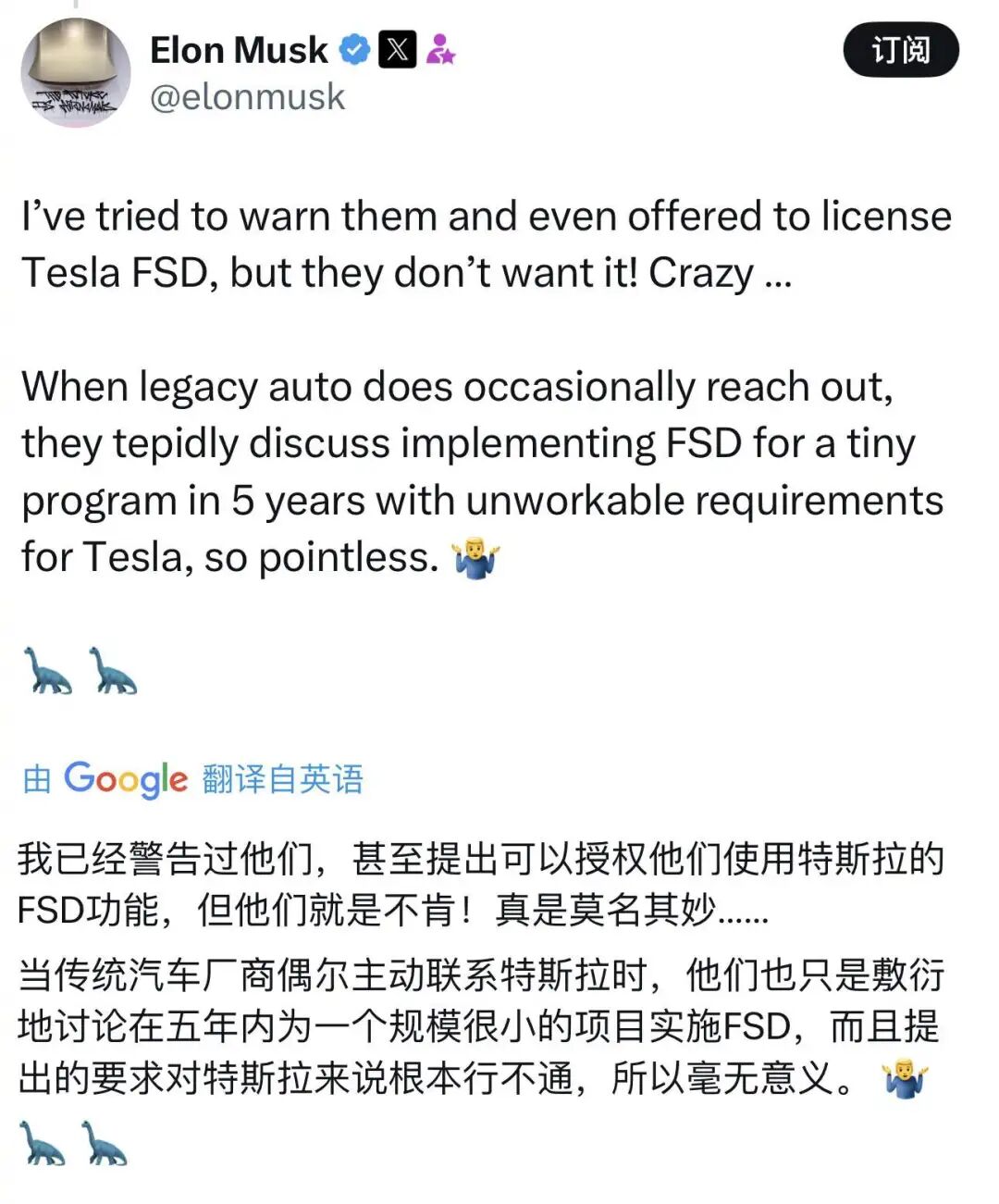
Group 1 - The core issue is that despite Elon Musk's enthusiasm for Tesla's Full Self-Driving (FSD) technology, no traditional automaker is willing to adopt it, leading to Musk's frustration expressed on social media [1][2][6] - Musk has indicated that discussions with traditional automakers about using FSD have been superficial, with requests that are unrealistic for Tesla to fulfill, which he finds meaningless [2][6] - The FSD authorization strategy involves a "hardware binding + software fee" model, where partner automakers must use Tesla's chips and hardware, allowing Tesla to profit from both hardware sales and high-margin software licensing [6][10] Group 2 - Concerns over data security are a significant barrier for automakers considering FSD, as they fear that using Tesla's system would allow Tesla to access sensitive data from their vehicles [10][11] - The lack of a clear legal framework regarding liability in the event of accidents involving FSD further deters automakers from adopting the technology, as there is uncertainty about who would be responsible [11][12] - Compared to Tesla, established autonomous driving suppliers like Waymo offer not only technology but also mature service solutions, making them more attractive to automakers [13]

硅基革命重构竞争格局:中国智驾的攻与守
Mei Ri Jing Ji Xin Wen· 2025-12-02 09:00
Group 1 - The global automotive industry is facing unprecedented challenges, with over 55,000 jobs lost in the past two years in Germany alone, and more than 100,000 layoffs reported worldwide in the last year [1][2] - In contrast, China's automotive sector is thriving, with significant advancements in smart electric vehicles and a robust supply chain, positioning itself as a global leader in the industry [1][3] Group 2 - 2025 is seen as a critical year for automotive manufacturers, with a focus on survival in the face of electrification and the need for innovation in smart technologies [2][10] - China's automotive industry has rapidly evolved, achieving over 30 million annual vehicle sales and over 50% penetration of new energy vehicles, showcasing its ability to catch up and lead in the electric transformation [3][10] Group 3 - Major automotive companies are balancing tradition and innovation, with firms like Mercedes-Benz adapting to local markets while maintaining high safety and quality standards [4][5] - The innovation paths of foreign and Chinese companies are converging, with a blend of cautious planning and agile execution becoming the norm in the industry [5][6] Group 4 - A significant debate is ongoing regarding the technical routes for intelligent driving, with different approaches such as Tesla's vision-based system and Huawei's lidar-based system highlighting diverse innovation strategies [6][7] - The introduction of mandatory safety standards for L2-level driving assistance in China marks a shift towards a more regulated and safety-focused industry [8][9] Group 5 - The Chinese government is facilitating the development of L3-level autonomous driving, with expectations for standards to be established soon, indicating a strong push towards advanced automated driving technologies [10][11] - The competitive landscape in China's smart driving sector is characterized by a diverse ecosystem of companies, fostering innovation and adaptability across various scenarios [10][11]

"认知大于事实"果真对吗?破除一个营销神话
Sou Hu Cai Jing· 2025-12-02 08:43
Core Viewpoint - The phrase "cognition is greater than fact" is often misinterpreted in the business context, leading many companies to focus excessively on marketing and branding at the expense of product quality and differentiation [5][25]. Group 1: Marketing and Cognition - The belief that "cognition is greater than fact" can lead to a marketing trap where companies prioritize branding over the actual value of their products [5][16]. - Examples like Volvo demonstrate how consistent branding can create strong associations in consumer minds, even if the underlying facts are not as clear [2][10]. - The concept of "black box business" illustrates that in certain markets, consumer judgment is heavily influenced by branding, as seen with luxury items like diamonds and high-end wines [9][10]. Group 2: Product Quality and Market Reality - In "white box business," where consumers can easily assess product quality, the reality of the product outweighs any marketing claims, as demonstrated by educational services and delivery companies [12][15]. - The case of "钟薛高" (Chongxuegao) highlights the risks of relying solely on marketing to create perceived value, as consumer backlash occurred when the product did not meet expectations [17][19]. - The comparison between Tesla and traditional luxury car brands shows that tangible product performance can disrupt established brand perceptions, emphasizing the importance of facts over marketing narratives [20][25]. Group 3: Recommendations for Businesses - Companies should maintain honesty about their products and focus on delivering quality, especially in sectors like healthcare and education where consumer evaluation is critical [23]. - Businesses must be wary of "concept inflation," as consumers become fatigued by overhyped marketing claims, making authenticity a valuable asset [24]. - A balanced approach that values both cognition and fact is essential for long-term success, as seen in companies like Apple that combine strong branding with high-quality products [24][25].
犹豫不决,正成为美国车市的主旋律
Guan Cha Zhe Wang· 2025-12-02 06:58
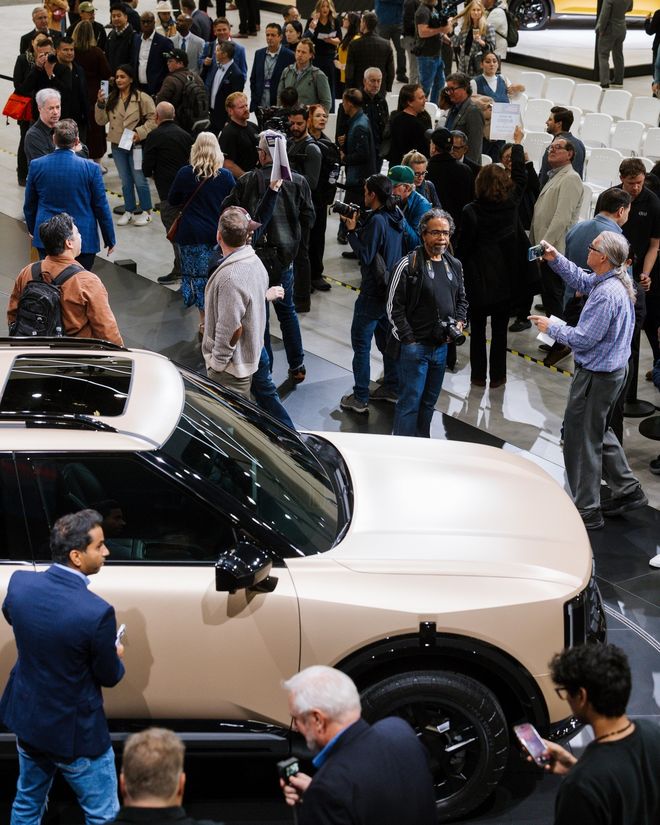
Core Viewpoint - The Los Angeles Auto Show, despite being the oldest and largest auto exhibition in the U.S., has received criticism for lacking innovative electric vehicle (EV) offerings and failing to attract major European automakers, leading to a perception of stagnation in the American automotive market [1][4][5]. Group 1: Event Overview - The Los Angeles Auto Show concluded on November 29, 2023, but was met with disappointment from both consumers and media, echoing sentiments from previous years [1][4]. - The event was overshadowed by the upcoming Tokyo Auto Show and SEMA aftermarket show, with many manufacturers focusing their efforts elsewhere [4][5]. Group 2: Participation and Offerings - Only American companies like Rivian, Lucid, and Tesla showcased new models, while Japanese and Korean manufacturers presented a diverse range of products [7]. - Notable electric vehicles displayed included the 2026 Nissan Leaf with a range of 487 km, Chevrolet Bolt with 410 km, and Jeep Recon with 370 km [9]. - Rivian and Lucid introduced models priced at $77,000 and $80,000 respectively, with ranges of 659 km and 724 km [11]. Group 3: Market Trends and Challenges - The U.S. electric vehicle market experienced a temporary surge in Q3 2023, particularly in California, but this growth did not translate into long-term stability [12]. - Following the cancellation of EV tax incentives by the Trump administration, the market share of electric vehicles dropped significantly from 12.9% in September to 5.2% in October [12]. - Major automakers like Acura, Ford, and GM have announced plans to halt production of certain EV models and cancel new development projects, reflecting uncertainty in future product strategies [12][14]. Group 4: Industry Sentiment - The hesitance of U.S. automakers to fully commit to electric vehicle production is evident, with many companies still focusing on traditional fuel models while exploring hybrid options [14]. - Media reports highlight a conflicting narrative regarding the future of electric vehicles in the U.S., oscillating between optimism and caution [16].


查处各类侵权假冒违法案件10805件
Mei Ri Shang Bao· 2025-12-02 05:43
Core Points - The Zhejiang Province has launched a "Double Strike Protection for Enterprises" campaign, resulting in the investigation of 10,805 cases of infringement and counterfeiting since July, with a total amount involved of 361 million yuan [1][2] - The campaign focuses on key areas such as digital economy, artificial intelligence, and emerging industries, emphasizing the importance of intellectual property protection for innovation [1] - A new mechanism has been established to address cross-regional illegal enforcement, enhancing the protection of local enterprises and optimizing the business environment [3] Group 1 - The "Double Strike Protection for Enterprises" campaign has been organized for the third consecutive year, involving 15 member units and leading to significant enforcement actions [1][2] - The campaign has resulted in the seizure of over 2,500 counterfeit "Zhengtai" dual power conversion switches and related equipment, with an involved amount exceeding 2 million yuan [2] - The campaign has also targeted various well-known brands, including "Huawei," "Moutai," and "Chanel," to strengthen trademark protection [3] Group 2 - The Zhejiang Provincial Market Supervision Administration has introduced eight measures to standardize cross-regional enforcement actions, aiming to prevent illegal practices and improve the regional business environment [3] - The provincial authorities are committed to enhancing the enforcement of intellectual property rights and fostering a collaborative environment between government and enterprises [4] - Continuous efforts will be made to strengthen the crackdown on infringement and counterfeiting, with a focus on optimizing the business environment for enterprises [4]
奥迪中国总裁:安全是绝不妥协的领域
Di Yi Cai Jing· 2025-12-02 00:46
"安全是绝不妥协的领域。绝大多数新规要求(我们)已完全满足,坚决支持旨在提升行业安全标准的 法规。"奥迪中国总裁罗英瀚(JohannesRoscheck)近日对第一财经记者表示。 罗英瀚称,奥迪的核心任务是依托两大合作伙伴(一汽奥迪和上汽奥迪),将最佳产品引入中国市场。 明年主力产品阵容全面革新,包括基于PPE平台的全新纯电车型,以及AUDI品牌新产品。 当前中国汽车市场竞争格局重塑,特斯拉、蔚来、问界等新能源汽车品牌在高端市场销量的攀升,分流 了传统豪华车品牌份额。外资豪华车企普遍转变了打法,尤其是在中国消费者看重的智能化领域,奥 迪、奔驰和宝马通过不同方式实施了深度本土化战略,这主要源于中国消费者对高端汽车的要求和期待 不同于全球其他地区的消费者。 AUDI 和PPE首款产品E5 Sportback和奥迪Q6-etron均在今年下半年推向市场。而相较于燃油车时代,外 资豪华车企的电动车产品的定价策略有所调整,起售价格门槛相对下调。比如,AUDI和奔驰最新电动 车平台首款产品的价格拉到了25万元上下。 奥迪中国管理层此前在接受记者采访时表示,根据调研,到2030年,高端汽车消费市场中75%的增量将 来自新能 ...
备战2026 宝马亮出两张王牌
2 1 Shi Ji Jing Ji Bao Dao· 2025-12-01 23:13
Core Insights - The luxury automotive market is facing a pivotal moment in 2026, with brands like BMW needing to define luxury in the era of smart electric vehicles [1][4] - BMW is focusing on a new generation of technology, including electric drive systems and smart driving solutions, with the first product being the new generation BMW iX3, set to be produced in Shenyang in 2026 [1][7] - The company is experiencing pressure in the Chinese market, with a 11.2% decline in deliveries, highlighting the importance of electric vehicle sales as a growth engine [1][5] Electric Vehicle Strategy - BMW's electric vehicle sales reached 323,000 units in the first three quarters of 2025, marking a 10% year-on-year increase, but the company recognizes the need for accelerated electrification in China [1][6] - The sixth generation eDrive system will utilize large cylindrical batteries, which offer over 20% improvement in energy density and 30% increase in range compared to previous square batteries [5][7] - BMW has partnered with CATL and EVE Energy for battery supply, establishing a localized supply chain in China and Europe [7][8] Smart Technology Integration - BMW is integrating smart cockpit and driving features tailored for the Chinese market, collaborating with companies like Momenta and Huawei to enhance user experience [8][9] - The new generation smart cockpit system will debut with the iX3 and aims to differentiate BMW's offerings through a unique user interface and localized features [9][10] - The collaboration with Momenta for smart driving technology will utilize AI models to improve vehicle perception and decision-making, maintaining BMW's driving dynamics [10][11] Competitive Landscape - Other luxury brands like Mercedes-Benz and Audi are also focusing on 2026 for key product launches, indicating a competitive race in the electric and smart vehicle segments [3][11] - The automotive industry is witnessing a shift towards leveraging China's advanced supply chain and technology ecosystem to enhance product offerings [11]