
李宁

Search documents
港股市场速览:科技巨头带动整体市场持续回撤
Guoxin Securities· 2025-12-20 13:45
Investment Rating - The report maintains an "Outperform" rating for the Hong Kong stock market [4] Core Insights - The overall market is experiencing a pullback driven by technology giants, with the Hang Seng Index down by 1.1% and the Hang Seng Composite Index down by 1.2% [1] - Valuation levels for most industries are declining, with the Hang Seng Index's forward P/E ratio decreasing by 1.7% to 11.6x [2] - Earnings expectations have been adjusted upwards overall, with the Hang Seng Index's EPS increasing by 0.3% compared to the previous week [3] Summary by Sections Market Performance - The Hang Seng Index decreased by 1.1%, while the Hang Seng Composite Index fell by 1.2%. Mid-cap stocks outperformed small-cap and large-cap stocks [1] - Among major concept indices, the Hang Seng Consumer Index rose by 0.3%, while the Hang Seng Internet Index dropped by 2.9% [1] Valuation Levels - The valuation of the Hang Seng Index decreased by 1.7% to 11.6x, and the Hang Seng Composite Index's valuation fell by 2.4% to 11.4x [2] - The most significant valuation increase was in the basic chemicals sector (+11.6%), while the real estate sector saw the largest decline (-19.0%) [2] Earnings Expectations - The EPS for the Hang Seng Index increased by 0.3%, and the Hang Seng Composite Index's EPS rose by 1.2% compared to the previous week [3] - The real estate sector saw a substantial EPS upward revision of 20.5%, while the basic chemicals sector experienced a downward revision of 10.2% [3]
Nike is struggling to stay culturally relevant in China
Business Insider· 2025-12-19 15:49
Core Insights - Nike is experiencing a decline in its cultural relevance in the Chinese sneaker market, leading to a 9% drop in stock after disappointing Q2 fiscal results [1][2] - Sales in Greater China fell by 17% to $1.42 billion, contrasting with a 9% increase in North America sales to $5.63 billion [1] Company Strategy - Nike's CEO acknowledged the need to "reset" the company's approach to the China marketplace, emphasizing the urgency of addressing lagging areas, particularly in China [2][5] - The company has made some progress in reducing promotions and improving inventory management, but deeper cultural challenges remain [6] Cultural Relevance - Analysts highlight a "systemic cultural lag," indicating that Nike must move beyond traditional sports marketing to connect with the cultural values and lifestyle aspirations of China's younger generation [7] - The rise of the "Guochao" movement, which celebrates Chinese heritage, has led younger consumers to favor local brands like Anta and Li-Ning, which create culturally relevant campaigns [7][8] Competitive Landscape - Local competitors are successfully engaging younger consumers through culturally relevant marketing and digital experiences, while Nike's messaging feels outdated [8][9] - Geopolitical tensions are also influencing consumer preferences, pushing them towards domestic brands [9] Digital Engagement - Nike is lagging in digital engagement, relying on traditional marketing channels, which limits its visibility among Gen Z shoppers who prefer discovering brands through apps and marketplaces [10][11] - Rivals like Lululemon and Adidas are leveraging local collaborations and community engagement to connect with consumers more effectively [10]


李宁(02331):荣耀金标系列+李宁龙店,助力品牌业绩增长
GF SECURITIES· 2025-12-19 13:47
Investment Rating - The report assigns a "Buy" rating to the company, with a current price of HKD 19.00 and a fair value of HKD 20.22 [5]. Core Insights - The launch of the Honor Gold Standard product series and the new "Dragon Store" concept is expected to drive brand performance growth. The Dragon Store aims to create a space that integrates product experience, emotional resonance, and cultural exchange, while the Honor Gold Standard series focuses on multifunctional and versatile designs for various scenarios [9]. - The company anticipates that the synergy between the Honor Gold Standard series and the Dragon Store will contribute to revenue growth in 2026, targeting high-quality consumer segments with diverse needs [9]. - Profit forecasts indicate that the company's net profit attributable to shareholders is expected to be CNY 2.472 billion in 2025, CNY 2.634 billion in 2026, and CNY 2.828 billion in 2027, with a reference PE of 18 times for 2026 [9]. Financial Summary - Main revenue projections for the company are as follows: - 2023: CNY 27,598 million - 2024: CNY 28,676 million - 2025: CNY 28,986 million - 2026: CNY 30,325 million - 2027: CNY 32,871 million - The growth rates for main revenue are projected at 7.0% for 2023, 3.9% for 2024, 1.1% for 2025, 4.6% for 2026, and 8.4% for 2027 [4]. - The company's EBITDA is forecasted to be CNY 5,814 million in 2023, declining to CNY 5,631 million in 2025, and then increasing to CNY 6,736 million by 2027 [4]. - The net profit attributable to shareholders is projected to decline from CNY 3,187 million in 2023 to CNY 2,472 million in 2025, before recovering to CNY 2,828 million in 2027 [4]. - The report also highlights key financial ratios, including a projected ROE of 9.0% in 2025 and an EV/EBITDA ratio of 6.4 in 2025 [4].

港股收评:恒指涨0.75%,大型科技股齐涨,生物医药、博彩股集体活跃





Ge Long Hui A P P· 2025-12-19 08:48
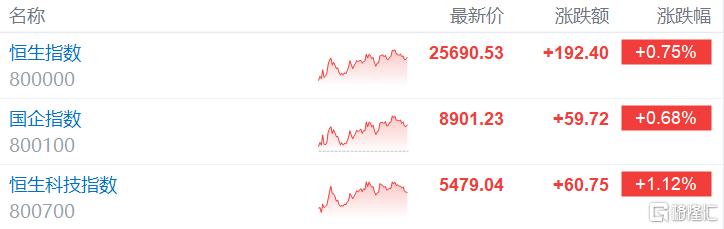
Market Overview - The US CPI annual rate decline has led to a rise in US stocks, boosting risk market sentiment [1] - The Hang Seng Index opened higher and closed up 0.75%, with the Hang Seng China Enterprises Index and Hang Seng Tech Index rising by 0.68% and 1.12% respectively [1][2] Sector Performance - Major technology stocks saw collective gains, with Tencent up 1.49%, Kuaishou up 1.45%, and Meituan up 1.28% [4] - Pharmaceutical stocks were active, with WuXi AppTec and other related stocks rising [2] - Gaming stocks continued to rise, with MGM China leading with a 6.6% increase [2][5] - AI-driven demand boosted optical fiber and cable stocks, with Yangtze Optical Fiber rising 12% [2] - Automotive, wind power, education, photovoltaic, insurance, and Apple-related stocks also experienced gains [2] Notable Stock Movements - Xpeng Motors rose 7.65%, Horizon Robotics up 7.04%, and Li Auto up 3.81% [4][10] - Electronic cigarette stocks saw significant increases, with China Tobacco Hong Kong up 6.68% [5] - Chinese brokerage stocks rose, with China International Capital Corporation up over 4% [7] - Intelligent driving concept stocks surged, with Youjia Innovation up 31.22% [8] Weak Performers - Heavy machinery stocks faced declines, with China National Heavy Duty Truck Group down over 6% [13] - Gold and precious metal stocks were weak, with several companies experiencing declines of over 2% [16] - Oil stocks also fell, with China Petroleum & Chemical Corporation down 1.52% [15] Capital Flows - Southbound funds recorded a net purchase of HKD 3.371 billion, with net selling from Shanghai-Hong Kong Stock Connect and net buying from Shenzhen-Hong Kong Stock Connect [18] Market Outlook - CITIC Securities suggests that after a strong performance in September, Hong Kong stocks are undergoing a mid-term adjustment, with quality assets entering a high-value zone [18]
申万宏源:国际多数运动品牌业绩超预期 国内垂类户外及高性价比品牌表现更优
智通财经网· 2025-12-19 08:44
Core Viewpoint - The latest financial quarter shows that most international sports brands, including Deckers, Adidas, VF, Nike, and Lululemon, have exceeded expectations, while Puma continues to face revenue and profit pressures but remains in line with expectations [1] Group 1: Financial Performance - Deckers, Lululemon, Adidas, VF, and Nike reported revenue growth of +9.1%, +7.1%, +3.0%, +1.6%, and +1.1% respectively, while Puma's revenue declined by -15.3% [1] - Net profit for Deckers, Lululemon, Adidas, VF, and Nike increased by +10.7%, decreased by -12.8%, increased by +4.1%, increased by +263.7%, and decreased by -30.8% respectively, with Puma reporting a loss [1] Group 2: Future Guidance - Nike expects a low single-digit revenue decline for the next quarter, while VF anticipates a revenue drop of 1-3% [2] - Most sports brands forecast a full-year revenue growth of about single digits, with Deckers projecting $5.35 billion for FY26 (up 7%), Adidas expecting a 9% increase for FY25, and Lululemon forecasting a 4% growth for FY25 [2] Group 3: Regional Sales Performance - North America: Adidas, Lululemon, Puma, VF, and Deckers reported revenue declines of -4.7%, -3.0%, -22.3%, -0.9%, and -1.7% respectively, while Nike's revenue grew by +4.0% [3] - Greater China: Lululemon and Adidas saw revenue increases of +42.4% and +0.1%, respectively, while Nike's revenue declined by -9.2% [3] - Europe: Adidas, VF, and Nike reported revenue growth of +8.2%, +6.3%, and +6.0%, while Puma's revenue fell by -9.4% [3] Group 4: Inventory Situation - Nike's inventory decreased by -1.7%, with successful inventory reduction in EMEA and Greater China, while North America saw an increase due to tariff impacts [4] - Adidas' inventory rose significantly by +20.9% as a strategy to ensure timely supply of World Cup-related products [4] Group 5: Domestic Brands Performance - Anta's outdoor brand showed strong growth, while the main brand's guidance was lowered from low single digits to low single digits due to a weak consumption environment [5] - Xtep's main brand experienced low single-digit growth, while its Saucony brand saw over 20% growth [5] - 361 Degrees continued double-digit growth with approximately 10% growth in its main brand and children's line [5] Group 6: Investment Opportunities - Suggested investment directions include global supply chain manufacturers such as Shenzhou International, Huayi Group, Xin'ao Co., and Weixing Co. [6] - Recommended brands for attention include Bosideng, Anta, Tabo, 361 Degrees, and others [7]

每日投资策略-20251219
Zhao Yin Guo Ji· 2025-12-19 03:55
Core Insights - The report highlights that the macroeconomic environment in 2026 will be influenced by U.S. midterm election pressures, defense demands in Europe and Japan, and China's focus on stable growth, leading to continued policy easing in the first half of the year [2] - The AI boom is expected to enhance efficiency and stock valuations but may also exacerbate job losses and economic K-shaped divergence [2] - The report suggests that the second half of 2026 may see a rebound in inflation due to global liquidity easing, a weaker dollar, and China's anti-involution efforts, potentially causing volatility in high-valuation assets [2] Industry Outlook Chinese Internet Software - 2026 is seen as a critical year for competing for user attention in the AI era, with a focus on lowering usage barriers, enhancing decision-making efficiency, and creating real value [2] - Companies with stable cash flows supporting AI investments and strong operational capabilities are expected to have higher long-term investment value [5] Semiconductor - The report maintains four core investment themes for 2026: AI-driven structural growth, China's semiconductor self-sufficiency trend, high-yield defensive allocations, and industry consolidation [7] - The global semiconductor market is projected to grow by 26% to $975 billion in 2026, with AI-related segments leading the growth [7] Technology - The global tech industry is expected to experience demand differentiation and accelerated AI innovation, with a focus on AI computing infrastructure and end-user AI products [8] - Key companies to watch include Apple, which is anticipated to have a year of innovation with new AI products [8] Consumer Sectors Essential Consumption - The report identifies three main investment themes: deepening consumption stratification, focusing on essential survival needs, and leveraging overseas expansion to hedge against domestic uncertainties [10][20] - Companies in the food and beverage sector, such as Nongfu Spring and China Resources Beverages, are recommended due to their stable demand and attractive valuations [21] Discretionary Consumption - The outlook for the discretionary consumption sector is cautious, with expected retail sales growth of about 3.5% in 2026, slightly down from 4% in 2025 [11] - The report suggests a focus on survival-type consumption and low-cost emotional comfort products, with recommendations for companies like Luckin Coffee and Bosideng [11][21] Automotive - The Chinese automotive industry is expected to show resilience despite pressures from subsidy reductions and tax incentives, with retail sales of passenger vehicles projected to remain stable [12] - Key trends include intensified competition and the introduction of new models, particularly in the new energy vehicle segment [12] Pharmaceuticals - The innovative drug sector has seen significant growth driven by overseas licensing deals, but future catalysts are expected to shift from upfront payments to milestone achievements [13] - The CXO industry is anticipated to continue its recovery in 2026, supported by a rebound in domestic R&D demand [13] Real Estate - The report forecasts a continued contraction in the real estate market, with total residential sales expected to decline by 8% in 2026 [16][17] - Investment themes include focusing on stock market service providers and companies with strong operational capabilities in commercial assets [18][19]




户外赛道“迟到者”李宁,这次能靠“时尚化”逆袭吗?
Xin Jing Bao· 2025-12-19 03:11
Core Viewpoint - Li Ning is accelerating its expansion into the outdoor market, opening its first independent outdoor store, COUNTERFLOW, in Beijing, which signifies a strategic shift to find new growth opportunities amid declining profits [1][2]. Group 1: Company Strategy and Performance - Li Ning's revenue for the first half of 2023 increased by 3.3% to 14.82 billion yuan, while net profit decreased by 11% to 1.737 billion yuan, indicating a need for new growth avenues [1][6]. - The establishment of the outdoor store represents a significant commitment to the outdoor segment, which is now treated as an independent business rather than a subcategory of the main brand [3][5]. - The outdoor product line includes shoes, apparel, and accessories, with a focus on fashionable outdoor wear targeting younger consumers [3][7]. Group 2: Market Context and Competition - The Chinese high-performance outdoor apparel market is projected to grow from 53.9 billion yuan in 2019 to 102.7 billion yuan by 2024, with a CAGR of 13.8%, making it one of the fastest-growing segments in functional apparel [5]. - Li Ning's entry into the outdoor market comes at a time when competition is intensifying, with established brands like Anta and emerging players like KAILAS and other international brands also vying for market share [8][9]. - The outdoor consumer base is diverse, and Li Ning aims to differentiate itself by focusing on the fashion aspect of outdoor products, which is seen as a significant opportunity [7][9]. Group 3: Future Outlook - The outdoor segment is viewed as a potential growth driver for Li Ning, especially as the company seeks to stabilize its cash flow amid increasing competition and market changes [6][8]. - Analysts suggest that while Li Ning has the potential to leverage its supply chain and brand recognition, the success of its outdoor strategy will depend on its ability to understand market dynamics and product development [9].
为什么苹果、华为,都干不过小天才?
Tai Mei Ti A P P· 2025-12-19 01:57
Core Insights - The article highlights the unexpected success of the children's smartwatch brand, Xiaotianzi, which has captured a significant market share despite competition from major tech giants [1][2][3] Market Position - Xiaotianzi sold over 8 million children's smartwatches in the first half of the year, holding a 35.3% market share, far ahead of Huawei's 12.2% [1] - The brand's flagship model, Z11, is priced at 2399 yuan, indicating a premium positioning in the market [15] Unique Selling Proposition - Xiaotianzi differentiated itself by focusing on communication rather than just safety features, addressing the needs of both parents and children [5][6] - The introduction of the "tap to add friends" feature created a social network among children, enhancing the product's appeal and driving demand [7][9] Business Model - Xiaotianzi's revenue model consists of three layers: direct sales of smartwatches, value-added services, and data monetization [12][13] - The entry-level model Q1R is priced affordably, while mid-range models like Z6P and Z8A cater to the core market, and the high-end Z11 targets affluent families [15] Growth Strategy - The brand has established a self-reinforcing growth cycle where increased user numbers enhance the social network's value, attracting more users [9][10] - Xiaotianzi's focus on social interaction has transformed the purchase motivation from parental necessity to children's desire [9] Competitive Landscape - Major competitors like Huawei and Xiaomi are shifting their strategies to focus on open ecosystems and educational tools, challenging Xiaotianzi's closed social network model [24][25][26] - These competitors aim to position their products as growth tools rather than social toys, appealing to parents concerned about education and health [26] Regulatory Environment - Increasing regulatory scrutiny regarding data privacy and child protection may impact Xiaotianzi's business model, particularly its social features [27] - The potential for stricter regulations poses a systemic risk to the brand's current operational strategies [27]
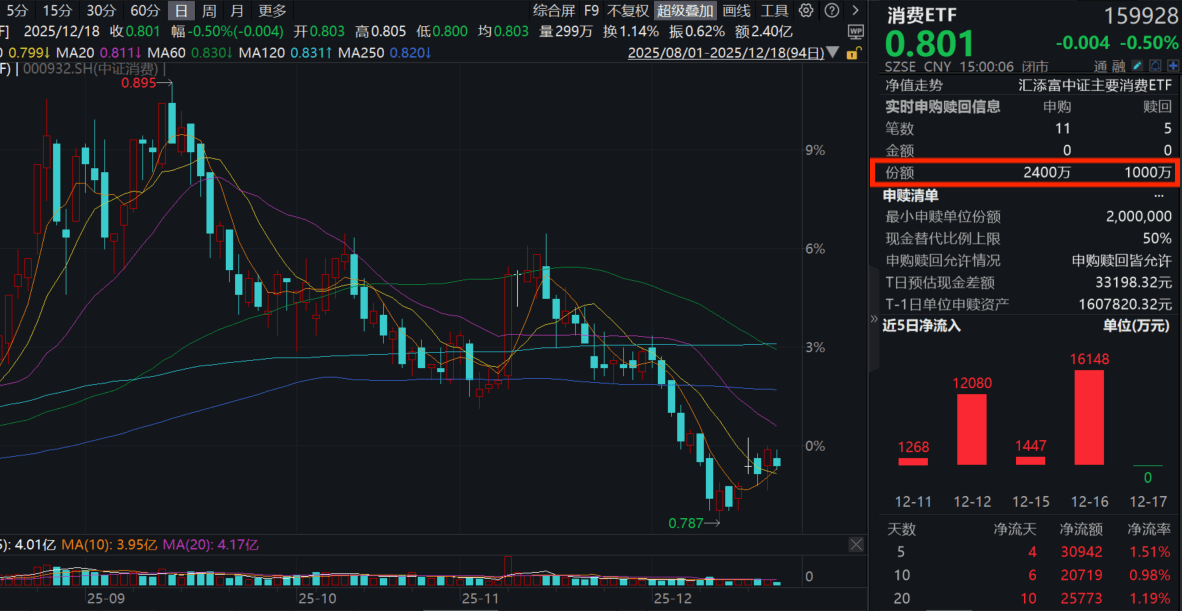
A股新概念来了!何为“犒赏经济”?消费ETF(159928)再获1400万份净申购!港股通消费50ETF(159268)回调超1%,2026新消费如何看?
Xin Lang Cai Jing· 2025-12-18 09:50
Group 1: Consumer Sector Performance - The consumer sector experienced a pullback, with the Consumer ETF (159928) declining by 0.5% and a total trading volume of 240 million yuan, while it saw a net subscription of 14 million shares, accumulating over 300 million yuan in the last five days [1] - The "Reward Economy" concept gained traction, indicating that consumers are increasingly purchasing non-essential items or experiences to alleviate stress and fulfill psychological needs, reflecting the vitality and resilience of the current consumer market [3] - The valuation of the Consumer ETF (159928) remains attractive, with a TTM price-to-earnings ratio of 19.4, placing it in the 3.17% percentile over the past decade, indicating it is cheaper than 97% of the historical time frame [4] Group 2: Market Trends and Insights - Seasonal patterns in Q4 suggest a tendency for market style shifts, particularly in December, where low valuation stocks may gain favor among investors [5] - The new consumption upgrade is driven by quality supply, with a focus on innovation and user-centric approaches, indicating a shift from previous consumption upgrades that were investment-driven [7] - The trend of "external expansion" in quality consumer supply is emerging, with opportunities for Chinese manufacturing to expand globally, particularly in personal care and textile sectors [8] Group 3: Future Opportunities in Consumption - AI applications are expected to enhance consumer products, with AI smart glasses anticipated to enter the market, presenting significant growth potential [10] - The K-shaped recovery in purchasing power highlights the resilience of luxury consumption, with a shift towards high-end experiences and services becoming more prominent [11] - Moutai's strategy to control product supply and focus on high-quality development aims to stabilize its distribution channels and enhance profitability for distributors [12][15]

全球体育用品品牌2025年三季度跟踪深度报告:Nike单季营收正增长,Adidas积极备战世界杯
Shenwan Hongyuan Securities· 2025-12-18 08:42
Investment Rating - The report maintains a "Positive" outlook on global sports brands, indicating a recovery in performance across most brands [4][5]. Core Insights - The latest financial quarter shows that most international sports brands exceeded expectations, with revenue growth for Deckers (+9.1%), Lululemon (+7.1%), Adidas (+3.0%), VF (+1.6%), and Nike (+1.1%), while Puma faced a decline of -15.3% [4][16]. - The guidance for the next financial quarter is cautious, with Nike expecting a low single-digit decline in revenue, while the overall annual performance outlook remains neutral to optimistic [4][17]. - Regional performance varies, with North America facing sales pressure, while the Greater China and European markets show signs of recovery [4][5]. Summary by Sections 1. Overview: Nike Revenue Growth and Adidas World Cup Preparations - Most brands reported better-than-expected performance, with significant revenue increases for Deckers, Lululemon, Adidas, VF, and Nike, while Puma continues to struggle [4][16]. 2. Nike: Strategic Adjustments and Revenue Forecast - Nike's revenue for FY26Q1 was $11.72 billion, a year-on-year increase of 1.1%, marking the first positive growth since FY24Q4. The company anticipates a low single-digit revenue decline for FY26Q2 [27][28]. 3. Adidas: Record Revenue and Upgraded Annual Guidance - Adidas reported a revenue increase of 3.0% in the latest quarter and has raised its annual performance guidance to a growth of approximately 9% [4][17]. 4. Lululemon: Exceeding Revenue and Profit Expectations - Lululemon's revenue grew by 7.1% in the latest quarter, with a notable 42.4% increase in the Greater China market [4][19]. 5. Puma: Continued Performance Pressure - Puma's revenue declined by 15.3%, with ongoing challenges affecting its profitability and market position [4][16]. 6. VF: Performance Exceeds Expectations - VF's revenue increased by 1.6%, but the company remains cautious about future guidance, expecting a decline in the next quarter [4][17]. 7. Deckers: Strong Performance from UGG and HOKA - Deckers reported a revenue increase of 9.1%, driven by strong sales from its UGG and HOKA brands [4][16]. 8. Investment Analysis Recommendations - The report suggests focusing on global supply chain manufacturers and outdoor sports brands, highlighting companies like Shenzhou International and Anta Sports as potential investment opportunities [5][18].