长安汽车

Search documents
整车有望反弹,零部件仍聚焦新产业方向:汽车行业周报(20260119-20260125)-20260125
Huachuang Securities· 2026-01-25 13:12
Investment Rating - The report maintains a "Buy" recommendation for the automotive sector, indicating a potential rebound in vehicle sales in the first quarter driven by retail and export growth [3][4]. Core Insights - The automotive sector is expected to see a rebound in vehicle sales, particularly in the first quarter, with catalysts from retail and export activities. The focus for auto parts remains on new industries such as intelligent driving, robotics, and liquid cooling technologies [3][4]. - Traditional automotive stocks have shown relative stability in prices, while the robotics sector is expanding into second-tier markets [3]. - The report highlights significant growth in new energy vehicle deliveries, with companies like NIO and Li Auto showing notable month-on-month increases [6][7]. Data Tracking - In early January, the discount rate for traditional vehicles remained stable at 9.6%, with an average discount amount of 22,259 yuan, reflecting a year-on-year increase of 2,192 yuan [5]. - December saw a decline in wholesale and retail sales of passenger vehicles, with wholesale sales down 8.7% year-on-year and retail sales down 16.8% [5][6]. - New energy vehicle deliveries in December showed a mixed performance, with BYD delivering 420,398 units (down 18.3% year-on-year) while NIO and Li Auto reported significant increases in deliveries [6][7]. Industry News - The report notes that the German government announced subsidies of up to 6,000 euros for families purchasing new electric vehicles to boost the domestic electric vehicle industry [10]. - The report also mentions that the Chinese government is implementing policies to promote the replacement of old vehicles and appliances, which is expected to enhance the automotive market [10][30]. - Geely's new MPV model, the Galaxy V900, was launched with a price range of 269,800 to 329,800 yuan, featuring advanced AI capabilities [30].





2025年度乘用车品牌影响力指数发布 自主品牌全面崛起引领格局重塑
Zheng Quan Ri Bao Wang· 2026-01-25 12:53
Core Insights - The 2025 China Passenger Car Brand Influence Index report reveals significant changes in brand influence within the Chinese automotive market, highlighting the dominance of domestic brands like Geely, BYD, and AITO in terms of technological advancements and user reputation [1] Group 1: Brand Performance - Geely ranks first with a comprehensive influence score of 810.96, supported by a brand network voice of 1.106 million and market sales of 2.081 million vehicles, showcasing its dual strength in communication and market presence [2] - BYD follows closely with a score of 802.90, demonstrating its leadership in the new energy sector with sales of 3.105 million vehicles and a high positive sentiment rate of 99.18% [2] - Tesla China maintains third place with a score of 798.53, leveraging its unique brand premium and media presence [3] Group 2: Emerging Brands and Technology - AITO stands out with a network voice of 2.7863 million and a user voice share of 93.34%, driven by Huawei's technological support, marking a significant breakthrough in the high-end market [4] - Traditional automakers are also launching competitive new energy sub-brands, with Geely's Galaxy series rapidly increasing sales and becoming a core growth driver [4] Group 3: Challenges for Joint Ventures - Traditional joint venture brands face pressure from the rise of domestic brands, leading to a critical phase of adjustment and strategic transformation [5] - Despite maintaining a strong market position, brands like SAIC Volkswagen and FAW-Volkswagen show signs of fatigue in user engagement and satisfaction compared to their domestic counterparts [5][6] - The need for accelerated local development of electric products and better alignment with Chinese consumer preferences is crucial for sustaining brand influence [6]
崔东树:2025年12月中国汽车实现出口99万辆 同比增73% 环比增23% 同比和环比走势总体较强
智通财经网· 2026-01-25 11:34
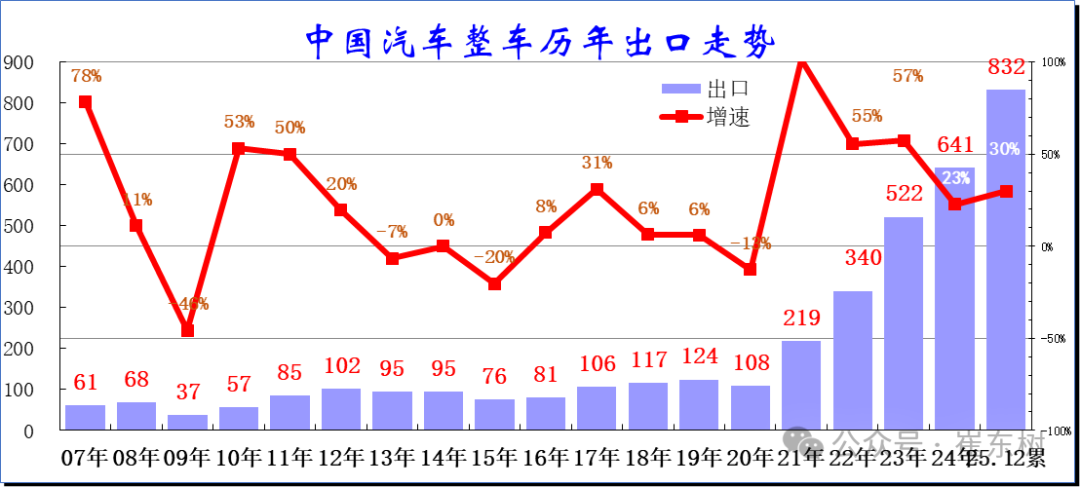
Core Insights - In December 2025, China's automobile exports reached 990,000 units, marking a year-on-year increase of 73% and a month-on-month increase of 23%, indicating strong overall growth trends [1][9] - For the entire year of 2025, China's automobile exports are projected to total 8.32 million units, reflecting a 30% increase compared to 2024 [1][9] - The export of new energy vehicles (NEVs) in December 2025 reached 420,000 units, a significant year-on-year increase of 174%, with an annual total of 3.43 million units, up 70% from 2024 [1][5] Export Performance - The top ten countries for China's automobile exports in December 2025 included the UAE (106,398 units), Russia (69,660 units), and the UK (54,791 units), with notable increases in exports to the UAE and the UK [2] - For the entire year, the cumulative export totals to the top ten countries were led by Mexico (625,187 units), Russia (582,738 units), and the UAE (571,937 units), with significant growth observed in exports to the UAE and Mexico [2] Vehicle Type Distribution - In December 2025, the composition of China's automobile exports included 25% pure electric vehicles (up 4% year-on-year), 17% plug-in hybrids (up 11%), 7% hybrids (up 2%), and 40% traditional fuel vehicles (down 18%) [3] - For the full year of 2025, the export composition was 28% pure electric vehicles (up 2%), 13% plug-in hybrids (up 8%), 6% hybrids (up 2%), and 43% traditional fuel vehicles (down 11%) [3] New Energy Vehicle Trends - The performance of China's NEV exports in 2025 exceeded expectations, with plug-in hybrids and hybrids emerging as new growth points, particularly in the pickup segment [5] - The export market for NEVs is showing high-quality development, particularly in the Middle East and developed countries, while the Russian market for fuel vehicles is experiencing a decline [5] Historical Context - China's automobile exports have seen significant growth since breaking the one million unit mark in 2021, with a sustained high growth rate continuing into 2025 [8][9] - The export volume has rebounded from a low point during the global economic downturn from 2013 to 2016, with a steady increase observed from 2017 to 2020 [8] Seasonal Trends - The monthly export trends indicate a seasonal characteristic, with stronger exports typically observed in the summer months, and fluctuations due to external trade policies affecting the early months of the year [10][12] Export Structure Characteristics - The share of passenger vehicles in total exports has been steadily increasing, reaching 85% by 2023, while the shares of trucks and buses have been declining [15][17] - The export of gasoline vehicles has seen a decrease, while the export of hybrid vehicles has shown strong growth, particularly in the plug-in hybrid segment [16][17]

(经济观察)中国内陆首个国家级新区未来五年有何新举措?
Xin Lang Cai Jing· 2026-01-25 11:02
Core Viewpoint - The establishment of the Liangjiang New Area as an administrative district marks a significant development opportunity for the region, integrating administrative and development functions to support national strategies and economic growth [2][3][10]. Group 1: Development and Strategic Goals - Liangjiang New Area was officially established on June 18, 2010, as China's third national-level development zone and the first in the inland region [3]. - The State Council approved the establishment of the Liangjiang New Area administrative district in October 2025, enabling a unified system that enhances its role as a strategic support point for western development and an inland open hub [3][10]. - The first committee meeting outlined key goals for the 14th Five-Year Plan, focusing on enhancing the development capacity of the Chengdu-Chongqing economic circle and supporting the quality development of the Yangtze River Economic Belt [6][10]. Group 2: Economic and Industrial Development - Liangjiang New Area covers an area of 1,360 square kilometers and has a population of 3.52 million, with significant industrial clusters including a 400 billion yuan smart connected new energy vehicle industry and a 300 billion yuan next-generation electronic information manufacturing sector [9]. - The region has established itself as a hub for advanced manufacturing and modern services, with over 670 billion yuan in industrial output and a 75% share of the city's new energy vehicle production [9]. - Key enterprises, including China Changan Automobile Group, have established headquarters in the area, contributing to a vibrant business environment with over 540,000 operating entities [9]. Group 3: Infrastructure and Connectivity - Liangjiang New Area features a unique comprehensive bonded zone with both water and air port functions, enhancing its logistics capabilities [9]. - The region is part of the western land-sea new channel and has developed various open platforms, including a free trade pilot zone, which collectively improve its connectivity and trade efficiency [9]. - Major transport hubs, such as Jiangbei Airport and Chongqing North Station, facilitate over 120 million passenger trips annually, with significant contributions to the city's import-export volume and foreign investment [9].

汽车行业周报:补贴政策变化致25Q4翘尾现象消失,对26年需求透支有所减少-20260125
GF SECURITIES· 2026-01-25 09:48
Investment Rating - The report provides a "Buy" rating for several companies in the automotive sector, indicating an expected performance that will exceed the market by more than 10% over the next 12 months [5][22]. Core Insights - The change in subsidy policies has led to the disappearance of the tail effect in Q4 2025, resulting in a reduction of demand overdraw for 2026. In December 2025, the number of insured vehicles was 2.278 million, down 16.4% year-on-year but up 13.6% month-on-month. The total number of insured vehicles for the year reached 23.047 million, a slight increase of 0.6% year-on-year, with the penetration rate of new energy vehicles rising to 54.0%, an increase of 7.1 percentage points year-on-year [4][7][16]. Summary by Sections 1. Changes in Subsidy Policies - The report highlights that the changes in subsidy policies have caused consumers to adopt a wait-and-see approach, leading to a decrease in demand overdraw for 2026. The expectation is that as replacement subsidy application channels open, pent-up demand will materialize, and the domestic terminal market will trend towards "price increase and stable volume" [4][7]. 2. PHEV Market Share Tracking - The focus is on the performance of PHEV market shares, particularly for BYD and Geely, as the "mid-level assisted driving equity" leads to share differentiation. The report emphasizes the importance of monitoring configuration adjustments and terminal discount changes to understand further market share differentiation [9][16]. 3. Recent Report Insights - The report notes that the passenger vehicle inventory saw a slight reduction in December 2025, with an estimated 1.5 million vehicles in demand waiting to be fulfilled. The overall industry theme for 2025 was "emerging from deflation," with a judgment of "stable volume and slow price increase" being validated. The outlook for 2026 remains "price increase and stable volume," differing from market consensus due to regulatory changes and risk-return assessments [16][17]. 4. Investment Recommendations - The report suggests a "shelf-style" investment approach, recommending various companies across the passenger vehicle chain. Right-side targets include Geely, BYD, and others, while left-side targets include Great Wall Motors and Changan Automobile. In the commercial vehicle chain, recommended companies include China National Heavy Duty Truck Group and Weichai Power [17].


勾勒行业决战之年新图景 中国汽车创新盛典在北京举办
Zhong Zheng Wang· 2026-01-25 09:13
Group 1 - The event "Auto-First Annual Gala and 2025-2026 China Automotive Innovation Ceremony" highlights the automotive industry's critical years ahead, emphasizing the importance of scale advantages for leading companies and the irreversible trend of smart technology in vehicles [1] - SAIC Motor Corporation was awarded "Annual Automotive Enterprise," while the "Annual Car" award went to the AITO M9, showcasing the recognition of significant players in the industry [1] - The awards reflect the upward vitality and international strength of Chinese brands, with Geely Galaxy recognized as "Annual Brand" and BYD and Chery as "Annual Export Brands" [1] Group 2 - The awards also illustrate a diverse market ecosystem, with models like XPeng G7 and SAIC Volkswagen Lavida Pro winning in various segments, indicating the success of traditional brands in the electric and smart vehicle transformation [2] - Data shows that by 2025, the penetration rate of new energy vehicles in China will exceed 54%, with multiple technology routes such as hybrid, range-extended, and pure electric advancing simultaneously [2] - The competition in the automotive market is expected to focus on technology, cost, and channel strength, testing companies' strategic determination and adaptability as the industry shifts from scale to strength [2]



乘用车行业月报:12月乘用车销量同环比下降,预计26年销量同比微增
GUOTAI HAITONG SECURITIES· 2026-01-25 07:45
Investment Rating - The report assigns an "Accumulate" rating for the automotive industry [22]. Core Insights - The report forecasts that the wholesale sales of passenger vehicles in China will reach 30.21 million units in 2026, reflecting a year-on-year increase of 1%. The sales of new energy passenger vehicles are expected to be approximately 16.85 million units, with a year-on-year growth of 10% [20][21]. - In December 2025, the wholesale sales of passenger vehicles in China were 2.814 million units, a decrease of 9% year-on-year and a decrease of 7% month-on-month. For the entire year of 2025, the wholesale sales reached 29.908 million units, an increase of 9% year-on-year [7][8]. Summary by Sections 1. Total Passenger Vehicle Sales - In December 2025, the total wholesale sales of passenger vehicles in China were 2.814 million units, down 9% year-on-year and down 7% month-on-month. The wholesale sales of new energy passenger vehicles were 156.3 thousand units, up 3% year-on-year and down 8% month-on-month. For the entire year of 2025, the wholesale sales of passenger vehicles were 29.908 million units, up 9% year-on-year, while new energy passenger vehicle sales reached 1.5319 million units, up 25% year-on-year [7][8]. 2. Key Automotive Companies' December Sales - **BYD**: In December, BYD delivered 420 thousand vehicles, down 18% year-on-year and down 12% month-on-month. The overseas sales reached 132 thousand units, up 130% year-on-year [8][9]. - **Geely**: In December, Geely delivered 237 thousand vehicles, up 13% year-on-year. The 2026 sales target is set at 3.45 million units, a 14% increase from 2025 [10]. - **Changan**: In December, Changan delivered 257 thousand vehicles, down 19% year-on-year. The 2026 sales target is 3.3 million units, a 13% increase from 2025 [12]. - **Great Wall Motors**: In December, Great Wall Motors delivered 124 thousand vehicles, down 8% year-on-year. The company launched the "Guiyuan Platform" globally [13][14]. - **Li Auto**: In December, Li Auto delivered 44 thousand vehicles, down 24% year-on-year. The OTA 8.2 version was fully pushed [15]. - **Leap Motor**: In December, Leap Motor delivered 60 thousand vehicles, up 42% year-on-year. The 2026 sales target is set at 1 million units [16][17]. - **Xpeng Motors**: In December, Xpeng Motors delivered 38 thousand vehicles, achieving double growth year-on-year and month-on-month. The 2025 total deliveries reached 429 thousand units, up 126% year-on-year [18][19]. 3. Policy Impact and Market Outlook - The report notes that the effectiveness of the old-for-new vehicle policy is expected to diminish, with a projected total of over 11.5 million vehicles replaced in 2025, of which nearly 60% are new energy vehicles. The new policy for 2026 will shift from fixed subsidies to a "proportional subsidy + cap" model [20]. - The report anticipates that the reduction in new energy vehicle purchase tax incentives will lead to a more competitive market, pushing the industry towards higher performance and efficiency standards [21].

乘用车行业月报:12月乘用车销量同环比下降,预计26年销量同比微增-20260125
GUOTAI HAITONG SECURITIES· 2026-01-25 07:30
Investment Rating - The report assigns an "Accumulate" rating for the automotive industry [22]. Core Insights - The report forecasts that the wholesale sales of passenger vehicles in China will reach 30.21 million units in 2026, reflecting a year-on-year increase of 1%. The sales of new energy passenger vehicles are expected to be approximately 16.85 million units, with a year-on-year growth of 10% [20][21]. - The report highlights that the overall passenger vehicle market in December 2025 saw a wholesale sales volume of 2.814 million units, a decrease of 9% year-on-year and a decrease of 7% month-on-month. For the entire year of 2025, the wholesale sales volume was 29.908 million units, an increase of 9% year-on-year [7][20]. Summary by Sections 1. Total Passenger Vehicle Sales - In December 2025, the total wholesale sales of passenger vehicles in China were 2.814 million units, down 9.4% year-on-year and down 7.0% month-on-month. The wholesale sales of new energy passenger vehicles were 156.3 thousand units, up 3% year-on-year and down 8% month-on-month. For the entire year of 2025, the wholesale sales of passenger vehicles reached 29.908 million units, up 9% year-on-year, while new energy passenger vehicle sales were 1.5319 million units, up 25% year-on-year [7][8]. 2. Key Automotive Companies' December Sales - **BYD**: In December, BYD delivered 420 thousand new vehicles, down 18% year-on-year and down 12% month-on-month. The overseas sales reached 132 thousand units, up 130% year-on-year [8][9]. - **Geely**: In December, Geely delivered 237 thousand new vehicles, up 13% year-on-year. The 2026 sales target is set at 3.45 million units, a 14% increase from 2025 [10]. - **Changan**: In December, Changan delivered 257 thousand new vehicles, down 19% year-on-year. The 2026 sales target is 3.3 million units, a 13% increase from 2025 [12]. - **Great Wall Motors**: In December, Great Wall Motors delivered 124 thousand new vehicles, down 8% year-on-year. The company launched the "Guiyuan Platform" globally [13][14]. - **Li Auto**: In December, Li Auto delivered 44 thousand new vehicles, down 24% year-on-year. The OTA 8.2 version was fully pushed [15]. - **Leap Motor**: In December, Leap Motor delivered 60 thousand new vehicles, up 42% year-on-year. The 2026 sales target is set at 1 million units [16][17]. - **Xpeng Motors**: In December, Xpeng Motors delivered 38 thousand new vehicles, achieving growth in both year-on-year and month-on-month comparisons. The 2025 cumulative delivery was 429 thousand units, up 126% year-on-year [18][19]. 3. Policy Impact and Market Outlook - The report notes that the effectiveness of the old-for-new vehicle policy is expected to diminish, with the total number of vehicles replaced exceeding 11.5 million in 2025, of which nearly 60% were new energy vehicles. The new policy for 2026 will shift from fixed subsidies to a "proportional subsidy + cap" model [20]. - The report anticipates that the reduction in new energy vehicle purchase tax incentives will lead to a more competitive market, pushing the industry towards higher performance and efficiency standards [21].
天津支持企业深耕二手车出口业务
Xin Lang Cai Jing· 2026-01-25 06:54
#天津二手车出海创新高#【#天津支持企业深耕二手车出口业务#】近年来,天津市二手车出口业务加速 发展。2025年二手车出口5.57万辆,同比增长41%,出口金额13.5亿美元,同比增长35.6%,居全国前 列。海外市场对中国汽车、新能源汽车需求旺盛,我国出口的车辆80%都是国产的新能源汽车,以比亚 迪、理想、长安、吉利等品牌为主,主要是集中在中亚地带、吉尔吉斯斯坦、哈萨克斯坦、阿塞拜疆以 及俄罗斯,还有东南亚。 (来源:北京新闻广播) ...
2026新能源汽车后市场新生态大会在重庆万州举办
Zhong Guo Qi Che Bao Wang· 2026-01-25 05:22
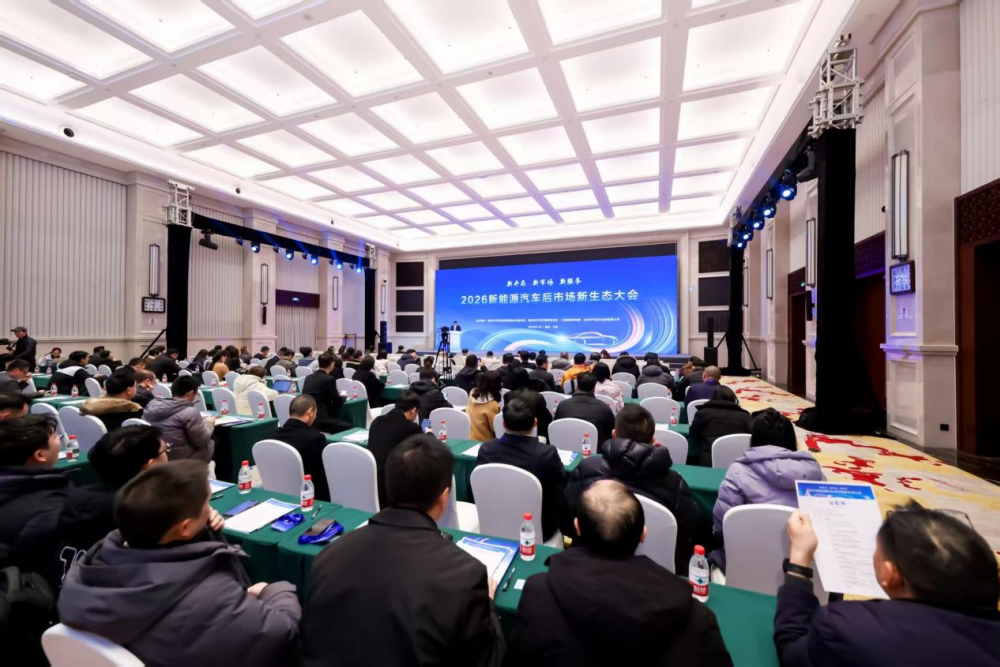
Core Insights - The 2026 New Energy Vehicle Aftermarket New Ecology Conference was held in Wanzhou, Chongqing, focusing on "new beginnings, new markets, and new services" to promote a safe, efficient, and green aftermarket ecosystem [1][3]. Group 1: Conference Overview - The conference was organized by various governmental and industry bodies, including the Chongqing Municipal Economic and Information Commission and the China Automotive Engineering Research Institute [1][3]. - Key figures from the Ministry of Industry and Information Technology and various industry organizations attended, emphasizing the importance of the new energy vehicle industry as a driver for high-quality manufacturing development [3][6]. Group 2: Industry Development Goals - The Chongqing government aims to enhance the automotive aftermarket system, focusing on smart connected new energy vehicles and establishing a globally influential hub for this sector [8][10]. - Key initiatives include improving vehicle inspection and maintenance capabilities, financial and insurance services, and fostering the battery recycling and automotive modification industries [8][10]. Group 3: Market Trends and Innovations - During the conference, it was noted that during the 14th Five-Year Plan, China's new energy vehicle sales and penetration rates were among the highest globally, driven by policy support and innovation [11]. - The industry is expected to continue evolving with a focus on quality improvement, internationalization, and the integration of services and products [11][14]. Group 4: Future Directions - The automotive aftermarket is anticipated to undergo significant changes, with trends towards openness, digitalization, and lifecycle services becoming prominent [17][20]. - Companies are encouraged to leverage AI technology for improved diagnostics and repair efficiency, and to establish standardized supply chains for new energy vehicle components [25][29]. Group 5: Recycling and Sustainability - The recycling of retired lithium batteries is highlighted as a critical national resource strategy, with significant market potential [34][36]. - Companies are urged to develop efficient recycling technologies and localized closed-loop networks to meet international regulatory requirements and support global carbon neutrality goals [37][39]. Group 6: Collaborative Efforts - The conference featured discussions on policy guidance, ecological collaboration, and innovative business models, showcasing the vibrant development of China's new energy vehicle aftermarket [40]. - The insights and consensus reached during the conference are expected to strengthen capabilities, enhance quality, and foster resource connections within the industry [40].