
北新建材

Search documents
研报掘金丨中金:消费建材行业价格有望温和修复,建议关注东方雨虹、三棵树等
Ge Long Hui A P P· 2026-02-05 06:08
Core Viewpoint - The report from CICC indicates that the consumption building materials industry is expected to experience a mild price recovery, with potential marginal improvement in the gross margins of leading companies [1] Industry Summary - Recent price increase notices have been issued by leading companies in various segments, including waterproofing, gypsum boards, and municipal pipelines [1] - The basis for these price increases is attributed to supply optimization and rising prices of upstream raw materials, primarily chemical products, since the beginning of the year [1] - Key raw materials such as PVC and emulsions have seen an upward shift in their price levels [1] Company Summary - CICC is optimistic about the profitability recovery of leading companies in the industry under the trend of price recovery [1] - Companies to watch include Dongfang Yuhong, Sankeshu, Beixin Building Materials, China Liansu, and Weixing New Materials [1]

——建材周专题2026W5:加大配置消费建材优质龙头,看好电子布景气
Changjiang Securities· 2026-02-05 04:45
Investment Rating - The report maintains a "Positive" investment rating for the building materials industry [10]. Core Viewpoints - The report emphasizes increasing allocations to high-quality leading companies in consumer building materials and anticipates price increases in electronic fabrics due to shortages [2][3]. - Consumer building materials are highlighted as a strong investment opportunity due to significant supply exits, with production levels for various materials projected to be at 97% for plastic pipes, 82% for gypsum boards, and 77% for cement in 2024 compared to their peak levels [3]. - The report identifies three main lines for 2026: the stock chain, the African chain, and the AI chain, suggesting a shift in demand dynamics and growth opportunities in these areas [7]. Summary by Sections Basic Situation - Cement shipments have seen a slight month-on-month increase, while glass inventory continues to decline [6]. - In late January, cement demand showed slight recovery due to warmer weather in southern regions, with a shipment rate of approximately 32% in key domestic areas, up by 3 percentage points [6][23]. Outlook for 2026 - The report suggests focusing on three main lines: stock chain, African chain, and AI chain. The stock chain is expected to see a qualitative change in demand, with home renovation demand projected to rise from 50% to nearly 70% by 2030 [7]. - The African chain highlights undervalued growth opportunities in the African market, with recommendations for leading companies such as Keda Manufacturing and Huaxin Cement [7]. - The AI chain focuses on the upgrade of special electronic fabrics, with significant opportunities for domestic replacements in low CTE and low-Dk products [7]. Electronic Fabrics - The report is optimistic about price increases in electronic fabrics due to dual demand dynamics, with AI electronic fabrics benefiting from high demand and ordinary electronic fabrics facing supply constraints [5]. - The shortage of weaving machines is expected to continue, leading to sustained price increases [5]. Cement and Glass Market - The report notes that the national average price of cement is 349.84 yuan per ton, with a month-on-month decrease of 2.74 yuan [24]. - The national average price of glass is reported at 63.11 yuan per weight box, with a slight month-on-month increase of 0.50 yuan [36].


电子布淡季再提价,楼市成交企稳修复
Ping An Securities· 2026-02-05 02:28
Investment Rating - Industry investment rating is "Outperform the Market" indicating an expected performance that exceeds the market by more than 5% over the next six months [5]. Core Insights - The report highlights that electronic fabric prices are increasing even during the off-season, with significant price hikes observed in January 2026. This trend is attributed to high demand from downstream AI applications, leading to a production shift towards high-end products, creating a capacity gap for traditional fabrics [4][3]. - The traditional building materials sector is also experiencing price increases, driven by a need for profitability amidst thin margins. Companies like Yuhong and Keshun have already raised prices for waterproof coatings, and this trend is expected to continue as demand improves post-holiday [4]. - The real estate market is showing signs of stabilization, with increased transactions in key cities and a reduction in listings. This recovery is anticipated to support price stabilization as the market enters the traditional demand peak in March [4]. Summary by Sections Electronic Fabric Market - Prices for electronic fabrics and yarns have risen significantly, with Linzhou Guangyuan's mainstream price for electronic fabric reported at 5.3-5.5 yuan/meter, up from 4.8-4.9 yuan/meter at the end of January [4]. - The ongoing price increases are expected to continue into the peak demand season of March and April 2026 [4]. Traditional Building Materials - The report notes that major companies in the building materials sector are actively pursuing price increases, with a focus on waterproof coatings and gypsum board products [4]. - The report suggests that if production limits are strictly enforced, it could lead to improved capacity utilization and price recovery in the cement market [4]. Real Estate Market - The report indicates a recovery in the real estate market, with a notable increase in second-hand home transactions in major cities and a decrease in listings [4]. - It emphasizes the expectation of supportive policies in 2026, particularly regarding mortgage rate adjustments, which could further stabilize the market [4].
如何看当前时点地产链投资机会
2026-02-05 02:21
Summary of Conference Call Records Industry: Real Estate Key Points - The real estate industry has undergone a deep cleansing of its fundamentals, with positive policy signals expected to gradually restore holdings, leading to valuation elasticity. In January, the second-hand housing market in core cities showed signs of recovery, with increased transaction volumes and decreased listing volumes, optimizing supply-demand relationships and narrowing price declines [1][2][3] - Multiple authoritative media outlets have released positive signals regarding the financial asset attributes of real estate and the cancellation of restrictive measures. Many real estate companies are no longer required to report the "three red lines" indicators monthly, indicating a period of intensive policy implementation, which enhances the investment value of the real estate sector [3] - The investment strategy for the building materials industry chain should focus on balance and early layout of related opportunities. Global expansion of balance sheets and marginally increasing liquidity in the A-share market support potential excess return opportunities in the building materials sector [1][4] - The A-share market's IPO financing is expected to be at historical average levels, but the second half of the year may see quarterly financing amounts exceeding expectations, which could signal a warning for the technology sector as relative returns may decrease [5] - The current economy is at the end of a Kondratiev wave depression, with non-ferrous metals and commodities being favorable investment options. The adjustment in the real estate market is nearing its end, with potential investment opportunities expected to emerge [6] Additional Insights - The real estate sector is currently in a core configuration window with high win rates and odds. As of Q4 2025, the sector's holdings accounted for approximately 0.43% of stock investment value, indicating a significant underweight that has persisted for 24 quarters [2] - The recovery of the Hong Kong real estate sector serves as a reference for the mainland market, with historical data suggesting that the adjustment in actual housing prices in China has been sufficient, leading to an increase in the sector's win rate [2] - The building materials sector's investment strategy emphasizes early positioning in response to market changes, with a focus on companies with low valuations and strong resource reserves, such as China Trade and Greentown China [4] - The cement industry is highlighted for its potential, with profitability closely tied to capacity utilization rates. Companies like Conch Cement are expected to see significant profit increases if prices rise [10] - The home appliance sector is anticipated to recover as real estate data stabilizes, which will directly boost demand for white goods and kitchen appliances [13] Industry: Building Materials Key Points - The investment strategy for the building materials industry should focus on both expansion and balance, with an emphasis on early positioning in real estate-related opportunities [4] - Companies with low valuations and strong resource reserves, such as China Trade and Greentown China, are recommended for investment [4] - The cement industry is expected to enter a new recovery cycle, with significant profit potential linked to price increases [10] Industry: Home Appliances Key Points - The home appliance sector is nearing the end of its darkest period, with potential investment opportunities arising as real estate data stabilizes and consumer demand is expected to recover [13] - The sector's current low valuations present opportunities for growth, particularly in white goods and kitchen appliances, which are closely tied to real estate performance [13] Additional Insights - Companies like Midea, Haier, and Gree are highlighted for their strong dividend yields, making them attractive investment options [13] - Newer companies in the market, such as Roborock and Ecovacs, are also noted for their competitive positioning and potential for valuation recovery [13]
地产政策有望持续宽松,地产链建材经营改善可期
Guotou Securities· 2026-02-04 10:04
Investment Rating - The industry is rated as "Leading the Market - A" indicating an expected investment return that will exceed the CSI 300 Index by 10% or more over the next six months [3]. Core Insights - The real estate policy is expected to remain accommodative, which is likely to improve the operating conditions for the building materials sector. Recent initiatives, such as Shanghai's acquisition of second-hand housing for rental projects, signal a positive shift in the market [1]. - The transaction volume of second-hand homes continues to grow, with prices showing signs of stabilization. In January 2026, second-hand home transactions in Shanghai reached approximately 22,000 units, marking a year-on-year increase of about 25% [1]. - The consumption building materials sector is anticipated to see improved performance, with several companies initiating price increases across various product categories, including coatings and waterproof materials [2][7]. Summary by Sections Real Estate Policy and Market Conditions - Recent real estate policies across multiple regions, including adjustments in loan-to-value ratios for commercial properties, aim to stabilize the market and boost housing consumption [1]. - The sales area of new homes is projected to decline at a slower rate, supporting the demand for building materials [1]. Performance of Consumption Building Materials - The revenue of the consumption building materials sector declined by 6.21% year-on-year in the first three quarters of 2025, but there are signs of improvement in the latter part of the year [2]. - Companies like Oriental Yuhong and Sanke Tree have announced price increases, indicating a potential end to the intense price competition in the industry [7]. Retail Channel Development - Companies are actively expanding their retail channels, which is expected to enhance profitability and cash flow. For instance, Sanke Tree's revenue from retail has increased significantly, demonstrating resilience in a challenging market [8]. - The shift towards retail and small B-end channels is becoming more pronounced, with companies like Oriental Yuhong and Beixin Building Materials benefiting from this trend [8]. Investment Recommendations - The report suggests a positive outlook for leading companies in the consumption building materials sector, particularly those involved in coatings, waterproofing, gypsum boards, and panels. Key companies to watch include Sanke Tree, Oriental Yuhong, Beixin Building Materials, and Rabbit Baby [9].
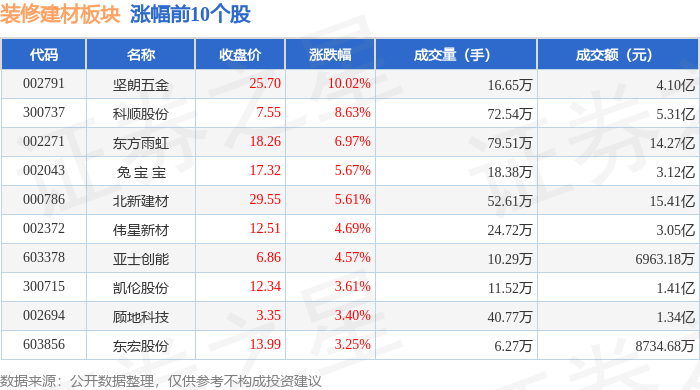
装修建材板块2月4日涨3.6%,坚朗五金领涨,主力资金净流入2.03亿元
Zheng Xing Xing Ye Ri Bao· 2026-02-04 08:57
Core Insights - The renovation and building materials sector experienced a significant increase of 3.6% on February 4, with Jianlang Hardware leading the gains [1] - The Shanghai Composite Index closed at 4102.2, up 0.85%, while the Shenzhen Component Index closed at 14156.27, up 0.21% [1] Sector Performance - Jianlang Hardware (002791) saw a closing price of 25.70, with a rise of 10.02% and a trading volume of 166,500 shares, amounting to a transaction value of 410 million yuan [1] - Keshun Co., Ltd. (300737) closed at 7.55, up 8.63%, with a trading volume of 725,400 shares and a transaction value of 531 million yuan [1] - Dongfang Yuhong (002271) closed at 18.26, increasing by 6.97%, with a trading volume of 795,100 shares and a transaction value of 1.427 billion yuan [1] - Other notable performers included Tubaobao (002043) with a 5.67% increase and Beixin Building Materials (000786) with a 5.61% increase [1] Capital Flow - The renovation and building materials sector saw a net inflow of 203 million yuan from institutional investors, while retail investors experienced a net outflow of 1.44 billion yuan [2] - The main capital inflow was observed in Dongfang Yuhong, with a net inflow of 129 million yuan, representing 9.07% of the total [3] - Beixin Building Materials had a net inflow of 119 million yuan, accounting for 7.70% of the total, while Keshun Co., Ltd. had a net inflow of 66.34 million yuan, representing 12.49% [3]




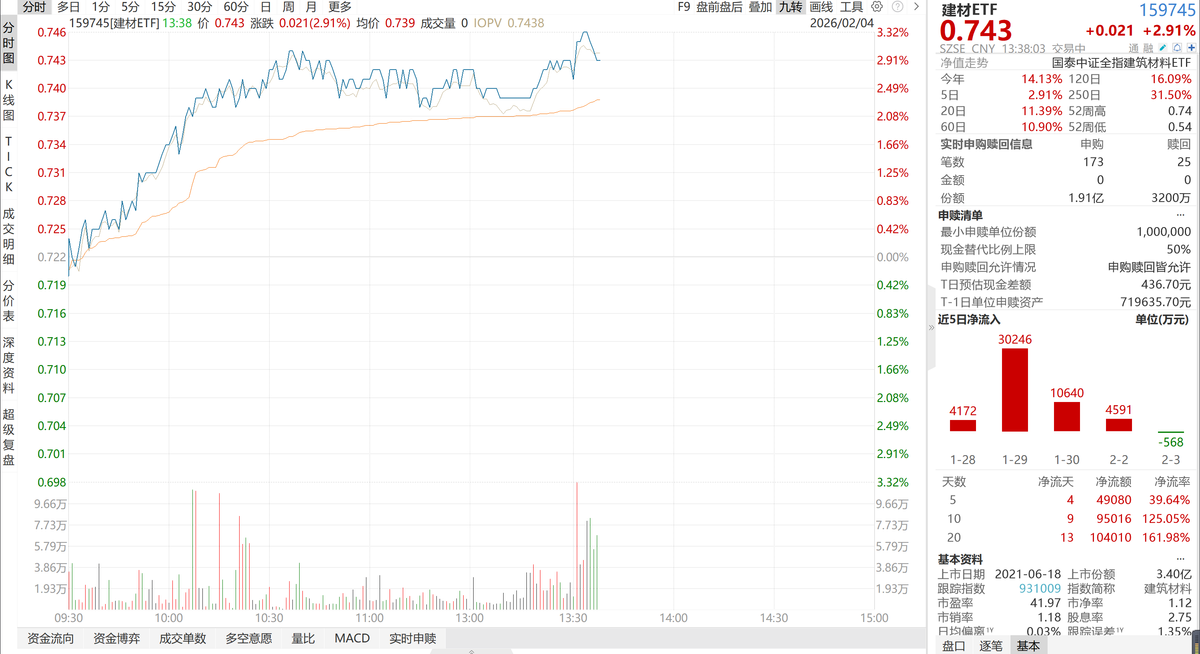
科技板块回调,顺周期板块领涨市场,建材ETF(159745)涨超3%
Mei Ri Jing Ji Xin Wen· 2026-02-04 06:01
Core Viewpoint - The construction materials sector is experiencing a phase of recovery driven by multiple favorable factors, including steady growth policies, improved expectations in the real estate chain, and an optimized supply structure, leading to a dual restoration of fundamentals and valuations [1][3]. Demand Side - Infrastructure investment is increasing, providing a solid demand foundation, with significant projects in urban renewal and water conservancy driving demand for construction materials like cement and waterproofing products [4]. - The real estate sector is seeing a recovery in demand due to policies supporting project completion and an uptick in second-hand home transactions, leading to increased consumption of materials such as gypsum boards and tiles [4]. - Emerging demands in high-end materials are being driven by new industries like AI servers and electric vehicles, creating new growth opportunities in the sector [4]. Supply Side - The construction materials industry is undergoing supply-side reforms, with a focus on reducing excess capacity through measures like staggered production and environmental restrictions, leading to a tightening supply-demand balance [5]. - Major companies are increasing their market share as inefficient capacities are eliminated, and the industry shifts from price competition to value competition [5]. Profitability - The decline in prices of upstream raw materials, combined with the implementation of price increases in the industry, is alleviating cost pressures for construction material companies, leading to a recovery in profitability [6]. - Key players in segments like cement and fiberglass are seeing improvements in gross and net profit margins, providing a solid foundation for sector growth [6]. Investment Logic - The construction materials sector is highlighted as a core cyclical investment, benefiting from a shift in market funds from high-valuation tech stocks to undervalued cyclical sectors [7]. - Continued government focus on stabilizing investment and infrastructure spending supports long-term demand for construction materials, while policies promoting green and prefabricated buildings open up new growth avenues [7]. - The sector's current valuation is at a historical low, with leading companies trading at price-to-earnings ratios significantly below those of consumer and tech sectors, indicating a high margin of safety [7]. Valuation Characteristics - The construction materials sector has seen its overall valuation drop to historical lows, with the index reflecting a significant valuation advantage compared to other cyclical and growth sectors [8]. - There is a clear differentiation in valuations among sub-sectors, with traditional materials like cement and glass showing lower valuations, while high-growth segments command higher valuations due to faster earnings growth [8]. Dividend Characteristics - Leading companies in the construction materials sector, such as Conch Cement and Huaxin Cement, typically offer high dividend yields exceeding 4%, making them attractive for long-term investors [9]. ETF Investment Opportunity - The Construction Materials ETF (159745) tracks the overall performance of the construction materials sector, providing an efficient tool for investors to gain exposure to leading companies in the industry [10]. - With the current market environment favoring cyclical sectors, the ETF presents an opportunity for both short-term trading and long-term investment in undervalued, high-dividend sectors [10].
建材行业周报:涨价预期提升,关注节后需求复苏落地情况
China Post Securities· 2026-02-03 02:24
Investment Rating - The industry investment rating is "Outperform the Market" and is maintained [1] Core Viewpoints - The report indicates that the construction materials sector is showing strong performance, with expectations for price increases in various categories such as waterproofing, coatings, and cement due to improving demand and economic conditions in 2026. The report emphasizes the importance of monitoring post-Spring Festival demand recovery and price adjustments [4][5] - The cement market is entering a seasonal downturn, with a notable decline in demand, particularly in the housing market. However, mid-term prospects suggest that production capacity may decrease under policies limiting overproduction, potentially leading to improved profit margins [4][9] - The glass industry is facing ongoing demand pressures, with traditional peak season orders showing limited improvement. Supply-side adjustments are expected to keep prices low in the short term [5][16] - The fiber glass sector is experiencing a demand boost driven by the AI industry, with expectations for significant growth in both volume and price [5] - The consumer building materials sector is anticipated to see a bottoming out of profits, with strong price increase demands following years of competitive pricing [5] Summary by Sections Cement - The national cement market is entering a seasonal downturn, with December 2025 production at 144 million tons, a year-on-year decline of 6.6%. Demand is expected to weaken further due to seasonal factors and the upcoming Spring Festival [9] Glass - The glass industry is under pressure, with high inventory levels among intermediaries and limited demand recovery. Recent supply-side adjustments have not alleviated the overall supply-demand imbalance, leading to expectations of continued low price fluctuations [16] Fiber Glass - The fiber glass sector is benefiting from demand related to the AI industry, with expectations for a significant increase in both volume and price as the industry evolves [5] Consumer Building Materials - The sector is expected to see a recovery in profitability, with several categories like waterproofing and coatings announcing price increases, indicating a potential turnaround in 2026 [5]
建材行业报告(2026.01.26-2026.02.01):涨价预期提升,关注节后需求复苏落地情况
China Post Securities· 2026-02-03 01:23
Investment Rating - The industry investment rating is "Outperform the Market" and is maintained [1] Core Views - The cyclical sector performed well recently, with price increase expectations rising. The construction materials sector is expected to see significant valuation elasticity in 2026, with waterproofing, coatings, and cement entering a phase of improved prosperity. Various categories such as gypsum boards, pipes, and glass are anticipated to reach price turning points in 2026, supported by expectations of recovery in real estate and the economy. Short-term demand is currently weak, with a focus on post-Spring Festival demand and price increases [4][5] - Cement demand is entering a seasonal downturn, with overall demand still declining. The housing market remains weak, while infrastructure demand shows significant regional differentiation driven by policy. The civil market exhibits relatively rigid demand. In the medium term, cement production capacity is expected to decline under policies limiting overproduction, leading to a significant increase in capacity utilization and profit elasticity [4][5] - The glass industry is experiencing sustained demand pressure due to real estate impacts, with traditional peak season orders showing limited improvement. Supply-side adjustments, including cold repairs of production lines, have occurred, but overall supply-demand pressures remain, leading to expectations of price stability at low levels [5][16] Summary by Sections Cement - National cement demand is gradually entering a seasonal downturn, with a 6.6% year-on-year decline in December 2025 production, totaling 144 million tons. The housing market remains weak, and infrastructure demand is regionally differentiated, with civil market demand being relatively rigid [9] Glass - The glass industry is under pressure, with traditional peak season orders showing limited improvement and high inventory levels among intermediaries. Despite recent cold repairs of production lines, supply-demand pressures persist, leading to expectations of continued low price fluctuations [5][16] Fiberglass - The fiberglass sector is seeing weak demand as manufacturers focus on cash flow. However, the electronic yarn segment is experiencing growth driven by AI industry demand, with expectations for a significant increase in both volume and price [5] Consumer Building Materials - The industry has reached a profitability bottom, with no further downward price space. The sector is strongly advocating for price increases, with waterproofing, coatings, and gypsum boards issuing price increase notices. Profitability improvements are expected for leading companies in 2026 [5]
建材业全链条推进减污降碳
Jing Ji Ri Bao· 2026-02-02 22:03
近年来,面对严峻复杂的内外部环境,建材行业通过有力措施深挖绿色低碳发展潜力。近日,工业和信 息化部会同国家发展改革委、市场监管总局发布2025年度重点行业能效"领跑者"企业名单,其中,作为 建材行业重要板块的水泥熟料行业,有4家企业入选。 如何在稳增长与降碳减排之间找到平衡点?"零碳"是破解这一矛盾的核心抓手,产业"微循环"则成为实 现零碳目标的关键路径。水泥、陶瓷、玻璃纤维等细分行业纷纷探索零碳工厂、零化石能源工厂等新模 式,绿色低碳技术装备成为行业竞争新焦点。 减排成效显著 "推进绿色低碳转型,是建材行业高质量发展的必然要求和强劲动力。"中国建筑材料联合会党委书记、 会长阎晓峰介绍,近年来,建材行业绿色转型纵深推进,发布了《建材行业开启碳中和新征程——中国 建材行业碳排放报告(2025年)》,宣布中国建材全行业已如期实现碳达峰,正全面迈向碳中和,明确 了清晰的技术实施路径,引发国内外广泛关注。 建材行业一直走在工业领域"双碳"工作前列。数据显示,"十四五"期间,建材行业二氧化碳排放量连续 下降。与2020年相比,预计2025年建材行业二氧化碳排放量下降24.9%,万元增加值能耗下降17.4%, 万元工业增 ...