小米汽车

Search documents
马斯克宣布Grok4免费;智元机器人入股玉树智能丨新鲜早科技
2 1 Shi Ji Jing Ji Bao Dao· 2025-08-12 01:01
Group 1: Technology Developments - Elon Musk announced that Grok 4 is now available for free to all users, with a generous usage limit for free users [2] - The world's first robot breeder "Jia Er" has been developed, which significantly reduces breeding costs and time through intelligent design [2] - WeChat has launched new features, including the ability to convert comments into images and save articles to the photo album [6][7] Group 2: Corporate Investments and Partnerships - Zhiyuan Robotics has acquired a 5% stake in Yushu Intelligent Robotics, which focuses on developing autonomous cleaning vehicles and sorting robots [3] - A strategic cooperation agreement was signed between Aobo Zhongguang and Horizon Robotics to promote technological innovation in the robotics industry [8] - Meituan has applied to register the "Meituan Borrow Money" trademark, indicating potential expansion into financial services [9] Group 3: Market Trends and Projections - AMD's server CPU market share has reached 50%, indicating a significant competitive landscape with Intel [11] - SK Hynix predicts that the custom HBM market will grow to hundreds of billions of dollars by 2030, driven by AI demand [12] - The global independent graphics card market is dominated by NVIDIA and AMD, with domestic GPU development still in its early stages [14] Group 4: Financing and Mergers - Guangku Technology plans to acquire 100% of Suzhou Anjie Xun Optoelectronics, enhancing its product and technology portfolio [17] - Jiu Ding Investment intends to acquire a 53.29% stake in Nanjing Shenyuan Intelligent Technology for 213 million yuan, aiming to strengthen its position in the robotics supply chain [18] - PAI Bao Robotics has completed a financing round to establish a production base in Guangdong, focusing on overseas markets [24]

汽车早报|广汽埃安拟对华望汽车进行股权投资 福特宣布在美投资50亿美元
Xin Lang Cai Jing· 2025-08-12 00:41
Automotive Sales and Production - In July, China's automotive sales reached 2.593 million units, a year-on-year increase of 14.7% [1] - New energy vehicle (NEV) sales accounted for 48.7% of total new car sales in July, with production and sales of 1.243 million and 1.262 million units respectively, marking a year-on-year growth of 26.3% and 27.4% [1] - From January to July, NEV production and sales totaled 8.232 million and 8.220 million units, reflecting a year-on-year increase of 39.2% and 38.5% [1] - The second-hand car market in July saw a transaction volume of 1.661 million units, a year-on-year increase of 3.20% [1] Company Performance - Dongfeng Group reported a cumulative automotive sales figure of 978,462 units from January to July, representing a year-on-year decline of approximately 8.9% [2] - The parent company, Dongfeng Motor Group, experienced a 10.8% year-on-year decrease in cumulative automotive sales, totaling 1,260,406 units [2] Investments and Innovations - GAC Aion plans to invest in Huawang Automotive, acquiring up to 30% equity, as part of a strategy to develop a new high-end automotive brand [3] - Tesla's global vice president announced that 90% of materials from recycled batteries will be reused in new battery production, with enough materials recovered in 2024 to manufacture batteries for approximately 21,000 Model Y vehicles [4] - Ford announced a $5 billion investment in the U.S. to create nearly 4,000 jobs for the production of new pickup trucks and advanced LFP batteries [6] Technological Developments - Xiaomi Automotive has published a patent for a collision detection method that enhances passenger safety by detecting collisions and triggering alerts [5] - Bosch and Volkswagen's CARIAD are collaborating to develop AI-based driving assistance systems for L2 and L3 automation, expected to be available for production projects by mid-2026 [7]
德赛西威上半年 净利润同比增长45.82%
Zheng Quan Shi Bao· 2025-08-11 17:40
Core Viewpoint - Desay SV's half-year report shows significant growth in net profit and revenue, driven by increased customer payments and overseas income growth outpacing domestic income [1][2] Financial Performance - The company achieved operating revenue of 14.644 billion yuan, a year-on-year increase of 25.25% [1] - Net profit attributable to shareholders reached 1.223 billion yuan, up 45.82% year-on-year [1] - Operating cash flow net amount increased by 166% year-on-year, reaching 1.6 billion yuan [1] Accounts Receivable and Payment Terms - The accounts receivable turnover days improved slightly to 112.97 days from 119.81 days in the first quarter [1] - In 2025, the automotive industry is expected to reduce payment terms to suppliers to no more than 60 days [1] Business Segments - The smart cockpit business generated sales of 9.459 billion yuan, a growth of 18.76% [2] - The fourth-generation smart cockpit has been mass-produced for clients such as Li Auto, Xiaomi, and Geely, with new project orders from several leading automakers [2] - The smart driving business achieved revenue of 4.147 billion yuan, growing by 55.49% [2] - The company maintains the largest market share in the domestic auxiliary driving domain controller sector [2]
德赛西威: 2025年半年度报告
Zheng Quan Zhi Xing· 2025-08-11 11:14
Core Viewpoint - The report highlights the financial performance and strategic direction of Huizhou Desay SV Automotive Co., Ltd. for the first half of 2025, showcasing significant growth in revenue and net profit, alongside a commitment to innovation and international expansion in the automotive electronics sector. Financial Performance - The company's operating revenue for the first half of 2025 reached approximately 14.64 billion yuan, representing a year-on-year increase of 25.25% compared to 11.69 billion yuan in the same period last year [11][21]. - The net profit attributable to shareholders was approximately 1.15 billion yuan, up 45.94% from 789.72 million yuan in the previous year [11][21]. - Basic earnings per share increased to 2.21 yuan, a rise of 46.36% from 1.51 yuan [11][21]. - The total assets at the end of the reporting period were approximately 21.66 billion yuan, showing a slight increase of 0.81% from the previous year [11][21]. Business Overview - The company focuses on three main areas: intelligent cockpits, intelligent driving, and connected services, maintaining a leading position in the industry [9][10]. - The intelligent cockpit segment generated approximately 9.46 billion yuan, accounting for 64.59% of total revenue, while the intelligent driving segment achieved 4.15 billion yuan, reflecting a growth of 55.49% [11][21]. - The connected services and other segments contributed approximately 1.04 billion yuan, a slight decrease of 2.11% [11][21]. Market Trends - The automotive industry in China experienced a significant increase in production and sales, with new energy vehicle sales reaching 696.8 million units, a year-on-year growth of 41.4% [7][8]. - The report indicates a strong demand for intelligent and connected vehicle technologies, driven by the rapid advancement of smart driving systems and the need for enhanced safety and reliability [8][9]. Strategic Initiatives - The company has updated its development strategy, emphasizing a mission to lead in safe, enjoyable, and green travel, and a vision of "smart travel, globally shared" [8][9]. - It aims to enhance its technological capabilities and expand its international presence, with a focus on building a global supply chain network and localizing services [16][18]. - The company is committed to sustainable development, aligning its operations with carbon neutrality goals and enhancing its product offerings to meet low-carbon standards [18][19].

销量占比超七成,自主汽车品牌加速“超车”
Bei Jing Shang Bao· 2025-08-11 11:08
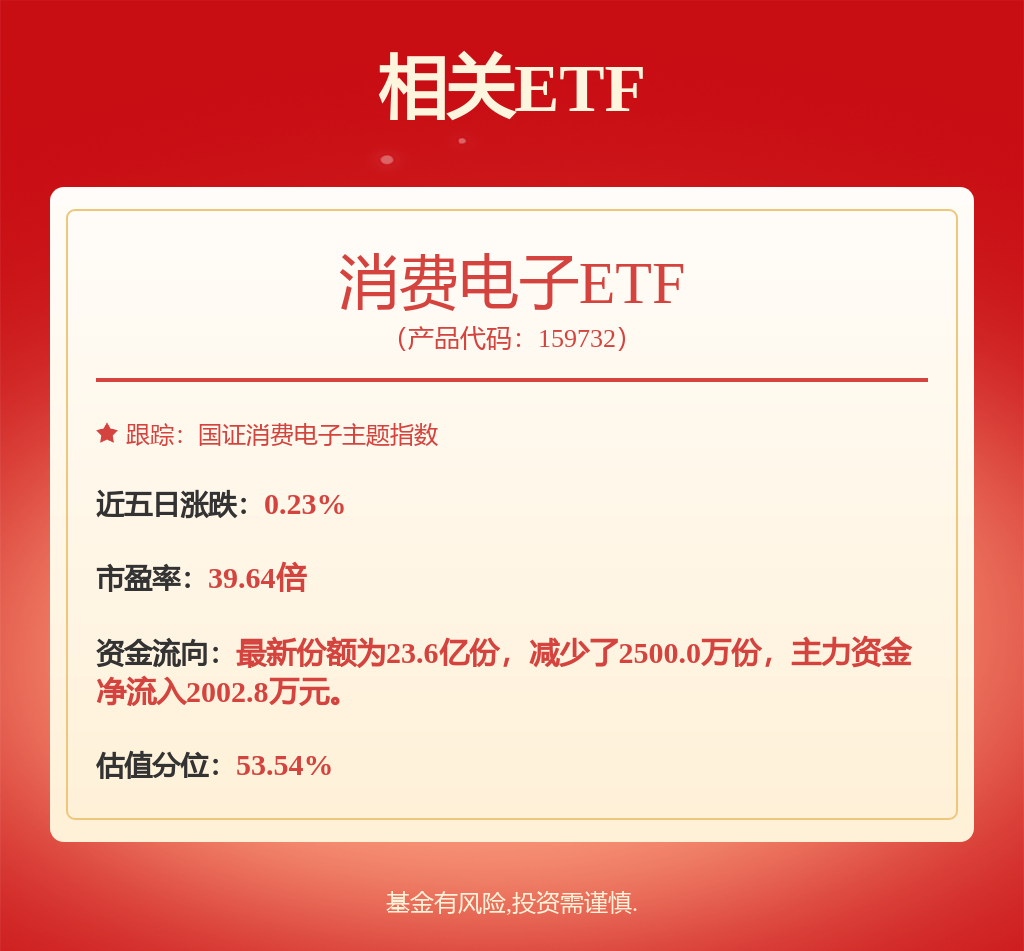
Group 1 - In July 2023, China's automotive production and sales reached 2.591 million and 2.593 million units respectively, showing a month-on-month decline of 7.3% and 10.7%, but a year-on-year increase of 13.3% and 14.7% [2] - The decline in July is attributed to the traditional off-season for the automotive market and some manufacturers conducting annual equipment maintenance, leading to a seasonal slowdown in production and sales [2] - The "trade-in" policy continues to show positive effects, and the comprehensive rectification of the industry is making progress, with new models being continuously launched by companies, contributing to stable market operations [2] Group 2 - In July 2023, the production and sales of passenger vehicles were 2.293 million and 2.287 million units, respectively, with year-on-year growth of 13% and 14.7% [3] - Chinese brands are becoming a significant support for passenger vehicle sales, with sales of Chinese brand passenger vehicles reaching 1.604 million units in July, a year-on-year increase of 21.3%, and a market share of 70.1%, up 3.8 percentage points year-on-year [3] - The market share of Chinese brand sedans, SUVs, and MPVs in July was 64.9%, 73.7%, and 68% respectively, indicating growth in all categories [3] Group 3 - In the first seven months of 2023, the domestic sales of new energy vehicles reached 6.913 million units, a year-on-year increase of 32.3%, with new energy passenger vehicles accounting for 6.499 million units, up 30.9% [4] - The top fifteen groups in new energy vehicle sales accounted for 95.1% of total sales, with BYD and Geely being the top two, together holding over 42% of the market share [4] - The competition among Chinese brands is intensifying, with Leap Motor surpassing Li Auto to become the sales champion in the first half of the year, and new entrants like AITO and Xpeng also showing strong sales performance [5] Group 4 - In July 2023, exports of Chinese vehicles reached 575,000 units, a year-on-year increase of 22.6%, with Chery and BYD leading the export growth [5] - Chery exported 119,000 units, a year-on-year increase of 31.9%, while BYD's exports reached 81,000 units, a significant increase of 160% [5] - Chinese brands are actively expanding into overseas markets, with several companies establishing overseas R&D and production bases [5]

1-7月新势力年度销量目标完成率:小鹏、零跑、小米超50%,小鹏第一
Hang Zhou Ri Bao· 2025-08-11 01:36
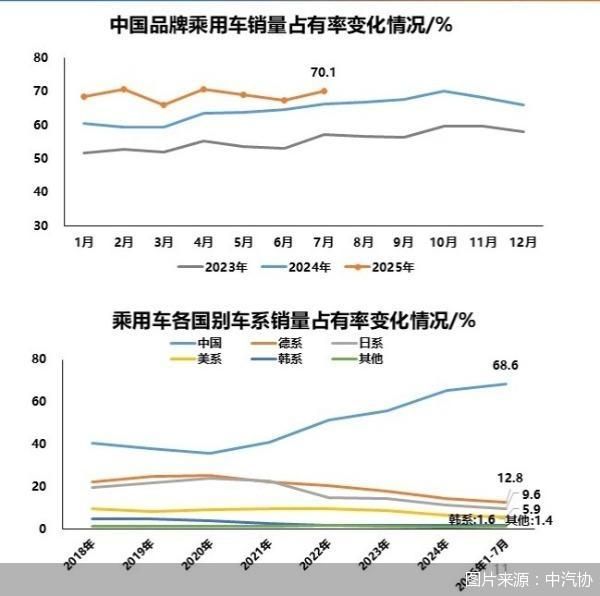
Core Insights - The report by China Automotive Data Research indicates that three new energy vehicle brands have achieved over 50% of their annual sales targets for the first seven months of 2025, with XPeng leading at 66.8% completion rate [1] Sales Performance Summary - **Li Auto**: Cumulative sales reached 235,000 units, a year-on-year decrease of 2.2%, with a target of 640,000 units, resulting in a completion rate of 36.7% [3] - **XPeng Motors**: Achieved cumulative sales of 234,000 units, a significant year-on-year increase of 270.3%, with a target of 350,000 units, leading to a completion rate of 66.8% [3] - **Xiaomi Motors**: Recorded cumulative sales of 180,000 units, with a completion rate of 51.4%, limited by production capacity [3] - **Leap Motor**: Cumulative sales of 272,000 units, a year-on-year increase of 149.8%, with a completion rate of 54.4% [3] - **Horizon Robotics**: Cumulative sales of 247,000 units, with a completion rate of 24.8%, indicating challenges in meeting the annual target of 1 million units [3] Market Positioning - XPeng Motors is positioned as a leading brand among new energy vehicle manufacturers, driven by strong sales of models like the XPeng Mona M03 Max and XPeng P7+ [3] - Xiaomi Motors is noted for its potential to lead in sales if not constrained by production capacity, highlighting the competitive landscape among new energy vehicle brands [3]


无锡振华20250809
2025-08-11 01:21
Summary of Wuxi Zhenhua Conference Call Company Overview - Wuxi Zhenhua has entered the selective electroplating sector through the acquisition of Wuxi Kaixiang, focusing on providing electroplating services for core engine components. The revenue from this business is projected to reach 180 million yuan in 2024, with a gross margin of 80% [2][6][14]. Core Business Insights - The company has diversified its customer base, including major clients such as SAIC Motor, Tesla, Li Auto, and Xiaomi Auto. Xiaomi Auto is experiencing rapid growth and is expected to become a significant growth driver for Wuxi Zhenhua [2][4]. - The company has established nine production bases close to its clients in regions like North China, the Yangtze River Delta, and Central China [2][5]. Financial Performance - Wuxi Zhenhua's net profit margin has significantly improved from 4.6% in 2022 to nearly 15% in 2024, aided by the integration of the selective electroplating business and cost reduction measures. The decline in steel prices has also contributed positively to the company's overall profitability [2][6][7]. - The selective electroplating business is expected to generate revenues of 150 million yuan in 2023 and increase to 180 million yuan in 2024, maintaining a gross margin of approximately 80% [6][14]. Customer and Market Dynamics - The company has a strong relationship with SAIC Motor, which has historically been a key partner. The sales of SAIC Motor's passenger vehicles have shown an 11% year-on-year increase in the first seven months of 2025, which is expected to benefit Wuxi Zhenhua's assembly business [4][11]. - Xiaomi Auto's second factory is anticipated to commence production in August 2025, which, along with the overall increase in the automotive sector, is expected to significantly boost Wuxi Zhenhua's revenue [2][8][9]. Growth Potential - The company is projected to achieve a profit of approximately 550 million yuan in 2025, reflecting a year-on-year growth of over 35%. The valuation is currently around 15-16 times earnings, indicating potential for further expansion given the accelerating performance across multiple business segments [4][15]. - The circuit business of Wuxi Zhenhua is also performing strongly, with net profit margins around 60% in 2023 and 2024. The focus on power semiconductors, including IGBT and silicon carbide, is expected to drive future growth [4][14]. Risks and Challenges - The revenue and gross margin of the assembly business for SAIC Motor are projected to decline in 2024, primarily due to high manufacturing costs and low capacity utilization. However, recovery in overall sales is expected to enhance profitability in 2025 [11]. Conclusion - Wuxi Zhenhua is positioned for significant growth driven by its strategic acquisitions, diversified customer base, and strong financial performance. The company’s focus on selective electroplating and power semiconductors presents promising opportunities for future expansion [2][15].

零售与批发均创单月新高 7月车市淡季不淡
Bei Jing Shang Bao· 2025-08-10 16:34
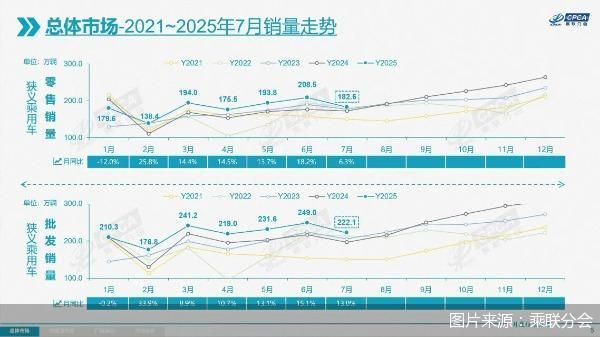
Group 1 - The retail volume of passenger cars in China reached 12.728 million units in the first seven months of the year, representing a year-on-year increase of 10.1% [1] - In July, the retail volume of passenger cars was 1.826 million units, up 6.3% year-on-year, and 3% higher than the historical peak of 1.768 million units in July 2023 [1] - Domestic brands showed significant growth, with retail sales of 1.21 million units in July, a 14% increase year-on-year, and their market share rising to 65.9%, up 4 percentage points [1] Group 2 - The wholesale volume of passenger cars also reached a historical high in July, with 2.221 million units, a 13% year-on-year increase [2] - New energy vehicles (NEVs) were a key driver of growth, with wholesale sales of 1.181 million units in July, up 24.4% year-on-year, and retail sales of 987,000 units, a 12% increase [2] - The market share of new force brands in the NEV segment reached 21.4%, an increase of nearly 2 percentage points year-on-year [2] Group 3 - Inventory pressure in the car market is easing, with total inventory decreasing by 90,000 units in July, and the dealer inventory warning index at 57.2%, down 2.2% year-on-year [3] - The number of models with price reductions in July was 17, compared to 23 in the same month last year, indicating a stabilization in the price war [3] - The market outlook for August is optimistic, with new model launches expected to boost retail sales, and government subsidies supporting consumption policies [3]




零售与批发均创单月历史新高,7月车市淡季不淡
Bei Jing Shang Bao· 2025-08-10 11:08
Group 1 - The retail volume of passenger cars in China reached 12.728 million units in the first seven months of the year, representing a year-on-year increase of 10.1%. In July alone, retail volume was 1.826 million units, up 6.3% compared to the previous year [2] - Domestic brands showed the most significant growth, with retail volume reaching 1.21 million units in July, a 14% increase year-on-year, and market share rising to 65.9%, an increase of 4 percentage points [2] - The wholesale volume of passenger cars also hit a record high in July, reaching 2.221 million units, a 13% year-on-year increase [3] Group 2 - New energy vehicles (NEVs) have become a key driver of growth, with wholesale sales reaching 1.181 million units in July, a 24.4% increase year-on-year, and retail sales at 987,000 units, up 12% [3] - The market share of new force brands in the NEV segment reached 21.4%, an increase of nearly 2 percentage points year-on-year [3] - The inventory pressure in the car market is easing, with total inventory decreasing by 90,000 units in July, and the dealer inventory warning index dropping to 57.2%, down 2.2% year-on-year [4] Group 3 - The competitive pricing environment is stabilizing, with only 17 models seeing price reductions in July compared to 23 in the same month last year [4] - The upcoming release of new models in August is expected to further boost retail sales, supported by the third batch of national subsidies for trade-in policies [5]
7月乘用车市:政策空档致增速放缓 纯电重夺新能源主导地位
Jing Ji Guan Cha Wang· 2025-08-09 07:10
Core Insights - In July, China's retail sales of passenger cars reached 1.826 million units, a year-on-year increase of 6.3%, while the cumulative retail sales from January to July totaled 12.728 million units, up 10.1% year-on-year [2] - The growth rate in July was lower compared to the 15% increase seen from March to June, attributed to a gap in subsidy funding and rising consumer costs [2] - The market for new energy vehicles (NEVs) showed a retail sales figure of 987,000 units in July, reflecting a year-on-year growth of 12.0% [4] Market Performance - The overall passenger car market is experiencing strong demand despite the traditional summer slowdown, with July's sales indicating resilience [2] - The price war in the car market has eased, with only 17 models seeing price reductions in July, compared to 23 in the same month last year [3] - The promotional intensity for NEVs remained high at 10.2%, while traditional fuel vehicles maintained a promotional level of 23.4% [3] New Energy Vehicles - NEVs accounted for a retail penetration rate of 54.0% in July, an increase of 2.7 percentage points year-on-year, with domestic brands leading at 74.9% [4] - Pure electric vehicles (EVs) saw a significant year-on-year growth of 24.5%, reclaiming market dominance over plug-in hybrids and range-extended vehicles [4] - The market share of domestic brand NEVs remained stable at 70%, while mainstream joint venture brands saw a decline to 3.6% [4] Brand Performance - Domestic brands continued to grow, with July retail sales reaching 1.21 million units, a 14% increase year-on-year, and a market share of 65.9% [5] - Joint venture brands experienced slight growth, with retail sales of 450,000 units in July, but market shares generally declined [5] - Luxury brands faced challenges, with July retail sales dropping to 170,000 units, a year-on-year decrease of 20% [6] Export Trends - In July, total passenger car exports reached 475,000 units, a year-on-year increase of 25%, with NEVs making up 44.7% of the total exports [6] - Domestic brand exports reached 415,000 units, reflecting a 34% year-on-year growth [6] Future Outlook - The upcoming launch of new models in August is expected to enhance market supply and stimulate retail sales, particularly for fuel vehicles [6]