海澜之家

Search documents
海澜之家宣布H股上市筹备,A股企业借港股拓国际化路径已成常态
Hua Xia Shi Bao· 2025-09-11 10:41
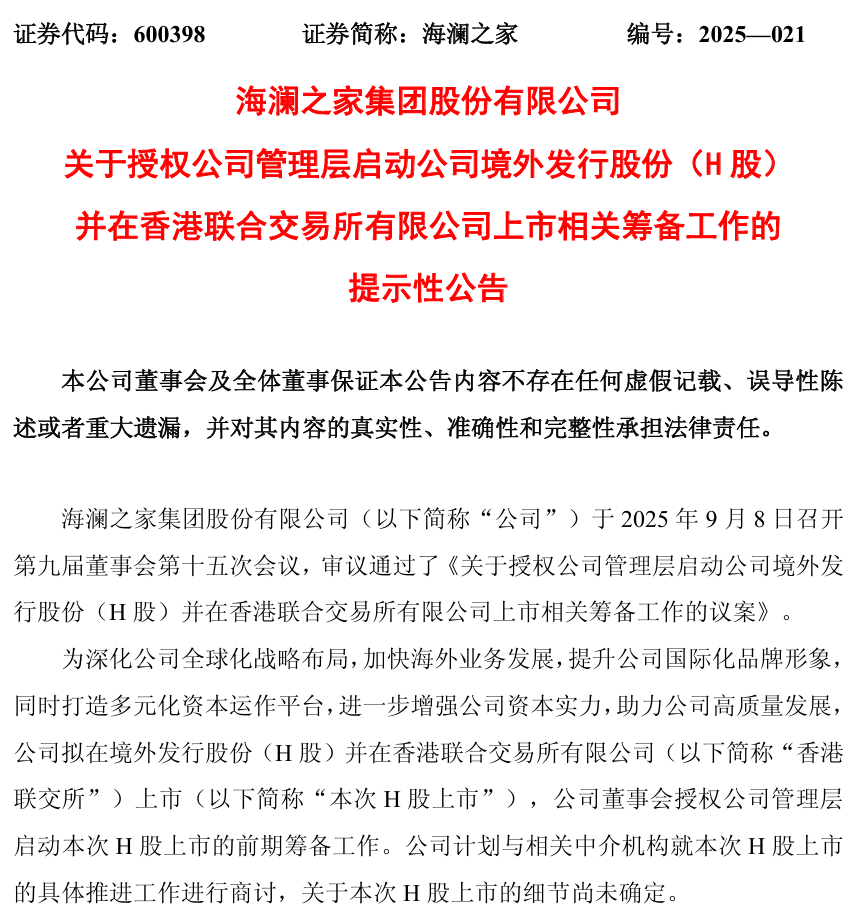
Core Viewpoint - The company, HLA (海澜之家), plans to issue H shares and list on the Hong Kong Stock Exchange to enhance its global strategy and international presence [2][3]. Group 1: Company Strategy - HLA aims to deepen its global strategy and accelerate overseas business development through the upcoming Hong Kong listing [3][6]. - The company has been expanding internationally since 2017, with a focus on Southeast Asia and plans to open its first store in Australia [2][4]. - As of the first half of this year, HLA has 111 overseas stores, generating a revenue of 206 million yuan, a 27.42% increase year-on-year [4][5]. Group 2: Financial Performance - In the first half of the year, HLA reported a revenue of 11.566 billion yuan, a year-on-year increase of 1.73%, while net profit decreased by 3.42% to 1.580 billion yuan [3][4]. - The company's revenue fluctuated significantly from 2020 to 2024, with a notable decline in 2020 and a recovery in subsequent years, although 2024 showed a slight decrease [4][6]. Group 3: Market Context - The trend of A-share companies listing in Hong Kong is increasing, with 11 companies having done so this year, bringing the total to 161 A+H companies [2][7]. - The Hong Kong market is seen as a mature international financial center, providing a broader investor base and diverse financing channels for companies [6][7]. - Recent policy changes by the China Securities Regulatory Commission have facilitated the process for mainland companies to list in Hong Kong, further encouraging this trend [7].



美的入局三星财险!何享健父子已布局14家金融机构
Sou Hu Cai Jing· 2025-09-11 09:53
Core Viewpoint - Samsung Property Insurance (China) Co., Ltd. is gaining attention again due to Midea Group's indirect acquisition through its subsidiary, Junlan Hotel Management Co., Ltd. [2][5] Group 1: Midea's Entry into Insurance - Midea Group's major shareholder, He Xiangjian, controls 94.54% of Midea Holdings, which fully owns Junlan Hotel, the new third-largest shareholder of Samsung Insurance [5][2] - The indirect acquisition strategy allows Midea to enter the insurance sector with strategic discretion, tax optimization, and risk isolation [5][7] - Midea's extensive home appliance sales network can provide Samsung Insurance with precise customer profiles and efficient sales channels, enhancing product development opportunities [7][12] Group 2: Performance and Financials - Samsung Insurance's premium income has shown significant growth since the introduction of Tencent and other shareholders, with a compound annual growth rate of 33.35% from 2022 to 2024 [10][12] - The company reported premium income of 21.32 billion in 2024, a 93.47% increase from the previous year, while net profit has declined [10][12] - Major insurance products include return freight insurance, which became the largest insurance type with a premium scale of 4.12 billion in 2024, and liability insurance, which saw over 300% growth [10][11] Group 3: Governance and Challenges - The multi-shareholder structure may bring diverse resources and perspectives, fostering innovation and development, but also poses governance challenges such as cultural differences and decision-making efficiency [14][12] - Compliance risks may arise from Midea's data handling practices, which could conflict with insurance industry regulations [7][12] Group 4: Midea's Financial Landscape - Midea Group has a history of involvement in financial services, including investments in banks, funds, and other financial entities, indicating a long-term strategy in the financial sector [15][22] - The current financial assets include stakes in Shunde Rural Commercial Bank and E Fund Management, alongside various financial service companies [22][19]


服装家纺板块9月11日涨0.3%,爱慕股份领涨,主力资金净流出1879.05万元
Zheng Xing Xing Ye Ri Bao· 2025-09-11 08:43
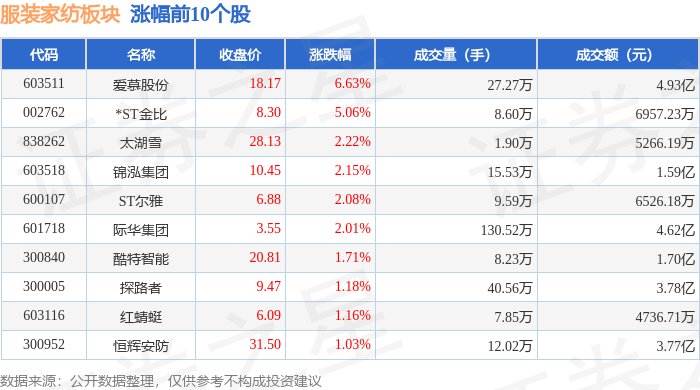
Market Overview - The apparel and home textile sector increased by 0.3% on September 11, with Aimer leading the gains [1] - The Shanghai Composite Index closed at 3875.31, up 1.65%, while the Shenzhen Component Index closed at 12979.89, up 3.36% [1] Top Gainers - Yancao Co., Ltd. (603511) closed at 18.17, up 6.63% with a trading volume of 272,700 shares and a turnover of 493 million yuan [1] - ST Jinbi (002762) closed at 8.30, up 5.06% with a trading volume of 86,000 shares and a turnover of 69.57 million yuan [1] - Taihu Snow (838262) closed at 28.13, up 2.22% with a trading volume of 19,000 shares and a turnover of 52.66 million yuan [1] Top Losers - Anzheng Fashion (603839) closed at 8.58, down 3.49% with a trading volume of 376,900 shares and a turnover of 32.2 million yuan [2] - ST Qibu (603557) closed at 2.58, down 2.27% with a trading volume of 145,400 shares and a turnover of 37.48 million yuan [2] - Sanfu Outdoor (002780) closed at 14.22, down 1.52% with a trading volume of 88,500 shares and a turnover of 125 million yuan [2] Capital Flow - The apparel and home textile sector experienced a net outflow of 18.79 million yuan from institutional investors and 81.12 million yuan from speculative funds, while retail investors saw a net inflow of 99.91 million yuan [2] - The capital flow for individual stocks in the sector is detailed in the following table [2] Individual Stock Capital Flow - Meibang Fashion (002269) had a net inflow of 117 million yuan from institutional investors, while it saw a net outflow of 73.61 million yuan from speculative funds and a net outflow of 43.19 million yuan from retail investors [3] - Aimer Co., Ltd. (603511) had a net inflow of 29.99 million yuan from institutional investors, with a net outflow of 3.49 million yuan from retail investors [3] - Haian Home (600398) had a net inflow of 13.12 million yuan from institutional investors, with a net outflow of 15.23 million yuan from speculative funds [3]

森马比音勒芬也快卖不动了,流量涌入折扣店和“微型社区”
3 6 Ke· 2025-09-11 08:28
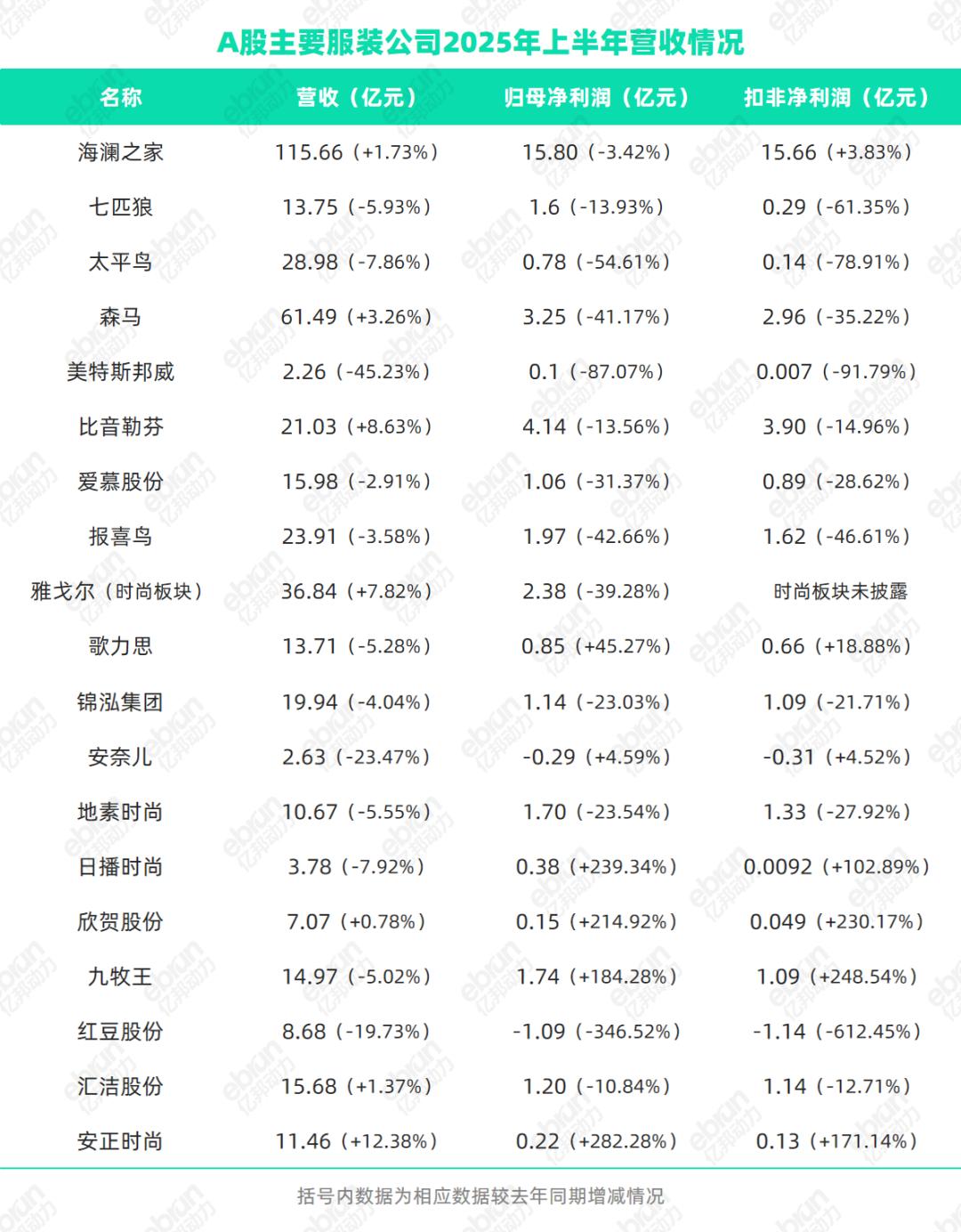
Core Viewpoint - The apparel industry is facing significant challenges, with many brands experiencing declining revenues and profits, highlighting a broader trend of struggles within the sector [1][4][30]. Group 1: Company Performance - Metersbonwe's revenue for the first half of 2025 was 226 million yuan, a decrease of 45.23% year-on-year, with a net profit of 0.1 million yuan, down 87.07% [1][3]. - The overall revenue for 19 A-share apparel brands was 42.849 billion yuan, a decline of 1.37%, with a net profit of 3.708 billion yuan, down 19.11% from the previous year [1][4]. - Among the 19 brands, nearly 70% reported revenue declines, with Metersbonwe, Annil, and Hongdou experiencing drops exceeding 10% [4][6]. Group 2: Retail Trends - The apparel industry has seen a continuous decline in single-store performance, with nearly 90% of brands reporting a decrease in sales per square meter [6][8]. - The trend of store closures is prevalent, with over 5% of stores closed across various brands, and Annil having the highest closure rate at 14.33% [9][12]. - The shift towards Direct to Consumer (DTC) models is being adopted by several brands, including Anzheng Fashion and Hongdou, as they aim to improve profitability and customer engagement [12][13]. Group 3: Online Sales and Market Dynamics - More than half of the brands reported growth in online sales, with notable increases for brands like Bi Yin Le Fen, which saw a 71.82% rise in online revenue [19][21]. - The market is experiencing a K-shaped recovery, where high-end brands are thriving while mid-range and budget brands are struggling, leading to a focus on discount channels and essential goods [21][30]. - Brands are diversifying their product lines through acquisitions and partnerships, with examples including Yagor's acquisition of the French luxury children's brand Bonpoint [20][22]. Group 4: Strategic Shifts - Many brands are investing in "super stores" and discount formats to adapt to changing consumer preferences and enhance in-store experiences [14][15]. - The transition to DTC models is expected to increase operational costs, but it may also improve gross margins by eliminating intermediaries [13][30]. - The apparel sector is witnessing a trend towards multi-brand strategies, with companies like Song Li and Hongdou expanding their brand portfolios to capture diverse market segments [20][30].



永安期货每日报告-20250911
Xin Yong An Guo Ji Zheng Quan· 2025-09-11 02:57
Economic Indicators - The US Producer Price Index (PPI) unexpectedly declined by 0.1% in August, marking the first drop in four months, with a year-on-year increase of 2.6%[11] - China's PPI fell by 2.9% year-on-year in August, while the Consumer Price Index (CPI) decreased by 0.4%[15] Market Performance - The Shanghai Composite Index rose by 0.13% to 3812.22 points, while the Shenzhen Component increased by 0.38%[1] - The Hang Seng Index closed up 1.01% at 26200.26 points, with the Hang Seng Technology Index gaining 1.27%[1] Trade Relations - Mexico plans to impose tariffs of up to 50% on Chinese automobiles, steel, and textiles, increasing from the current 20%[11] - The proposed tariffs aim to protect local jobs and industries, affecting approximately 1,400 products from countries without trade agreements with Mexico[11] Financial Market Developments - The total market turnover in Hong Kong reached 2882.086 billion HKD[1] - Tencent Holdings repurchased 86,600 shares for approximately 5.5 billion HKD, representing 0.586% of its total shares[12]



海澜之家拟赴港上市加速“出海” 多元发展半年海外收入增27.42%
Chang Jiang Shang Bao· 2025-09-11 00:05
Core Viewpoint - The company, HLA, is planning to issue H-shares and list on the Hong Kong Stock Exchange to enhance its capital strength and international brand image while expanding its overseas market presence [2][3]. Group 1: Company Overview - HLA was founded in 1997 in Jiangyin, Jiangsu Province, and went public in 2014 through a reverse merger [3]. - As of June 30, 2025, the company has total assets of 33.422 billion and operates over 7,200 stores globally, with 2,099 direct-operated stores accounting for 29.12% of the total [3]. - The company has been actively pursuing a diversification strategy, launching multiple proprietary brands and expanding its international presence [2][4]. Group 2: Financial Performance - In the first half of 2025, HLA achieved operating revenue of 11.566 billion, a year-on-year increase of 1.73%, while net profit attributable to shareholders was 1.580 billion, a decrease of 3.42% [6]. - The company reported a robust operating cash flow of 2.718 billion in the first half of 2025, reflecting a year-on-year growth of 36.1% [7]. - The overall gross margin for the first half of 2025 reached 46.35%, marking the highest level for the same period since the company went public, with a year-on-year increase of 1.14 percentage points [8]. Group 3: International Expansion - HLA has opened its first overseas store in Kuala Lumpur, Malaysia, in 2017 and has since accelerated its international expansion, with 111 overseas stores as of June 30, 2025, up from 101 at the end of 2024 [4]. - The company generated 206 million in revenue from overseas markets in the first half of 2025, representing a year-on-year growth of 27.42% [4]. - HLA is focusing on a strategy of "rooting in Southeast Asia, radiating to Asia-Pacific, and looking globally," while exploring new markets and channels for expansion [3][4].
332亿市值海澜之家再谋上市:清华富二代掌舵,能否借港股东风破局?
Sou Hu Cai Jing· 2025-09-10 15:19
Core Viewpoint - Hailan Home (600398.SH) plans to issue H-shares and list on the Hong Kong Stock Exchange, marking a significant step in its internationalization strategy as a leading player in the domestic menswear industry [1][4]. Company Overview - Founded in the late 1970s by Zhou Jianping, Hailan Home started as a photography studio and later transitioned into the textile industry, successfully turning around a struggling woolen mill in 1988 [4]. - The company shifted its focus to fine wool production in 1991, avoiding the oversupply crisis in coarse wool, and achieved sales exceeding 1 billion yuan by 1994 [4]. - Hailan Home's sales reached 10 billion yuan by 1997, positioning it among the top five in the textile industry [4]. Brand Development - In December 2000, the company successfully listed on the Shanghai Stock Exchange, later rebranding as Hailan Group in 2001 and launching its own brand, Hailan Home, in 2002 [5]. - Zhou Licheng, the founder's son, took over leadership roles in the company after gaining experience in private equity, becoming the president in 2017 and chairman in 2020 [7]. - The company has developed a multi-brand strategy, including women's brand OVV and children's brand Ying's, although new brand revenue accounts for less than 30% of total income [7]. Financial Performance - From 2021 to 2024, the company's revenue fluctuated between 18.56 billion yuan and 21.53 billion yuan, with net profits ranging from 2.16 billion yuan to 2.95 billion yuan [8]. - The gross profit margin improved from 41.79% to 46.07%, but remains lower than competitors like Youngor and Seven Wolves [8]. - As of the first half of 2025, the company's inventory balance reached 10.26 billion yuan, an increase of 702 million yuan year-on-year, indicating ongoing inventory pressure [7][8]. Market Challenges - The company faces challenges in improving inventory structure, enhancing profitability of new businesses, and boosting investor confidence amid increasing industry competition [8].
消费行业联合行业深度:十五五系列报告解读(51页附下载)
Sou Hu Cai Jing· 2025-09-10 11:41
Core Insights - The importance of the "14th Five-Year Plan": The upcoming "14th Five-Year Plan" is expected to significantly impact China's economic and social development over the next five years, shifting focus from production to a balance between production and consumption due to the current issue of insufficient effective demand [1] - Strengthening consumption policies: Starting in 2024, consumption policies will be significantly enhanced, including the allocation of special government bond funds to support consumption upgrades. Continued funding is expected in 2025 and 2026 [1] - Potential of service consumption: China's service consumption still lags behind developed economies, indicating a substantial opportunity for growth in this sector to stimulate consumer interest and optimize the consumption environment [1] - Rise of technology consumption: With a rapid technological development and an engineering talent surplus, products like robotic vacuum cleaners and drones are gaining market attention, likely creating new consumer demand [1] - Optimization of the overall consumption mechanism: Measures such as consumption tax reform will encourage local governments to transition from production-oriented to service-oriented, promoting the internationalization of quality consumption companies and enhancing residents' consumption capacity [1] Investment Recommendations - Food and Beverage: Recommended companies include Dongpeng Beverage and Lihigh Food, with a focus on Youran Dairy and Bairun Co [2] - Service Sector: Recommended companies include Guming, Mixue Group, and Bubugao, with a focus on Zhongsheng Holdings [2] - Light Industry: Companies to watch include Hengfeng Paper and Xilinmen [3] - Trendy Toys: Recommended companies include Pop Mart and Blokus [4] - Home Appliances: Recommended companies include Midea Group, Haier Smart Home, TCL Electronics H, Roborock, and Ecovacs, with a focus on Yingshi Innovation [5] - Agriculture: Recommended companies include Zhongchong Co, Petty Co, Muyuan Foods, and Haida Group [11] - Textile and Apparel: Recommended companies include Anta Sports, Xtep International, 361 Degrees, and Hailan Home, with a focus on Li Ning and Sanfu Outdoor [11] Report Content Analysis - Expanding consumption share: The report emphasizes that expanding consumption share is essential for achieving Chinese-style modernization, as China's consumption rate is significantly lower than that of developed countries [9] - Shift in fiscal spending: During the "14th Five-Year Plan" period, fiscal spending will shift from material investments to human capital investments, increasing support for education, healthcare, and housing [9] - Promotion of common prosperity: The report highlights the need for income distribution reform and the promotion of the Zhejiang common prosperity model to achieve balanced development [9] - Consumption tax reform: The report suggests that consumption tax reform will help local governments transition from production-oriented to service-oriented, enhancing the consumption environment [9] - Transition from traditional to new consumption: The report analyzes the maturation of traditional consumption markets and the rise of new consumption, which is characterized by a focus on quality and personal satisfaction [9] - Stimulating interest in service consumption: The report indicates that the shift from physical to service consumption is crucial for expanding domestic demand, with growing demand for events and performances benefiting local consumption [9]






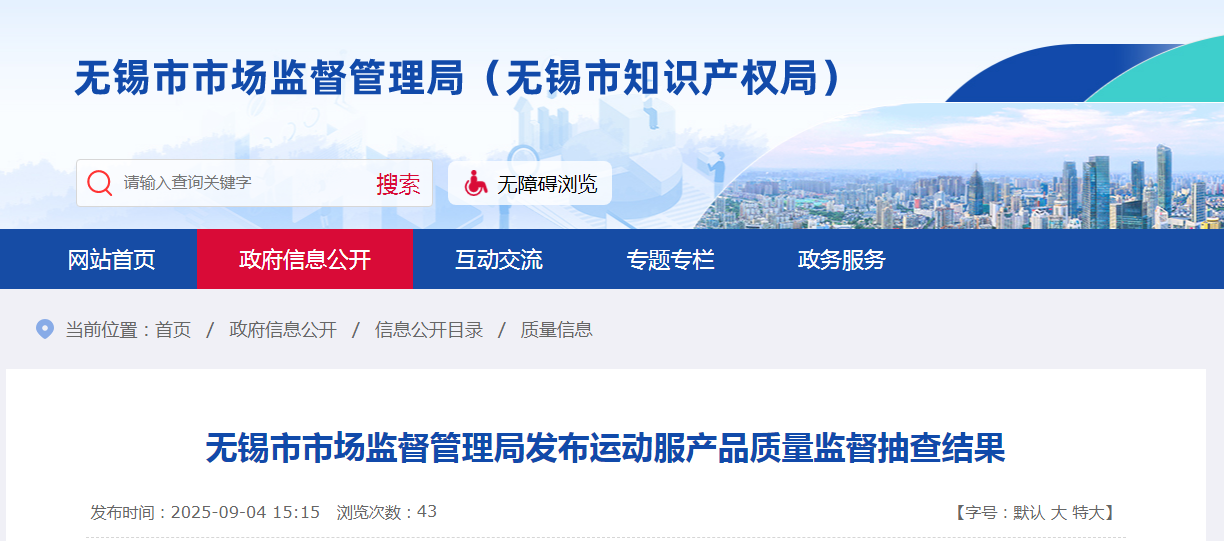
江苏省无锡市市场监督管理局发布运动服产品质量监督抽查结果
Zhong Guo Zhi Liang Xin Wen Wang· 2025-09-10 08:06
Core Point - The quality inspection of sportswear products in Wuxi City for the year 2025 revealed that all 10 batches tested were found to be compliant with quality standards [3]. Group 1: Inspection Results - A total of 10 batches of sportswear products were sampled and none were found to be non-compliant [3]. - The inspected products included various types of sportswear such as T-shirts, pants, and other athletic apparel from different brands [4]. Group 2: Companies Involved - The inspection covered products from several companies, including Jiangyin Aijitu Clothing Co., Ltd., Wuxi Hongdou Sports Technology Co., Ltd., and Decathlon (Shanghai) Sports Goods Management Co., Ltd. [4]. - Notable brands involved in the inspection included Monster Guardians, HODO, HLA, and PONY, all of which passed the quality checks [4].
纺织服装9月投资策略暨中报总结:制造板块中期业绩韧性强,运动板块领跑服饰消费
Guoxin Securities· 2025-09-10 07:41
Market Overview - The textile and apparel sector has shown resilience in mid-term performance, with the sports segment leading apparel consumption [1][12] - In August, the A-share textile and apparel sector slightly underperformed the broader market, but has shown stable performance since September, with brand apparel outperforming textile manufacturing [1][12] Brand Apparel Insights - Retail sales of clothing in July grew by 1.8% year-on-year, with a slight deceleration compared to the previous month [1] - E-commerce growth in July rebounded significantly, with outdoor sports leading the way; growth rates for various segments included sports apparel at +11%, outdoor apparel at +26%, and home textiles at +10% [1] - Notable brand performances included Decathlon with +63%, Puma with +41%, and Lululemon with +39% in sports apparel; outdoor brands like Kailas and Arc'teryx also showed strong growth [1] Textile Manufacturing Insights - In August, Vietnam's textile exports fell by 4.5% year-on-year, while China's textile exports improved slightly with a growth rate of 1.4% [2] - The export performance of apparel and footwear from China was poor, with declines of 10.1% and 17.1% respectively [2] - The price of cotton showed slight fluctuations in August, with a small decline noted in September [2] Sector Performance Summary - For the first half of 2025, textile manufacturing revenue grew by 7.8% year-on-year, while the apparel and home textile sector faced a decline of 6.4% [3] - The gross margin for the textile manufacturing sector remained stable at 19.4%, while the apparel and home textile sector's gross margin increased slightly to 46.1% [3] - Key players in the apparel sector, such as Anta and Xtep, maintained steady growth in revenue and profit, while non-sports apparel faced significant challenges [3] Investment Recommendations - Focus on undervalued leaders with strong fundamentals in brand apparel, particularly in the sports segment, with recommendations for Anta Sports, Xtep International, and Li Ning [6] - In textile manufacturing, recommend companies with significant rebound potential and strong fundamentals, such as Shenzhou International and Huayi Group [6]